Can Ethereum succeed without Ether (ETH)?

Ethereum (ETH)
Published onUpdated on

Despite its exponential growth, Ethena’s USDe still faces a notable challenge: the volatility of its native yield mechanically limits its adoption, especially among institutional players or actors requiring stability. Strata addresses this by segmenting USDe’s yield into two distinct assets: srUSDe and jrUSDe. In this Early Bird, we break down Strata, its mechanics, the farming opportunities, and share our perspective.
The rise of USDe, Ethena’s delta-neutral stablecoin, has transformed how yield is expressed within DeFi. At the forefront of “yield-bearing stablecoins,” this new class of assets that redistributes value to users, USDe has experienced explosive growth, reaching 15 billion dollars in market capitalization.
This expansion cycle was nonetheless marked by a depeg event on Binance during the October 10 crash, when USDe briefly touched 0.65 dollars. Although the incident was not attributable to Ethena, it prompted some users to rotate into other stablecoins as a precaution.
Despite this, sUSDe, its staked and yield-bearing version, remains widely used as a base layer by many protocols. Through it, users can accumulate two layers of yield: the yield from sUSDe and the yield from the strategy they choose to pair with it.
Despite its potential, this model remains homogeneous. sUSDe presents a single yield profile, with no possibility of adjusting volatility, smoothing returns, or structuring exposure to match specific needs. For some actors, especially institutions, this variability is difficult to integrate into predictable and standardized portfolio management.
In other words, the ecosystem lacks a mechanism capable of splitting USDe’s yield into several versions tailored to different risk levels. This is precisely where Strata comes in, with an innovative yield-segmentation mechanism that separates yield into multiple risk tranches.
→ Revisit our analysis of Ethena’s various stablecoins and their respective roles:
Strata is a protocol offering structured on-chain yield products on USDe, the synthetic dollar issued by Ethena. It is built on a concept that separates the yield of USDe from its associated risk through a tranche-based system, allowing users to choose their exposure level according to their profile.
Strata’s design draws directly from mechanisms used in traditional finance, particularly instruments such as CDOs and CLOs. Concretely, the protocol introduces two tokens backed by Ethena’s sUSDe: Strata Senior USDe (srUSDe) and Strata Junior USDe (jrUSDe).
In practice, jrUSDe functions as a form of insurance that absorbs the excess risk associated with sUSDe’s yield to allow srUSDe to exist, while offering a risk premium to users whose profile is suited for it.
Unlike Pendle, Strata does not split sUSDe into principal (PT) and yield (YT). It only segments the yield stream into two independent exposures.
This approach creates a more granular market for risk around USDe. It enhances its flexibility for use cases requiring stability while introducing a natural leverage effect for those seeking more dynamic exposure to the performance of Ethena’s stablecoin.
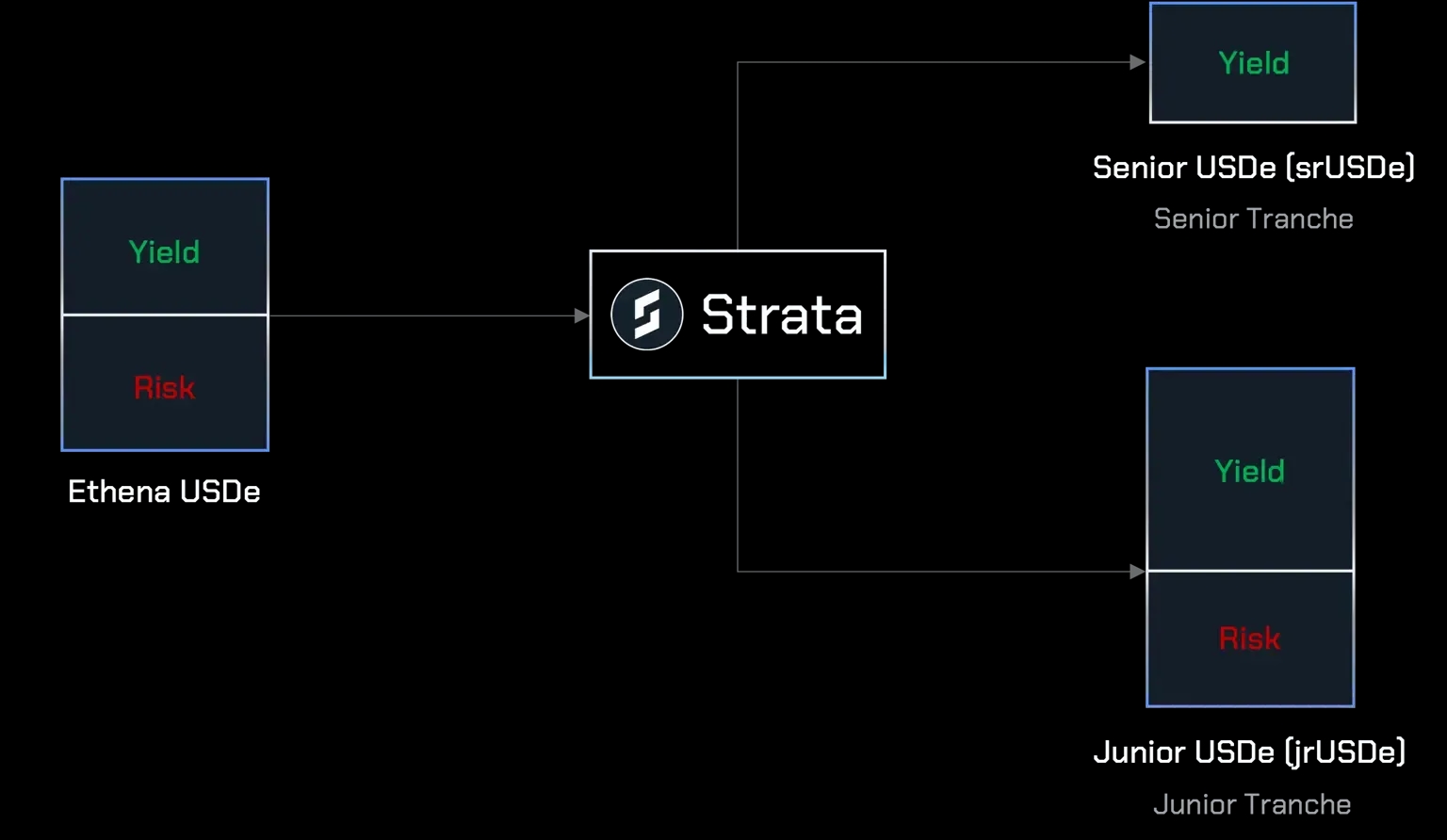
Strata divides the yield of sUSDe into two ERC-20 tokens: srUSDe, the capital-preservation tranche offering a stable yield fixed at a floor rate, and jrUSDe, the volatile tranche offering leveraged exposure to sUSDe’s yield in exchange for absorbing the volatility.
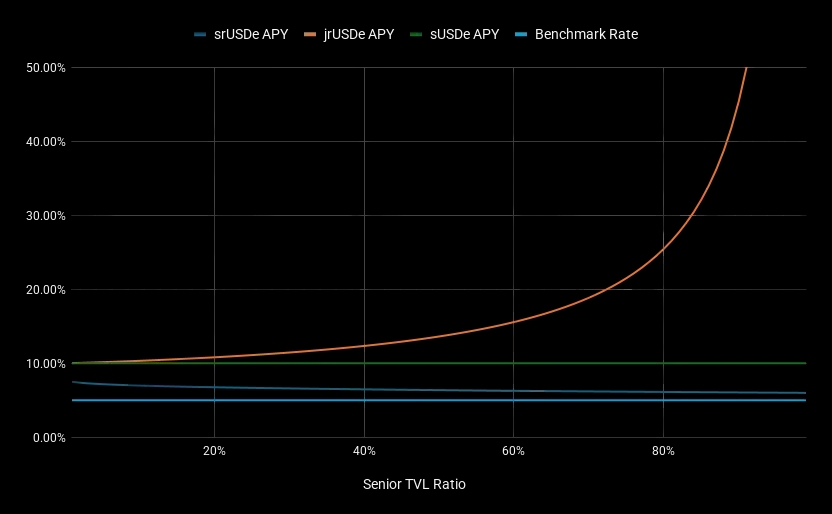
Concretely, Strata sets a yield floor for srUSDe, defined by the lending rates of USDC and USDT on Aave. The protocol uses a mechanism called Dynamic Yield Split (DYS) to adjust jrUSDe’s yield so that srUSDe’s yield is continuously maintained at this floor.
It operates on an 8-hour cycle based on the amount of stablecoins held in the staking reward smart contract for Ethena’s sUSDe.
The Dynamic Yield Split mechanism is simple: Strata prioritizes the most stable and least volatile portion of sUSDe’s yield for the senior tranche. If sUSDe’s yield drops below the floor, the junior tranche absorbs the contraction to maintain srUSDe’s yield profile.
Conversely, when sUSDe’s yield exceeds the stability threshold, jrUSDe captures the entire excess, creating a natural leverage effect during periods of strong performance.
For reference, over the last 30 days, srUSDe offered an average APY of 4.17 percent, while jrUSDe offered 15.04 percent APY with significantly higher daily volatility. In this sense, srUSDe behaves like a predictable yield-bearing stablecoin, while jrUSDe captures the surplus yield of sUSDe with an unpredictable daily return.
Whether for srUSDe or jrUSDe, both assets can only be minted with USDe or sUSDe. As such, Strata’s success directly benefits Ethena, since it serves as an implicit growth engine for USDe.
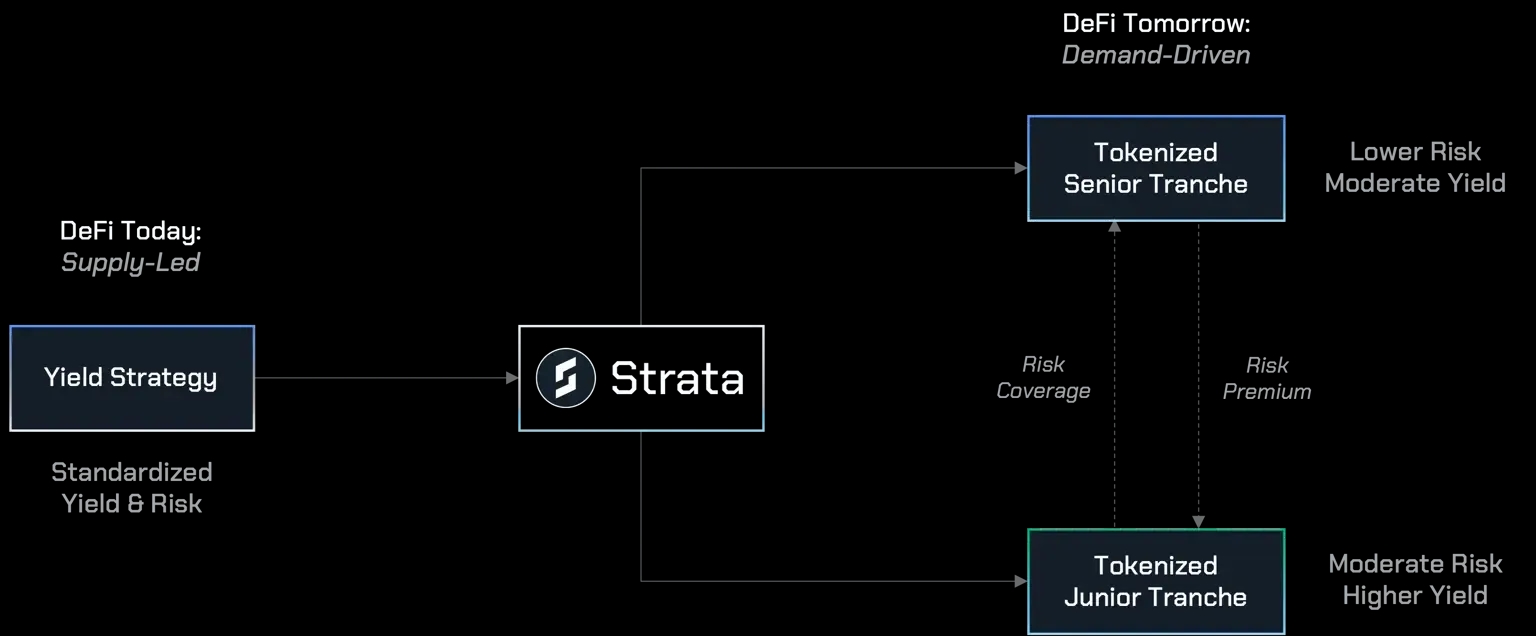
As we have seen, Strata is designed to transform the homogeneous yield of sUSDe into two yield-bearing assets, each suited to very different risk profiles.
Strata enables use cases that sUSDe alone could not address. On the one hand, with srUSDe, Strata provides a stable and predictable yield aligned with Aave’s reference rate for USDC, meeting the needs of participants seeking low-volatility exposure.
On the other hand, with jrUSDe, it offers a more dynamic exposure for those who want to amplify their participation in Ethena’s yield and capture excess performance. Indeed, jrUSDe offers a significantly higher average APY than srUSDe, but with far greater volatility.
The structure of srUSDe caters to the needs of lending protocols, treasuries, and funds seeking collateral with controlled yield characteristics. Meanwhile, jrUSDe gives investors direct access to a more aggressive yield strategy.
By segmenting yield in this way, Strata introduces new granularity to USDe exposure while preserving Ethena’s core attributes. The system remains entirely on-chain, transparent, and capable of operating at scale.
At the time of writing, Strata is currently in Season 1. This follows Season 0, focused on liquidity bootstrapping, during which it was only possible to deposit stablecoins in exchange for pUSDe, a temporary receipt token.
Season 0 ended on 13 October 2025, bringing pUSDe to a close. Users were able to redeem this token at a 1:1 ratio for jrUSDe or srUSDe, at their choice. This also triggered the launch of Season 1 and Strata’s mainnet.
From now on, Strata points are earned exclusively by acquiring srUSDe or jrUSDe. Simply holding them generates points, but it is far more efficient to deploy them on Euler, Morpho, or Pendle, the three current partners of Strata.
As usual, we focus primarily on Pendle. Currently, there are two markets: one for srUSDe and one for jrUSDe, each offering three ways to gain exposure to the yield:
At present, the most efficient strategy is exposure to YT-srUSDe to benefit from the points leverage offered by the protocol. However, it is important to remember that once they reach maturity, YTs lose all their value. That is the price to pay for amplified exposure to available points.
→ For a deeper understanding of how Pendle works and why it is the best tool for farming airdrops, read our full analysis:
A second option remains relevant. It offers fewer points, but it preserves all capital while capturing additional yield: LP deposits. It is a straightforward way to put capital to work while gaining exposure to both Strata and Ethena.
In all cases, you must first acquire jrUSDe or srUSDe directly on Strata.
You can use our referral link to support us and receive a 10 percent bonus on your Strata points earned.
For now, no information is available regarding the end date of Season 1 or a potential TGE. However, since Season 0 lasted three months, it is possible Season 1 will follow a similar duration.
→ We will publish a complete tutorial of our strategies to gain exposure to the Strata airdrop in the coming days in our Alpha Feed.
Ultimately, Strata introduces a new way to access Ethena’s yield. By splitting sUSDe’s yield into two distinct tranches, the protocol makes Ethena’s yield engine more flexible and modular.
srUSDe positions itself as a stable, transparent asset aligned with the needs of more conservative participants, while jrUSDe concentrates the excess performance for those expressing a more dynamic profile.
This structure brings DeFi closer to the standards of traditional finance while preserving blockchain’s programmability and composability, alongside optimized yield with smoothed volatility.
Ethena already had one foot in traditional finance through its USDtb stablecoin, backed by BlackRock’s tokenized BUIDL fund, but this approach clearly adds another dimension to its model.
If Strata’s model were to gain adoption among institutions, the entire Ethena ecosystem would benefit via expansion driven by USDe’s growth.
Finally, the inherent composability of the two tranches opens the door to new yield strategies. For now, Strata is only in Season 1, and upcoming integrations should multiply potential use cases.
As we do regularly with our Early Bird format, we will continue to update you on opportunities and developments surrounding Strata in our Alpha Feed.
You can use our referral link to support us and receive a 10 percent bonus on your Strata points earned.