Market Briefing 11: Bitcoin (BTC) Confirms Its Trend Reversal, Altcoins Are Rebounding


Bitcoin (BTC), Ethereum (ETH), Derive (DRV)
Published onUpdated on

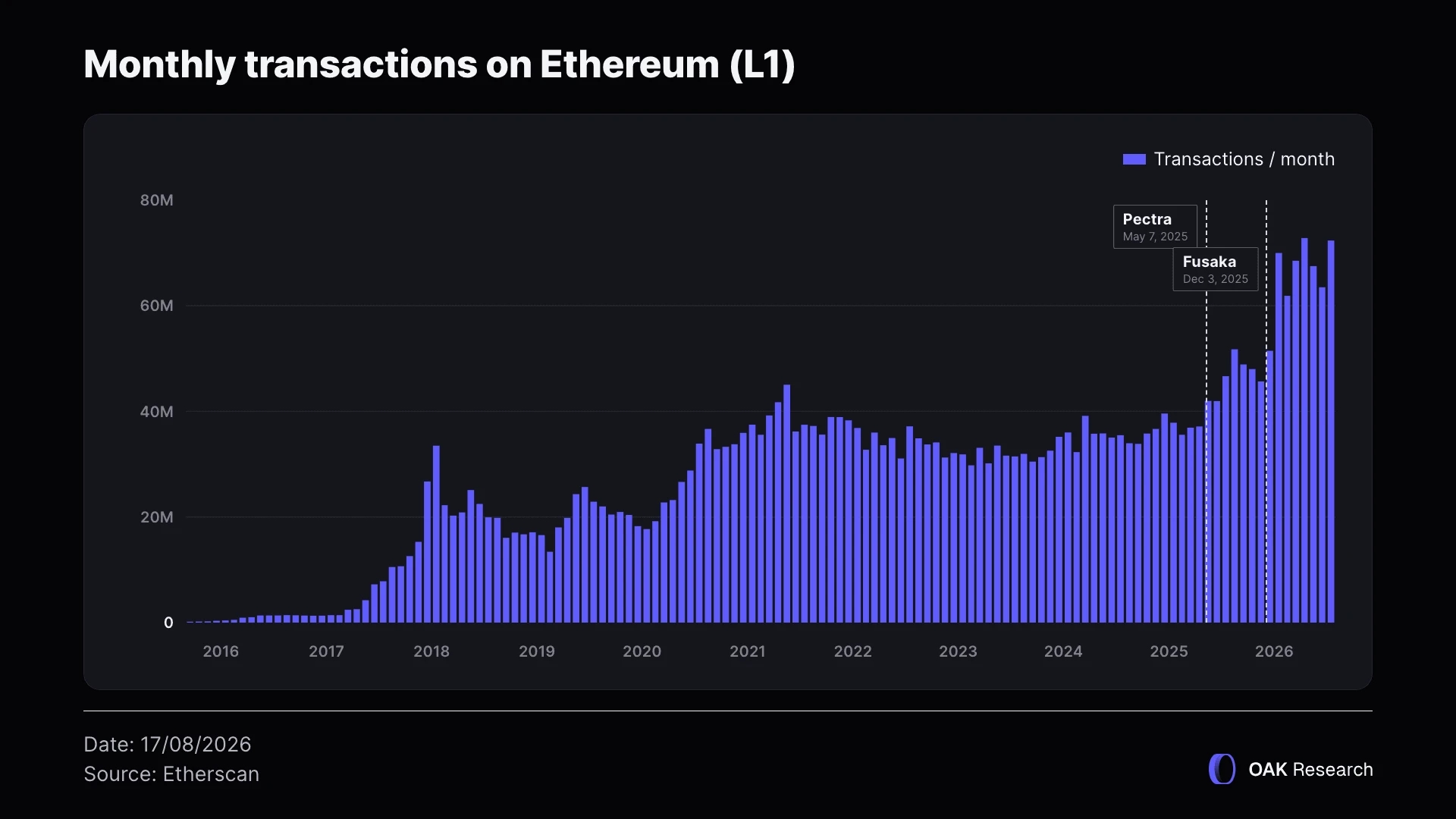
In less than a year, ETH has lost nearly two thirds of its value. Over the same period, activity on Ethereum reached all-time highs, with close to 73 million transactions recorded in April. Meanwhile, more than a third of the Ether supply is locked up in staking, and it remains the leading collateral in on-chain finance. In the end, the asset everyone considers disappointing is also the one nobody can do without. Here is our analysis of this paradox, of the theses that have broken down, and of what is left today of the investment case for ETH.
Ethereum's Ether is currently trading at around $1,900, after slipping back below $1,600 last month.
To put that in perspective, ETH has shed nearly two-thirds of its value in under a year relative to its all-time high of $4,946, reached in August 2025.
With a market capitalization of roughly $230 billion, it still holds second place among the most valuable cryptocurrencies, though USDT is close on its heels and briefly overtook it on this metric on June 6 and June 25, 2026. Bitcoin, meanwhile, remains far ahead, with a market cap of around $1.2 trillion.
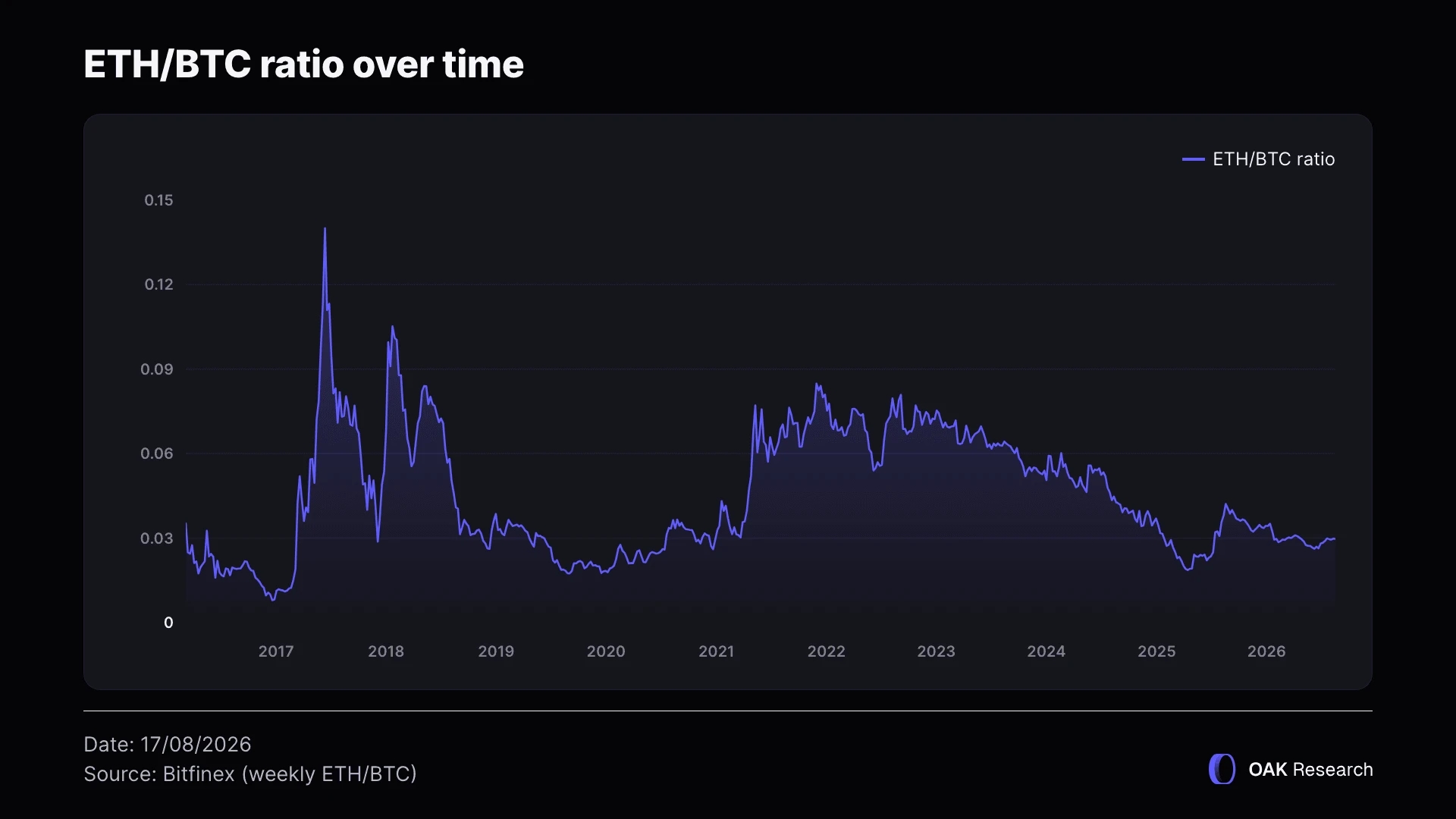
Looking at the ETH/BTC ratio, after peaking above 0.14 in 2017 and around 0.08 at its highest point of the current decade, it fell to roughly 0.026 last June, a ten-month low. Against Bitcoin, then, Ether has lost close to two-thirds of its relative value since its 2022 peak.
Paradoxically, over the same period, network activity has kept setting new all-time records. After holding fairly steady since 2020, transaction counts passed their 2021 peaks earlier this year to reach nearly 73 million transactions this past April, an absolute record, driven by the Pectra and Fusaka upgrades.
On top of the weak price, there is a crisis of confidence, crystallized around prominent figures in the ecosystem. David Hoffman, co-founder of Bankless, liquidated his entire position in late May, arguing that the "ETH is money" thesis had "played out"; his co-founder Ryan Sean Adams maintains that, without ETH established as a store of value, Ethereum remains a "failed project."
At the same time, the Ethereum Foundation gave this unease concrete form when, on June 23, it announced a restructuring that cut 54 positions, nearly 20% of its workforce. The wave of departures at the EF is no longer just a handful of senior executives heading for the door; it now adds up to around ten exits or transitions at the top since the start of 2026. This is a clean cut across the teams, and it reflects a deliberate move to refocus the foundation's work on a narrower remit.
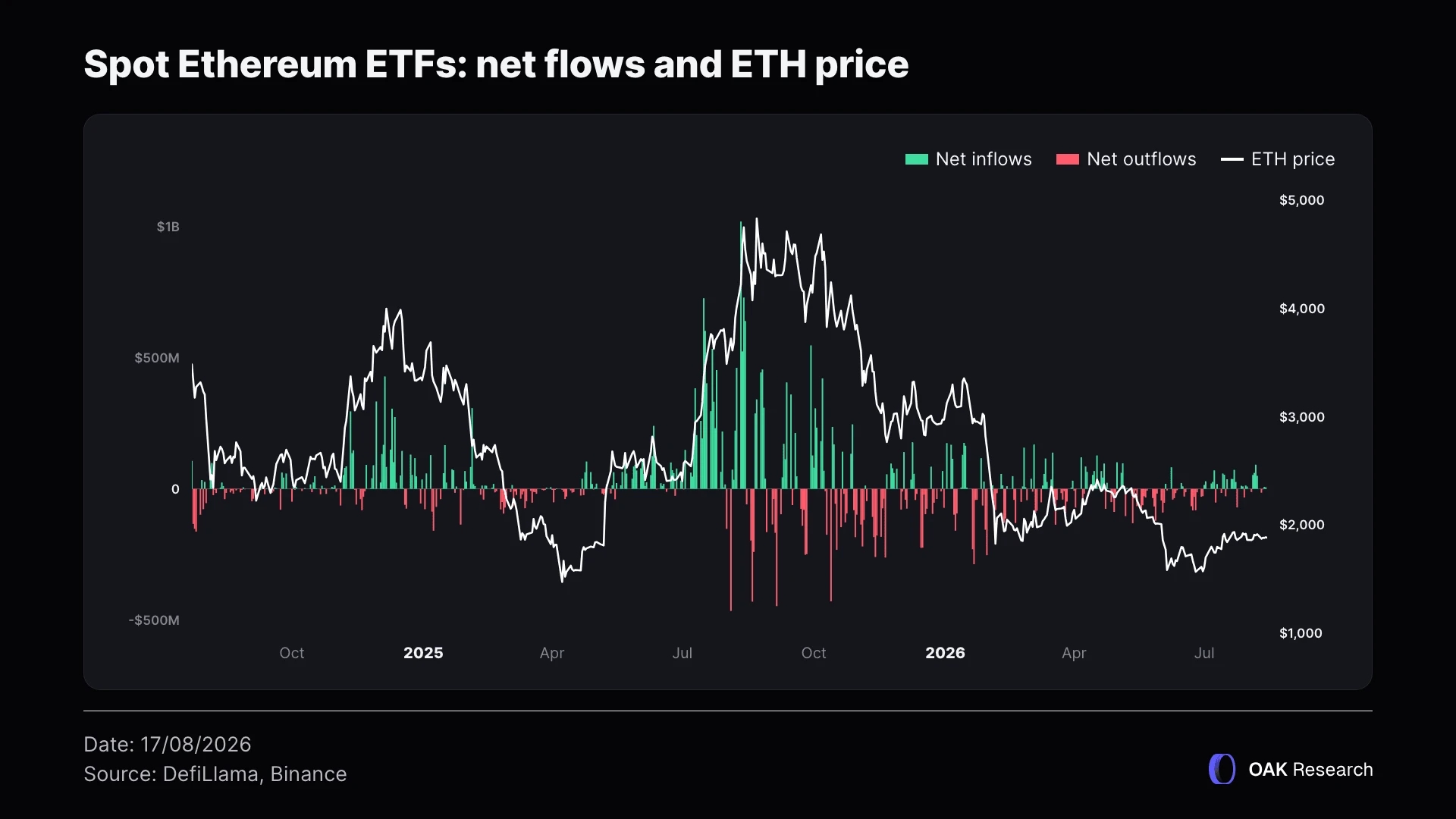
Turning to spot Ethereum ETFs, these have now recorded 17 straight sessions of net outflows, adding up to several hundred million dollars in cumulative withdrawals. The signal is all the more striking given that, over the same stretch, some crypto ETFs outside of Bitcoin and Ethereum were still posting modest inflows at the margin.
Today the doubt is no longer only about the price of Ether, but also about its ability to capture the value it generates. And yet this mistrust sits uneasily alongside the place ETH occupies in the ecosystem.
The KelpDAO exploit this past April illustrates the point perfectly. As a reminder, hackers (reportedly North Korea's Lazarus Group) managed to drain 116,500 rsETH from LayerZero's OFT Adapter using a forged cross-chain message.
→ For a deeper dive, see our report on the KelpDAO hack:
Because the rsETH had been pulled out of the OFT Adapter on Ethereum, their counterparts were left uncollateralized on the Layer 2s, worth roughly $292 million. The incident exposed a substantial part of the on-chain finance ecosystem, starting with Aave, whose TVL dropped by about $10 billion in the space of a few days.
In reality, if the attack was able to reach this scale and spread from one protocol to the next, it is because credit backed by ETH and its derivatives is one of the deepest and most interconnected markets in on-chain finance.
In other words, while Ether's underperformance as an asset is undeniable, its role as the cornerstone of the ecosystem is not in question.
This is precisely the paradox that leads to the following question: at a time when ETH ranks among the most disappointing assets of this cycle, why do protocols and treasuries keep holding so much of it?
Before going further, it's worth revisiting what historically underpinned the bull case for ETH.
Following The Merge, deployed to mainnet on September 15, 2022, Ether seemed to combine a fairly unique set of properties within the ecosystem.
It was at once a productive asset through staking, a consumed asset since transaction fees were paid in ETH and partly burned, and a reserve asset, serving as the ecosystem's native collateral with no counterparty risk.
Long before that, David Hoffman had already captured this idea through the concept of a "triple-point asset," meaning an asset that combines the functions of a capital asset, a consumable asset, and a store of value. EIP-1559 and then The Merge seemed to reinforce exactly this reading, the former introducing a mechanism to burn part of transaction fees, the latter aiming to sharply reduce net ETH issuance.
During periods of heavy activity, the amount of ETH burned could exceed new issuance, mechanically making supply deflationary. This is where the "ultrasound money" promise came from: the more Ethereum was used, the scarcer ETH became.
The strength of a deflationary asset is that it doesn't necessarily need ever-rising demand for its price to climb. Once liquid supply shrinks and holders sell little, relatively steady demand is enough to push the marginal price gradually higher.
Meanwhile, the arrival of US spot ETFs in 2024 seemed to add the final piece of the puzzle. For many, this institutional validation was set to open the way to structurally rising demand for ETH.
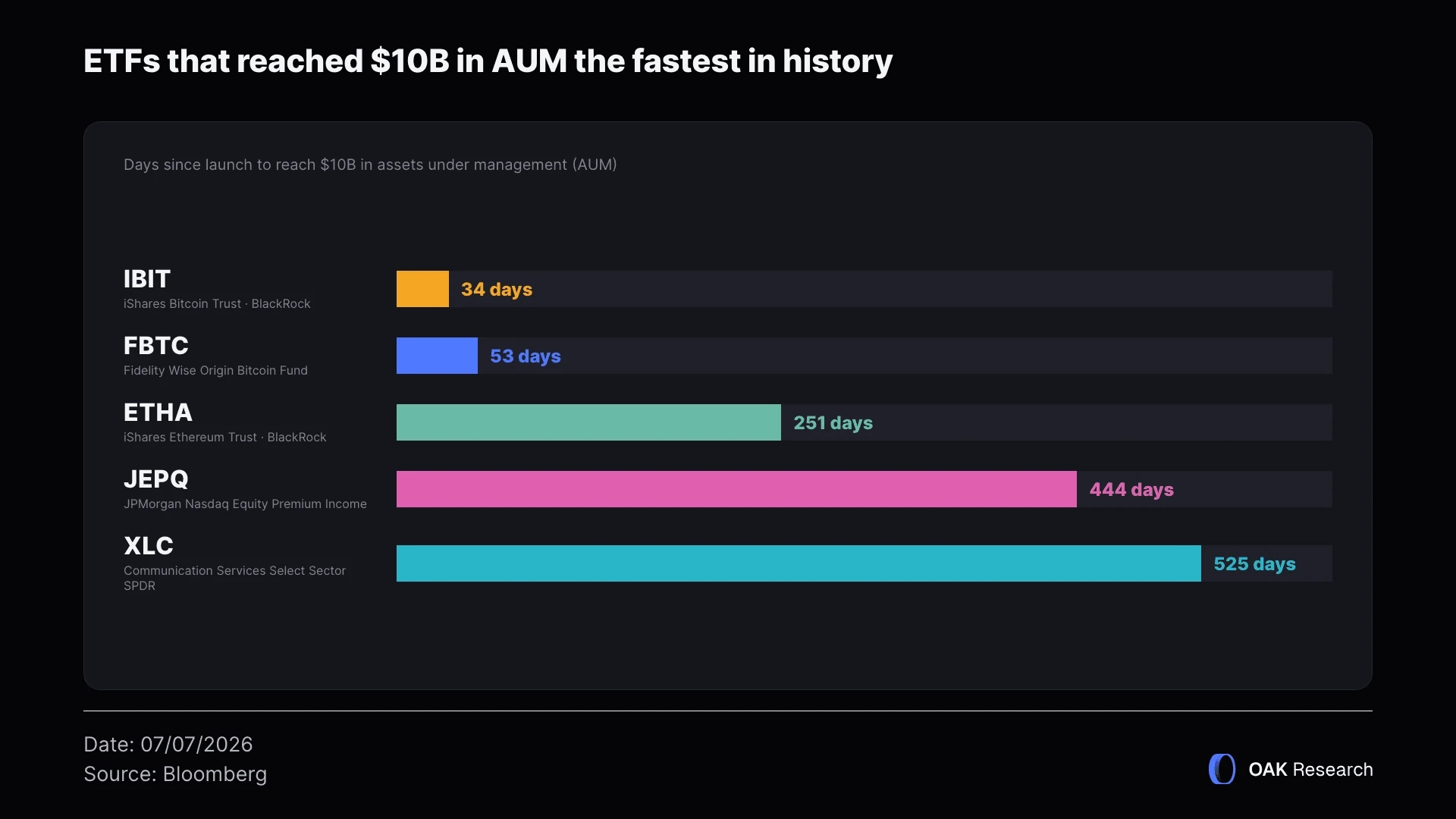
BlackRock's iShares Ethereum Trust (ETHA) reached $10 billion in assets under management (AUM) in 251 days, making it the third-fastest ETF in history to cross that threshold, behind two spot Bitcoin ETFs. On that score, its launch is an undeniable success.
To all of this you can add an equally important thesis, that of "economic bandwidth." ETH was meant to be the base asset of all on-chain finance: its collateral, its settlement asset, and its unit of security all at once.
The reasoning seemed sound enough: if Ethereum was to host an ever-larger share of global finance, then the network would need ever-greater economic security. And since that security rests on the amount of ETH staked, the value of the asset should logically rise along with the value it secures.
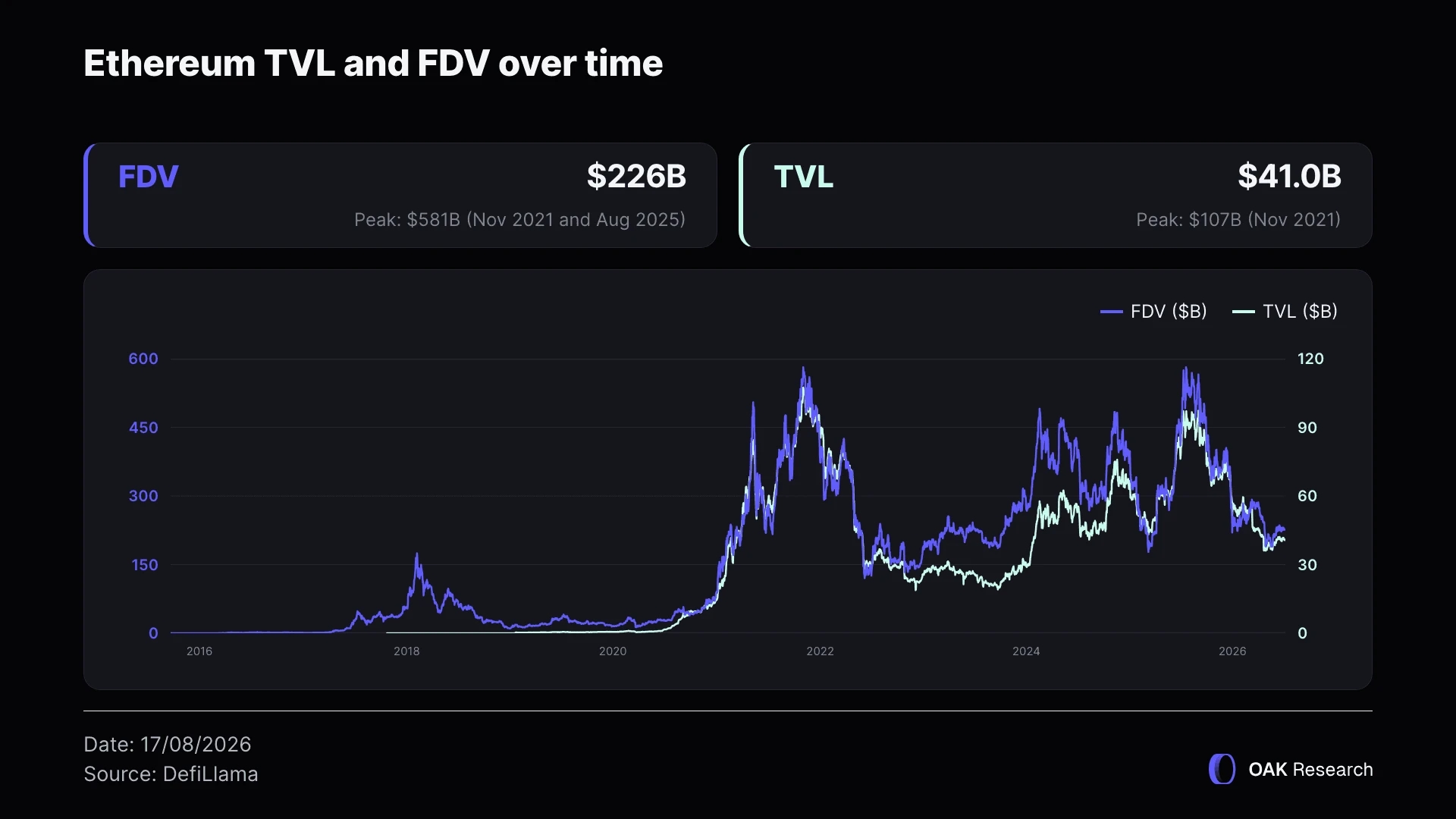
That said, this otherwise coherent thesis rested from the outset on a confusion between a security requirement and a valuation mechanism.
Ethereum's economic security should not be seen as a stock of immobilized assets, but rather as settlement insurance: the guarantee that the blockchain won't be reorganized, that transaction finality remains immutable, and that validators cannot durably censor activity on the network.
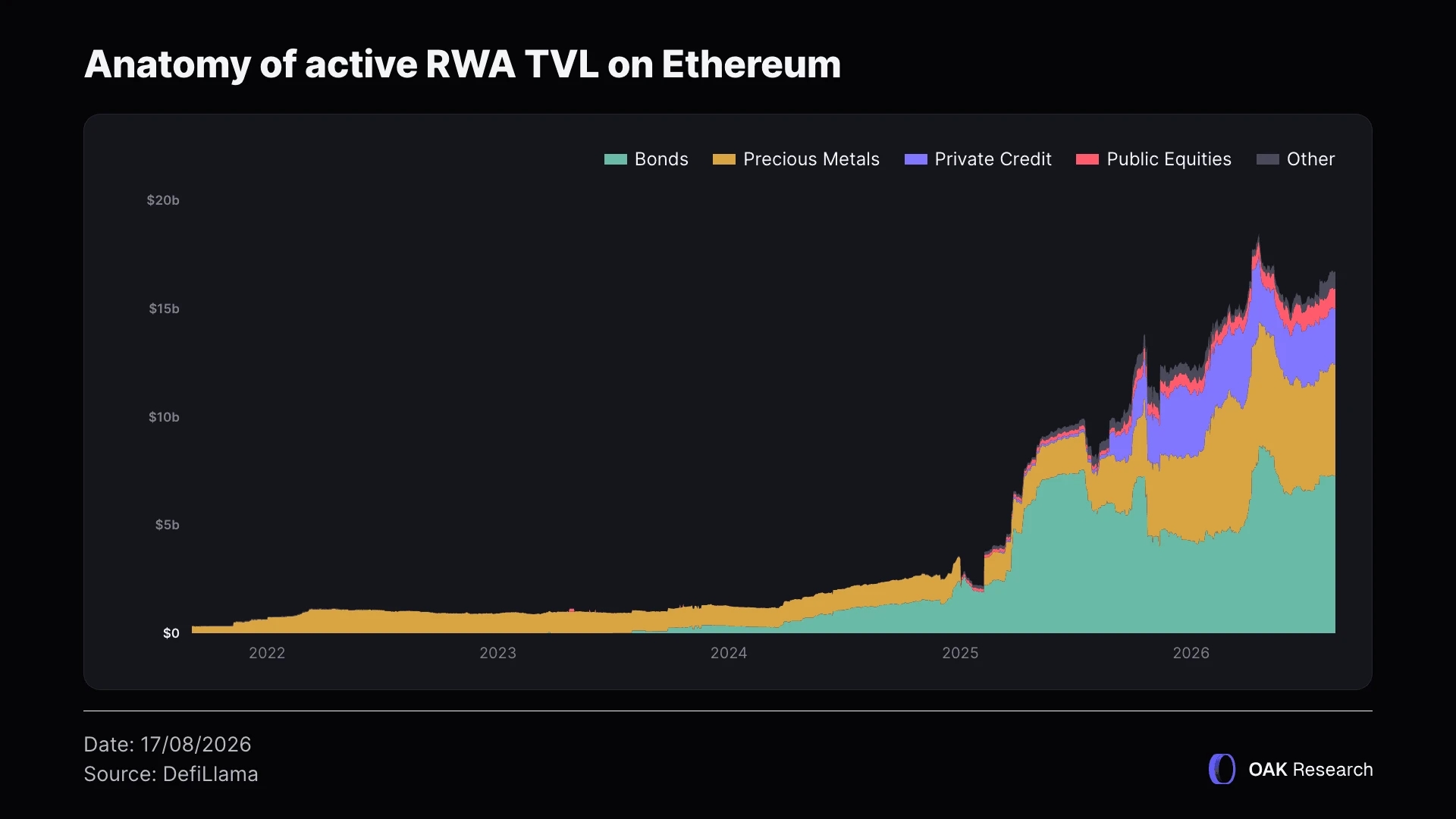
The recent evolution of the ecosystem illustrates this rather well: today, close to 40% of Ethereum's RWA TVL, excluding stablecoins, consists of assets that can be frozen by their issuers. So if economic security truly served to protect the total value hosted on the network, this dependence would directly call the thesis into question.
Ethereum does indeed need a high level of security if its activity becomes systemic. Clearly, a bank, a hedge fund, or an institution won't settle large transactions on a blockchain that could be reorganized without a prohibitive economic cost.
But this notion creates no mechanical floor under the price of ETH. No arbitrage forces ETH's market cap to converge on some theoretical level of security. If its price becomes insufficient, the network isn't automatically repriced; it simply becomes cheaper to attack.
Security depends on a range of factors, notably the price of ETH, the staking rate, validator distribution, issuance, and slashing. As such, it shouldn't be seen as a valuation anchor.
In fact, the causality often runs the other way: when ETH's price falls, the dollar value of staked ETH falls too, shrinking the security budget even as the economic value the network secures may keep rising.
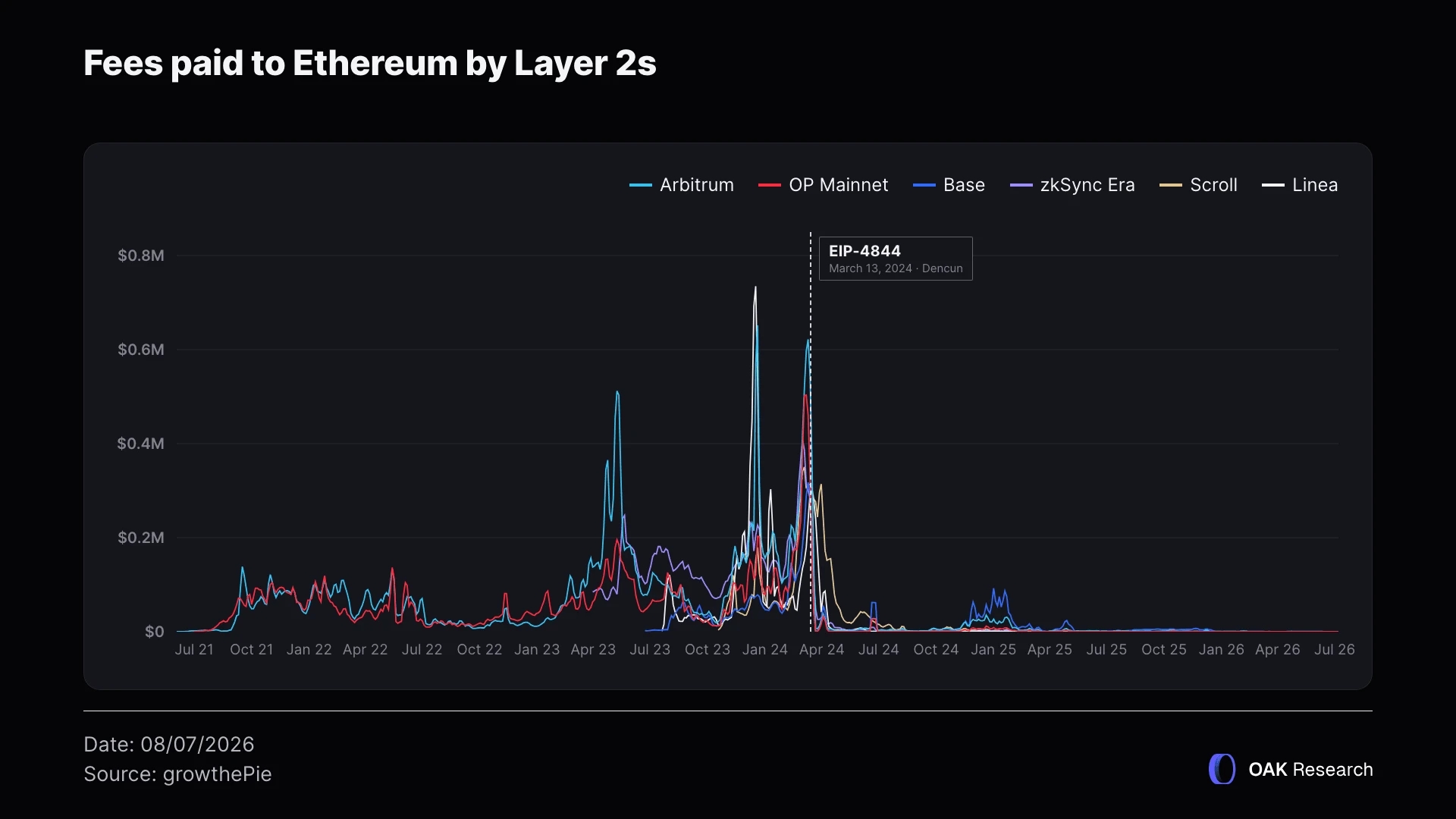
The other pillars of the Ethereum thesis have had their own breakdowns. The most obvious is "ultrasound money." The Dencun upgrade of March 2024 was a technical success: thanks to blobs, the cost of publishing data on Ethereum fell sharply, letting Layer 2s drastically cut their transaction fees.
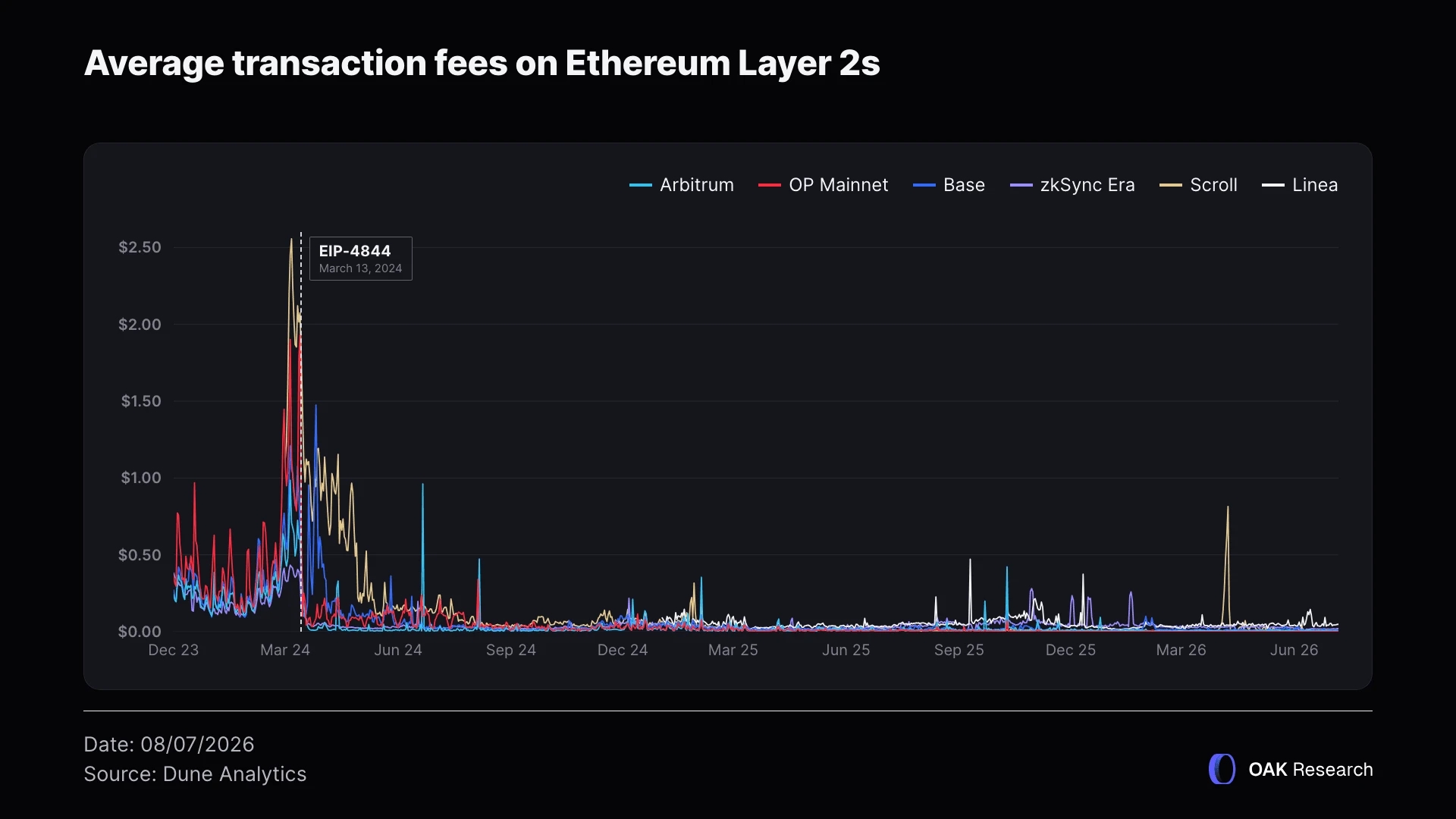
→ For a deeper dive, see our report on the impact of EIP-4844 on Ethereum and its Layer 2s:
Yet this success came at a real economic cost for ETH. By making data availability far cheaper, Ethereum let rollups process more activity while paying lower fees to the Layer 1, which helped bring an end to ETH's deflationary character.
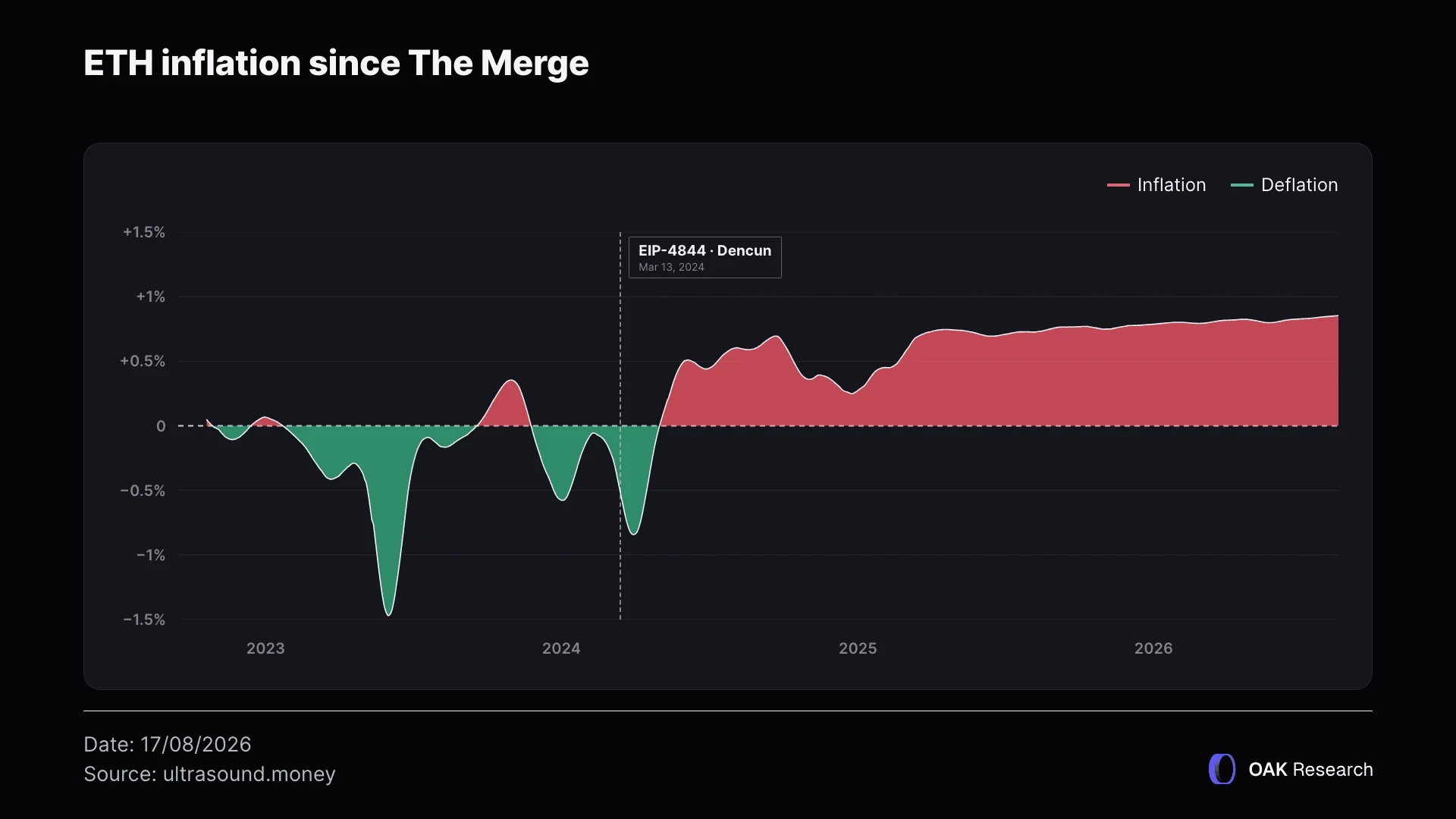
Fundamentally, ETH has remained indispensable to the functioning of Ethereum and its Layer 2s. But a growing share of the economic value is now captured by those same Layer 2s, which collect the fees, optimize their costs before publishing their data on Ethereum, and then hand back to the Layer 1 only a fraction of the value they generate.
It's worth adding that, over the past 30 days, Ethereum generated only about $7.44 million in transaction fees, less than half of what Solana generated over the same period.
In other words, the network that serves as the settlement layer for most of on-chain finance now generates, at its base layer, less gross fees as a blockchain with eight times less TVL and more than three times fewer active protocols.
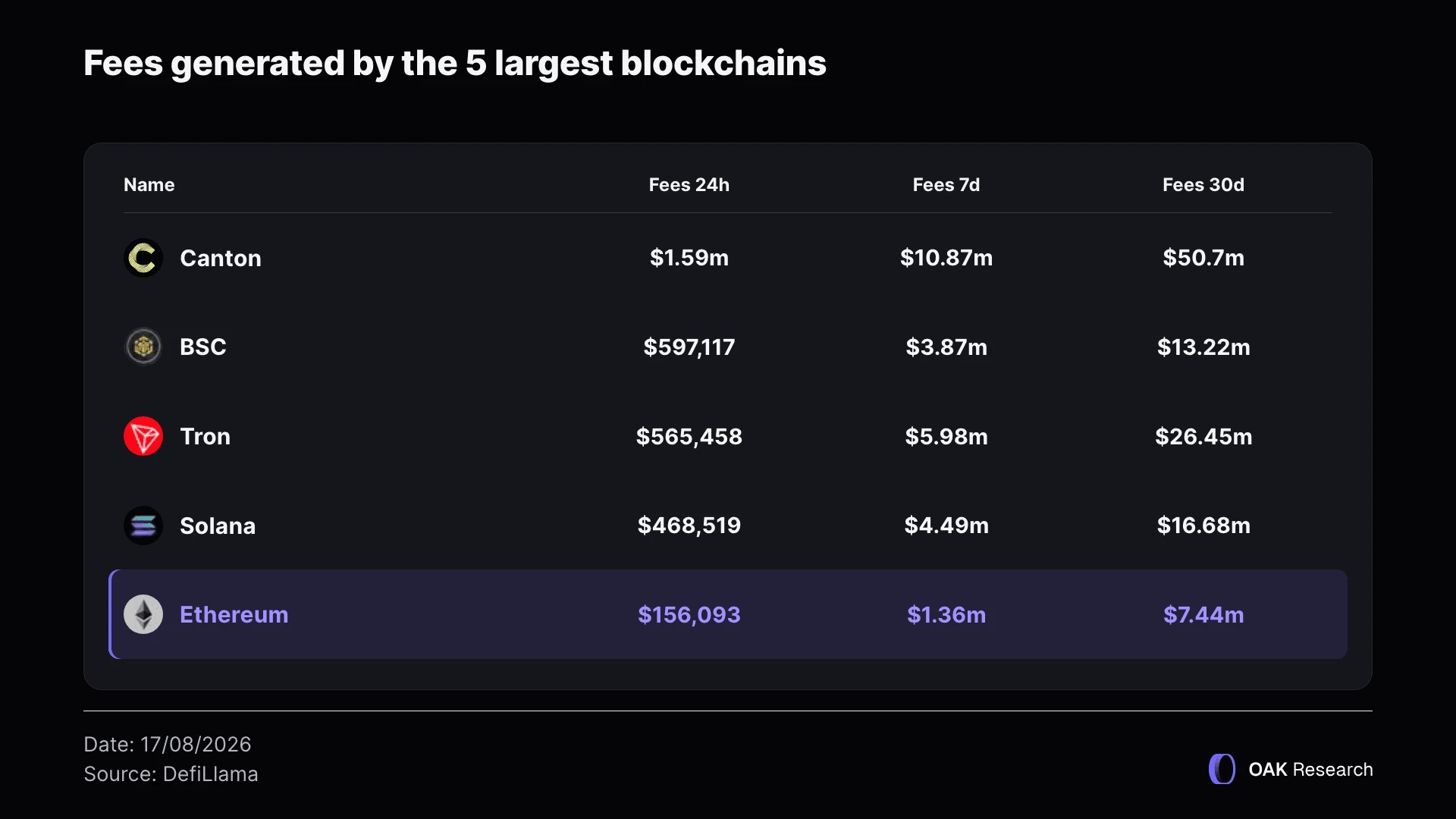
Over the same period, applications built on Ethereum generated around $166.3 million in fees, more than twenty times the Layer 1's revenue. The economic value is not in doubt, but the key is to understand that it no longer flows mechanically through ETH. It now concentrates in the applications, the rollups, the interfaces, the sequencers, and the protocols, while the base layer recovers only a marginal fraction of it.
Over the years, Ethereum thus shows that it can succeed as infrastructure while failing, at least in part, as a value-capture asset.
Even so, ETH remains necessary as a staking and settlement asset, as native collateral, and as the ultimate backstop for data availability.
This observation naturally leads us to ask why, despite all of this, ETH remains so dominant in the ecosystem, even as its ability to capture value is being questioned and its price underperformance increasingly looks set to last.
Unlock all our research and get the right insights, at the right time.
The question "why hold ETH despite its underperformance?" presupposes a bet on the asset's price. Yet for a large share of the ETH on protocols' balance sheets, there is precisely no bet. Ether is there out of functional necessity. A fairly simple test helps separate the use cases: who owns this ETH, and who bears the loss if its price falls?
For a first category of protocols, the holding is above all operational: ETH is an integral part of their business model, or at least part of it. For example, the 9.5 million ETH associated with Lido are not in the protocol's own treasury; they are the ETH deposited by its users. The same applies to protocols like Aave, Morpho, or Euler, where the ETH collateral belongs to the depositors.
The protocol custodies and administers it, but in no way owns it. So a drop in ETH's price would be a loss for users, not a bad bet by the protocol. At this level, holding ETH is purely a matter of operational dependence.
For a second category, it's the opposite: a discretionary allocation. These players explicitly choose to place part of their treasury in Ether when they could have kept it in dollars or Bitcoin. It's a genuine allocation decision, whose cost the DAO bears, and it's in this case that the question of underperformance fully applies.
Several examples illustrate this approach, such as Compound, which in 2023 converted roughly $500,000 of ZRX and BAT into a vault with exposure to wstETH among other assets. There was also Moonwell Apollo, which allocated part of its USDC reserves to WETH, and Nexus Mutual, which sold wNXM for WETH in 2025 before staking part of it as rETH.
That said, the line between these two categories is sometimes blurrier than it looks. Even the first category carries a dimension of betting, because, depending on the protocol's activity, some or all of its revenue comes from a cut taken on the assets it manages, and that cut is denominated in ETH.
At Lido, the protocol takes 10% of staking rewards, paid in ETH, half of which then goes to node operators. Aave, for its part, applies a reserve factor to borrowing interest, which accrues notably in WETH on the relevant markets.
In other words, these protocols gradually become ETH holders without ever having had to buy any. Keeping it rather than selling off a portion through regular rebalancing turns the situation into an implicit bet: a protocol whose costs are largely in dollars watches its reserve melt away if it lets gains denominated in a historically underperforming asset run.
Lido is a good example here: the DAO set up a pipeline to sell stETH for DAI to fund its operating needs, then in 2026 approved a program aiming to put up to 10,000 stETH to work buying back LDO. In other words, even a protocol structurally exposed to ETH can decide to reduce or redirect that exposure when treasury management calls for it.
So in practice, many protocols mechanically accumulate ETH because their revenue is generated in that asset. Far fewer, however, go on to make a genuine strategic choice to deliberately increase that exposure.
To gauge what ETH concretely represents for protocols, the lending market offers the clearest vantage point.
Today, close to 76.4% of on-chain debt is denominated in stablecoins. Yet that debt is mostly backed by ETH. Of the roughly $43.9 billion in collateral deposited in lending protocols this past April, about 40.9% was ETH, 25.6% liquid staking tokens, and 23.6% wBTC and other BTC derivatives, with the rest attributable to other assets.
In other words, ETH and its derivatives alone account for nearly two-thirds of on-chain finance's collateral. To this we can add staking, which has kept growing despite the underperformance of its underlying's price, standing today at more than 34.8% of circulating supply.
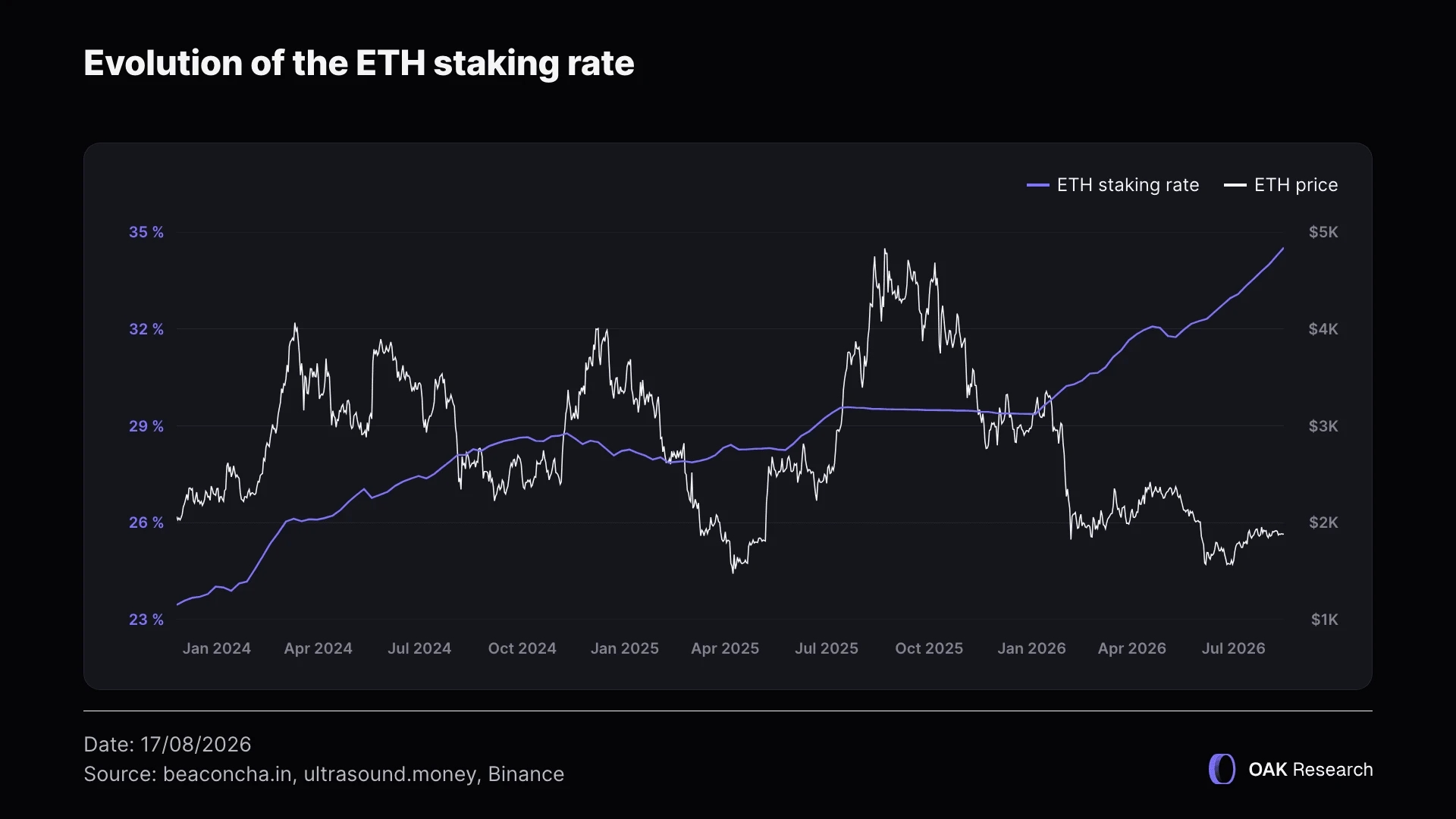
More than 35% of these staked Ether then pass through liquid staking, where Lido remains the top player with roughly 24% of all staked ETH and more than 60% market share, making it the main supplier of the collateral that feeds the leverage mechanics we'll come to later.
Now, looking at the largest ETH treasuries, the protocols listed below total nearly 880,000 ETH. But this figure should not be read as proof that protocols are buying ETH en masse, since it instead reflects very different origins: ETH raised historically in ICOs, initial foundation allocations, protocol revenue, and so on.
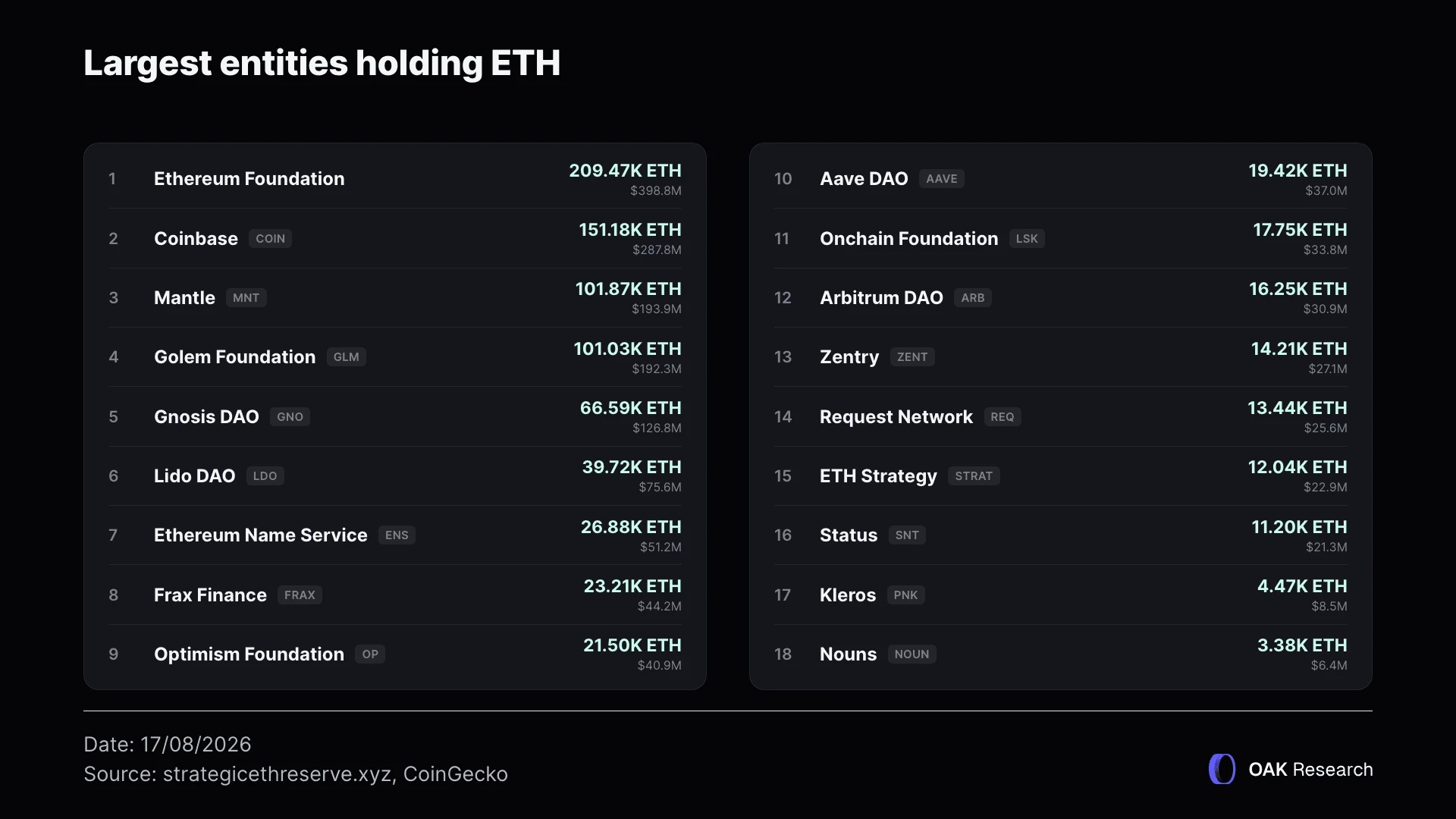
We've just seen that ETH and its derivatives make up the main collateral of on-chain finance, and that the amount of ETH staked keeps rising despite the asset's weak price. That leaves the question of where the demand that borrows against this collateral comes from, and this is the crux of the matter, because that demand is largely reflexive.
On Aave V3's Ethereum instance, the most-borrowed asset is not a stablecoin but WETH itself, used mainly in leveraged "looping" strategies, and this WETH demand comes almost entirely from positions already backed by staked ETH.
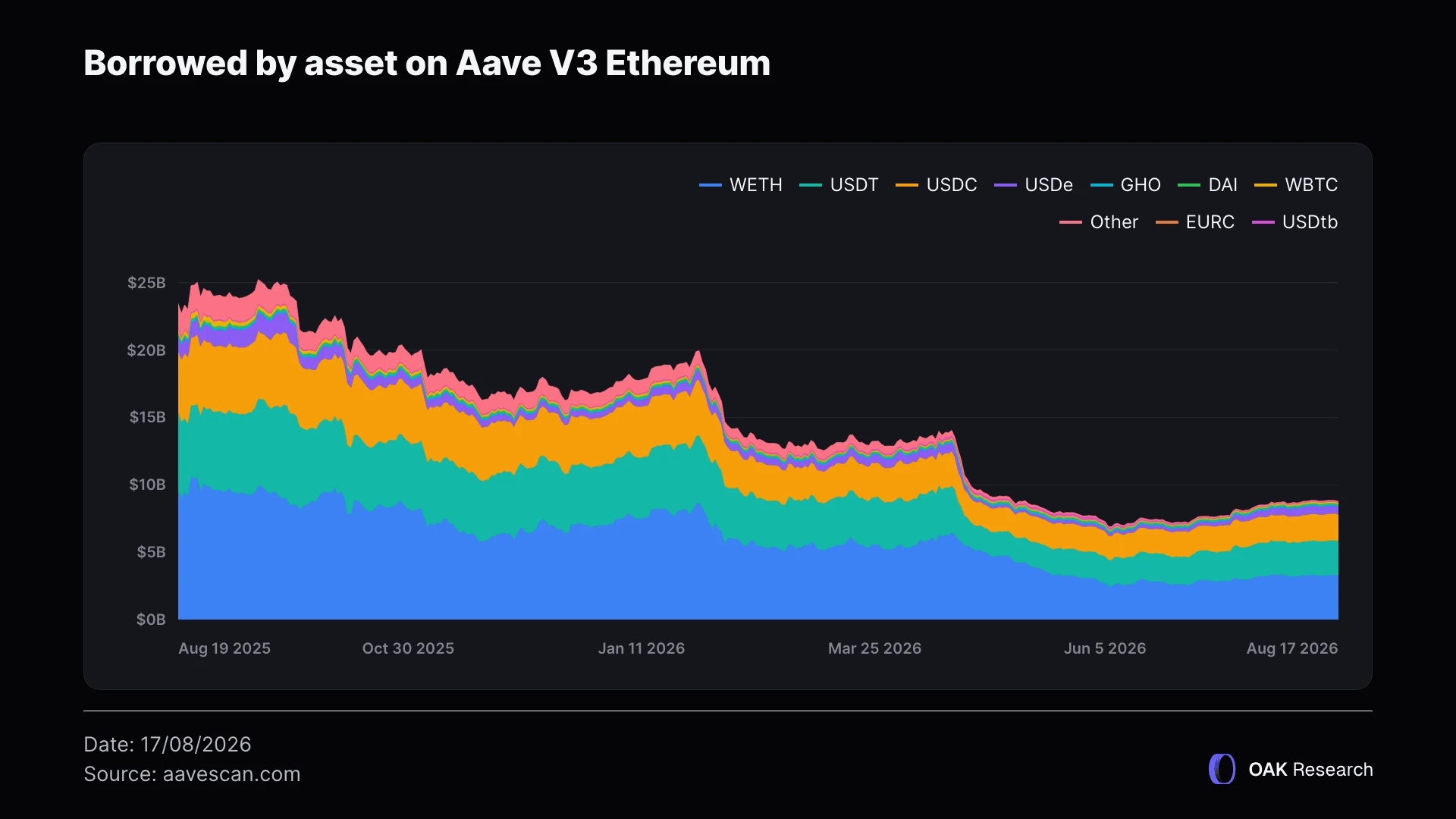
In other words, a large part of WETH demand already comes from users who have posted another form of ETH as collateral.
This is what's known as looping, or leveraged staking: a user deposits, say, wstETH or weETH as collateral, borrows WETH, swaps that WETH for more wstETH, then repeats the operation several times to increase their exposure to staking yield.
These strategies are made possible by Aave's E-Mode, which allows particularly high loan-to-value ratios between strongly correlated assets. For liquid-staking pairs, LTV reaches 93%, and even 95% on the specific market built around Lido.
In practice, as long as the staking yield exceeds the cost of borrowing WETH, the position generates a positive carry. The structure is inherently layered: LRT holders borrow wstETH, wstETH holders borrow WETH, and so on.
According to data published in February 2026 by a contributor to the Aave Chan Initiative, weETH holders alone accounted at that point for 57.9% of all WETH borrowing on Aave. Adding the other LRTs brought the share to 75.1%, and including wstETH, 97.6%, in other words nearly all WETH borrowing demand.
This phenomenon isn't specific to Aave; you find the same structure at Spark, for instance, the third-largest lending and borrowing protocol, which is itself an Aave fork.
So demand for ETH does not mainly come from monetary use or a need for payment. It is largely endogenous, meaning ETH serves as collateral to borrow more ETH.
That reflexivity, however, is also the source of its fragility, because looping is nothing more than a carry trade. It stays profitable only as long as the cost of borrowing remains below the staking yield.
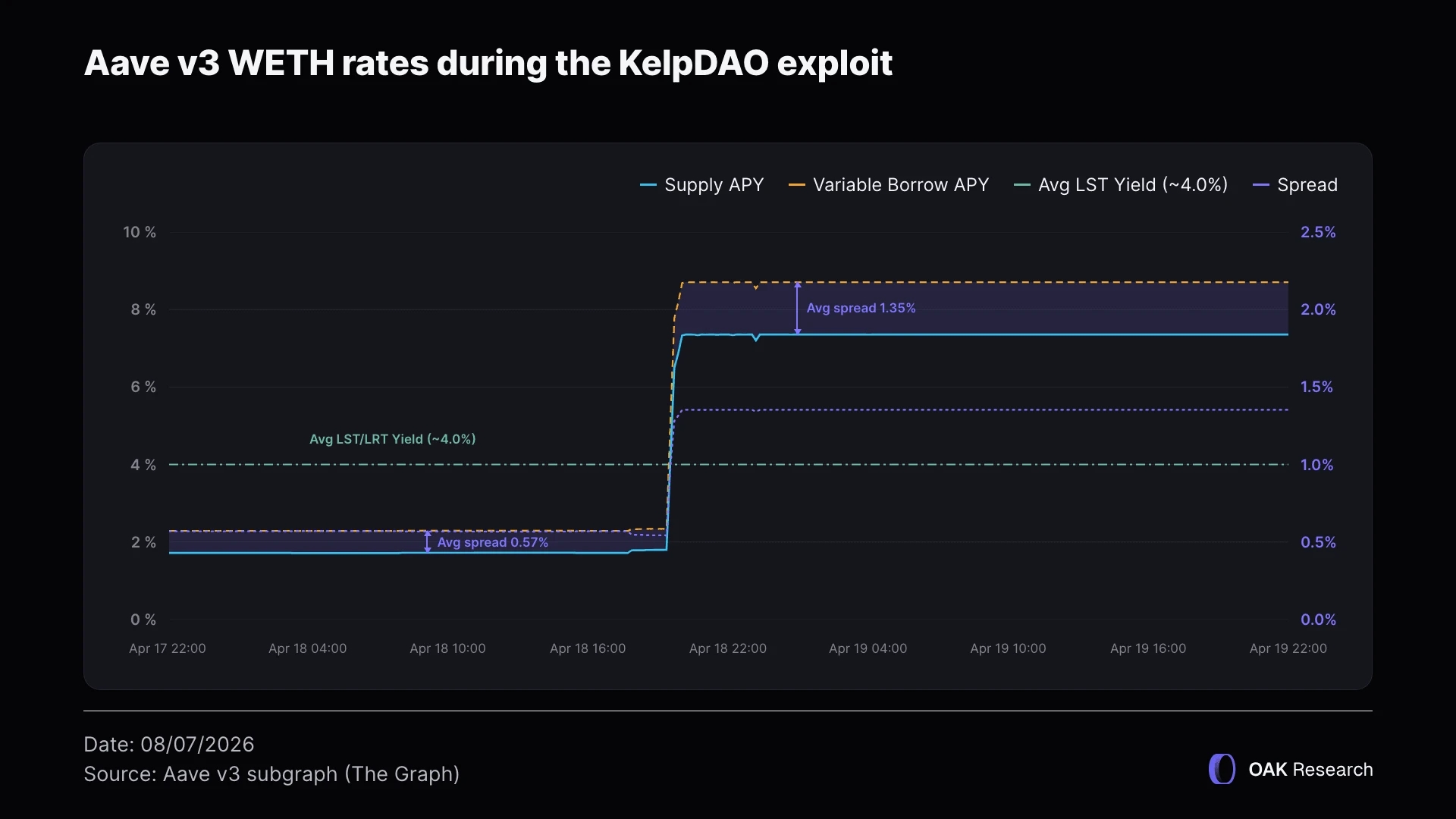
Before the KelpDAO hack, borrowing WETH cost about 1.5%, while staking returned around 2.5%, leaving a positive carry of roughly 1%. But when the borrow rate jumped to 8.7%, that carry turned negative by 6.2%, pushing leveraged positions into the red.
On Aave, as soon as WETH pool utilization approaches 100%, rates rise quickly to entice lenders to supply more liquidity. A confidence shock to ETH or one of its main derivatives is therefore enough to drain that liquidity and wipe out the profitability of looping strategies.
Your weekly crypto digest delivered directly to your inbox.
For the portion of ETH a protocol holds by choice rather than operational necessity, the question "why keep an asset that underperforms" has no single answer; it actually depends on the reason for holding it.
In practice, we can distinguish three main motives.
The first is exposure to the price of ETH. This is the only case where the asset's underperformance is truly the heart of the matter, since the value of the position depends directly on it.
In practice, this exposure is rarely the result of a deliberate purchase. Indeed, few protocols today display an explicit conviction to accumulate ETH because they anticipate a rise.
The most common case is far more passive, where ETH simply accumulates at the pace of the protocol's activity and then sits in the treasury.
Aave is a good example: the protocol takes a reserve factor on the interest paid by borrowers, always in the asset concerned. A WETH loan therefore generates revenue in aWETH, which accrues in the Collector contract. The mechanism is identical for USDC, USDT, or WBTC, but since WETH is among the protocol's most-borrowed assets, it mechanically represents a large share of revenue, and then of the treasury.
On top of this there's an optical effect: since treasuries are aggregated in dollars, ETH's share appears to shrink when its price falls, and vice versa.
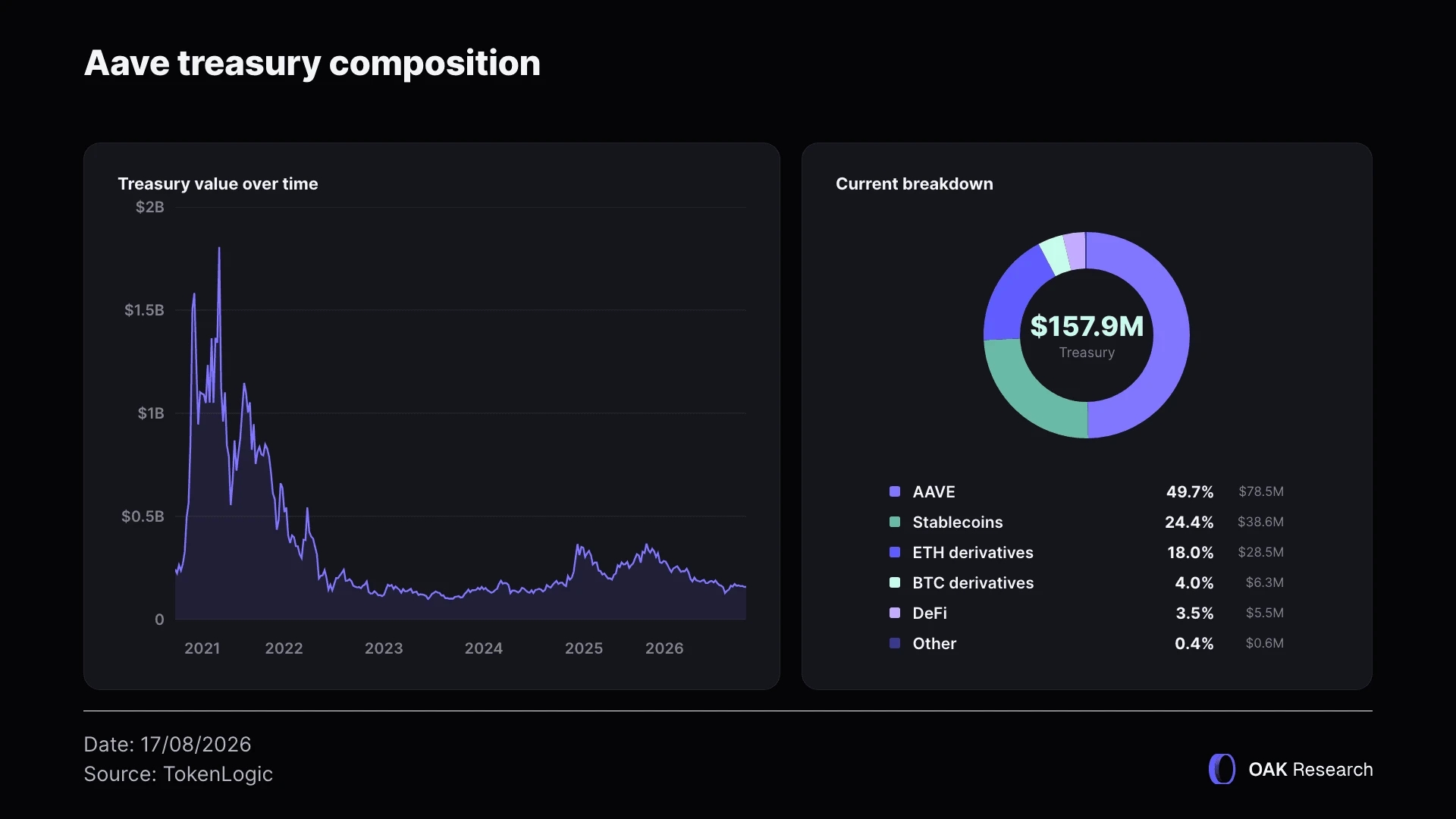
When a treasury like Aave's looks ETH-exposed, it isn't necessarily a sign of directional conviction, but rather of revenue accumulated in one of the dominant assets of its market.
The only truly discretionary decision lies at the level of rebalancing: whether to periodically convert this revenue or let it run. In that case, underperformance hits the position in accounting terms, but it penalizes an exposure inherited from activity, not an allocation choice.
ETH can be staked, converted into derivatives like wstETH or weETH, and then deployed in lending or liquidity protocols like Aave, Fluid, or Camelot to generate additional revenue.
Arbitrum's DAO, for instance, approved in 2025 the allocation of part of its treasury to several strategies: 5,000 ETH staked via Lido for wstETH, 4,200 wstETH deposited on Aave V3, 2,500 ETH lent on Fluid, and 800 wstETH provided as liquidity on Camelot. Here, the goal wasn't simply to hold ETH, but to turn a dormant asset into productive capital while strengthening the liquidity of the Arbitrum ecosystem.
That said, this logic quickly runs into its limits. As long as the treasury stays exposed to ETH's price, a few points of APY are sometimes not enough to offset a prolonged decline. Without an appropriate strategy to neutralize this risk, yield doesn't really protect against the asset's volatility.
Finally, the third motive relates to ecosystem liquidity and alignment: providing or holding ETH to bootstrap markets, support partner protocols, or signal a commitment to Ethereum. The expected return here is strategic, not financial, and it's on this ground, rather than that of yield, that Arbitrum's proposal was contested: several delegates faulted the committee for funding non-native protocols rather than the local ecosystem.
ETH's underperformance therefore doesn't affect every use with the same intensity. It hits purely directional positions directly, which nonetheless remain the least common among protocols, where exposure is far more often inherited from activity than deliberately chosen.
It represents a real risk for yield strategies, since a sharp drop in the asset can wipe out the revenue generated by staking or lending. As for alignment, the question becomes almost secondary: ETH isn't held there to outperform the market, but rather to stay economically plugged into the ecosystem the protocol serves.
This distinction between operational holdings and directional bets ultimately points back to a far more fundamental question, one that publicly divided Bankless's two co-founders in spring 2026: can Ethereum succeed as a network without ETH capturing that value as an asset?
David Hoffman sold all of his ETH after nine years of holding it; Ryan Sean Adams held on to his conviction. Their disagreement sums up the two main readings that face off around Ethereum today.
For Ryan Sean Adams, the network and its native asset are inseparable. ETH is the economic bandwidth of on-chain finance: it serves as collateral, settlement asset, and security guarantee, and in time must establish itself as a store of value. In this reading, Ethereum's success cannot be separated from ETH's. If the asset doesn't durably capture the value created by the network, then the project misses its economic objective.
Conversely, for David Hoffman, Ethereum can perfectly well become the dominant infrastructure of on-chain finance without that success automatically benefiting ETH. Applications, Layer 2s, stablecoins, and tokenized assets create enormous value, but that value is increasingly captured by the layers built on top of Ethereum rather than by its native asset.
He thus describes Ethereum as a network that distributes more value than it recovers. Rollups enjoy cheap blockspace, stablecoins have robust infrastructure, and DeFi protocols benefit from deep liquidity, without this activity necessarily translating into a durable appreciation of ETH.
The "ETH-as-money" thesis, in his view, hasn't failed for lack of being tested; it has simply reached the end of its reasoning, and the verdict goes against it.
Objectively, the best arbiter of this debate is probably still the burn mechanism introduced by EIP-1559. Its purpose was precisely to route part of the network's economic activity back into the value of ETH. But since the introduction of EIP-4844, most of that activity has been migrating to the Layer 2s, where data-publishing costs have fallen sharply. Fees generated on mainnet have contracted accordingly, mechanically reducing the volume of ETH burned.
ETH's total supply has thus climbed back above the level seen at the time of The Merge, and is now growing by about 0.23% a year. That's why, in the end, the narrative of a structurally deflationary ETH has become much harder to defend. The very success of scaling has undermined the deflationary narrative: the network as infrastructure met its objective, but the channel meant to transmit that value to ETH has seized up.
Even so, more than 34.8% of ETH's supply remains staked today, with the trend still pointing higher, which gradually reduces the available float. ETH also remains the main collateral of on-chain finance, while the Fusaka upgrade introduced, with EIP-7918, a fee floor on blobs to keep the burn from durably falling to zero.
Above all, while the mechanism is indeed weakened, it isn't destroyed. 21Shares describes ETH as "mildly inflationary, under the leverage of scalability," a deflationary thesis that has become conditional on a pickup in mainnet activity, which the rise of RWAs and institutional settlement on the Layer 1 could, in time, gradually fuel.
At this stage, the call leans toward Hoffman on the question of price alone: between 2024 and 2026, the network's clear success did not translate into appreciation of the asset.
That said, it doesn't settle the choice between the two possible readings of this observation, namely a fundamental decoupling or a cyclical lag awaiting Layer 1 demand capable of reconnecting the value of the network and that of ETH. So the investment thesis for Ether no longer rests on an automatic value-capture mechanism, but ultimately on the assumption that this link will eventually rebuild itself.
Unlock all our research and get the right insights, at the right time.
Bitcoin (BTC), Ethereum (ETH), Derive (DRV)

Bitcoin (BTC), Ethereum (ETH), Derive (DRV), Hyperliquid (HYPE)

Bitcoin (BTC), Ethereum (ETH)

Bitcoin (BTC), Ethereum (ETH), Zcash (ZEC)