



Market Briefing 9: Bitcoin (BTC) corrects ahead of the Fed, CLARITY Act rejection shakes crypto markets


Bitcoin (BTC), Ethereum (ETH)
Published on

On September 8, Meta launched Muse, its first consumer AI agent, and the success was immediate, with a launch that outpaces ChatGPT's and Meta stock up 11% in a single session. But behind the hype, a question arises for investors: who really benefits from the explosion of agentic AI. In this analysis, we break down how Muse works, how Meta plans to monetize it, the threat it poses to aggregators like Booking, and above all why this launch is waking up the entire value chain of CPU makers like AMD, Intel and Arm.
We already covered Meta's comeback in the AI race in our July 10 Alpha, where we broke down its strategy of integrating across the value chain.
At the time, one piece was still missing: a consumer product capable of proving that those billions in investment could actually reach end users. With Muse, that box is now ticked.
Muse is a personal agent that genuinely carries out tasks for you, on its own. Ask it to find a hotel in New York for under $200, order a meal at the best price or cancel a subscription, and it gets it done.
It can even go as far as asking for your approval to pay through Stripe, which generates a single-use virtual card so your real banking details stay protected.
In practice, Muse connects to outside services in three ways:
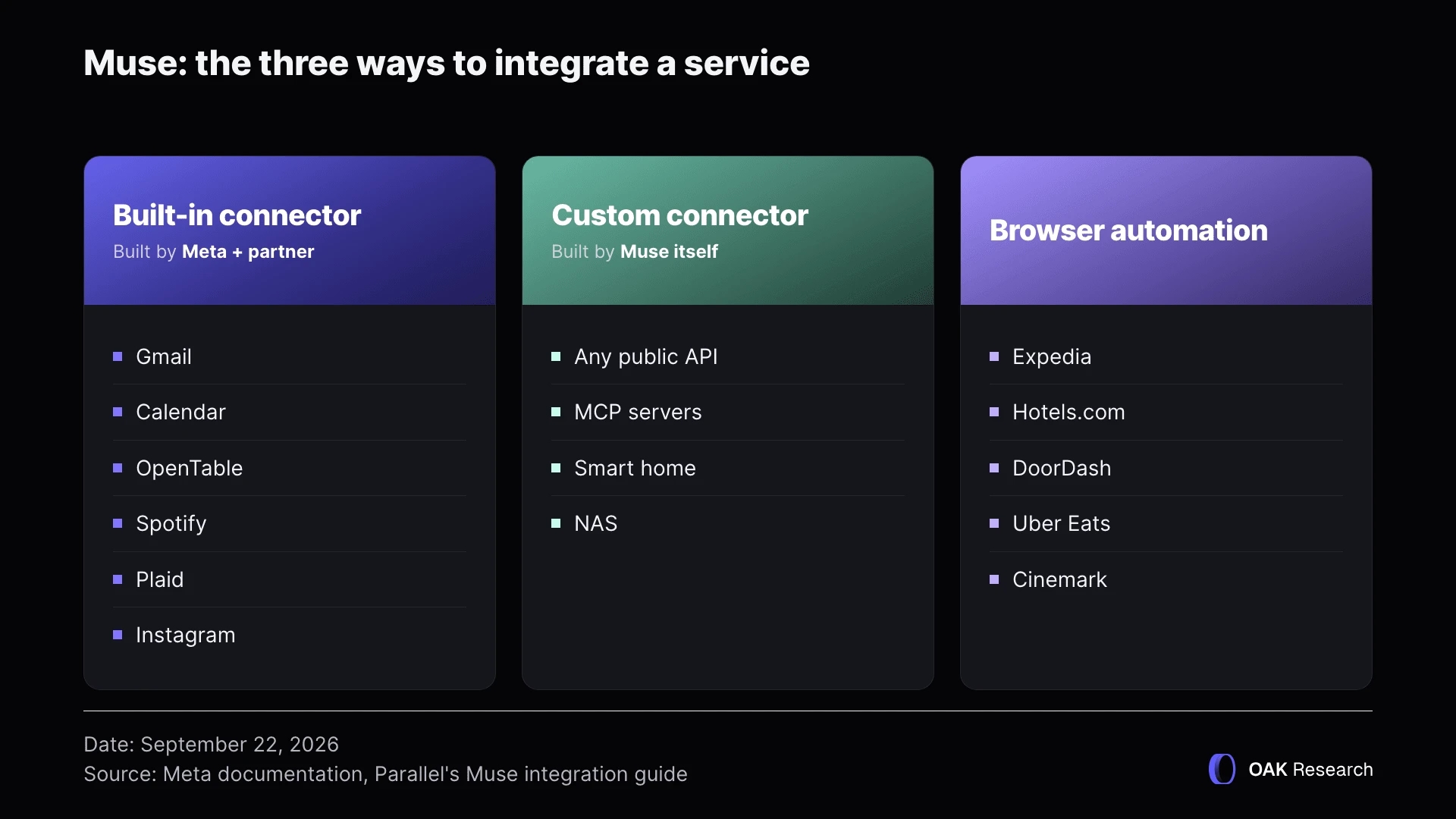
The launch has been a genuine success, with more than 2.8 million downloads in 12 days and the top spot on the US app stores.
More importantly, Muse beat ChatGPT's debut, racking up 1.8 million iOS downloads in the US and Canada versus 1.3 million for ChatGPT over the same post-launch period. Muse even hit 448,000 daily active users within 10 days, a level ChatGPT took 49 days to reach.
In other words, Muse has pulled off the biggest consumer AI launch since ChatGPT.
Muse can already book, compare and buy, but those purchases are still marginal at market scale, so for now they don't pose a real threat to intermediaries' business. In our view, however, that is likely to change very quickly.
A human compares three or four options before picking a favorite, because their time is worth more than the $10 they might save by searching further.
An agent, on the other hand, compares hundreds of options in a matter of seconds and optimizes for your exact criteria. The information asymmetry that aggregators have built their margins on for twenty years disappears, and the benefit flows back to the consumer.
The most exposed are travel aggregators like Booking, Trivago or Kayak whose entire business boils down to being the place where people search and compare, which is precisely what the agent now does for you.
By contrast, players like Uber are better protected: even if the agent compares prices across platforms, someone still has to deliver the meal or drive the passenger.
The big winners, meanwhile, are payment giants like Stripe, which process the transaction volume generated by Muse, along with card networks like Visa and Mastercard.
That leaves the central question of monetization, since the market has clearly understood that Muse could become far more than just an agent. We see four potential revenue streams.
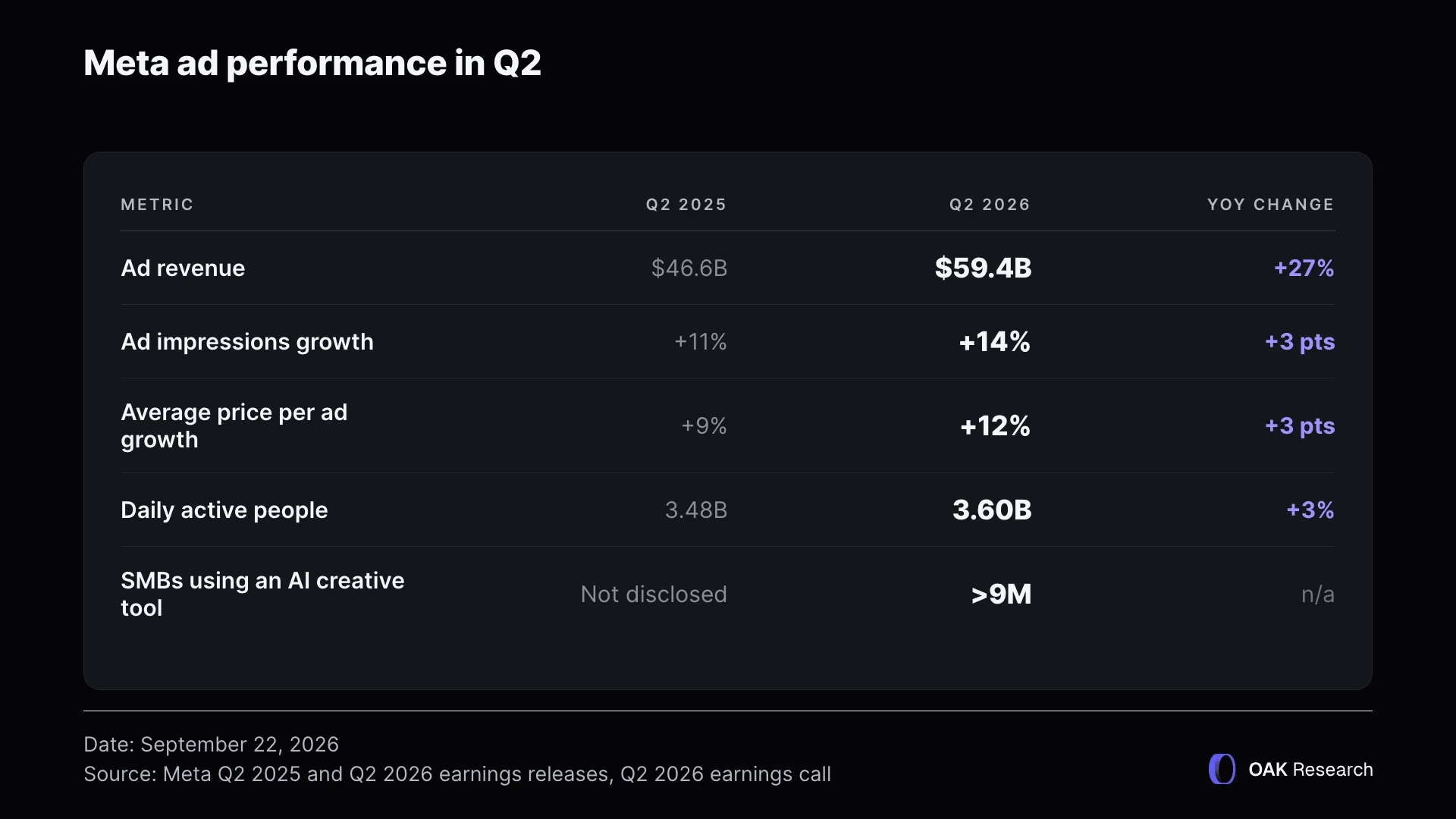
Even though the group says conversations with Muse don't directly feed its ad engine, the agent strengthens the link between seeing an ad and making a purchase. If Muse makes it easier for users to act after seeing an ad, the value of that ad rises mechanically.
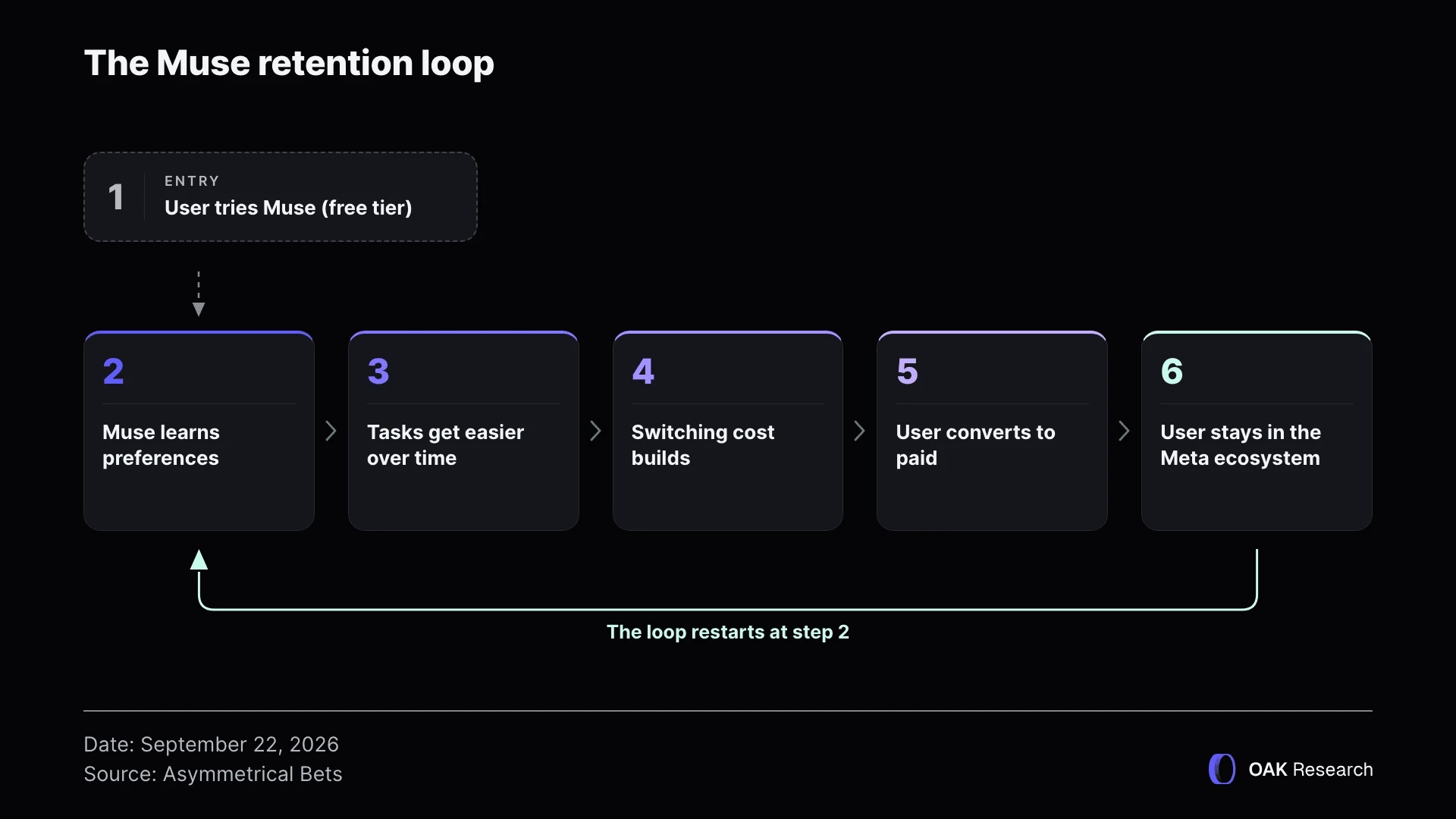
Muse is free up to a certain limit, then moves to $20 or $100 a month for users who burn through the most credits. But an agent that knows your preferences after a few months of use becomes very hard to walk away from, just as users stuck with ChatGPT out of sheer habit.
Assuming a conversion rate of just 1% of Meta's user base, or roughly 36 million users, at $10 a month, that would already add close to $4.3B in annual revenue for the company.
Mark Zuckerberg said it explicitly: the plan is to take "a very small fee" on transactions, charged not to users but to the merchants benefiting from the traffic Muse sends their way.
Nothing is set in stone yet, but if Muse becomes the starting point for purchases, this revenue line could become substantial.
Yesterday, Amazon flat-out blocked Muse from its website after Meta refused to remove Amazon from the experience. Users now see a message stating that access by an unauthorized AI agent violates Amazon's terms of use.
From Amazon's standpoint, the move makes sense: if customers shop through an agent, Amazon loses valuable sponsored advertising revenue on its platform.
Amazon also points to a real issue. To act on a user's account, Muse has to log in on their behalf with their Amazon credentials, without ever disclosing that it is an agent rather than a human.
The company argues that handing login credentials over to Meta this way exposes its customers to security and privacy risks.
Conversely, Shopify made the opposite choice by striking a direct partnership with Meta. The deal lets Muse browse Shopify-powered stores and complete purchases there, relying on Shop Pay, Shopify's one-tap checkout service that already stores customers' payment and delivery details.
Where Amazon sees a threat, Shopify sees an opportunity, that of giving Muse a controlled gateway to millions of merchants, with the seller's consent built in from the start.
These two opposite reactions, an outright block on one side and cooperation on the other, sum up on their own the dilemma every platform will have to answer as agents take off.
This is arguably the most interesting angle for investors, and the one that explains the surge in AMD, Intel and Arm over the past few days.
Until now, AI has mostly been a GPU story, with those chips handling model training and token generation. An agent like Muse obviously relies on that layer, but what it does goes well beyond simply generating text.
At Meta, every user gets their own virtual machine, with a browser to run, tool calls to execute and a whole layer of orchestration to manage. That work isn't handled by GPUs but by CPUs, the traditional processor, to the point that tool calls alone reportedly account for around 66% of the time an agent spends completing a task.
Put simply, if agents like Muse reach hundreds of millions of users, each with a virtual machine running around the clock, that creates massive demand for server CPUs and memory.
To give you a sense of scale, a scenario with 100 million dedicated users would require roughly 1.6 million server chips, or about 15% of what AMD ships in an entire year.
Intel's CEO has said demand is so strong that the company can only meet half of it, and AMD CEO Lisa Su saw this coming back in 2025, noting that "the adoption of agentic AI is driving growing demand for general-purpose compute."
In our latest Premium Alpha, we compiled the main companies set to benefit from the rise of agentic AI driven by Muse, with a look at each one's valuation and its real exposure to this new demand.
Because today, playing the Muse launch may no longer just mean buying Meta. It also means understanding who supplies the infrastructure behind every agent, which companies are capturing CPU demand, and which are best positioned for the next phase of agentic AI.
Want to see the full list and our detailed analysis? Head over to OAK Premium and enjoy a 7-day free trial!
Bitcoin (BTC), Ethereum (ETH)

Bitcoin (BTC), Ethereum (ETH), Zcash (ZEC)

Bitcoin (BTC), Ethereum (ETH)

Bitcoin (BTC), Ethereum (ETH), Hyperliquid (HYPE), Ethena (ENA)


