Context on Ethereum
Despite heightened competition over recent years,  EEthereum+1.42% remains the core infrastructure of on-chain finance, both as the preferred settlement layer for stablecoins, tokenization, and financial applications, and as the security backbone for a growing ecosystem of layer 2 networks.
Q4 2025 was a period of sharp correction for the crypto market. A broader reduction in macro risk and rising trade tensions weighed on high-beta assets as a whole, and ETH was no exception.
That said, fundamental metrics continued to improve and institutional allocation further segmented: ETFs proved more sensitive to portfolio rotations, while corporate treasuries adopted accumulation and staking strategies.
The “rollup-centric” trajectory was further confirmed in Q4 2025. The Fusaka / PeerDAS upgrade improved scalability, at the cost of compressed short-term data availability revenues, and shifted the ETH narrative away from direct fee monetization toward scarcity and the progressive immobilization of supply.
Financial analysis of Ethereum in Q4 2025
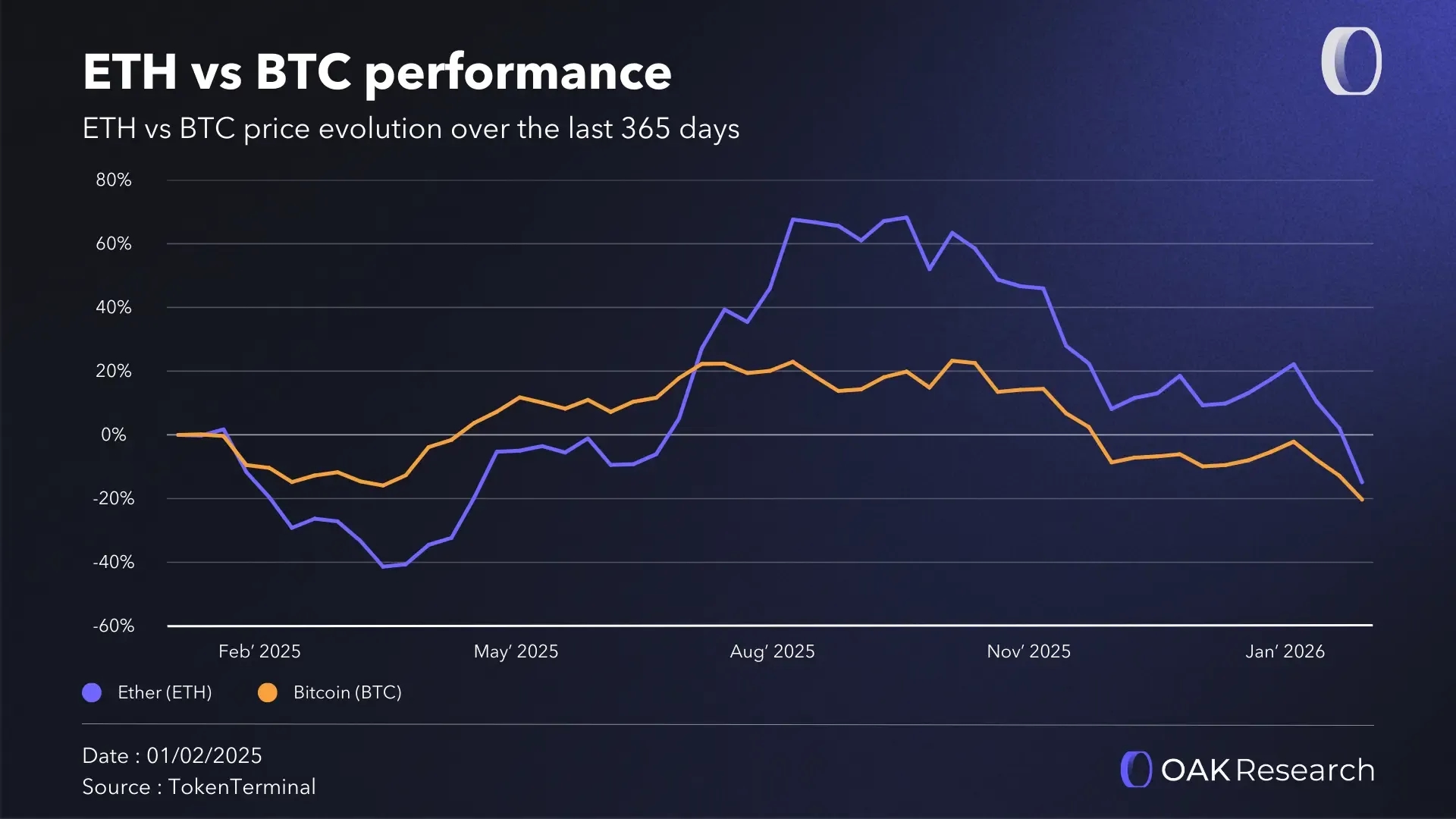
Q4 2025 was a negative quarter for the crypto market: BTC -23%, ETH -28%, amid trade tensions and tighter macro expectations. ETH opened the quarter around $4,150 and closed the year at $2,982, marking a clear break from the bullish momentum seen in Q3.
ETH price performance
- ETH performance: -28.3% QoQ.
- The quarter was marked by the invalidation of key support levels, notably the break below $3,500 in November, which accelerated the correction.
- The activation of Fusaka in December improved roadmap visibility but did not act as an immediate price catalyst (largely anticipated event).
ETH/BTC ratio
Despite the spot market correction and the resulting nominal decline, the ETH/BTC ratio remained relatively stable, trading in a range around 0.034-0.035.
- ETH no longer experiences systematic capital outflows toward BTC during market corrections.
- The ETH/BTC pair is increasingly less used as a simple defensive arbitrage tool, reflecting a shift in how Ether is perceived.
- This coincides with Ethereum’s growing role as the primary layer of on-chain finance, helping anchor the ratio even during more challenging market phases.
Spot ETH ETFs
The Q4 correction took place in a context of gradual de-risking from risk assets (driven by macro conditions) and year-end profit taking by professional and institutional investors.
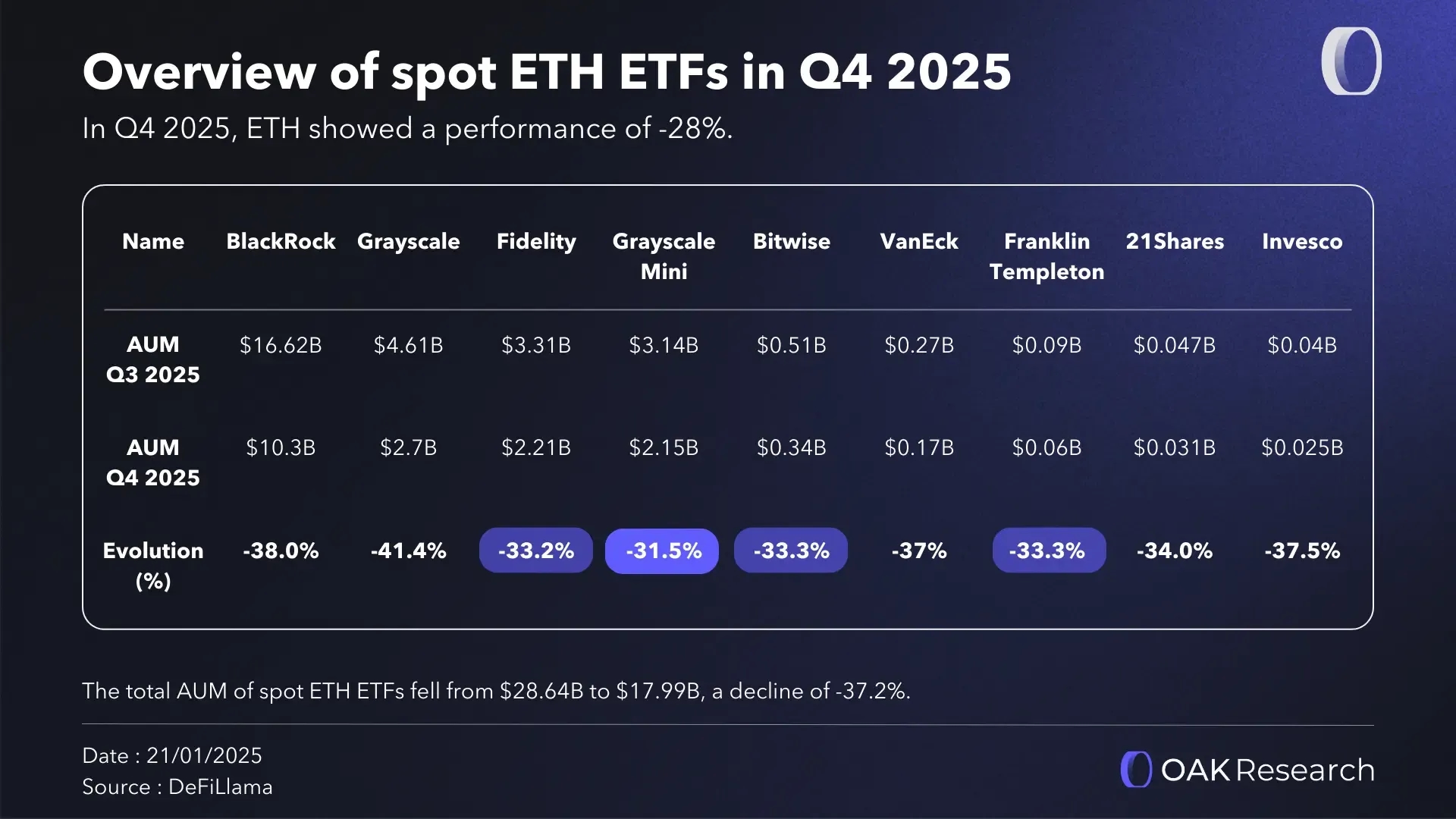
- BlackRock’s dominance declined sharply over the quarter, falling from 72.1% to 51.8% market share.
- This shift coincided with the launch of staking within the Grayscale Mini ETH, activated on October 6, 2025.
- With around 64% of assets staked, Grayscale Mini ETH generates an estimated 4.07% gross yield, while also offering the lowest fees in the segment (0.15%).
- This combination of yield and low costs explains why Grayscale Mini ETH has been the most resilient vehicle amid the decline in AUM.
- BlackRock’s first-mover advantage and brand status are no longer sufficient to retain liquidity, which has been migrating toward more attractive products.
- The market is converging toward a duopoly: BlackRock and Grayscale now control over 84% of total AUM.
Q4 2025 marks a turning point for ETH ETFs. Liquidity is no longer concentrated solely among the largest issuers, but is increasingly flowing toward products offering productive exposure to Ether. Staking is becoming a key allocation criterion, with the potential to durably reshape the structure of the market.
Ethereum treasury companies
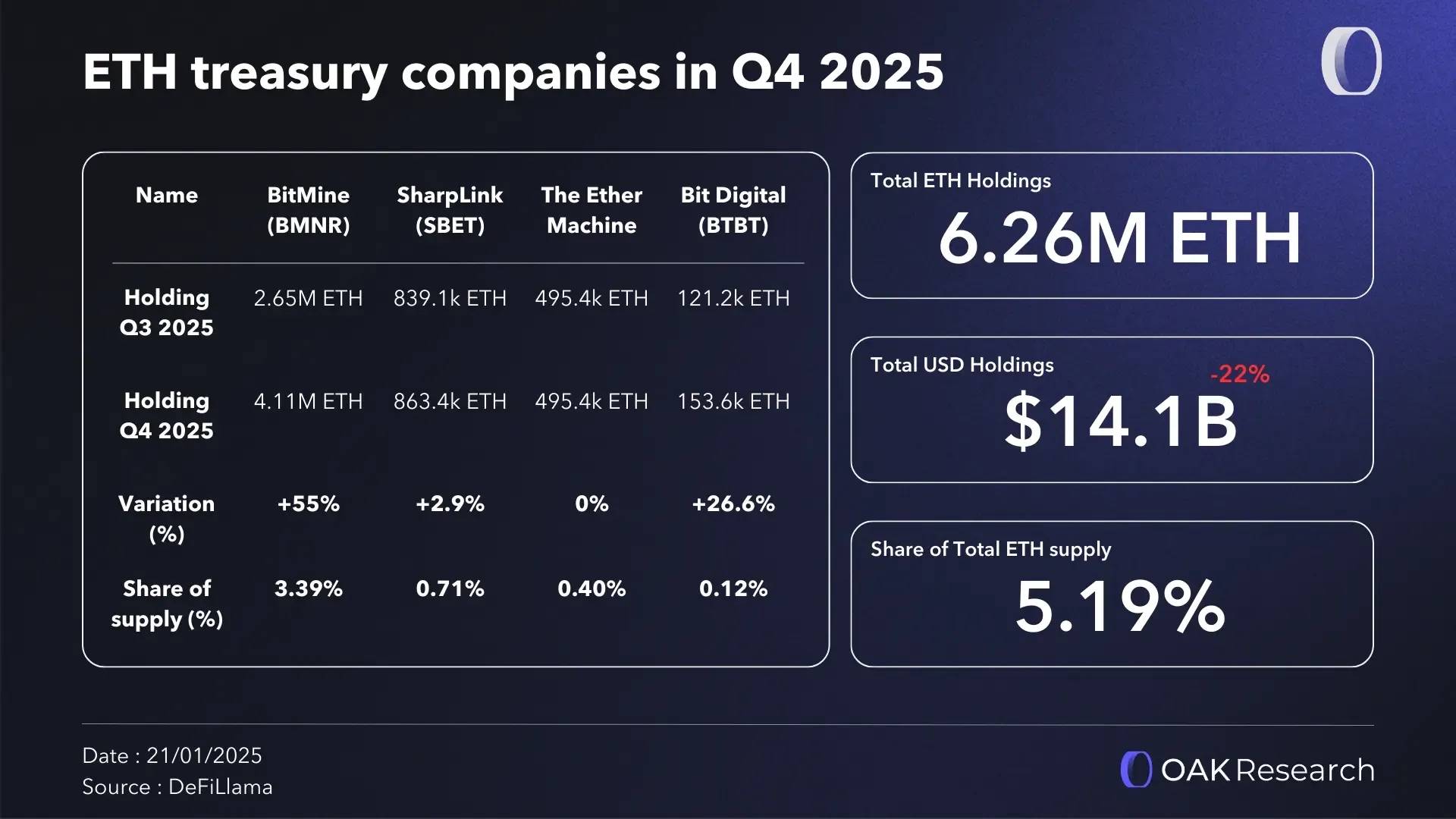
In contrast to ETFs, corporate actors exposed to Ether adopted a clearly counter-cyclical strategy in Q4 2025. The spot correction was viewed as an allocation opportunity rather than a signal to reduce exposure.
- Corporate ETH holdings increased significantly, rising from 3.6% to 4.99% of total supply over the quarter (+1.39pp).
- This reflects a transfer of supply from short-term holders toward long-horizon institutional balance sheets.
- Players such as BitMine Immersion Technologies, SharpLink Gaming, and Bit Digital now concentrate a meaningful share of total supply.
With ETH down -28%, managing cost of carry became central, pushing companies to turn ETH into a productive asset.
- Several treasuries adopted a staking-as-a-treasury model, with very high staking ratios (up to 100% for some actors).
- Staking yields (around 3-4% annualized) act as a volatility buffer and encourage long-term holding.
- SharpLink Gaming (SBET) deployed $170M of ETH on the Linea network via integrations with EtherFi and EigenCloud. Bit Digital (BTBT) stakes 89% of its ETH holdings.
- BitMine (BMNR) is preparing the launch of its own validation infrastructure (MAVAN, Q1 2026), illustrating the growing professionalization of ETH treasury management.
Finally, Q4 2025 also marked the growing importance of restaking as an institutional performance lever.
- The global staking ratio exceeded 29% of total supply by the end of the quarter.
- The contraction in base staking yields (around 2.81%) increased the appeal of restaking strategies.
- Solutions such as EigenLayer or Symbiotic enable some actors to reach net yields of 4.8% to 5.2%, regaining attractiveness despite the spot correction.
Institutional allocation in ETH is increasingly segmented between tactical vehicles (ETFs) and structural holders (treasuries). The latter contribute to the progressive immobilization of supply and reinforce the resilience of Ethereum’s market structure.
On-chain analysis of Ethereum in Q4 2025
Ethereum closed 2025 with a mixed Q4: despite the decline in ETH price and lower fees, network usage continued to intensify.
On-chain activity
- Transactions: new all-time high at 2.23M daily transactions (December 31), with monthly volume up roughly +48% YoY.
- New addresses: over 15M created during the quarter, including 6.2M in December, the fastest pace since 2017.
- Developers: sustained activity, with a peak close to 500k contracts deployed in 24h in late November.
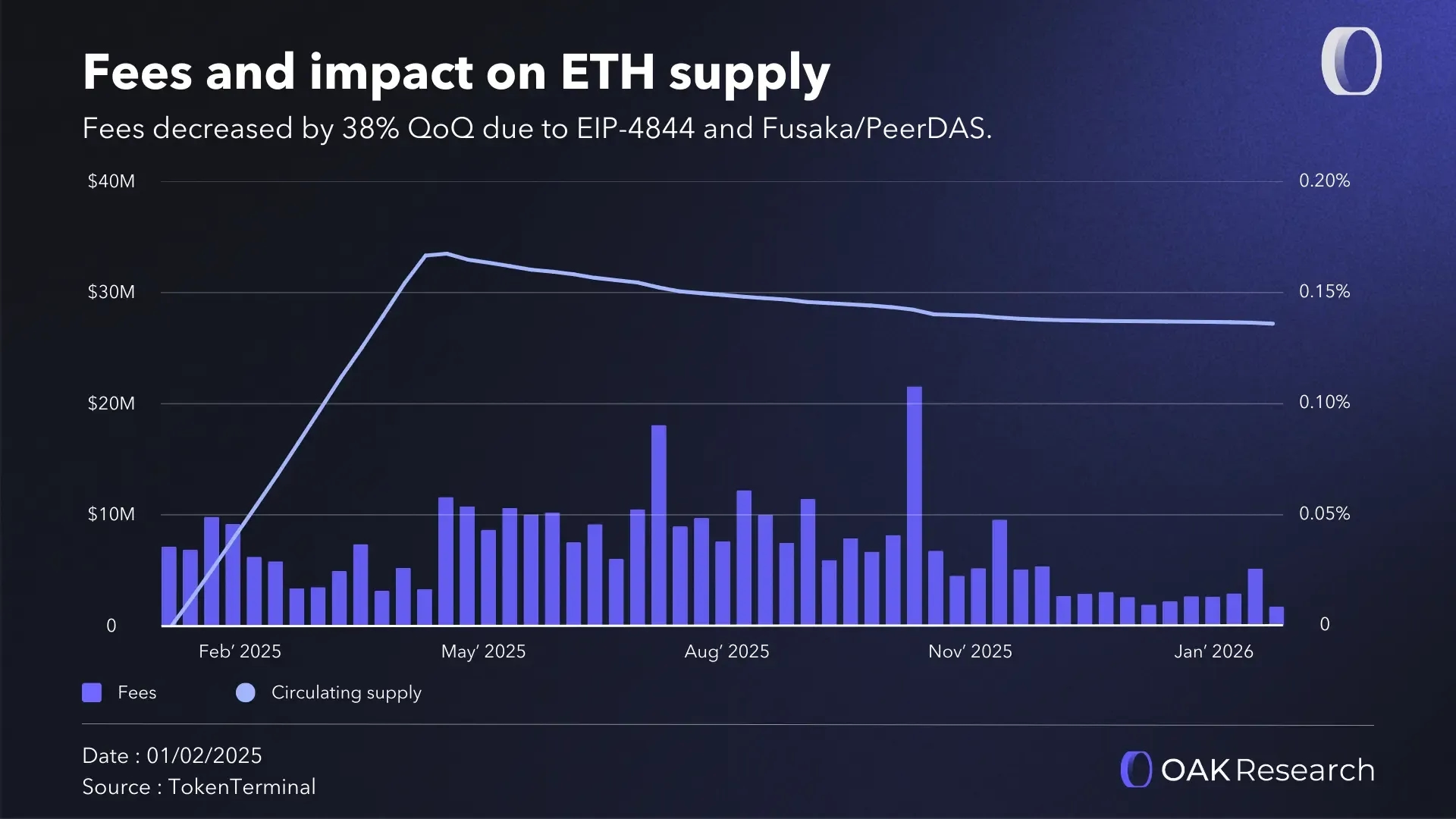
Fees and impact on ETH supply
- Fees: $76.6M, down 39% QoQ, largely driven by the combined effects of EIP-4844 and Fusaka / PeerDAS (the share of L2 revenues paid back to mainnet fell from ~40% to under 10%).
- ETH burn: compression of burn due to lower data availability revenues, keeping ETH slightly inflationary over the quarter.
- Observation: protocol economics now prioritize cost reduction and L2 scaling over short-term L1 revenue maximization.
Q4 2025 marks the technical completion of the rollup-centric roadmap, while putting pressure on ETH’s historical value capture model. Ethereum effectively forwent an estimated $100M+ in fees in favor of L2 scalability.
Staking and network security
- Staked ETH: over 35M ETH, representing 29% of circulating supply at quarter end.
- EIP-7251 impact: the Maximal Effective Balance per validator increased from 32 to 2,048 ETH, enabling operational consolidation and a 9% reduction in the number of validators.
- Staking flows: net inflows remained positive even during ETH price declines.
- Restaking share: largely unchanged, with EigenLayer still holding around 4.2M ETH.
- Base yield (CESR): down to around 2.8% due to dilution.
- Staking continues to reduce floating supply and anchor a growing share of ETH off-market.
Ecosystem analysis of Ethereum in Q4 2025
Q4 2025 reaffirmed Ethereum’s central role as an on-chain settlement and liquidity infrastructure. Despite the market correction, ecosystem activity remained strong, driven by stablecoins, tokenization, and on-chain finance.
DeFi and on-chain liquidity
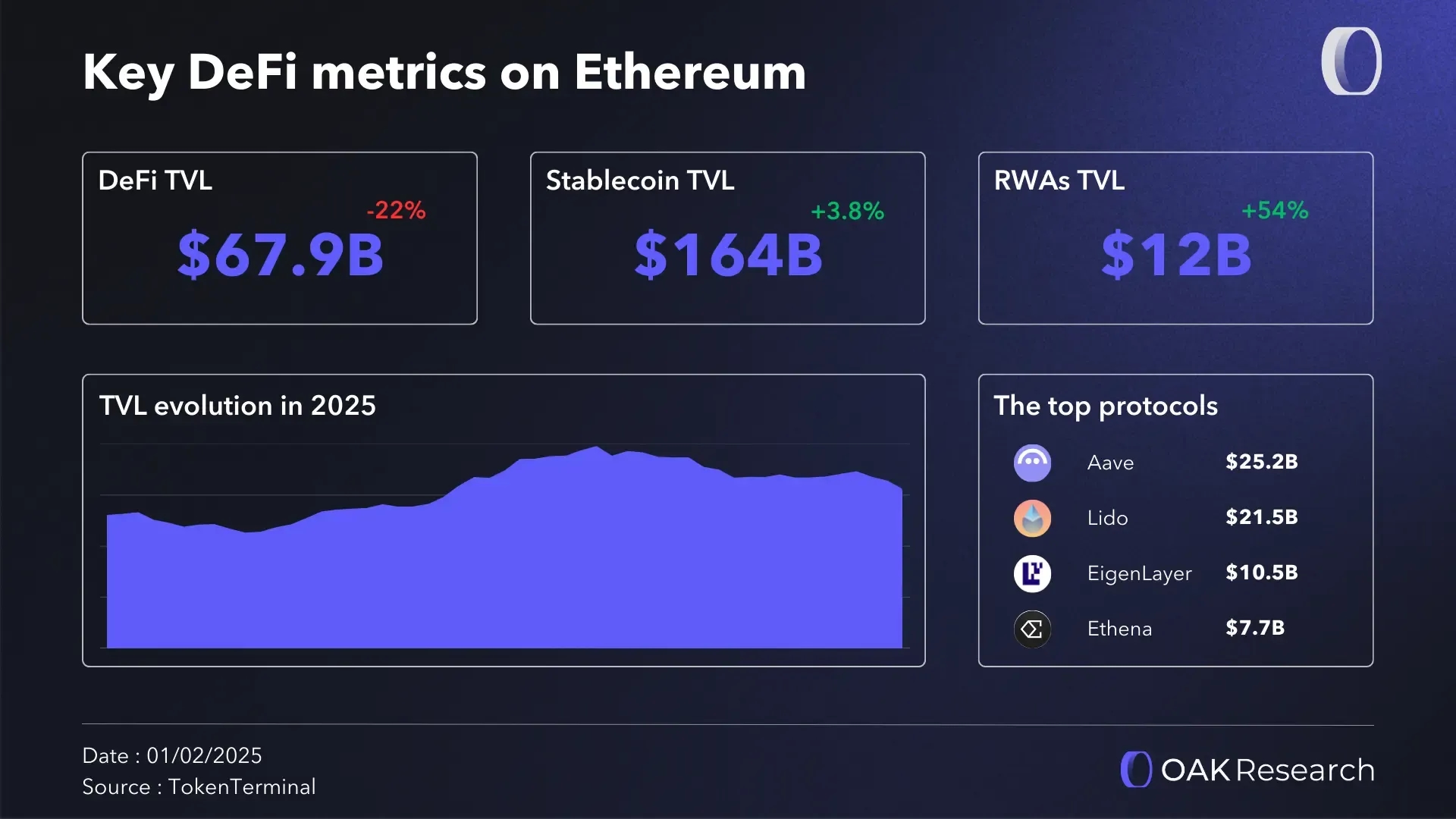
- DeFi TVL: close to $100B during the quarter, maintaining a wide lead over other ecosystems.
- The decline in dollar-denominated TVL (26%) is primarily explained by ETH’s price drop (28%), rather than large-scale capital withdrawals.
- When expressed in ETH, TVL across major protocols remained broadly stable.
Beyond the key figures, the TVL distribution reveals several interesting points:
- The RWAs sector rose by +10.3% QoQ and +202% YoY.
- The lending sector rose +624% YoY, the best performance among all sectors.
- Pendle (-46%) and Ethena (-47%) saw the largest declines among the major protocols.
Stablecoins
- On-chain volume: nearly $8T processed during the quarter, a new record.
- TVL: over $164B at year-end, up approximately +47% in 2025.
- Stablecoin liquidity remained broadly stable throughout the quarter despite market volatility.
Real World Assets (RWAs)
- TVL (ex-stablecoins): around $12B secured on Ethereum mainnet, representing 60% of total on-chain value.
- Including layer 2s, Ethereum ecosystem dominance reaches 70%.
- Tokenized commodities were the main growth driver in Q4, up roughly +54%, largely supported by gold’s performance.
Technical development and roadmap
Q4 2025 marks an important step in the execution of Ethereum’s roadmap. Priorities remain unchanged: scalability, consensus efficiency, and improvements to the user experience, all under decentralization constraints.
Fusaka upgrade and PeerDAS
- Fusaka, activated in December 2025, introduced a redesign of the data availability model through blobs and PeerDAS.
- PeerDAS enables data availability to be verified via sampling, without requiring full block downloads, thereby reducing hardware constraints for validators.
- Blob throughput capacity was significantly increased, with the target raised to 14 blobs (and a maximum of 21 blobs in early 2026).
- Actual usage remains below these new limits, reflecting deliberate overprovisioning aimed at keeping fees close to the floor and providing economic predictability for layer 2 networks.
Impact on network economics
- Lower data availability fees led to a compression of ETH burn under EIP-1559.
- Throughout 2025, Ethereum sacrificed a meaningful share of short-term revenues in order to support rollup adoption and scaling.
- This trajectory shifts the interpretation of ETH away from a fee-monetization model toward one focused on volume absorption and the progressive immobilization of supply.
Ethereum Foundation initiatives
- Devconnect Buenos Aires (November 2025) served as an acceleration point for several structural initiatives.
- Privacy & Scaling Explorations was rebranded as Privacy Stewards of Ethereum (PSE), with an expanded mandate focused on the operational deployment of privacy solutions.
- Progress was made on ZK-KYC standards, aimed at enabling regulated actors to interact with DeFi without exposing sensitive data.
- The presentation of PlasmaFold demonstrated significant efficiency gains in proof generation and aggregation, with client-side latencies below one second in certain cases.
- Stabilization of standards related to autonomous agents (ERC-8004, x402), facilitating machine-to-machine interactions and on-chain payments.
Glamsterdam outlook (2026)
- Glamsterdam opens the so-called “The Scourge” phase of the roadmap, focused on consensus efficiency and censorship resistance.
- EIP-7782 (reducing slot times from 12 to 6 seconds) is at the center of ongoing discussions, with the goal of improving responsiveness for latency-sensitive use cases.
- The introduction of enshrined PBS (ePBS) aims to natively integrate proposer/builder separation, further professionalizing block production.
- These changes introduce new challenges around operational centralization (latency, hardware requirements), which will determine the pace and exact scope of the upgrade.
- The sustainability of this trajectory will largely depend on the upgrades planned under Hegota (Verkle Trees, State Expiry), expected in late 2026.