
Alpha Recap 37: LayerZero's ATLAS, yield on Liminal and AQAv2 on Hyperliquid
Hyperliquid (HYPE)
Published onUpdated on

Ethena has launched Hyena, a trading interface that introduces yield-bearing collateral at the core of Hyperliquid. By leveraging USDe and HIP-3, the protocol turns previously idle capital into a source of return for users. This analysis outlines how Hyena works, the products it introduces and the strategic implications for both Hyperliquid and Ethena.
Access to Hyena is currently limited and only available via invitation links. OAK Research has obtained some for you, and we invite you to use them to support our work. Thank you in advance.
Hyperliquid has established itself as one of the most efficient perpetual DEXs on the market. With CEX-level orderbook depth, several billion dollars in daily volume and an open interest exceeding most competitors, the protocol has demonstrated that on-chain infrastructure can rival centralized exchanges.
Yet one weakness remains: USDC collateral on Hyperliquid is entirely passive. Billions of dollars produce no yield, even though this capital could be reinjected into the ecosystem and returned to users.
This issue extends beyond Hyperliquid. On-chain finance is built around the USDC/USDT duopoly, two stablecoins that capture the full yield generated by their reserves without redistributing any portion to the protocols or users who rely on them. In the case of Hyperliquid, this represents roughly 200 million dollars captured by Circle.
The result is straightforward: a massive leakage of value from the on-chain ecosystem. For years, this was considered an unavoidable trade-off, as alternatives largely failed to gain traction. But yield-bearing stablecoin models, illustrated by Ethena with USDe and sUSDe, challenged this structure by introducing assets that return yield to users rather than issuers.
On Hyperliquid, these stablecoins could not be fully utilized until recently. They could not serve as quote assets for new markets, as the most liquid pairs remained denominated in USDC. The native stablecoin USDH never reached meaningful adoption, as we previously discussed in our analysis.
This missing piece now exists with HIP-3, an upgrade that allows permissionless market creation on Hyperliquid. Hyena emerges in this context as a protocol designed to introduce productive collateral into Hyperliquid and mechanically improve the trading experience, from margin efficiency to funding, by relying on USDe.
→ To go further, read our analysis on the white-label stablecoin-as-a-service solution introduced by Ethena:
Hyena is a trading interface dedicated to perpetual markets, built on Hyperliquid and developed by Ethena. Its defining feature is that the platform uses USDe as the reference asset, allowing users to benefit from Hyperliquid’s execution layer while earning yield on their collateral.
Under the hood, Hyena leverages the Builder-Deployed Perpetuals model introduced by HIP-3. This upgrade, deployed in October 2025, allows anyone to create new markets on Hyperliquid’s infrastructure, provided they stake 500,000 HYPE.
Hyena uses HIP-3 to deploy new markets denominated in USDe. Orders are executed on HyperCore through Builder Codes, giving users access to the same matching engine and performance that built Hyperliquid’s reputation, with the added benefit of yield-bearing collateral.
This initiative aligns with Hyperliquid’s vision of becoming the “AWS of liquidity,” where builders deploy products on top of shared infrastructure while capturing part of the economic flow. Hyena extends this logic by introducing a product centered on the yield of user collateral.
Hyena relies on Based infrastructure as its backend layer. As a result, the protocol combines HIP-3’s permissionless model, HyperCore’s execution performance and Based’s technical stack.
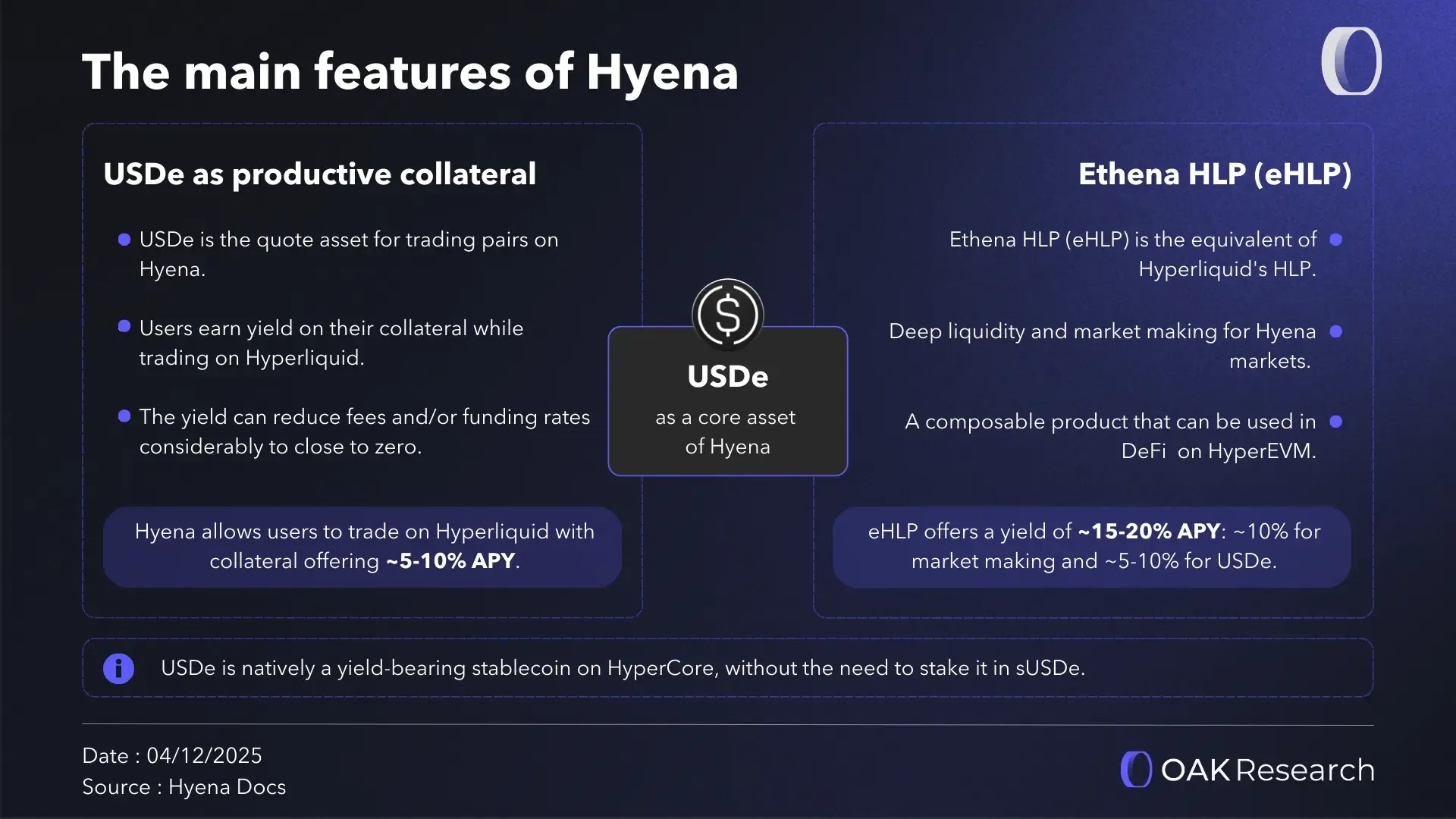
Hyena’s primary product is a dedicated trading interface for perpetual markets using USDe as the quote asset. Functionally, it is an extension of Hyperliquid: same execution, same assets, same UX, but markets are priced in USDe rather than USDC or USDH.
This seemingly minor change introduces a significant shift: where USDC keeps capital idle on Hyperliquid, USDe allows trading collateral to generate yield.
Technically, USDe is not a yield-bearing stablecoin by itself; users must stake it into sUSDe to earn yield. But on HyperCore (and on Binance, Bybit or Deribit), USDe earns yield natively without prior staking.
As a result, user positions on Hyena automatically earn daily yield proportional to their collateral. This yield can reinforce margin, offset part of the trading fees or compensate funding payments.
Hyena’s second core product is HLPe, a liquidity vault inspired by Hyperliquid’s HLP. To understand its structure, recall how the HLP works: a community vault that runs market-making strategies. Users deposit USDC, and the vault provides liquidity across the platform, sharing PnL among depositors in a fully transparent on-chain model.
Hyena adapts this architecture but deploys it in an isolated environment. HLPe is a separate vault dedicated solely to Hyena markets and funded with USDe. It does not draw from the global HLP liquidity, allowing Ethena to structure more targeted incentives.
Users deposit USDe into HLPe and receive eHLP, a tokenized, composable asset that can circulate freely within HyperEVM DeFi (lending, LP, points campaigns, etc.).
HLPe distributes several sources of yield: market-making fees on Hyena markets, native USDe yield via HyperCore, Ethena points and potentially additional incentives. Estimates point to roughly 20% annualized yield, higher than comparable vaults (Hyperliquid, Lighter, etc.).
Trade on Hyperliquid and earn a 12% yield on your USDe collateral.
Hyena reshapes how users interact with Hyperliquid. Whether traders, yield seekers or airdrop farmers, Hyena opens several new opportunities.
Collateral no longer sits idle. With USDe as the base asset, each position generates yield that can offset funding payments, reduce trading fees or strengthen margin.
In a typical perp market, holding a position becomes costly when funding turns positive. Traders have no mechanism to compensate for this. With Hyena, part of that cost is naturally absorbed by USDe yield.
For example, a trader paying 10% annualized funding on a BTC position sees that cost fully offset by USDe yield, which has averaged roughly 10% over the past three months.
Hyena is not limited to trading. The HLPe vault combines native USDe yield and market-making fees to reach an estimated 15 to 20% annualized yield.
While one of the main points of criticism levelled at Hyperliquid recently has been the lack of clear incentives for traders, Hyena provides a solution by introducing a new reward system. In addition to the returns generated by USDe, Hyena users benefit from several incentives:
First, migrating positions from Hyperliquid to Hyena is free of charge (the fees are reimbursed by the platform). Second, trading on Hyena allows users to earn HyENA points for six months, which will ultimately be converted into ENA token rewards (there will be no HYENA token).
Furthermore, Hyena is designed in collaboration with Based, which means that using the trading interface generates volume on Based, whose campaign is currently underway. In addition, the final infrastructure remains Hyperliquid, which could potentially lead to an S3 during which volume on HIP-3 markets will be important.
Finally, for non-traders, using HLPe allows you to earn a x70 boost on EThena points (for recurring ENA airdrops) and a x5 boost on Upshift points, which is the vault manager. On top of that, there are of course the estimated rewards of 15-22% APY.
The term “Hyena” has been circulating for a long time, referring to a contraction of the two project names and illustrated by the memecoin launched in December 2024. It symbolized the anticipated synergy between Hyperliquid and Ethena, and the protocol launched this week is its most concrete expression.
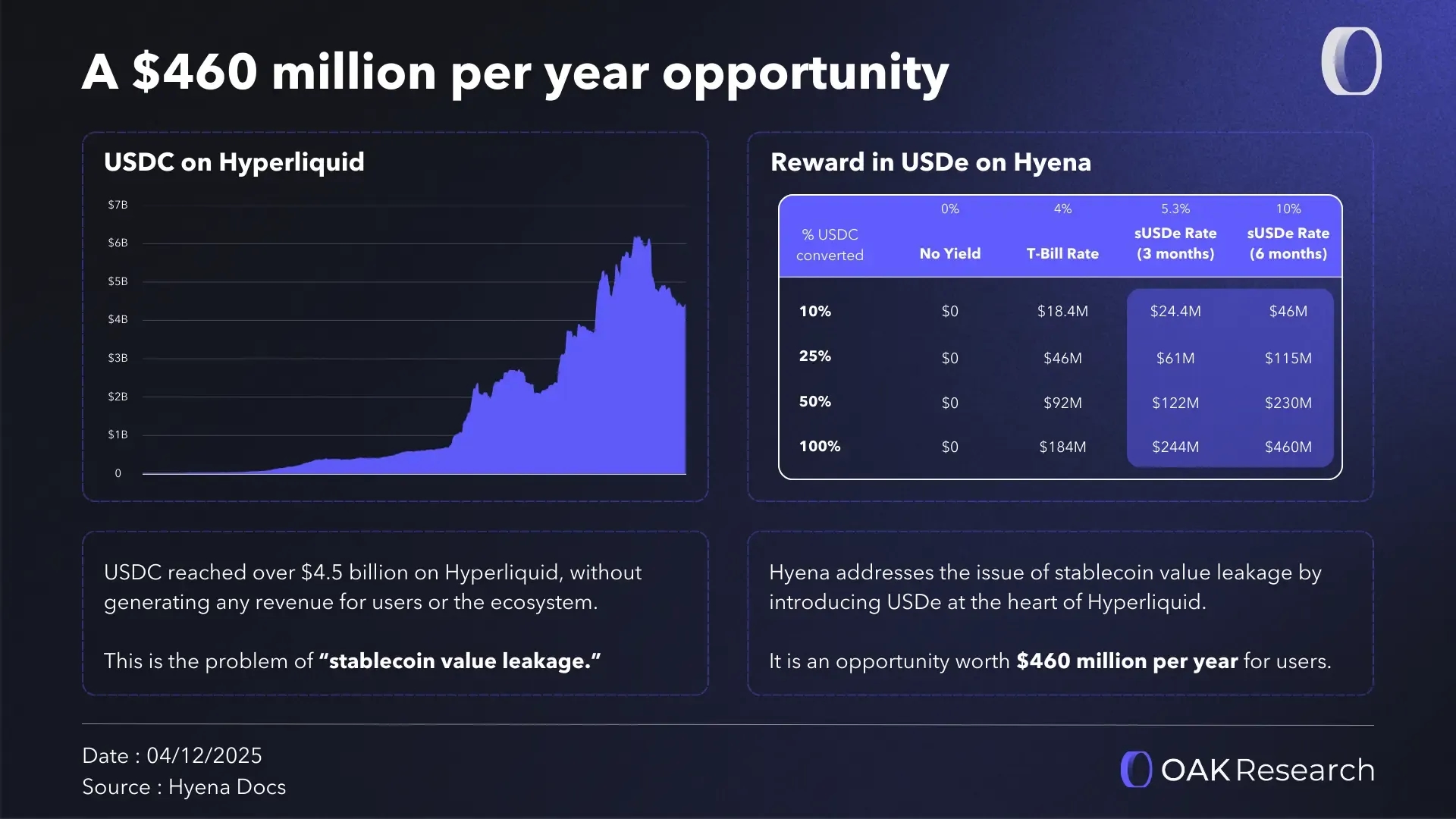
Hyena addresses a simple issue: more than 4.5 billion dollars in USDC collateral sit idle on Hyperliquid. A critical resource for the platform’s functioning, but one that generates no return for users or the ecosystem.
By introducing USDe as the reference asset for HIP-3 markets, Hyena reverses this dynamic. Collateral becomes productive, and yield is redistributed to users instead of being captured by a centralized issuer.
Hyena’s goal is to convert part of the USDC-denominated activity into USDe. If successful, the impact for Hyperliquid users would be significant, offering the platform a structural hedge against other on-chain perp DEXs.
Estimated annual impact under various USDC-to-USDe conversion scenarios:
| % of USDC converted | 0% Yield | T-Bill 4% | sUSDe 3m 5.3% | sUSDe 6m 10% |
|---|---|---|---|---|
| 10% | $0 | $18.4M | $24.4M | $46M |
| 25% | $0 | $46M | $61M | $115M |
| 50% | $0 | $92M | $122M | $230M |
| 100% | $0 | $184M | $244M | $460M |
This effect comes in addition to increases in trading revenues and market attractiveness.
USDe is a delta-neutral stablecoin. To maintain its neutrality, Ethena must constantly open short positions on perpetual markets to hedge BTC and ETH exposure.
Hyena becomes a natural execution venue for these hedges. Ethena plans to route part of its USDe hedging flow directly into Hyena markets.
With more than 5.5 billion dollars in deployable collateral, these flows immediately create meaningful depth on Hyena and improve execution quality for all traders. This creates a structural alignment between a stablecoin issuer and a perpetual infrastructure, a unique model in the industry.
Ethena previously attempted a similar model on Hyperliquid through a proposal to issue USDH, backed by USDtb. While not identical to USDe, the underlying logic was the same: redirect yield to users and to Hyperliquid rather than to the issuer alone.
With HIP-3, Ethena can finally deploy this approach, while also using Hyperliquid funding to generate additional yield on USDe.
Trade on Hyperliquid and earn a 12% yield on your USDe collateral.
Hyena sits at the intersection of three major trends: the rise of Ethena and yield-bearing stablecoins, Hyperliquid’s dominance of on-chain perps and the new permissionless market structure introduced by HIP-3.
By positioning USDe as a quote asset on Hyperliquid, Hyena changes the structure of perp markets. Capital becomes productive and liquidity providers benefit from a vault designed to capture part of the economic flow while remaining composable across the ecosystem.
If USDe replaces even a small fraction of the USDC collateral on Hyperliquid, the impact would be substantial. A shift of just 10% would already redistribute tens of millions of dollars annually.
Hyena’s reliance on its own liquidity vault, HLPe, introduces a structural challenge: its markets will not benefit from the depth normally provided by the HLP. This creates a potential vulnerability, especially given past manipulation attempts on exotic pairs such as JELLY or POPCAT.
Still, when weighed against Ethena’s traction, the growth of yield-bearing stablecoins and Hyperliquid’s infrastructure vision, Hyena stands at the convergence of three major forces. This makes it one of the most important projects to watch.
→ Follow the evolution and yield opportunities of promising protocols like Hyena on our Alpha Feed, a channel exclusively reserved for OAK Premium members.
Access to Hyena is currently limited and only available via invitation links. OAK Research has obtained some for you, and we invite you to use them to support our work. Thank you in advance.
Unlock all our research and get the right insights, at the right time.
Hyperliquid (HYPE)

Hyperliquid (HYPE)

Bitcoin (BTC), Ethereum (ETH), Hyperliquid (HYPE), Ethena (ENA)
Hyperliquid (HYPE), Bitcoin (BTC), SKHYNIX (SKHX)