
Market Briefing 9: Bitcoin (BTC) corrects ahead of the Fed, CLARITY Act rejection shakes crypto markets

Bitcoin (BTC), Ethereum (ETH)
Published on

Since the start of 2026, Ethereum has posted record levels of activity. Over the same period, ETH lost 44% of its market value. A technological edge that captures no economic value: that is Ethereum's great paradox. But since April 2026, the ecosystem has gone through a sequence of events unlike anything we've seen in years: a Foundation stepping back on purpose, independent entities springing up to each own a specific vertical, a technical roadmap that finally reads clearly, and financial institutions shifting into a higher gear. Here is our full state of play on Ethereum's transformation, and why we believe the tide is finally turning for ETH.
There are two radically different ways to tell Ethereum's story right now. The first is about the market and ETH's performance. The second is about the network and the state of its ecosystem.
Seen through the lens of the market, the conclusion is brutal. ETH is down roughly 44% since the start of 2026 and 67% from its August 2025 all-time high, a record it took 1,379 days to beat, only to clear it by a mere $87. Add to that four long years of underperformance against BTC, ETFs bleeding out, and treasury companies whose shares have shed close to 90% from their peaks.
Look only at the network's metrics, however, and the story flips entirely. An all-time high in usage since the start of 2026, roughly 60% of the global stablecoin supply, and nearly two-thirds of all tokenized RWAs. Above all, the kind of players using Ethereum has changed completely. We're now talking about BlackRock, whose BUIDL money market fund tops $2.5 billion, JPMorgan and its two tokenized money market funds, Amundi and its €2.4 trillion in assets under management, and Franklin Templeton.
This gap between network usage and ETH's valuation is the story of the entire cycle Ethereum has lived through. For years, the ecosystem gave the impression of moving in a direction set by Vitalik and the Ethereum Foundation, without ever asking how to turn its technological edge into an economic one. Activity kept climbing, but Ethereum captured less and less value.
The clearest example of this paradox is the strategic bet on Layer 2s. Defensible at first, since the goal was near-zero fees to accelerate adoption and compete with rival Layer 1s, it nonetheless led to fragmented liquidity and a brutal collapse in Ethereum's revenue. Many investors read that outcome as a failure, and pinned it on the Ethereum Foundation and its leadership, criticized above all for its slowness, its lack of legibility, and its inability to embody a clear direction.
But since April, a string of events has started writing a different story. The Foundation restructured deeply and accepted a smaller role for itself. New independent organizations were spun up within weeks to take over precise missions. Vitalik Buterin set a new course for the protocol with its most ambitious roadmap since The Merge. And institutions have never been more present.
For the first time in a long while, Ethereum looks like it has found a direction again. In this analysis, we walk through every major event between April and July 2026 to understand why, at the depths of ETH's worst bear market, the foundations of a genuine revival are being laid.
Unlock all our research and get the right insights, at the right time.
To grasp what's at stake today, you first have to measure the depth of the crisis that hit Ethereum, and probably still lingers a little. We touched on it in the introduction, but it's worth going into detail.
In early July 2026, ETH was trading around $1,610, roughly 67% below its August 2025 high of nearly $4,955. That's a steeper fall than BTC, which ETH underperformed by about 40% over the same window. And the problem is nothing new: had you bought ETH in January 2023, at the very start of the bull run, you'd still be down 64% against BTC.
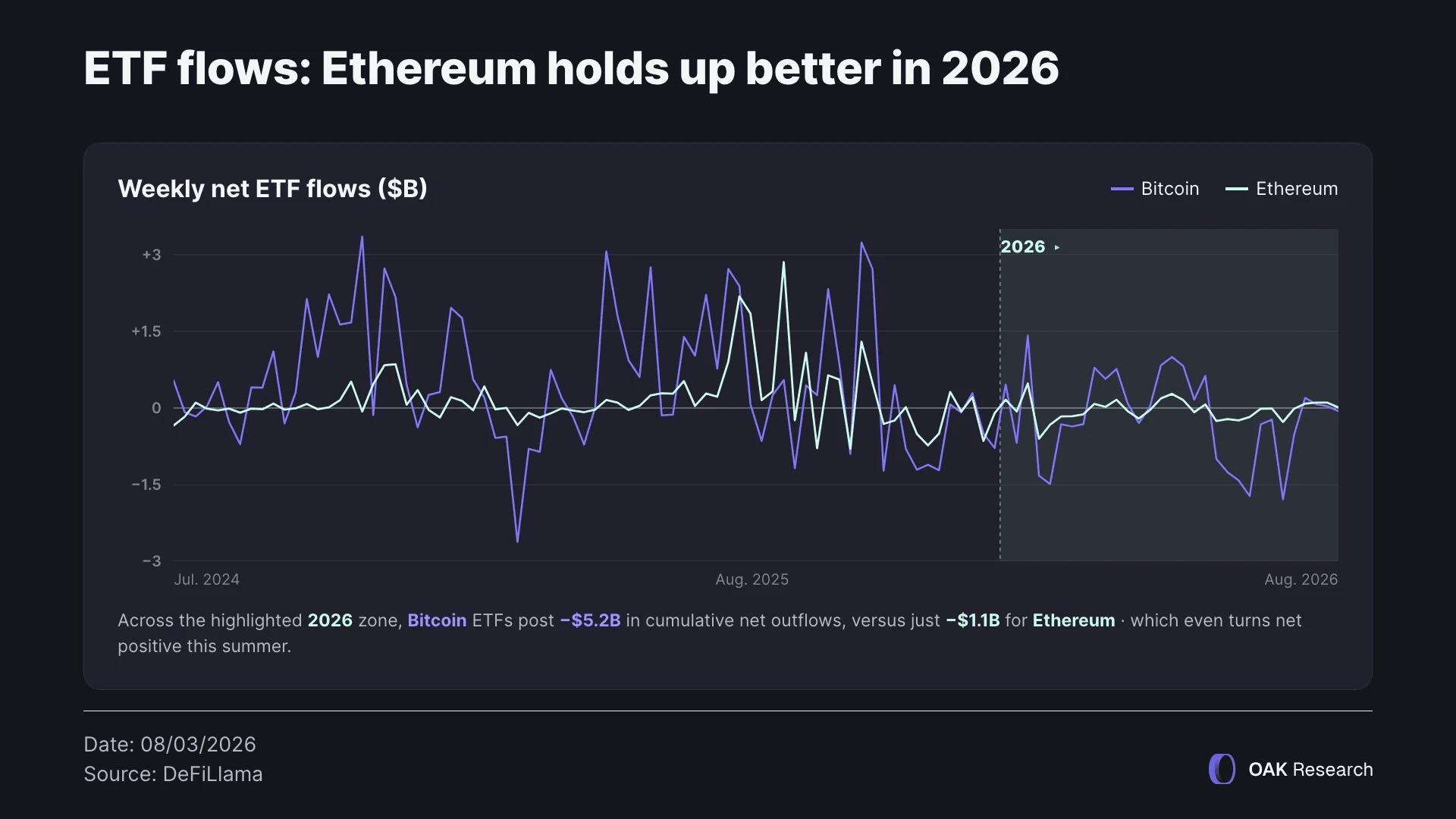
US spot ETFs, meant to embody the institutional demand everyone kept waiting for, never came close to the success of their BTC counterparts. As for the Ethereum treasury companies, whose model carried the market in 2025, their valuation multiples caved over recent months: SharpLink went from 25x in August 2025 to 1.1x by early 2026, its stock losing 90% of its value along the way.
And while all of this was unfolding, the network was quietly breaking its own record with 200.4 million transactions and 755,000 daily active addresses in the first quarter of 2026. Stablecoins in circulation hit a fresh all-time high above $167 billion in April, while nearly 90% of the ecosystem's transactions now ran on its Layer 2s, whose combined TVL reached around $41 billion.
How could you not conclude, on paper, that the strategy pursued for years was working exactly as designed? Ethereum held its dominance over rival Layer 1s and pushed part of its activity onto its Layer 2s, all while remaining the reference layer for security and data availability. And yet, wasn't that precisely where Ethereum's real problem lay?
For years, we argued that migrating activity to Layer 2s was the very point of Ethereum's roadmap. Layer 1 didn't need to execute every transaction; what mattered was that it kept its role as the settlement, security, and data availability layer.
That vision made technical sense, especially against competitors like Solana, whose bet was to be a single high-performance chain handling everything itself and capturing most of the revenue activity generates. We believed it was smarter to prioritize the network's security and decentralization, and to lean on Layer 2s to tick the scalability box.
Economically, though, the vision quickly became indefensible. Since blobs arrived with EIP-4844, Layer 2s publish their data on Ethereum for next to nothing. Users enjoy almost-free transactions, but Layer 1's revenue collapsed with them. Rollup activity soared without ever lifting the fees Ethereum collects, which shrank the burn to the point where ETH turned inflationary again.
It also became clear, fairly fast, that most Layer 2s were playing the rules to their own advantage to pay Ethereum as little as possible. Because nearly all of them run their own centralized sequencer, they can capture and keep every fee the network generates, and, more importantly, manage certain actions themselves to optimize their costs and revenue, at Layer 1's expense.
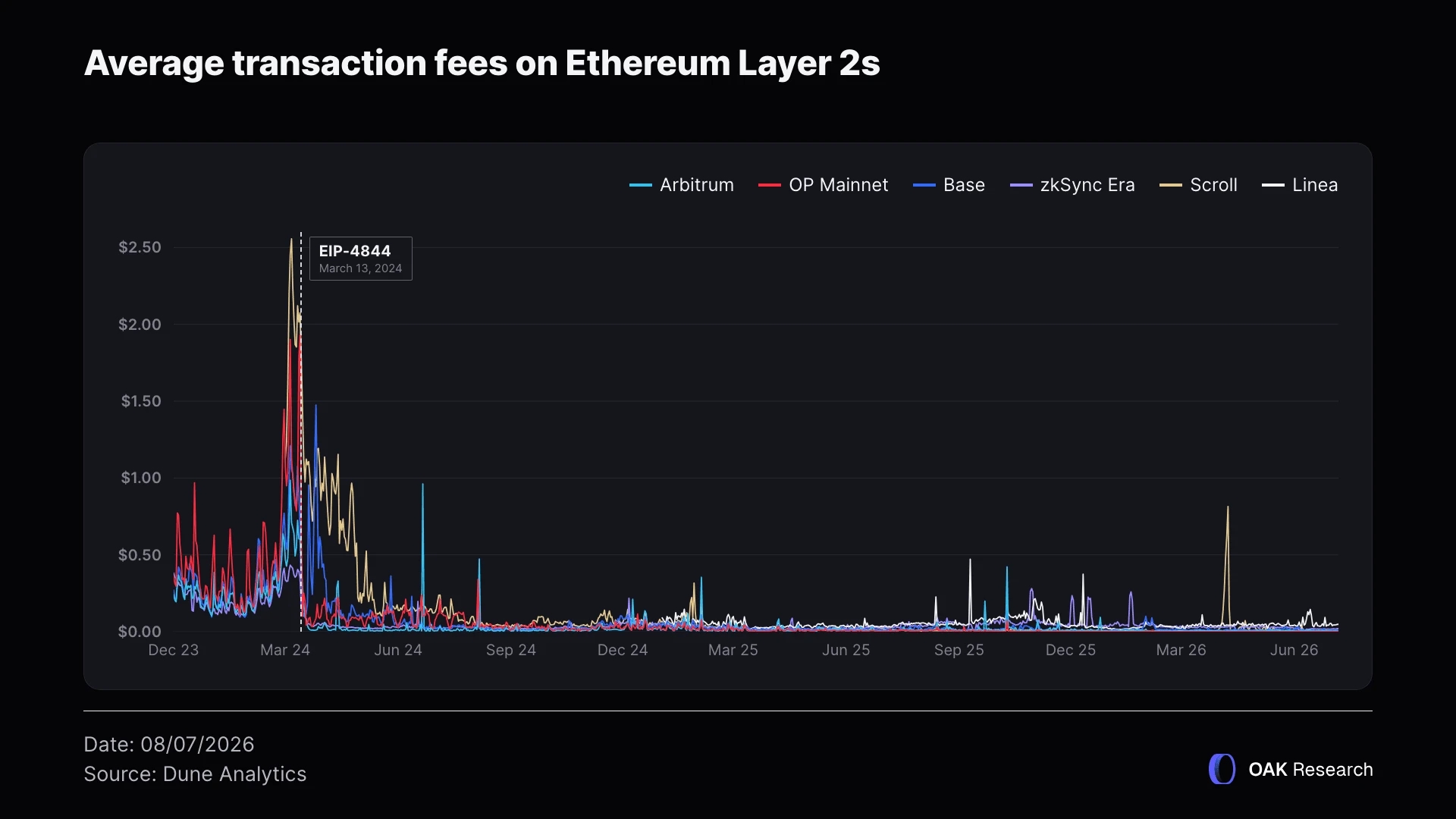
Take peak activity periods, which are supposed to generate more fees for Layer 1: rollups frequently chose to defer their "batching." That subtle move let them keep costs down by staying under the per-block blob limit. For some of us, and we count ourselves among them, this behavior is questionable, because it openly calls into question how aligned these Layer 2s really are with Ethereum.
Either way, this strategy was often framed as a "loss leader," designed, for instance, to offer blob space at a loss to outcompete projects specialized in data availability. And it clearly worked: Layer 2s have multiplied since the Dencun upgrade, and blobs are now the default way to post their transaction data.
Criticism then shifted, step by step, from the protocol to the organization tasked with shepherding it. For months, the Ethereum Foundation had been accused of moving too slowly, lacking legibility, failing to properly support its own ecosystem, whether through visibility or asset delegations, and neglecting ETH's appeal as an asset.
A truth too often forgotten is worth restating here. Ethereum is one of the oldest projects in the space, caught between the old world, that of total organizational decentralization à la Bitcoin, and the new cycle, made of real companies determined to grow a business. Ethereum has no CEO. No one can impose a strategy and coordinate every developer with a simple memo.
Legally, the Foundation is neither the owner of the protocol nor Ethereum's management team. It nonetheless remained its most visible organization, funded a large share of research, and employed several of the network's sharpest minds. So it naturally became the lightning rod for every frustration whenever the roadmap turned hard to read or ETH underperformed.
Those criticisms turned far more serious in early 2026, at the exact moment the Foundation was losing its most important figures. Tomasz Stańczak, one of the two co-executive directors, stepped down in February. Hsiao-Wei Wang, the other, followed with a departure that took effect on June 18. All told, nine senior leaders or contributors left the Foundation within a few months, including long-standing ecosystem figures like Josh Stark and Trent Van Epps, leaving board member Bastian Aue to hold the fort. On paper, just a run of departures. In practice, the unsettling sense that even the truest believers were jumping ship at the very moment someone needed to hold the wheel.
As if that crisis of confidence weren't enough, one last event landed a hammer blow on what had, until then, been Ethereum's unshakable strength: its on-chain finance ecosystem. On April 18, the KelpDAO hack, carried out through LayerZero's infrastructure, allowed the creation of 116,500 rsETH with no real collateral behind them, immediately reused across various lending protocols to steal close to $292 million, in an attack attributed to the Lazarus Group.
The fallout was instant and vicious. DeFi's TVL dropped about 7% in 24 hours, Aave absorbed more than $10 billion in outflows, and over 25 protocols preemptively froze their bridges. The worst possible scenario for an ecosystem that was, precisely, trying to convince institutions to entrust it with billions.
We covered this episode in depth in our investigation into the KelpDAO hack, and then in our LayerZero editorial, and in our view it marks the psychological low point of the entire period. The picture is now complete: a network used like never before, an asset abandoned like rarely before, a contested economic model, a historic organization losing steam, and a traumatized on-chain finance sector. And it was precisely in that trough, not from a triumphant peak, that everything began to change.
Contrary to what you might assume, Ethereum's transformation didn't start with June's layoffs. It was conceived and written well before, on March 13, 2026, when the Foundation published its Mandate. That document, half constitution and half manifesto, is probably the most important text the Ethereum Foundation has produced in years.
The Mandate refocuses the organization on a handful of core properties, captured by the acronym CROPS: censorship resistance, openness, privacy, and security. But behind that slightly technical vocabulary sits a real change of posture. The Foundation stops presenting itself as Ethereum's chief builder and coordinator, and recasts itself as a mere long-term steward, one guardian of the protocol among many.
One line from the Protocol cluster's mandate deserves a close read, because it says everything. The Foundation explains that it does not exist to make Ethereum more "marketable," nor to turn it into a financial rail controlled by intermediaries. In other words, the EF publicly accepts that it no longer wants to carry Ethereum's commercial and institutional agenda itself, even as institutional demand has never been stronger.
You can see where this is going: that choice was bound to create a vacuum. And it is precisely that vacuum which explains everything that followed.
On June 23, 2026, the Foundation put its Mandate into practice, and the news hit like an electric shock. Fifty-four positions cut, roughly 20% of a headcount of around 270. A 2026 operating budget slashed by about 40%. And the outright closure of PSE (Privacy and Scaling Explorations), its historic applied-cryptography lab, to which the ecosystem owes a large chunk of its zero-knowledge tooling.
Behind these cuts sits, above all, a complete shift in financial philosophy. Until now, the Foundation spent around 15% of its treasury each year, an unsustainable pace that would eventually have drained its reserves. So Vitalik moved it toward an endowment model, in the vein of major American universities, aiming to spend only about 5% a year by 2030. In parallel, roughly 70,000 ETH from the treasury was staked, to generate recurring income rather than selling the asset.
It's worth appreciating just how counterintuitive this decision is in our industry. Most crypto organizations grow alongside their treasury, pile on initiatives, and measure their importance by headcount. The Foundation did the exact opposite, mid-bear-market and under a barrage of criticism. Put simply, the EF chose to get smaller in order to become eternal.
But the most interesting part isn't in the numbers, it's in the intent. Vitalik explicitly described the Foundation as "one node among many," no longer the ecosystem's center of gravity. David Hoffman summed it up differently: the Foundation is intentionally leaving a power vacuum so that new structures can rise and take the wheel on Ethereum's direction.
And for anyone still doubting how deliberate this all is, just look at the calendar. On June 22, the day before the layoffs, board member Bastian Aue published an official framework spelling out, in black and white, how the Foundation's future spin-offs should be evaluated and funded. In other words, the EF deliberately orchestrated its own dismantling.
This, in our view, is the most important development of the entire period. In just three weeks, three independent organizations came to life, each picking up a precise mission the Foundation was letting go of. All are led by former EF members, and all share the exact same backers: Bitmine and SharpLink, the two largest listed ETH treasuries, alongside Joe Lubin, Ethereum co-founder and Consensys CEO.
As a reminder, Bitmine (chaired by Tom Lee) holds around 5.77 million ETH, nearly 5% of the circulating supply, while SharpLink (led by Joseph Chalom, a former BlackRock executive) holds around 886,725 ETH. These are, by a wide margin, the two largest ETH treasuries on the market.
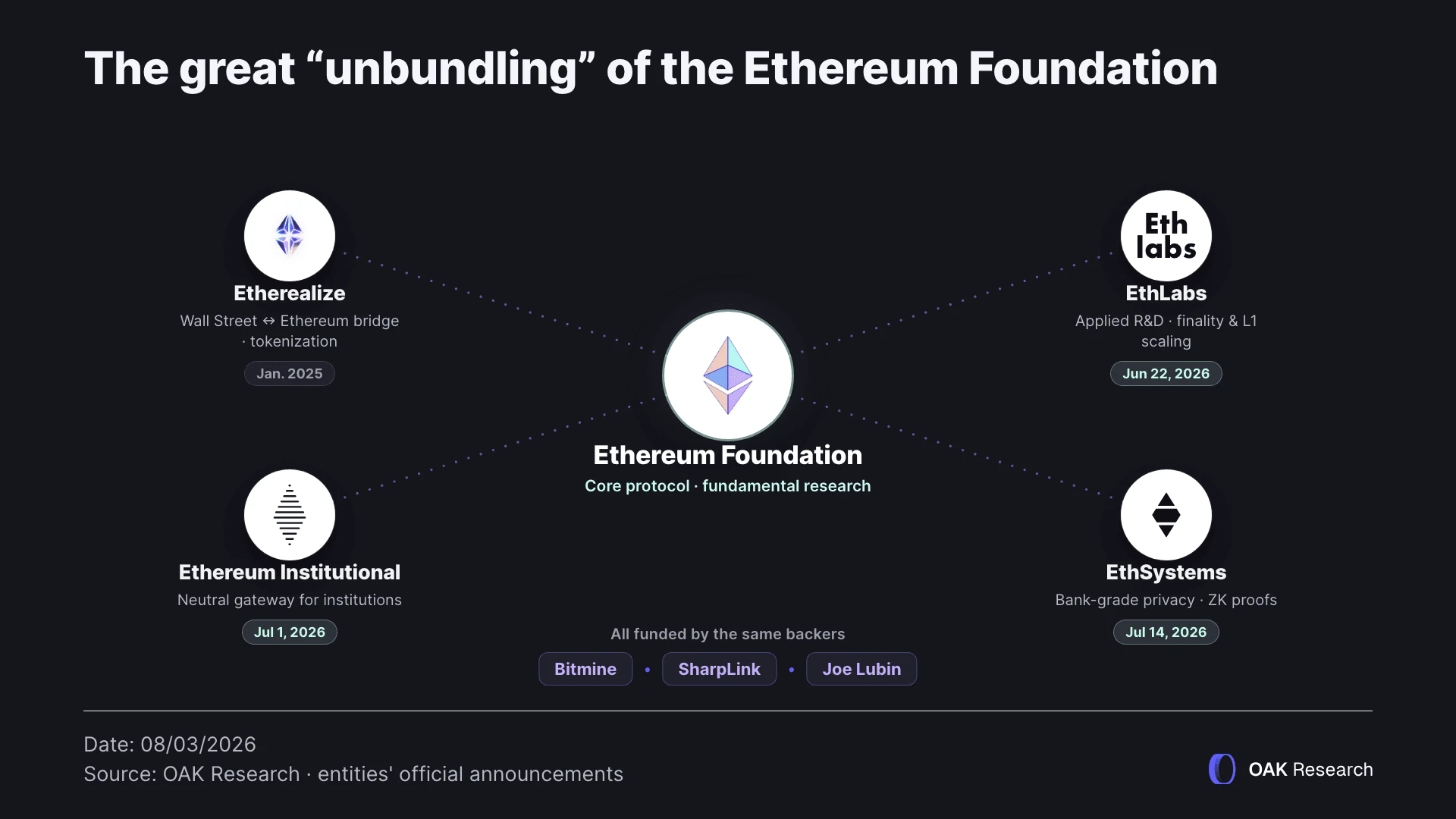
This model of a specialized, ecosystem-funded entity isn't entirely new. It was pioneered back in January 2025 by Etherealize, launched by Vivek Raman, a former banker with ten years on Wall Street, alongside Danny Ryan, one of the Foundation's founding figures.
Etherealize's mission is to support the migration of traditional finance onto blockchain, and, naturally, onto Ethereum first. That means conversations, marketing, and education aimed at institutions, so they can issue and manage tokenized assets on Ethereum with proper guidance. One key theme, which we'll come back to, is privacy, which appears to be paramount for these players.
Success came fairly quickly, with the company raising $40 million from Electric Capital and Paradigm in September 2025. By June 2026, Raman was noting that Wall Street had definitively moved from proof-of-concept to live deployments, while arguing that the Foundation should hand these topics off for good. In his words, the substrate of the financial system cannot be controlled by a single party. Etherealize served, in a sense, as the prototype, and 2026 simply turned its recipe into a template.
"Ethereum is ready. Institutions are ready. Etherealize is delivering the rails to bring them together." That's Etherealize's motto.
The first of the three new entities is EthLabs, launched on June 22. It's a nonprofit R&D lab founded by five former senior Foundation researchers, and not just any researchers. Among them are Ansgar Dietrichs and Barnabé Monnot, two of the most respected minds on proposer-builder separation and mechanism design, joined by Caspar Schwarz-Schilling, Josh Rudolf, and Julian Ma. Three weeks later, a sixth former EF researcher, Francesco D'Amato, had already come aboard.
EthLabs' mission is different from Etherealize's, but aligned at its core: helping Ethereum become the base layer of the global economy. The lab takes on concrete problems like Layer 1 scaling, interoperability, and ETH's monetary properties. Their central focus, judging by their early publications, is finality. As long as a bank or institution has to wait 15 minutes to treat a transaction as final, it simply cannot settle hundreds of millions of dollars through Ethereum.
Where the Ethereum Foundation does fundamental research, EthLabs does research geared toward execution and real-world adoption.
The second entity, launched on July 1 in New York, is Ethereum Institutional. It's an independent nonprofit, spun directly out of the team that already handled institutional engagement inside the Foundation, led by David Walsh, who spent five years building that function and engaging with hundreds of institutions.
Ethereum Institutional's mission is to become the entity Ethereum had been missing all along: a neutral, credible gateway for banks, asset managers, custodians, and institutional players in general. A free point of contact for anyone who wants to evaluate Ethereum's infrastructure but doesn't know where to start.
As its manifesto puts it, the infrastructure is ready to welcome traditional finance, but there was no neutral institution to run the conversation. Ethereum's neutrality is both one of its greatest strengths and a weakness with institutions, because they need a real counterpart on the other side of the table. Ethereum Institutional creates the demand, and EthLabs then supplies the technical answer.
The figures announced at launch: over 500 institutional relationships already established, a forum bringing together more than 150 executives representing roughly $250 trillion in assets under management, and planned expansion to Zurich, Frankfurt, Tokyo, and Abu Dhabi.
The third and final entity, launched on July 14, is EthSystems, and in our view it might be the most interesting of the three. It came out of a restructuring of the Foundation's Institutional Privacy Task Force, founded by Mo Jalil, Oskar Thorén, and Aaryamann Challani, the team that spent a year working with central banks and regulators. Notably, it's the only one of the three set up as a for-profit, a choice explained by the fact that a commercial structure is simply better suited to selling bespoke solutions to banking clients.
EthSystems is going after a problem that appears to be everywhere among institutions: confidentiality. Per its manifesto, banks can't operate on a network where anyone can read transaction histories, amounts, counterparties, and strategies in real time.
So the company builds "selective disclosure" systems based on zero-knowledge proofs. Concretely, the network verifies that a transaction is valid (no fraud, no double spend), while amounts, identities, and counterparties stay encrypted. Only the holder of the right "viewing key," a regulator for instance, can pull up the full history. This is what's known as verification without revelation, and it's a compelling answer that may well unlock banking adoption at scale.
You've surely noticed the timing is no accident. EthSystems fills the exact void left by PSE's closure three weeks earlier. In the span of a month, Ethereum's applied privacy moved from a Foundation-funded working group to a commercial company backed by the largest treasuries. That handoff isn't neutral, and we'll come back to it.
Take a step back and look at this new organizational model, and you'll recognize something the open-source world knows well: a central entity with a deliberately narrow mandate, surrounded by a constellation of specialized, independent organizations. That's how Linux, Apache, and Rust have endured for so long, with a foundation that maintains only the core of the protocol and companies building products on top.
The unbundling of Ethereum we've just described closely mirrors that model. It isn't a sign of decline, as many assumed when the Foundation parted ways with some historic members, but rather a healthy sign of maturity. A network being public doesn't require its entire adoption to rest on a nonprofit foundation. Quite the opposite, in fact, since well-incentivized companies will always be better at shipping products and meeting their clients' needs.
One last point is worth flagging: the financial alignment across all these entities. The backers behind EthSystems, EthLabs, and Ethereum Institutional are, for the most part, the same ones who stand to benefit economically from them. SharpLink's CEO, Joseph Chalom, has himself acknowledged that these entities will eventually overlap with the Foundation, but that the densest concentration of talent now sits on their side. One question stays open, and we'll return to it at the end: can a constellation funded entirely by the largest ETH holders really stay neutral?
Your weekly crypto digest delivered directly to your inbox.
Another part of Ethereum's revival we felt was important to cover is the technical side. Not that it was ever a weak spot for the protocol, quite the contrary, but because it was too hard for a general audience to grasp, in concrete terms, what Ethereum was actually trying to build. We've tried to break the roadmap down in plain language more than once, and it always ended up too dense, too technical, and too illegible for most investors. That, it seems, is starting to change, so let's take it in order.
Let's begin with what has already shipped. On December 3, the Fusaka upgrade went live on Ethereum mainnet, headlined by the introduction of PeerDAS. To give you a sense of the mood, the article we wrote at the time got relatively little traction, a sign that a good chunk of investors had stopped believing Ethereum's roadmap was a bullish catalyst for ETH.
Yet Fusaka packed in several major changes. PeerDAS, for one, lets nodes avoid downloading the full blob dataset (only 12.5%), sharply cutting their workload without weakening the network's data availability guarantees. Insignificant on paper for investors, but crucial for any operator.
Another quiet little revolution was the BPO forks. Again, this only touches blobs, but it made it possible to raise their capacity without waiting for a named fork and its long development cycle. The per-block blob limit went from 6/9 to 10/15, then to 14/21 on January 7. Capacity more than doubled in a single month, without a single incident, for a network so often mocked for how slowly it ships.
Ethereum's next big milestone is Glamsterdam. As usual, the name is a portmanteau: "Gloas" (the consensus layer upgrade) and "Amsterdam" (the execution layer one). It's routinely described as the biggest change to the protocol since The Merge. Devnet-7 opened to developers on July 16, and mainnet deployment is slated for the second half of 2026, with a realistic window between September and December.
Two changes dominate this fork. The first, EIP-7732 (or ePBS), builds the separation between proposers and builders directly into the protocol, a job currently handled off-chain via MEV-Boost and third-party relays everyone has to trust. In other words, it ends a dependence on private intermediaries, and with it one of the network's most criticized points of centralization.
The second, EIP-7928 (or Block-Level Access Lists), adds to each block an upfront map of the state it will touch. Once again, it looks like a minor tweak to most of us, but it's actually the key to parallel transaction execution. Put simply, if you know ahead of time that two transactions don't overlap, you can process them at the same time.
Above all, by combining these building blocks with a gas repricing, Glamsterdam enables the most concrete change of all: raising the gas limit toward a floor of 200 million, up from around 60 million today. That's more than a threefold increase in Layer 1 capacity, with theoretical throughput eventually approaching 10,000 transactions per second, and steep fee reductions on the most common operations.
Which brings us right back to what we said in the introduction about Ethereum's vision. After years of betting entirely on Layer 2s for scalability, Glamsterdam should mark the first step in a major return to scaling directly on Layer 1. Vitalik has explicitly acknowledged as much, admitting that the "everything on rollups" idea he championed from the start had to evolve.
Worth noting, this could be a compelling answer to the value-capture problem we raised earlier. If activity returns to a higher-capacity Layer 1, then fees, the burn, and ETH's economic thesis all benefit immediately.
The next fork, scheduled after Glamsterdam, is Hegotá. It applies the Mandate directly by focusing on censorship resistance and privacy. Researchers detailed its likely contents first in December 2025, then more recently in mid-July, notably with FOCIL, a mechanism ensuring a valid transaction cannot be censored by builders, along with a set of EIPs that finally enable private, trustless transactions directly in the public mempool, without relying on external infrastructure.
In parallel, the Foundation released the Kohaku SDK in late May, which plugs existing privacy protocols like Railgun and Privacy Pools straight into the wallet layer, with a different address per application by default to limit tracking. Vitalik publicly backed the initiative, urging the ecosystem to drop the grand speeches and finally ship real integrations. In short, and it was high time the Ethereum ecosystem heard it, privacy, like plenty of other core aspects of the protocol, should no longer be a conference talking point, but a feature developers can actually use.
Then, on July 4, 2026, Vitalik published the post that ties everything above together. Written after a researcher gathering in Berlin in late June, it frames "Lean Ethereum" as the protocol's third major iteration, after the original launch and 2022's Merge. The plan is enormous: over three to four years, nearly every major component of the protocol will be replaced, without ever forcing existing applications to migrate.
→ For the full picture, read our comprehensive, detailed breakdown of Lean Ethereum:
In concrete terms, the practice of every node re-executing every transaction to verify it would give way to verifying compact cryptographic proofs, using recursive STARKs enshrined in the protocol. We move from an "everyone recomputes everything" model to an "everyone verifies a proof" model, which fundamentally changes the workload and, with it, lifts the main constraint on the network's scalability.
Consensus would be streamlined toward finality in one or two rounds; the entire quantum-vulnerable portion of the cryptography would be phased out and replaced; and the execution engine would eventually move toward a RISC-V-style architecture. Vitalik also calls the storage-model overhaul "the most disruptive part of the plan," one that could cut transaction fees for ERC-20 tokens by more than tenfold.
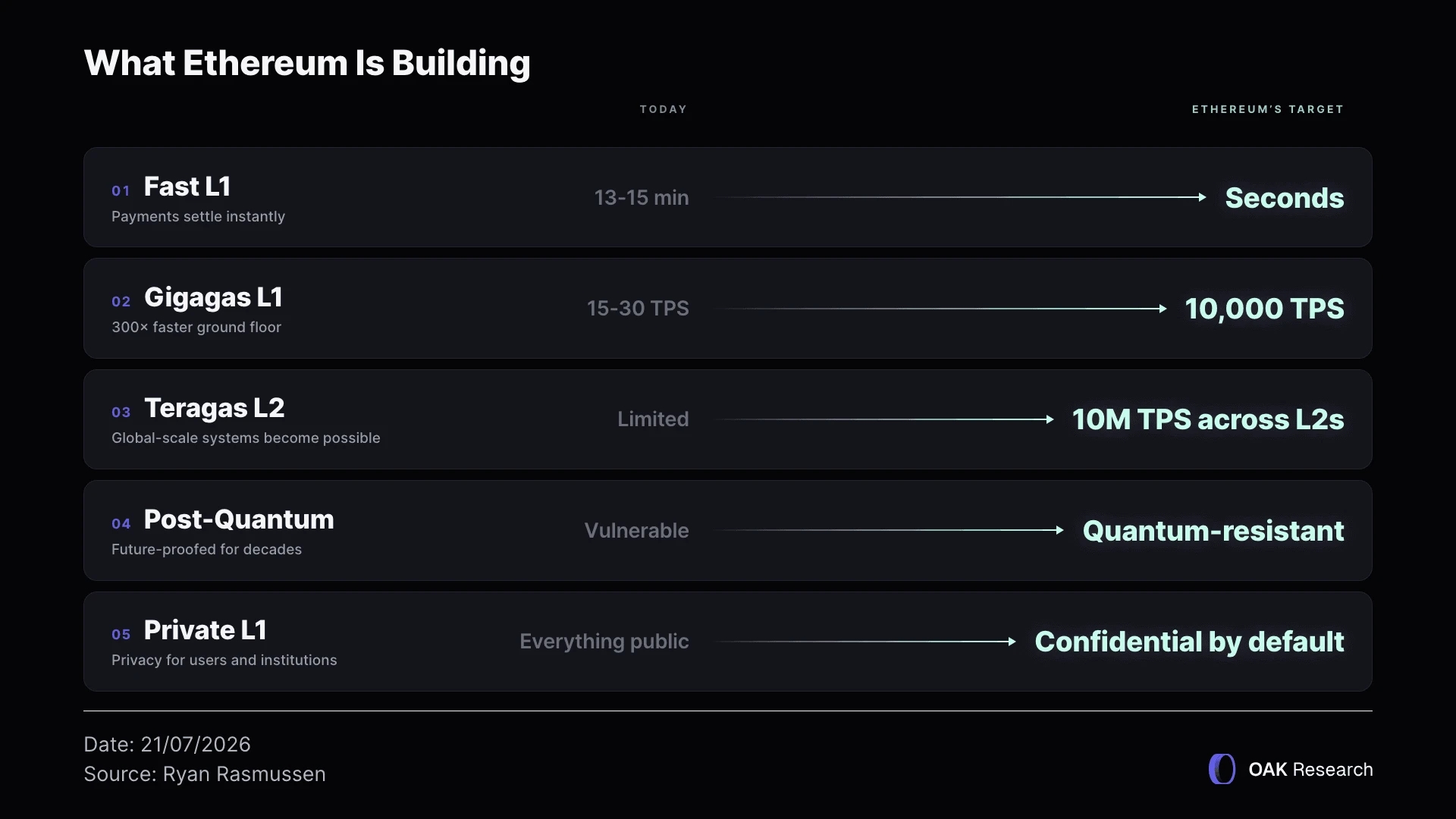
This plan builds on the "strawmap" Justin Drake published in February 2026, which lays out roughly seven hard forks through 2029 around five big goals: a fast Layer 1 (finality down from 16 minutes to a few seconds), a Layer 1 doing 10,000 transactions per second via zkEVMs, Layer 2s doing 10 million, a quantum-resistant Layer 1, and a Layer 1 with native privacy.
Vitalik closed his announcement with a line that loops perfectly back to the Foundation's Mandate: "Ethereum is CROPS." The market answered in its own way, with ETH up more than 12% in the seven days that followed. Not everyone applauded the timeline, mind you: researcher Dankrad Feist, now at Tempo, thinks the three-to-four-year window is far too slow in the age of AI-assisted development. It's probably the first time Ethereum's roadmap has been criticized for being too cautious rather than too vague, and that, in itself, is already a signal.
The third pillar of this revival is by far the most concrete, because it rests on neither a promise nor a roadmap. Over this stretch, financial institutions simply stopped running tests and started putting real products into production. And this shift owes nothing to chance: it flows from two regulatory frameworks that lined up within months of each other.
In the United States, the GENIUS Act, signed in July 2025, laid down the federal framework for stablecoins. It contains one provision whose effects are playing out right now: a ban on stablecoin issuers paying yield to holders. The result is a mechanical, massive demand for regulated reserve instruments that can generate that yield, namely tokenized money market funds. In Europe, MiCA's stablecoin provisions took full effect on July 1, 2026, finally giving banks a clear framework to issue their own tokens. As for Japan, it keeps opening up, with the first regulated yen stablecoin already live on Ethereum.
The most striking symbol of this shift may sit in Jamie Dimon's April 2026 annual letter. The JPMorgan CEO, who once called Bitcoin a fraud, now writes that his bank has to deploy its own blockchain technology to face a new generation of competitors. When the head of America's largest bank frames your technology as a strategic threat, the debate over its relevance is well and truly settled.
One date sums up this shift better than any other. On July 1, 2026, three events landed on the same day: MiCA came into full effect, Ethereum Institutional opened its doors in New York, and, most importantly, Crédit Agricole, France's second-largest bank with over €2 trillion in assets, launched its euro stablecoin EURXT on Ethereum through its subsidiary CACEIS.
But the most interesting part isn't the launch itself, it's its very first transaction. This wasn't a test, but a genuine subscription to a tokenized money market fund from Amundi, Europe's largest asset manager with €2.4 trillion under management, settled atomically on Ethereum. Concretely, the investor sends their EURXT to the fund's smart contract and receives their shares in one and the same transaction. Either both legs of the settlement execute together, or neither does. No more counterparty risk, no more settlement delay, no more exposure windows of the kind that define traditional finance.
To our knowledge, this is the first European settlement of its type between a regulated bank stablecoin and a tokenized fund, and it's far from isolated. Société Générale is already circulating its own euro and dollar stablecoins via SG-Forge, going as far as deploying them on Uniswap and Morpho. When France's universal banks become the world's pioneers of bank stablecoins on public Ethereum, you can hardly call it a coincidence.
The move obviously reaches well beyond Europe, and it has crystallized around one very specific prize: becoming the yield reserve for stablecoins in the GENIUS Act era. JPMorgan now runs two tokenized money market funds on public Ethereum, the latest of which, launched in May 2026, is explicitly built to serve as a reserve asset for stablecoin issuers. BlackRock followed the same logic by filing two funds of the same kind, while its BUIDL fund already tops $2.5 billion in assets, with Fidelity and Invesco joining in.
Put simply, the world's largest asset managers are now in a fight to capture the collateral of a stablecoin market worth over $300 billion, and that fight is playing out on Ethereum. It's no accident, either, that BlackRock's 2026 outlook credits the network with more than 65% of all tokenized assets across chains. That's simply where the regulated infrastructure lives.
This is a global phenomenon, and Asia illustrates it perfectly. In mid-July, SBI, DigiFT, and Startale showed how a regulated yen stablecoin could run the entire lifecycle of a tokenized security on Ethereum: instant settlement of subscriptions, plus automated on-chain dividend distribution. The next announced step is nothing less than tokenizing an equity fund worth roughly $1.3 billion.
And this point matters more than it looks. The real challenge of tokenization was never representing an asset on-chain, but handling everything around it, cash settlement and income distribution, which kept depending on traditional banking rails. SBI's demonstration closes that loop. And when you consider that SBI generates ¥1.9 trillion in annual revenue, it's clear this is no longer a startup tinkering, but the methodical build-out of Japan's capital-markets infrastructure.
Finally, two market developments deserve a mention, because they reshape the very nature of demand for ETH. The first is the arrival of yield in ETFs. In March 2026, BlackRock launched ETHB, its first Ethereum ETF to include staking, paying out 82% of the rewards it generates to holders each month. That's a benefit a Bitcoin ETF can never structurally offer, and it changes the conversation entirely with pension funds and wealth managers.
The second is the reversal in flows. After eight long weeks of outflows, Ethereum ETFs swung back to net inflows in early July, with more than $84 million in the week of July 13 alone. Over the same window, Bitmine kept accumulating toward its 6-million-ETH target, while SharpLink generated over $12 million in quarterly revenue almost entirely from staking, versus less than $1 million a year earlier. As a result, ETH, which started July around $1,610, was trading near $1,920 by mid-month.
Careful not to get carried away, though. A 15% bounce off a low doesn't make a trend reversal, and ten days of positive flows don't make a thesis. What these numbers do show is that sentiment stopped deteriorating at the exact moment fundamentals started improving. And historically, that's precisely how reversals begin.
Ethereum has very likely just come through the most uncomfortable stretch of its recent history. The network was breaking usage records while its asset price cratered. Its Layer 2s were fulfilling their scalability mission to perfection while draining Layer 1's revenue. And the Foundation was under fire for its slowness at the exact moment new specialized blockchains started encroaching on its market.
We're convinced Ethereum's resurgence is very real, but that it isn't where the market usually looks for it. This isn't one more narrative to chase, but something concrete that looks far more durable. What actually happened between April and July 2026 was the synchronization, for the very first time, of three clocks that had each been ticking at their own pace.
The first is the regulatory clock. With the GENIUS Act and MiCA, stablecoins and tokenization moved from gray zones to fully regulated markets. And every new framework mechanically creates demand for the infrastructure these assets mostly live on. For once, it isn't a crypto product chasing institutions, but the reverse, with regulators effectively nudging institutions toward the dominant infrastructure.
The second is the organizational clock. The Foundation's unbundling, which many read as an admission of weakness, is actually the opposite. A public infrastructure built to last decades has to organize itself around specialized companies that have a financial incentive to deliver. The Foundation, however positive its work has been in recent years, was never really meant to sell the features institutions need. This granularity of entities is a considerable strength.
The third is the technical clock. With Fusaka delivered without a hitch, Glamsterdam in its final phase, Hegotá already mapped out, and Lean Ethereum charting a course through 2029, Ethereum now has, for the first time since The Merge, a legible roadmap with dates the market can judge. And the content of that roadmap speaks directly to the two historic criticisms: the return of scaling on Layer 1 tackles the value-capture problem, while native privacy removes the last obstacle to institutional adoption.
This optimistic read still has to be weighed honestly against what remains to be proven, since this new setup is only a few weeks old.
Maybe it's a stretch to say the tide has definitively turned for Ethereum, but it would be disingenuous not to acknowledge that all of these developments point in the same direction: a Layer 1 able to scale directly, offer privacy, settle transactions in seconds, and win institutional adoption without leaning on a single foundation. The transformation is documented, dated, and already well underway. The only real question left is how long the market will take to notice, and whether ETH will finally capture its fair share of that success.
Unlock all our research and get the right insights, at the right time.
Bitcoin (BTC), Ethereum (ETH)

Bitcoin (BTC), Ethereum (ETH), Zcash (ZEC)

Bitcoin (BTC), Ethereum (ETH)

Bitcoin (BTC), Ethereum (ETH), Hyperliquid (HYPE), Ethena (ENA)