Can Ethereum succeed without Ether (ETH)?

Ethereum (ETH)
Published on
Sponsored Content
This content was written as part of a commercial collaboration. Although the OAK Research team conducted a preliminary assessment of the project presented, we disclaim any liability for losses or damages resulting from decisions based on this article. Cryptocurrencies involve high risks, and this content is provided for informational purposes only and does not constitute investment advice.
The key takeaways on Polygon (POL) in Q4 2025. A concise and fast-read report analyzing financial performance, on-chain activity, ecosystem dynamics, and the network’s key developments.
Launched in 2019, Polygon was a pioneer of Ethereum scalability solutions. After reaching peak popularity in 2021, the project was hit hard by the 2022 bear market and the rise of new competitors, without managing to reclaim its former leadership position.
However, 2025 marked a turning point. Under the leadership of its new head, Sandeep Nailwal, Polygon underwent a strategic shift aimed at refocusing the ecosystem around payments, stablecoins, and institutional use cases.
Today, Polygon is built on three pillars: the Polygon PoS sidechain, the Polygon CDK for deploying interoperable Layer 2s, and AggLayer, designed as the aggregation and interoperability layer of the ecosystem.
Together, these components form the foundation of the new “Gigagas” roadmap, whose ambition is to reposition Polygon as a reference infrastructure for large-scale payments and tokenization.
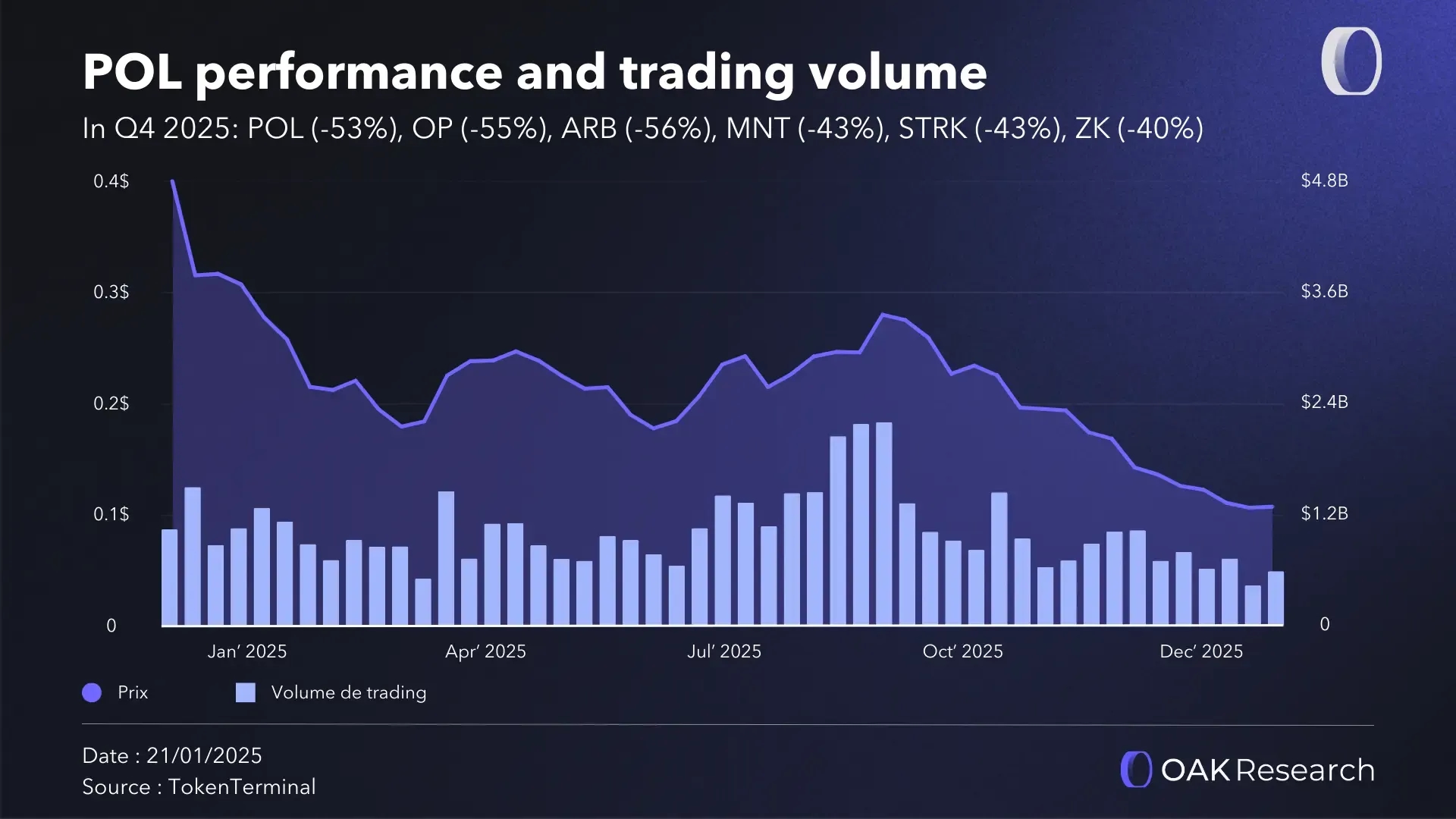
The last quarter of 2025 was particularly challenging for the crypto market: BTC fell by 23%, ETH by 28%, and the October 10 event deeply impacted the entire altcoin market.
Polygon’s POL token significantly underperformed on financial metrics in Q4 2025:
The entire Layer 2 sector experienced a sharp correction over the period: -55% for Optimism (OP), -56% for Arbitrum (ARB), -43% for Mantle (MNT), -43% for Starknet (STRK), and -40% for zkSync (ZK).
Sector indices in Q3 2025:
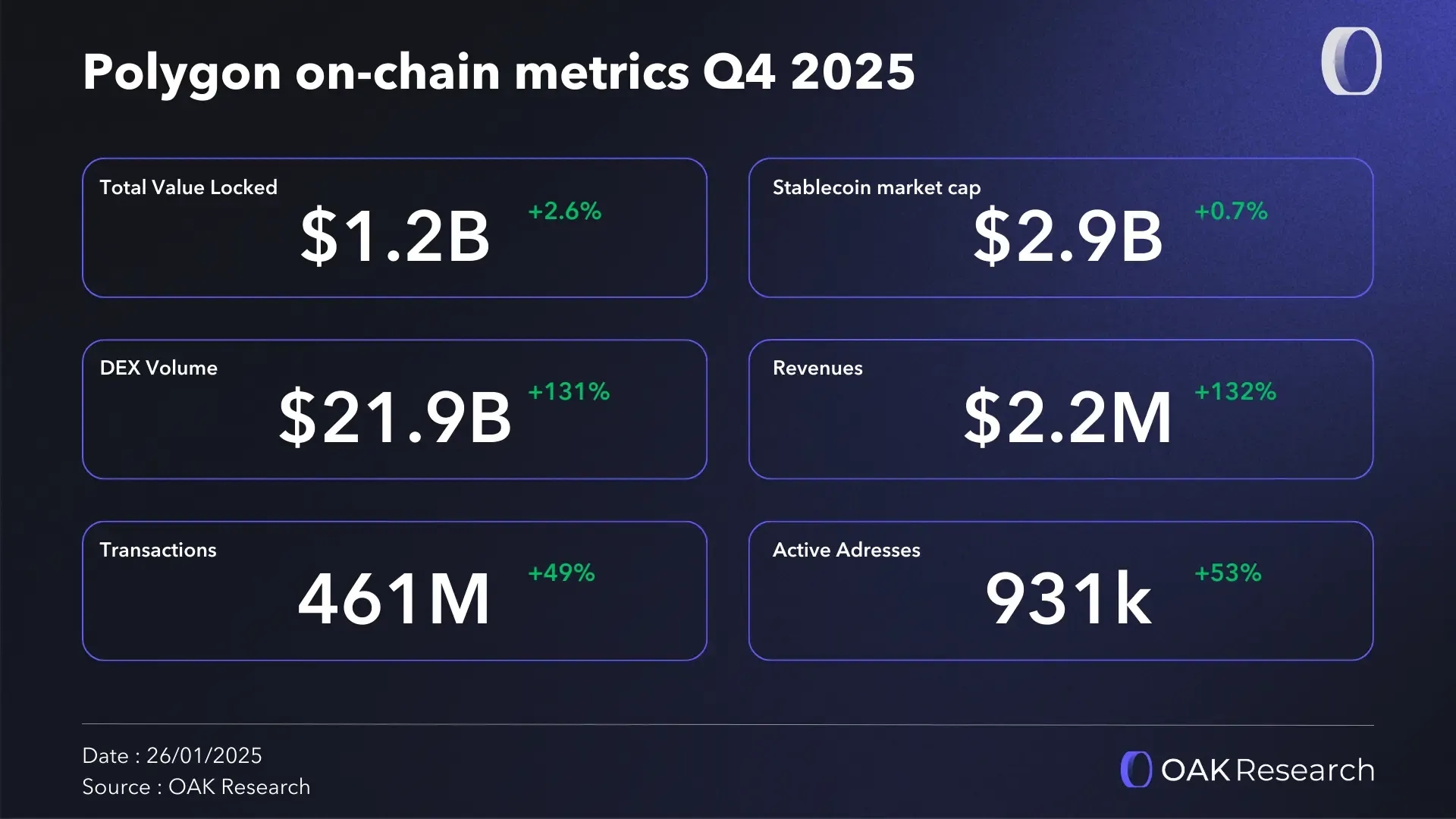
Polygon recorded a relatively solid Q4 2025 compared to the broader on-chain finance landscape. Activity increased across most metrics:
Polygon’s revenue growth is partly explained by the sharp decline in POL (-53%), which mechanically reduced token emissions. The network recorded its first positive revenue week (+$234,000) in six years of operation.
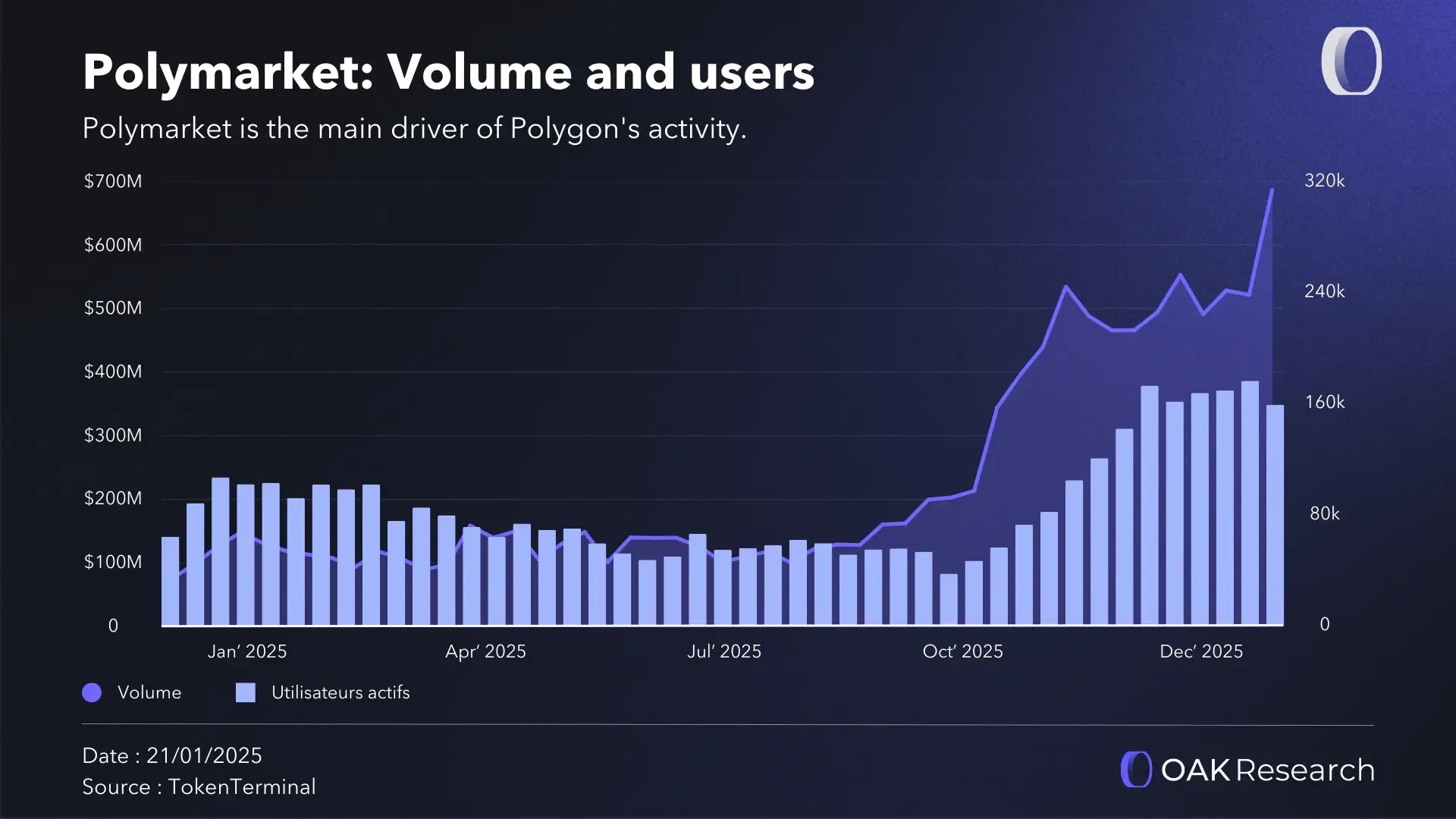
Polymarket is the main driver behind the renewed activity on Polygon. The surge in interest for prediction markets led to an increase in active addresses, transactions, and trading volumes.
Q3 2025 was particularly favorable for Katana, a new Layer 2 launched in July 2025 and powered by the Polygon CDK, largely driven by airdrop incentives. In Q4, however, the network entered a stagnation phase.
With $400 million in TVL, on-chain metrics remain high for a blockchain that has existed for only six months. That said, Katana’s main challenge will be the TGE of its KAT token, expected no later than February 2026, which has played a major role in incentivizing liquidity.
The majority of Polygon’s on-chain activity can be attributed to Polymarket. The prediction market is emerging as Polygon’s “killer app”, with strong on-chain metrics in Q3 2025:
However, Polymarket has announced its departure from Polygon and is preparing to launch its own Ethereum Layer 2 along with its POLY token, signaling a move toward operational independence.
Polygon’s interoperability layer continues to expand, with 12 chains currently connected and six more in testnet or development. In Q3, Polygon introduced AggKit, a tool enabling any chain to connect to AggLayer, whereas previously this was limited to chains built using the Polygon CDK.
In Q3, Polygon made progress toward its ambition of becoming a reference blockchain for stablecoins, RWAs, and institutional investment. Notable partners include Mastercard, Manifold, and Decard.
Regarding RWAs:
The main update of the quarter was the Madhugiri hard fork, deployed in early December. It improved Polygon’s performance by 33%, effectively processing up to 1,400 transactions per second.
This hard fork also includes several EIPs from Ethereum’s Fusaka upgrade, ensuring alignment with the broader EVM ecosystem. Madhugiri also introduces a mechanism to adjust block time without requiring an additional hard fork.
The Gigagas roadmap, which includes the Madhugiri hard fork, targets 100,000 TPS by the end of 2026. As a result, regular network upgrades should be expected in the coming months.
The Polygon team unveiled the Open Money Stack, a suite of tools designed to make Polygon easily accessible to professionals, individuals, and AI agents. The project includes multiple components: wallets, account abstraction, RPC infrastructure, on-ramp and off-ramp services, stablecoins, yield, interoperability, compliance, and identity.
The objective is clearly stated: to migrate money on-chain and simplify its usage. More details are expected in the coming weeks.