

On-chain Privacy: What Monero and Zcash Can Teach Ethereum


Ethereum (ETH), Monero (XMR), Zcash (ZEC)
Published on

Privacy is regaining a distinct role in a crypto market increasingly shaped by institutional flows and regulatory constraints. As financial surveillance expands and users migrate on-chain, privacy-oriented assets are beginning to move independently from the broader market. This analysis provides a clear, data-driven overview of a segment long considered marginal yet now structurally relevant.
In recent weeks, the privacy segment has started behaving more and more independently from the rest of the crypto market. In an environment where regulatory compliance, traceability and financial surveillance are all intensifying, privacy-focused assets are regaining a role that goes far beyond pure speculation.
The crypto market is increasingly driven by institutional flows and correlated with traditional assets. In that context, privacy has become one of the only true intra-crypto hedges against the financialization of the ecosystem. On-chain usage of privacy protocols has reached an all-time high, now exceeding that of other, more yield-driven sectors.
Rising social demand for financial discretion confirms an anti-cyclical pattern, and the regulatory trajectory across major jurisdictions now indirectly strengthens the privacy thesis it is supposed to contain.
This report offers a factual overview of a segment that has long been marginalized, yet remains structurally important in crypto. Is the renewed momentum around privacy assets just another speculative bubble in an uninspiring market cycle, or a signal that a more durable trend is taking shape?
Between 2024 and 2025, the crypto market entered a phase dominated by institutional flows. The rise of regulated products, particularly spot Bitcoin ETFs, has redirected liquidity toward assets viewed as compliant and institutional-grade, starting with BTC.
This shift has gone hand in hand with a tightening of regulations, which has deepened the divide between institutional assets and those considered sensitive, notably privacy coins. The specifics vary by jurisdiction, but the overall pattern is similar: regulated platforms reduce exposure and increase constraints on anonymity tools.
In the European Union, the combination of MiCA and TFR explicitly bans anonymity-enhancing coins. Registered exchanges have had to comply, and Monero (XMR) trading pairs were delisted from Kraken and Binance for EEA customers as early as 2024.
In the United States, there is no formal ban, but AML requirements from FinCEN and OFAC have a similar effect. Major platforms either avoid or heavily restrict privacy coins. Coinbase has never listed Monero, and Zcash is only available there under technical constraints.
By 2025, 73 exchanges worldwide had delisted at least one privacy coin, compared to 51 in 2023. Delistings on platforms like Binance, Kraken and Upbit have removed an estimated 600 million dollars in daily trading volume.
FinCEN also proposed a rule earlier this year requiring reporting of privacy transactions above 500 dollars. In parallel, 97 countries now have a dedicated regulatory framework for these assets, compared with 79 in 2023.
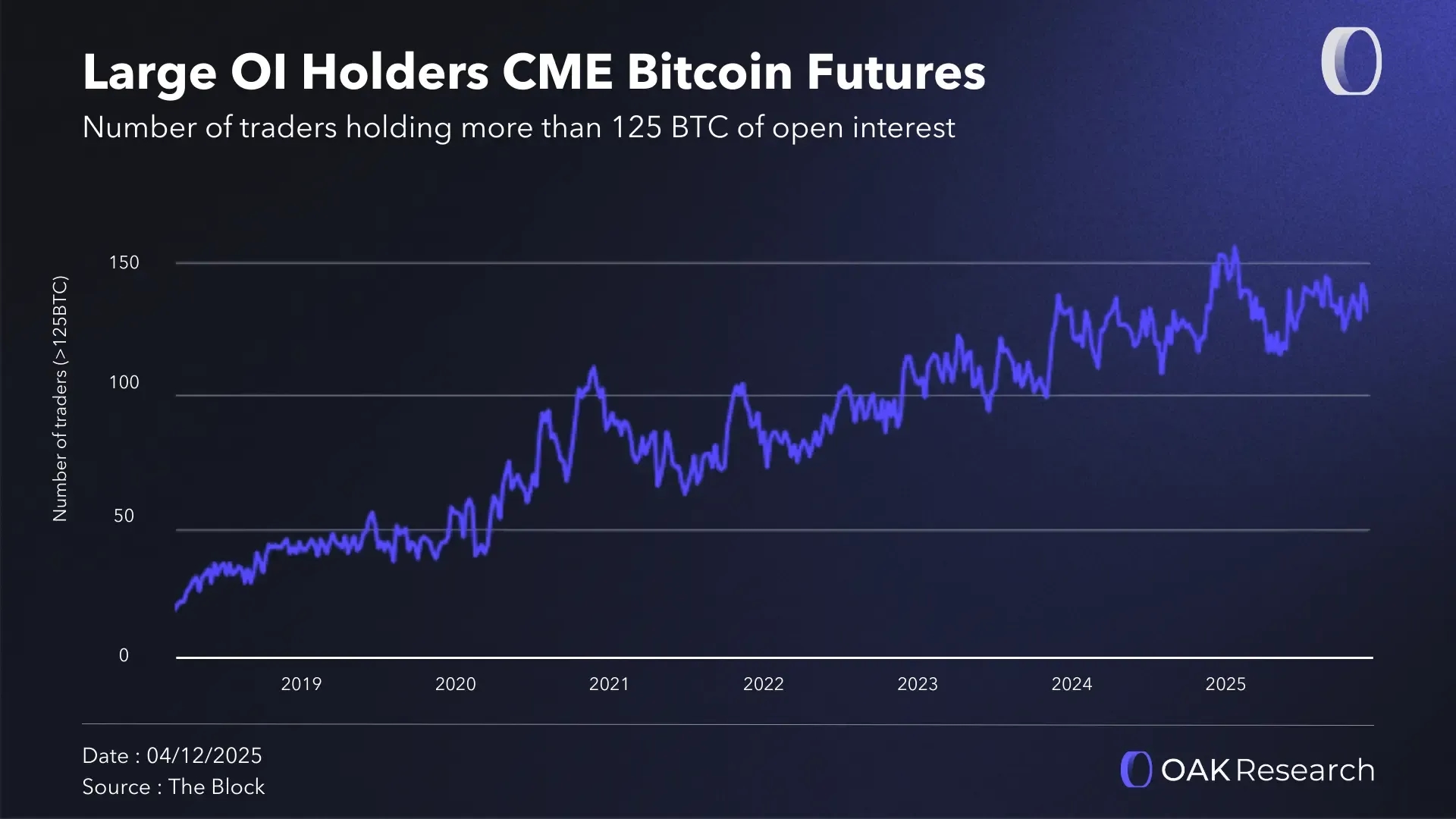
The share of regulated markets has grown, particularly on the derivatives side. The CME is now one of the top venues globally by open interest and volume on Bitcoin futures.
At the same time, Bitcoin dominance has remained above 50 percent for nearly two years, something not seen since 2018. This stability illustrates how flows are concentrating on compliant assets and regulated markets.
Despite this, users have not abandoned their privacy ideals, and on-chain activity reflects that. While institutional flows do concentrate in regulated products (Bitcoin ETFs, licensed platforms, compliant assets), a growing share of liquidity is moving to decentralized infrastructure.
In 2025, the DEX/CEX ratio reached an all-time high, signaling a structural shift of liquidity toward on-chain platforms. The share of derivatives volume processed on DEXs has doubled in two years, strongly supported by players such as Hyperliquid.
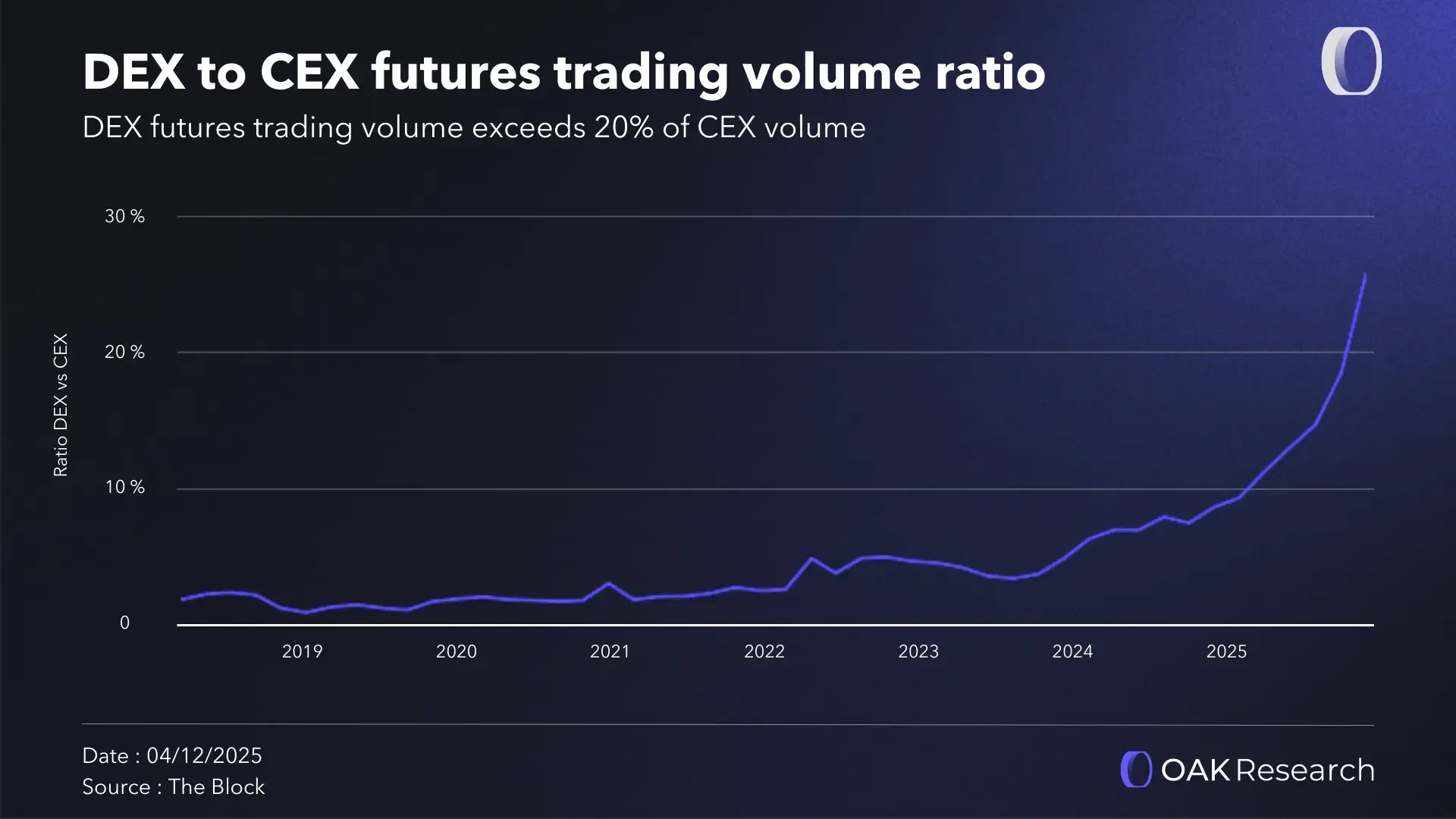
On a strictly technical level, this trend has limited direct impact on the privacy segment and its main assets. However, it stems from the same motivations that have driven privacy coins for a decade: avoiding surveillance, preserving confidentiality of identity and activity, and maintaining full sovereignty over one’s assets.
The resurgence of activity on decentralized platforms is also amplified by points and airdrop systems, which have become a standalone driver of on-chain behavior. Interacting, providing liquidity or trading on-chain gives users claims on future distributions, which keeps engagement high even outside speculative phases.
At the same time, ongoing uncertainty around CEXs (opacity, regulatory pressure, investigations, temporary withdrawal restrictions) continues to fuel user distrust. The current cycle clearly shows this duality: institutional capital consolidates in regulated channels, while crypto-native capital migrates to decentralized structures.
The sustained decline in Bitcoin and Ethereum reserves on exchanges since 2023 is one of the clearest illustrations of this. Part of this liquidity moves to institutional custody structures, particularly ETFs, while another part flows into decentralized protocols. Two ideologies now coexist: regulated custody on one side, on-chain sovereignty on the other.
Performance cycles in privacy coins tend to follow a recurring pattern. In each broad market euphoric phase, interest in privacy-focused assets resurfaces briefly, often at the tail end of the cycle.
In 2017, the narrative of anonymous digital cash dominated. Zcash (ZEC), Monero (XMR) and Dash (DASH) significantly outperformed the broader market. Their promise of untraceable money attracted early investors concerned with financial sovereignty. While Bitcoin offered only limited pseudonymity, privacy coins introduced full transactional confidentiality.
By 2021, the trend had faded. Correlation with Bitcoin intensified, technical innovation slowed, and capital rotated toward DeFi and NFTs, increasingly focused on Ethereum.
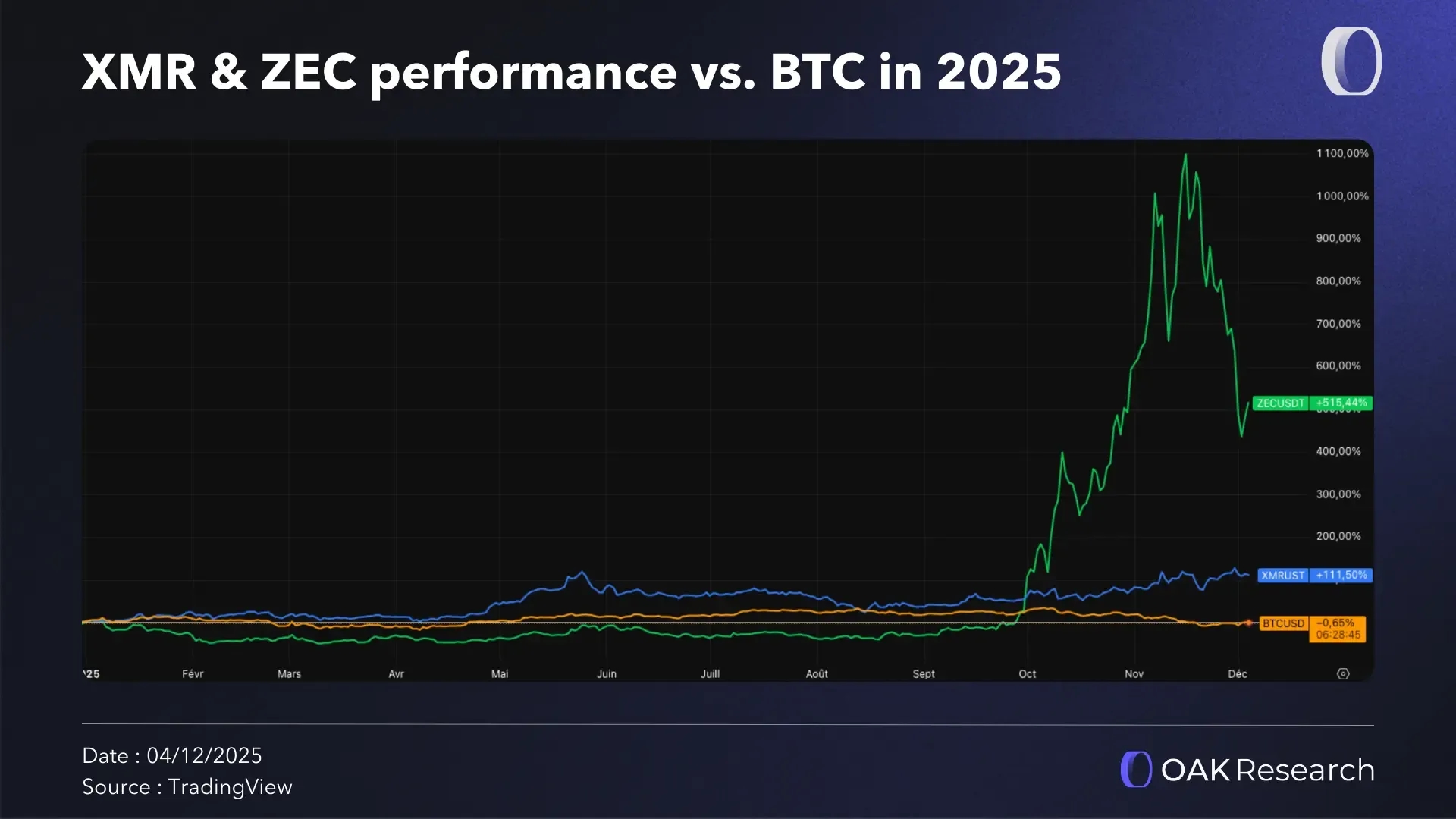
In 2025, the privacy theme re-emerged in a context of heightened surveillance and stricter regulation. Zcash stood out with strong outperformance versus Bitcoin, while Monero and Dash also posted positive performance from the start of the year.
This move in ZEC is partly explained by its hybrid design. Not all transactions are private. The coexistence of transparent and shielded addresses allows regulated platforms to keep it listed, unlike Monero, whose full opacity is structurally incompatible with KYC/AML requirements.
Being maintained on CEXs such as Coinbase and Kraken gives ZEC more stable access and liquidity, making it easier for investors to gain privacy exposure without leaving regulated venues altogether. This structural feature explains much of its relative performance, despite the absence of major protocol innovation.
Beyond speculation, the behavior of privacy coins remains tightly linked to macro sentiment. Historically, they tend to over-react in euphoric phases and then serve as a post-bull refuge, often interpreted as a leading signal for cycle tops.
However, “privacy season” has never lasted very long. In 2017 and again in 2021, the phases of outperformance of ZEC, XMR or DASH versus Bitcoin and Ethereum were limited to a few weeks or months, before reversing sharply when liquidity rotated toward newer narratives.
Over multi-year periods, relative performance charts show the same pattern: a short-lived spike, followed by extended flat performance or clear underperformance versus benchmark assets. The 2025 move fits this pattern: a sharp acceleration in a stressed regulatory environment, but still too recent and too concentrated to be considered a durable regime change.
In Q1 2025, confidential transactions accounted for 11.4 percent of all crypto transactions (versus 9.7 percent in 2024), despite institutional focus shifting toward regulated markets.
Monero remains the anchor of the segment, with 58 percent of total privacy market cap, compared to 21 percent for Zcash and 10 percent for Dash. In February 2025, aggregate trading volume in the segment reached 8.7 billion dollars, up 15 percent year-on-year.
Despite Zcash’s recent momentum, Monero continues to act as the core reference of the segment, reflecting a rare resilience to regulatory pressure and repeated delistings.
Cross-asset correlation analysis shows a clear divide between privacy coins and the rest of the market. Privacy coins form the most decorrelated segment in crypto. Average coefficients indicate weak, and in some cases negative, correlation between major privacy assets (XMR, ZEC, DASH) and benchmarks such as Bitcoin and Ethereum.
By contrast, privacy coins show moderately positive correlations with one another. This suggests internal cohesion but little dependence on broader market cycles. They move according to their own drivers, which are mostly sociopolitical rather than purely macro or crypto-native liquidity flows.
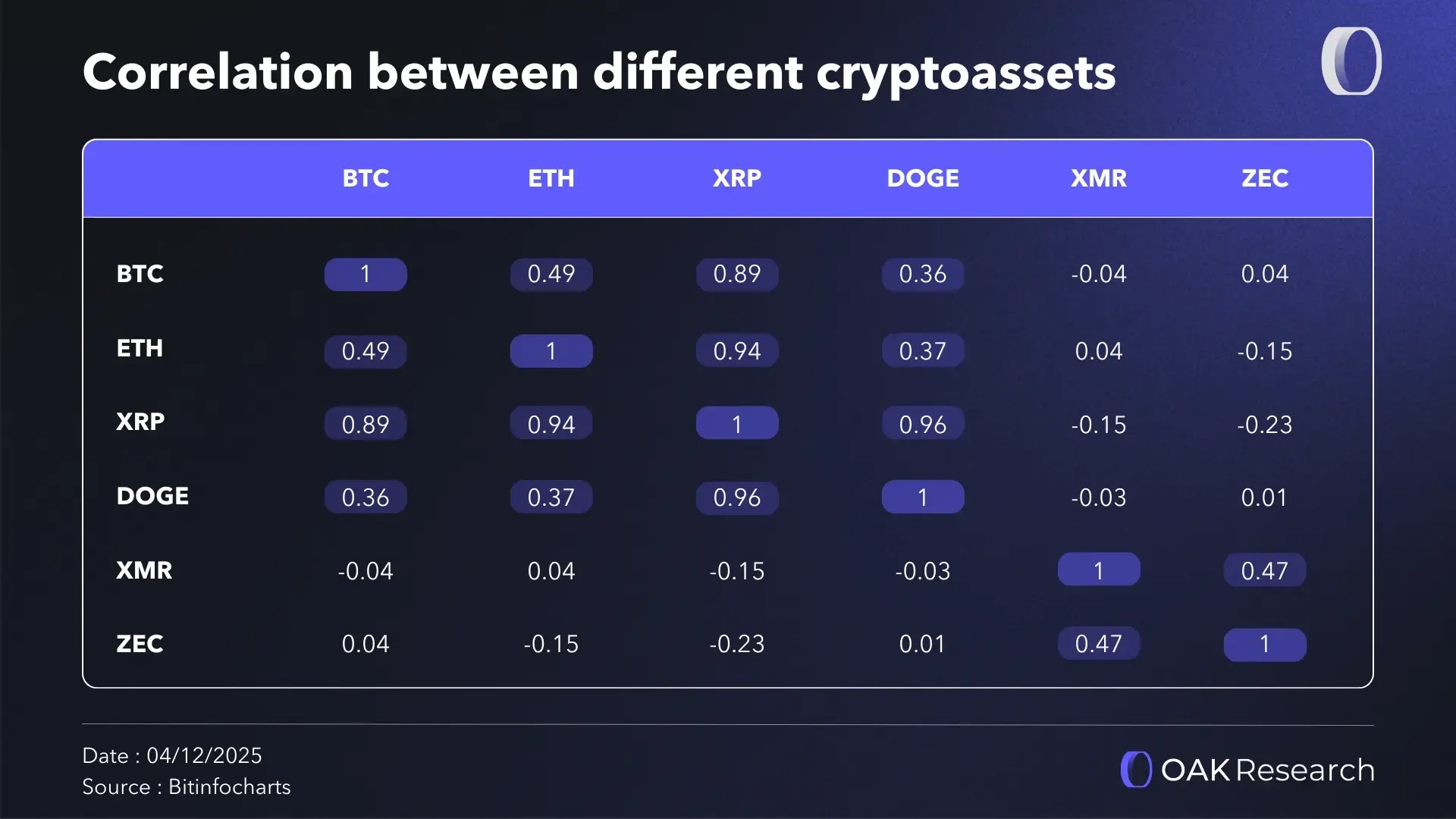
This decorrelation does not mean lower risk. Privacy coins remain among the most volatile assets in the ecosystem. Over the past year, one-month rolling volatility has been around five times higher than that of Bitcoin.
This profile reflects an exposure to a distinct narrative, disconnected from standard macro factors. While Bitcoin reacts mainly to institutional liquidity flows, Zcash and other privacy assets are more sensitive to sociopolitical variables: perceptions of surveillance, regulatory tightening, and demand for financial confidentiality.
From a portfolio perspective, this independence gives privacy coins the role of an internal crypto hedge. They do not strongly track arbitrage flows between major assets or dominance cycles. Their valuation is tied to demand for autonomy and discretion, not to integration with traditional financial infrastructure.
In an environment where correlation between Bitcoin and equity indices has tightened, privacy now stands out as one of the very few segments that remains meaningfully non-correlated, acting as a counterweight to the sector’s growing financialization.
Privacy coins therefore function less as a traditional financial safe haven and more as a narrative safe haven. They form a sub-market driven by distinct social and regulatory dynamics, often moving out of sync with dominant narratives.
In Q1 2025, privacy coins processed a combined 258 billion dollars in transaction volume, roughly 12 percent of total crypto transactional volume. This supports the view that they now operate as a parallel ecosystem driven by usage, rather than as a purely speculative side-bet on broader market cycles.
Over the past three years, Zcash has not undergone any major structural upgrade that would directly justify its recent price action. The key technical milestones remain Sapling (2018) and Orchard (2022), which made confidential transactions lighter and faster. These now form the backbone of the network’s infrastructure.
Total shielded supply, meaning the share of ZEC held in private addresses where amounts, senders and recipients are encrypted, stands at roughly 4.8 million ZEC, or close to 30 percent of circulating supply. This shielded supply is split across three generations of pools:
The gradual shift from transparent to shielded supply confirms this trend: the stock of funds held in transparent addresses has been declining since 2024. This progressive migration indicates growing adoption of confidentiality features, even in the absence of recent protocol changes.
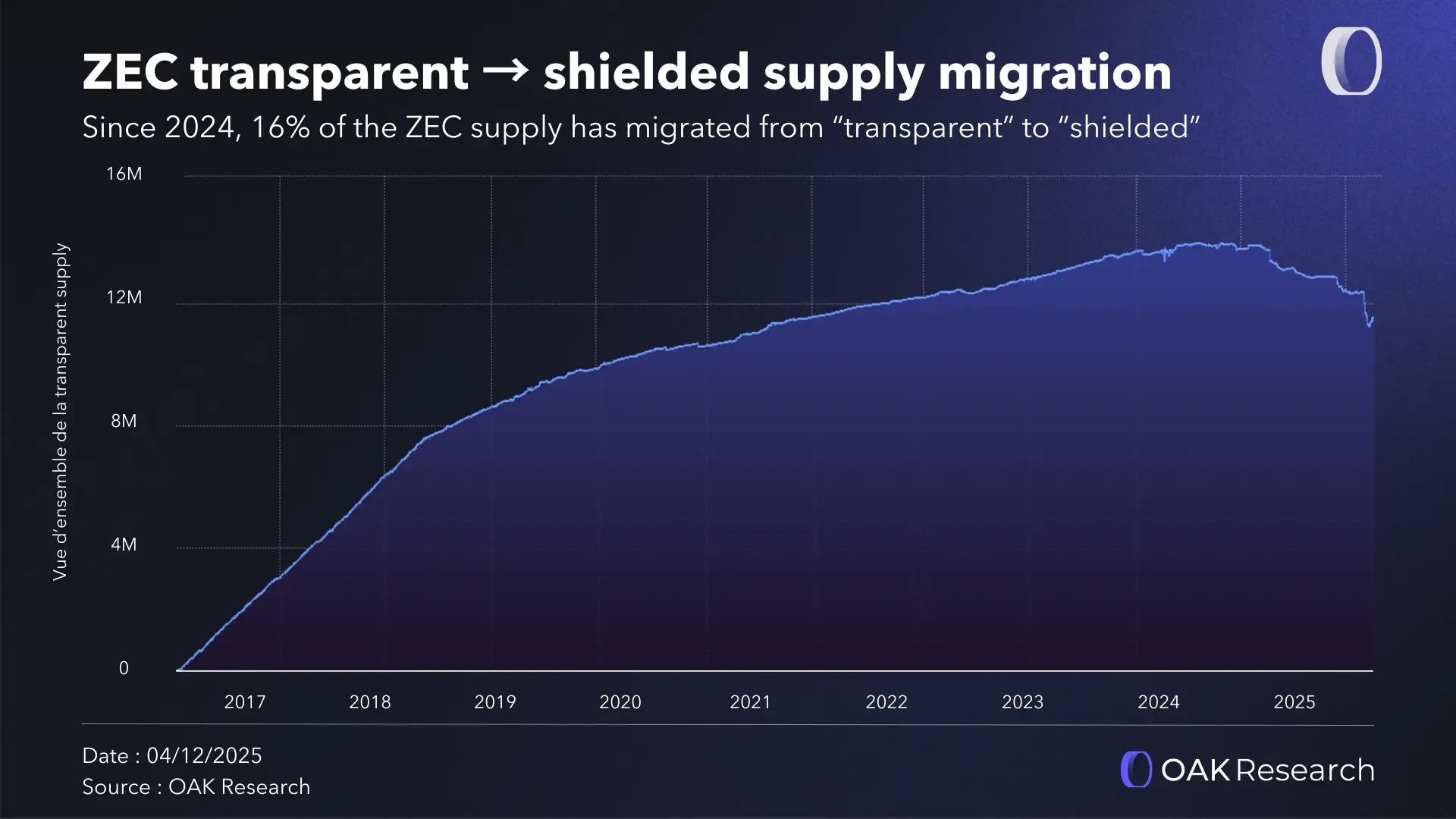
Shielded activity has grown by around 90 percent year-on-year, supported by renewed interest in a context of tighter financial surveillance and more intrusive regulatory frameworks. This trend is not driven by new technical features in Zcash, but by a narrative shift: ZEC is regaining relevance in an environment where preserving financial privacy is increasingly difficult.
At the same time, this activity spike should not be overinterpreted. ZEC’s recent performance also reflects clear speculative behavior. The token first experienced a sharp, explosive move higher that resembled late-cycle altcoin rallies, at a time when the rest of the market was relatively flat. That speculative pattern helped fuel the rally and was followed by an equally abrupt correction.
Zcash’s structural advantage remains its hybrid design. The coexistence of transparent and shielded addresses makes it easier for some regulated platforms to keep it listed, unlike Monero, whose full opacity tends to trigger systematic delistings. This relative accessibility allows ZEC to capture part of privacy-driven demand without fully exiting compliant venues, a distinct positioning in a segment that is often pushed to the margins.
Since 2024, the regulatory trajectory of crypto markets has been moving toward near-total traceability of flows. In the United States, OFAC and the IRS have stepped up their oversight of on-chain transactions, supported by stricter tax reporting requirements and targeted enforcement actions against anonymization protocols.
In Europe, the introduction of the Digital Identity Wallet and the creation of AMLA have extended compliance obligations across the entire digital asset service provider stack.
This tightening creates a structural tension: the more surveillance and reporting obligations expand, the more demand for privacy tools grows. The episodes of outperformance seen in 2025 on Zcash and Monero partly reflect this dynamic, without necessarily signaling a structural shift. They are better interpreted as reactions to a more intrusive environment than as direct consequences of protocol fundamentals.
Search trends related to financial privacy also point to rising symbolic demand. Since mid-2025, queries tied to financial surveillance have reached record levels, indicating a shift in public debate toward concerns about traceability and digital sovereignty.
This change aligns with a broader narrative transformation: privacy is no longer perceived only as a cryptographic feature, but as a symbolic refuge against expanding financial surveillance. High-profile cases such as Tornado Cash and Samourai Wallet have reinforced this paradoxical status. While privacy tools are marginalized in institutional settings, they gain ideological legitimacy among users who care about individual sovereignty.
At the same time, the data moderates some of the more alarmist narratives. In 2025, only about 7 percent of global privacy-coin transactions are suspected of illicit intent, a level below public perception often amplified by headlines. Monero nonetheless accounts for roughly 87 percent of volumes linked to illicit activity within the privacy segment, which largely explains its systematic exclusion from regulated platforms.
Despite its relatively small market cap compared to the broader space, the privacy segment continues to play a strategic role as a structural hedge within DeFi, independent of yield cycles and institutional adoption.
As of November 2025, aggregate TVL across privacy-focused protocols stands at 1.34 billion dollars, in steady growth since Q2. This is a new high, above the previous 2021 peak, and it has been reached without any institutional flows.
This progression is an interesting structural anomaly: the privacy segment’s aggregate TVL now exceeds that of the entire on-chain insurance category, a sector usually supported by explicit incentives. Privacy protocols, by contrast, operate mostly on organic user demand.
Tornado Cash, still under OFAC sanctions, accounts for more than 90 percent of this TVL, or about 1.22 billion dollars. The slow but persistent rebuilding of deposits since 2023 shows that demand for direct on-chain anonymization has not disappeared, despite the regulatory environment.
In parallel, a new generation of protocols such as Railgun, Nocturne, Zama, Aleo and Nillion is driving a transition from the classic mixer model to privacy-as-a-layer. Their approach relies on homomorphic encryption, zero-knowledge proofs and cross-chain modularity.
This shift signals a maturing of the sector, from purely transactional anonymity toward privacy integrated into infrastructure. Confidentiality is no longer presented as a standalone product, but as a background service designed to plug into existing stacks without heavy mixing or obfuscation mechanisms.
The ecosystem remains small in terms of volume and adoption, but it is becoming more coherent technically: low visibility, few explicit incentives, but a clear focus on on-chain sovereignty. In this framing, privacy increasingly looks like a defensive layer in a market dominated by institutional compliance.
Regulatory implementation over the next few years will be a key driver for the segment. Several frameworks, still in rulemaking or early implementation phases, could significantly affect access to privacy assets and how regulated platforms handle them.
In Europe, the concrete rollout of MiCA, TFR and the AML package from 2026 onward will determine the status of anonymity-enhancing coins within regulated environments. The impact on listings and operational handling of private transactions will be critical to monitor.
In the United States, FinCEN rules on digital asset recordkeeping and reporting may further constrain the use of privacy tools. The evolution of the GENIUS Act, the proposed framework for stablecoins and non-KYC services, and the update of IRS Form 1099-DA are among the most sensitive points. The main risk lies not just in the text of the rules, but in how they are enforced by market participants.
Innovation is steadily moving away from the pure mixing model toward native confidentiality embedded in blockchain infrastructure. Early FHE implementations (Zama, Nillion) already allow encrypted execution of simple operations. New generations of ZK systems (Halo2, Plonk) lower proving costs and extend privacy beyond transfers to governance, settlement and automation.
Cross-chain approaches (Railgun, Nocturne, Anoma) aim to maintain coherent privacy across L1 and L2 despite growing architectural fragmentation. Taken together, these developments point to a structural transition: privacy is shifting from product to infrastructure component.
The 2024-2025 cycle confirms the structural distinctiveness of the privacy segment within crypto. Its assets, protocols and flows now evolve in partial decorrelation from a market increasingly dominated by institutional participation and compliance logic. While regulated capital concentrates in ETFs and licensed platforms, a portion of crypto-native liquidity continues to move toward non-KYC environments, reinforcing a lasting split between regulated finance and sovereign finance.
The resilience of TVL across privacy-focused protocols, which keeps rising despite regulatory headwinds and no institutional capital, illustrates this dynamic. On-chain activity is driven by autonomous, often non-speculative usage, responding to a persistent demand for discretion. In absolute terms, the privacy market remains small, but it is robust from a sociotechnical perspective.
Several studies project continued growth in privacy-coin adoption, with a rising share of crypto transactions incorporating some form of confidentiality by 2026-2027. These projections support the idea that privacy is increasingly treated as a narrative refuge in a market dominated by compliance.
In a landscape where correlations between crypto and traditional assets keep tightening, privacy stands out as one of the last pockets of meaningful decorrelation, driven by sociopolitical rather than macro-financial engines. This does not make privacy assets a classic financial safe haven, but a narrative one, activated when regulation tightens or surveillance intensifies.
Privacy does not move against the market, it moves against the prevailing regime. It is an anti-cyclical segment that tends to activate when the rest of the ecosystem is institutionalizing. Each new wave of regulatory tightening mechanically revives interest in financial discretion tools. More than a relic of a previous cycle, privacy is emerging as its contrarian counterpart: an experimental space for sovereignty that persists, and that regulation, paradoxically, helps sustain by trying to contain it.
Ethereum (ETH), Monero (XMR), Zcash (ZEC)
Bitcoin (BTC), Monero (XMR)

Bitcoin (BTC), Strategy Inc (MSTR)

Bitcoin (BTC)


