Alpha Recap 38: Clarity Act Fails, Rates Rise and KIP-5

Kinetiq (KNTQ), Bitcoin (BTC)
Published onUpdated on

Strategy is no longer just buying Bitcoin. With STRC, the company has built a new financial instrument designed to turn its balance sheet into a permanent capital machine. Stable around $100, yielding 11.5%, and increasingly integrated into on-chain finance, STRC may become one of the most important products ever created by a Bitcoin Treasury Company.
STRC is a floating-rate perpetual preferred stock, listed on Nasdaq, designed to trade within a tight range around $100. Its mechanism relies on two complementary levers: a monthly adjusted dividend rate and a continuous at-the-market (ATM) issuance program activated when the stock trades above par ($100). Together, these two levers create a pullback force toward the stated value, without creating any contractual guarantee of stability.
Launched in July 2025 with an initial $2.521 billion raise, STRC was the largest U.S. IPO of the year at the time. As of late April 2026, STRC represents $8.54 billion in notional value, with 30-day average liquidity of roughly $375 million. On March 23, 2026, Strategy formalized the industrialization of this model by announcing its “42/42” plan, which includes $42 billion of additional ATM authorizations split equally between MSTR and STRC, with the explicit goal of reaching 1 million BTC by the end of 2026.
The dividends associated with STRC, historically funded through MSTR share issuance, have found a new potential source since the Q1 2026 announcements: the explicit possibility of selling BTC depending on market conditions and the company’s overall situation.
STRC is no longer only an internal financing tool for Strategy. It is also starting to be used as a yield-bearing asset by certain stablecoin protocols and on-chain financial products, which integrate it into their reserves to capture its dividend. This evolution broadens the potential demand for the security, but also creates a new dependency chain.
Finally, its risk/reward profile is not the same for all investors: the Return of Capital tax treatment significantly improves the net yield for certain U.S. taxpayers, while a European investor bears the same Strategy/BTC risk with a potentially less favorable effective return.
Before 2025, Strategy financed most of its Bitcoin purchases through convertible bonds. These instruments had two key characteristics: a weighted annual coupon of roughly 0.42% and the possibility of conversion into MSTR shares if the stock appreciated enough.
Inevitably, this model ended up creating a major constraint for the company. Successive convertible issuances gradually built a wall of maturities spread between 2027 and 2032, exposing the company to refinancing risk at fixed dates, potentially under unfavorable market conditions.
The mismatch was total. Strategy was accumulating a volatile monetary asset that generates no recurring cash flow, while financing it with instruments requiring repayment at fixed dates. Mathematically, this was incompatible with a model designed to operate over several decades.
Starting in 2025, alongside its rebranding from MicroStrategy to Strategy, the company replaced this convertible debt with a series of perpetual preferred stocks: STRK, STRF, STRD, STRC, and then STRE denominated in euros. These instruments remove the notion of principal repayment, and holders are now compensated through contractual dividends, while exits happen only through sales on the secondary market.
→ For a deeper look at the different share classes, see our most complete analysis currently available on Strategy’s model:
STRC is the most advanced product built around this logic. Michael Saylor described it as Strategy’s “iPhone moment,” meaning the first instrument capable of opening the model to a very different investor base than MSTR.
Where MSTR primarily targets investors seeking amplified exposure to Bitcoin, STRC targets more income-oriented holders: investors looking for high yield, reduced volatility, and indirect exposure to Strategy’s Bitcoin balance sheet rather than direct directional exposure to Bitcoin. STRC is a floating-rate perpetual preferred stock listed on the Nasdaq Global Select Market.
In practice, three characteristics define its mechanics, which we will detail below.
First, it is equity, not debt. Strategy has no obligation to repay the principal. Holders exit by selling their shares on the secondary market. The instrument does include two contractual exits: a redemption option at Strategy’s discretion at $101 plus accrued dividends, and a repurchase right in the event of a “fundamental change” at $100 plus accrued dividends, subject to conditions.
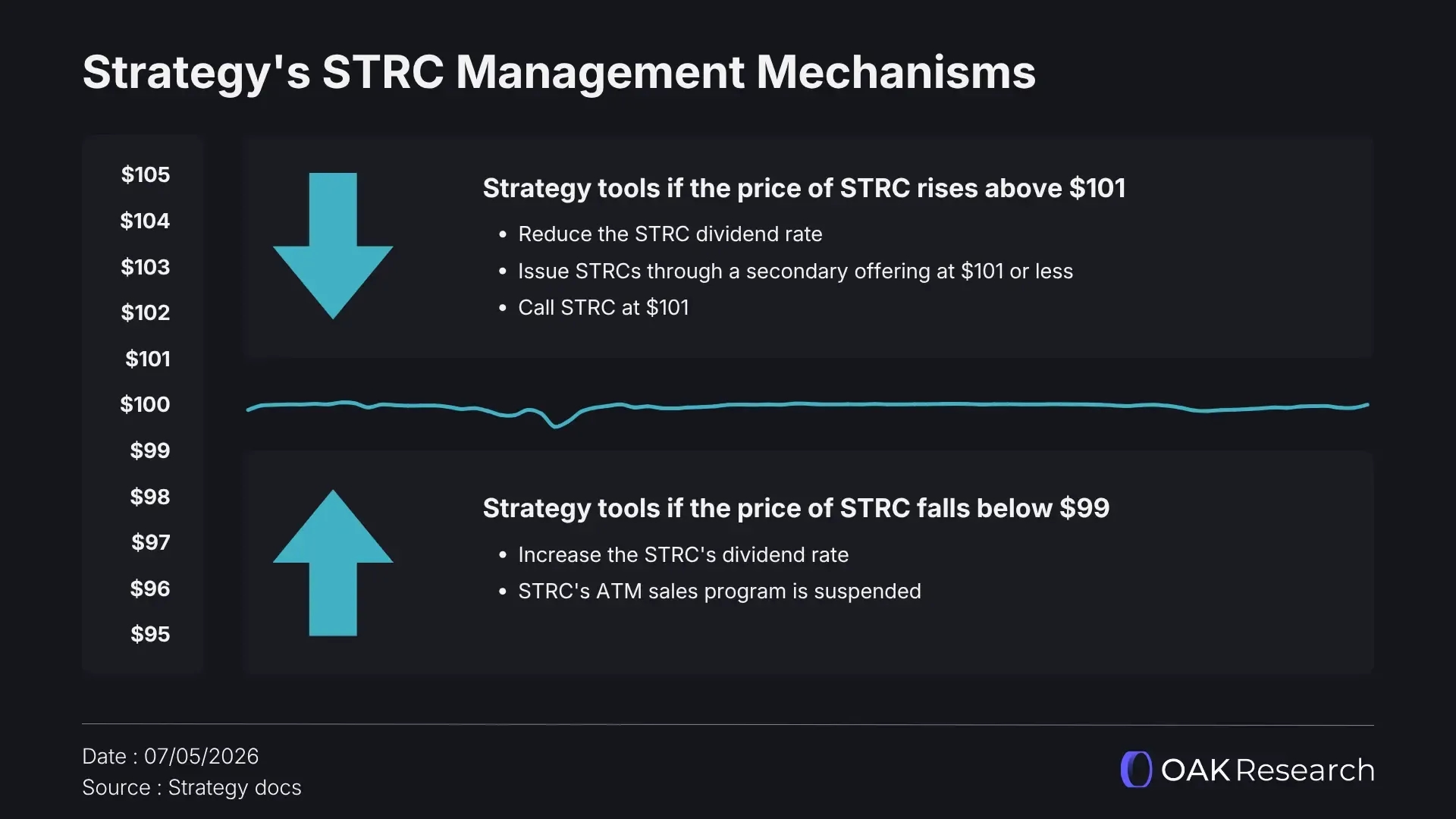
Second, the security is calibrated to trade close to $100 through a dual market and rate mechanism. When the price rises above $101, Strategy can lower the dividend rate, issue new shares via the ATM program, or exercise its redemption option at $101 plus accrued dividends.
These three levers limit the market’s incentive to value STRC sustainably above par. Issuance increases circulating supply, a lower dividend rate reduces the security’s relative attractiveness, and the $101 call creates an economic ceiling. Conversely, when the price falls below $99, the ATM program is suspended and the monthly dividend rate can be increased, making the security more attractive and creating a pullback force toward par.
This adjustment mechanism is not unlimited. Strategy cannot reduce the monthly rate by more than 25 basis points from one period to the next, plus a factor linked to 1-month SOFR, nor can it reduce the rate below SOFR itself. On the upside, no contractual ceiling is imposed. This asymmetry protects holders against an abrupt compression in yield.
Note: SOFR (Secured Overnight Financing Rate) is the U.S. interbank reference rate that replaced LIBOR in 2023, representing the cost of overnight secured borrowing collateralized by Treasuries.
Strategy has also published an indicative framework for its rate adjustment recommendations:
These recommendations remain subject to board approval, and the framework can be suspended or modified at any time.
Third, the dividend rate is high. Initially set at 9.00% at the July 2025 IPO, it was gradually increased to 11.50% annualized as of March 1, 2026. Over 30 days, STRC’s historical volatility stands at 3.1%, with a Sharpe ratio of 2.53, unusual figures for an instrument indirectly backed by Bitcoin.
STRC’s IPO, initially announced for 5 million shares, ultimately covered 28,011,111 shares at $90, raising $2.521 billion gross due to significant oversubscription.
This is where STRC analyses start to diverge. One clarification is necessary: Strategy does not issue STRC to pay STRC dividends. Proceeds from STRC issuances are allocated to Bitcoin purchases.
STRC dividends are mainly funded through the issuance of MSTR common stock. In practice, Strategy issues MSTR through its own ATM program when the mNAV is high enough for the transaction to remain accretive in BTC per share, and part of this capital is used to cover dividend obligations across the preferred stack. A dollar cash reserve, built to around $2.25 billion by the end of 2025 through MSTR share issuance, acts as a safety buffer.
Strategy’s prospectus also leaves open the possibility of using other capital instruments, including more junior preferreds such as STRD, to fund distributions. But in practice, the core mechanism remains the MSTR ATM and the USD reserve built through common share issuance.
Since Q1 2026, another channel has been explicitly added: Strategy reserves the right to sell part of its Bitcoin to fund dividends when it considers the transaction favorable for the company, meaning when it does not reduce the number of BTC per MSTR share.
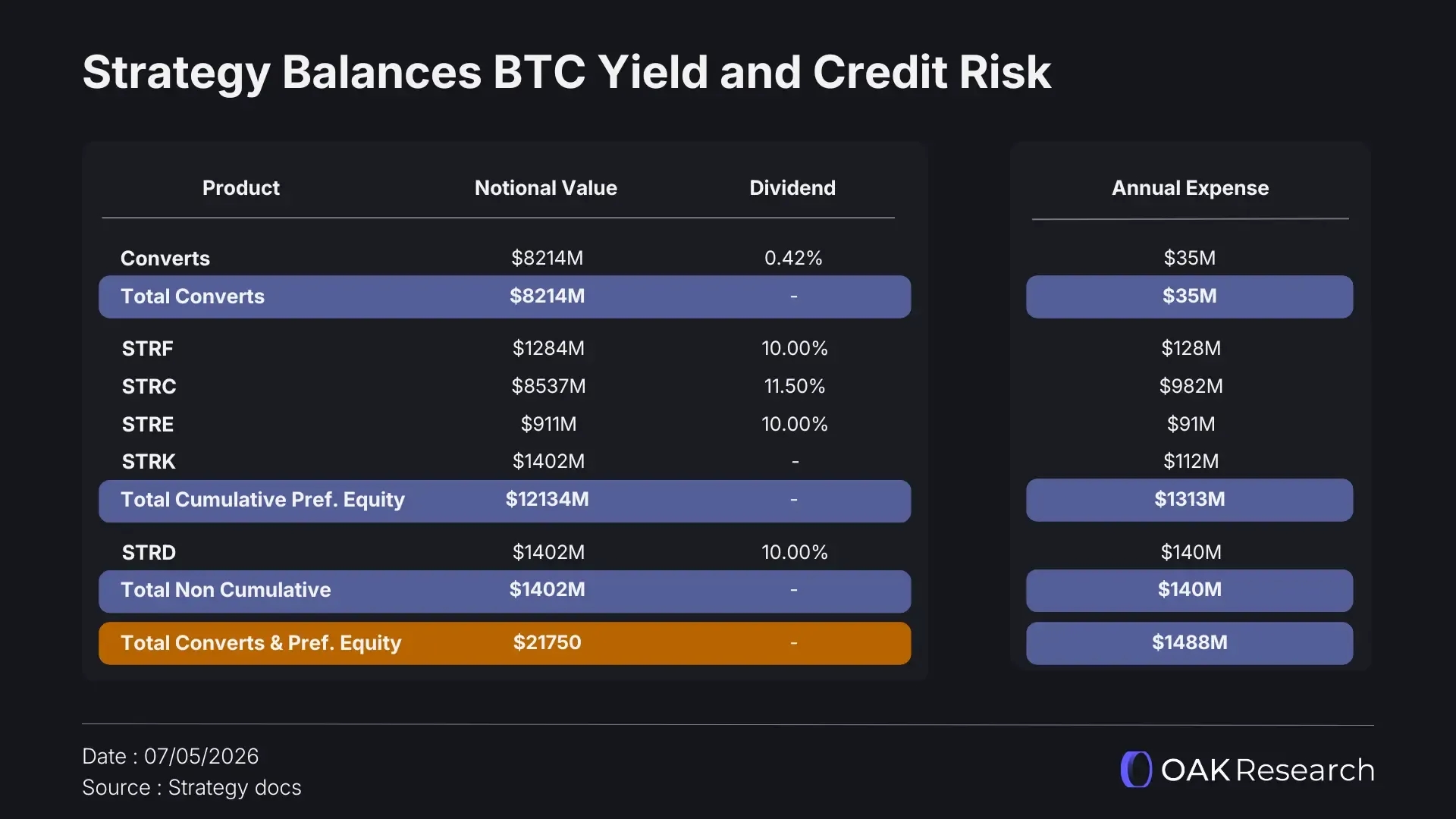
To frame the issue, Strategy’s capital structure looks as follows:
In short, Strategy carries around $12.13 billion of cumulative preferred equity, plus STRD and the residual value of convertible bonds, and must service approximately $1.488 billion annually. At this level, the USD reserve covers roughly 18 months of payments.
The real question is the following: why would MSTR common shareholders accept dilution to fund dividends for another category of investors, namely STRC holders?
The answer lies in the concept of accretive dilution. For an MSTR issuance intended to buy Bitcoin to be accretive in BTC per share, the mNAV must be above a breakeven threshold that incorporates all of Strategy’s senior obligations. At the time of the Q1 2026 earnings release, that threshold stood at roughly 1.22x.
The logic is mechanical: at 1.0x, the value of issued shares equals the value of the BTC purchased, but it does not offset the cost of preferred dividends and convertible debt, which capture part of the future value before common shareholders. This threshold evolves with the capital structure. Above 1.22x, each issued share is sold at a price above the economic value of the BTC it represents, after accounting for senior obligations.
This premium is not simply a premium on the BTC held on the balance sheet. If that were the case, it would be hard to justify sustainably, since investors can buy Bitcoin directly or through a spot ETF at lower cost. Strategy’s premium instead rests on the company’s ability to monetize its BTC reserve through the creation and issuance of financial products, reaching investors who would not buy Bitcoin directly while enabling accelerated BTC accumulation for common shareholders.
This is what distinguishes Strategy from a purely passive Bitcoin Treasury Company. A company that simply accumulates Bitcoin without actively monetizing its balance sheet looks more like a listed ETF. In that case, a durable mNAV premium is harder to defend, because the market is not paying for financial engineering capacity, but simply for indirect exposure to an asset that is already available elsewhere.
This premium makes dilution accretive: common shareholders, after preferred dividends are paid, mechanically see BTC per share increase, which Strategy measures through BTC Yield. For fiscal year 2025, this metric stood at 22.8%, within the communicated target range of 22% to 26%.
It is important to remember, however, that BTC Yield is not a yield in the traditional financial sense. Strategy defines it as the change in Bitcoin per diluted share, not as an income stream distributed to shareholders. In addition, this metric does not directly account for the fact that the BTC on the balance sheet remains subject to debt claims and preferred rights before benefiting common shareholders.
An amendment is currently being submitted to shareholder vote, with the vote closing on June 8, 2026. It aims to change the dividend payment frequency from monthly to semi-monthly, without modifying the 11.50% annualized rate. A first semi-monthly payment is expected on July 15, 2026 if the resolution is approved.
The logic behind this amendment is mechanical. Each month, after the ex-dividend date, STRC’s price drops by an average of $0.45 and takes roughly two weeks to return to $100. During this window, the security trades below par, which suspends the ATM program: Strategy can no longer issue STRC and therefore can no longer buy Bitcoin through this channel. With 12 annual cycles, this creates 12 monthly periods of forced inactivity.
Moving to a semi-monthly cycle cuts the amplitude of each post-ex-dividend drop in half and significantly reduces these inactivity windows. The objective is therefore twofold: keep STRC closer to $100 for longer, and keep the ATM program open for a larger share of the time.
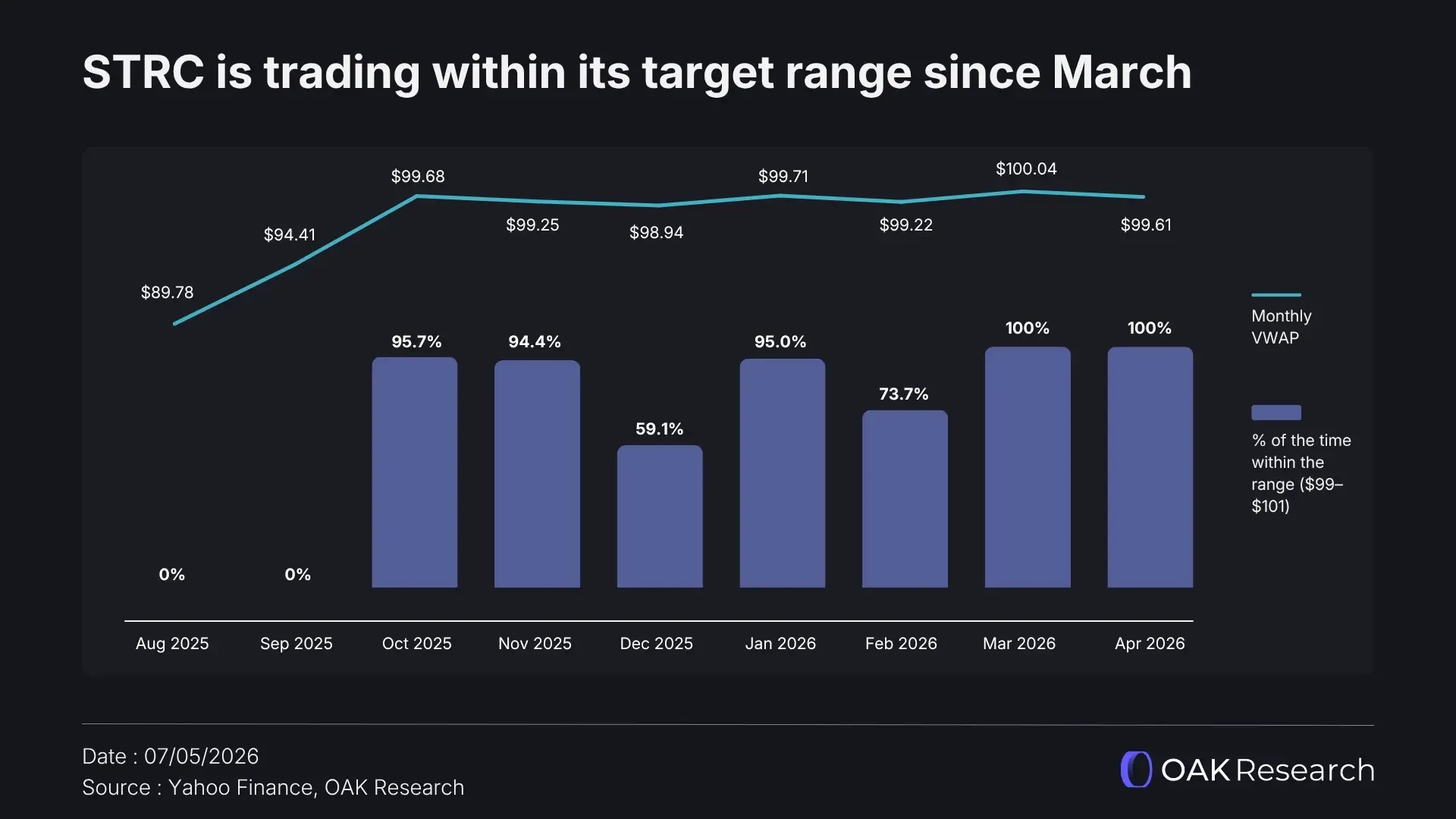
In Q1 2026, STRC traded 100% of the time within the target range of $99-101, compared with 22% in October 2025 and 49% in November 2025. Average daily liquidity increased by roughly seven times over five months, from around $54 million in December 2025 to $365 million in April 2026. Over the same period, the rate remained stable at 11.50%.
STRC serves several functions for Strategy at the same time. It opens access to an investor base distinct from MSTR’s. CEO Phong Le indicated that roughly 80% of STRC holders are retail investors, while MSTR is largely held by institutional investors seeking amplified Bitcoin exposure. By segmenting its capital, Strategy captures two types of demand without cannibalizing one with the other.
It also reduces dilution pressure on MSTR. As long as STRC trades at or above par, Strategy can raise capital without directly issuing common shares. In exchange, this structure creates a senior dividend obligation that captures part of the future value of the balance sheet before common shareholders.
Then comes the concept of amplification. Strategy distinguishes this amplification from traditional leverage: net leverage corresponds to the historical convertible debt relative to the value of the Bitcoin reserve, or roughly 9%. Amplification includes both convertible debt and preferred equity relative to that same Bitcoin reserve. It reaches 34%.
The distinction is central for MSTR shareholders. Traditional debt increases Bitcoin exposure but also creates a repayment obligation at maturity. If the market turns at the wrong time, the company must refinance or repay under unfavorable conditions. Preferreds do not impose principal repayment. They therefore allow Strategy to raise permanent capital to buy Bitcoin without creating a maturity wall comparable to that of convertibles.
For MSTR holders, the appeal is straightforward: if Bitcoin appreciates faster than the cost of preferred dividends, the surplus accrues to common shareholders through higher BTC per share. STRC therefore amplifies MSTR’s economic exposure to Bitcoin without directly increasing net leverage. In exchange, this structure adds a senior dividend burden that must be serviced before residual value flows back to MSTR holders.
STRC also materializes a carry trade. Strategy currently pays 11.50% on capital it converts into Bitcoin, an asset for which Michael Saylor projects a 29% annualized return over the next two decades. The spread between these two rates mechanically benefits MSTR holders through the increase in BTC per share.
As of May 5, 2026, Strategy held 818,334 BTC at an aggregate cost of $61.81 billion, or roughly $75,537 per BTC, representing nearly 3.9% of total supply.
The 42/42 plan, announced on March 23, 2026, includes $42 billion of additional ATM authorizations split equally between MSTR and STRC, with the explicit goal of acquiring 1 million BTC by the end of 2026. On the announcement date, Strategy held 762,099 BTC, implying the acquisition of roughly 240,000 additional BTC to reach the target.
Several protocols have also started integrating STRC into their reserves as a yield source. As of May 4, 2026, cumulative STRC AUM in on-chain finance is estimated at more than $270 million, compared with near-zero presence eight weeks earlier. The main vehicles include Apyx, Roxom through tokenized xSTRC, Hermetica, and Saturn Labs through sUSDat. On the traditional finance side, 21Shares launched an STRC ETP in Europe, and Strive filed for a U.S. ETF including STRC and SATA.
This on-chain integration creates a potential second flywheel. If stablecoins or on-chain finance protocols buy STRC as a reserve asset, they create marginal demand for the security. This demand allows Strategy to issue more STRC at par, and therefore buy more Bitcoin. But this loop also imports a new risk: stablecoin holders become indirectly exposed to Strategy’s economic solvency, STRC liquidity, and the price of Bitcoin, sometimes without fully understanding the entire dependency chain.
During the Q1 2026 earnings call, Strategy formalized an expansion of its capital markets toolkit. In addition to the three historical trades (selling MSTR to buy Bitcoin, selling MSTR to build a dollar reserve, and selling STRC to buy Bitcoin), the company can now execute several additional trades depending on market conditions.
The first consists of using part of STRC issuances to repurchase convertible debt rather than buy Bitcoin. Mechanically, this substitutes fixed-maturity debt with perpetual capital at an adjustable cost. The transaction reduces the 2027-2032 repayment wall, indirectly strengthening the perceived credit quality of STRC as its position in the seniority stack gradually improves.
The second consists of allocating part of STRC proceeds to the dollar reserve itself. Until now, this reserve had been built almost exclusively through MSTR issuance. The third is the formalization of the ability to sell Bitcoin to service dividends, including STRC dividends.
The company is considering tactical sales, especially of BTC with a high acquisition cost, to capture latent tax losses (estimated at roughly $2.2 billion of potential tax benefit). For STRC holders, this evolution broadens the range of available capital sources to service the dividend, reducing exclusive dependence on the MSTR channel and on the condition of an mNAV above 1.22x.
For investors, STRC offers an unusual profile in public markets. The current 11.50% yield compares with 4-5% on U.S. money market funds, 4-7% on investment-grade bonds, and 7-9% on high yield. The stated objective is to offer a higher yield than T-bills, CDs, or money market funds, with reduced volatility.
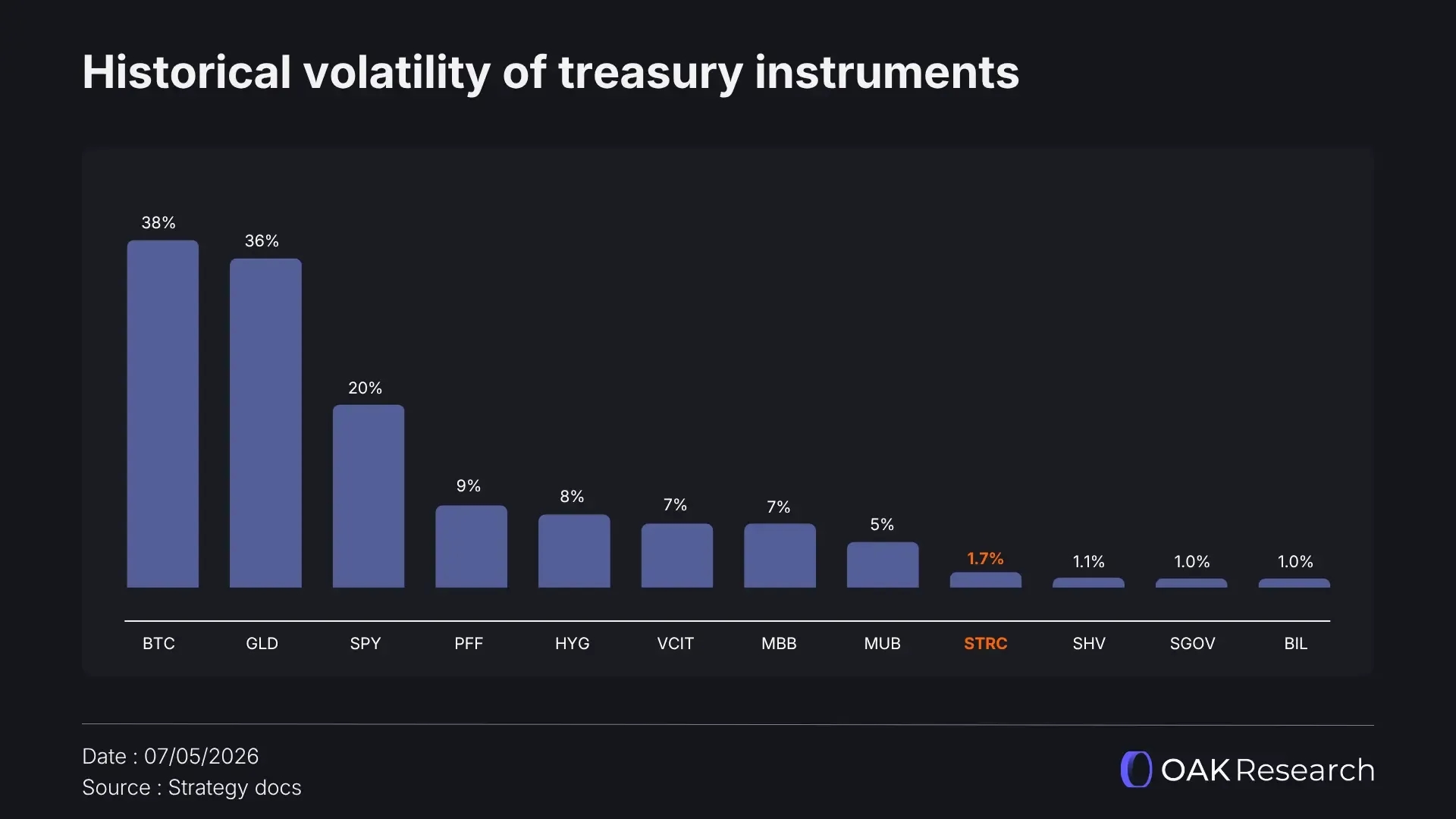
The 30-day volatility comparison helps define this positioning. Over the selected window, March/April, STRC showed 1.7% volatility, compared with 38% for Bitcoin, 36% for gold, 20% for the S&P 500, 9% for preferreds, 8% for high yield, and roughly 1% for major T-bill ETFs.
Over this period, the security therefore traded much closer to cash-like instruments than to the risky assets to which it is economically linked. This interpretation should remain cautious: the market history is short, and the observed low volatility does not constitute any guarantee of stability.
Liquidity is another argument. On a 30-day moving average, STRC shows roughly $375 million in daily volume, about 25 times the liquidity of Wells Fargo or Bank of America preferred shares. On April 13, 2026, it recorded a daily volume record of $1.156 billion.
Tax treatment is a significant advantage, but only for U.S. investors. 100% of the distributions paid in 2025 on its preferred equity were classified as Return of Capital (ROC) for U.S. taxpayers. Dividends are not taxed when received, but instead reduce the cost basis of the security, with taxation deferred until sale.
For an investor in the 37% marginal tax bracket, STRC’s tax-equivalent yield comes out to roughly 18.3%. In other words, to achieve an after-tax return equivalent to STRC through a traditional bond taxed as ordinary income, that bond would need to yield 18.3% gross.
This tax distinction directly changes the risk interpretation. A risky instrument compensated at 18.3% on a tax-equivalent basis does not have the same profile as a risky instrument compensated at 11.5% gross. For a U.S. investor, STRC can therefore be analyzed as a listed, liquid product, relatively stable over its recent history, offering a high yield and a particularly favorable tax deferral treatment.
For a European investor, the equation is different: the ROC advantage does not apply, and the effective return remains subject to local regimes applicable to foreign dividends. The Strategy/BTC risk is therefore compensated by a potentially much less attractive net yield.
More broadly, STRC does not stand out only through its nominal yield, but through its risk-adjusted yield. STRC’s 30-day Sharpe ratio stands at 2.53, compared with 0.66 for high yield, 0.26 for investment grade, 0.22 for bank preferreds, and -0.14 for T-bills. In other words, over the observed period, STRC delivered significantly more return per unit of volatility than major traditional credit instruments.
For investors, this is the core argument: if the security remains close to par, the dividend is paid, and liquidity remains deep, STRC becomes a highly efficient instrument from a risk/reward perspective. But this metric must still be interpreted carefully: the market history is short, Strategy/BTC risk remains specific, and the Sharpe ratio can deteriorate quickly if the price breaks down or if confidence in the dividend fades.
It is also important to avoid a confusion widely reinforced by the founder’s communications. Strategy compares STRC to short-term cash instruments, but it is not a money market fund, not a bank deposit, and not a Treasury bill. STRC is not regulated like these instruments and does not benefit from the same protections. The superior yield therefore compensates a specific Strategy/BTC risk, not simply a market inefficiency.
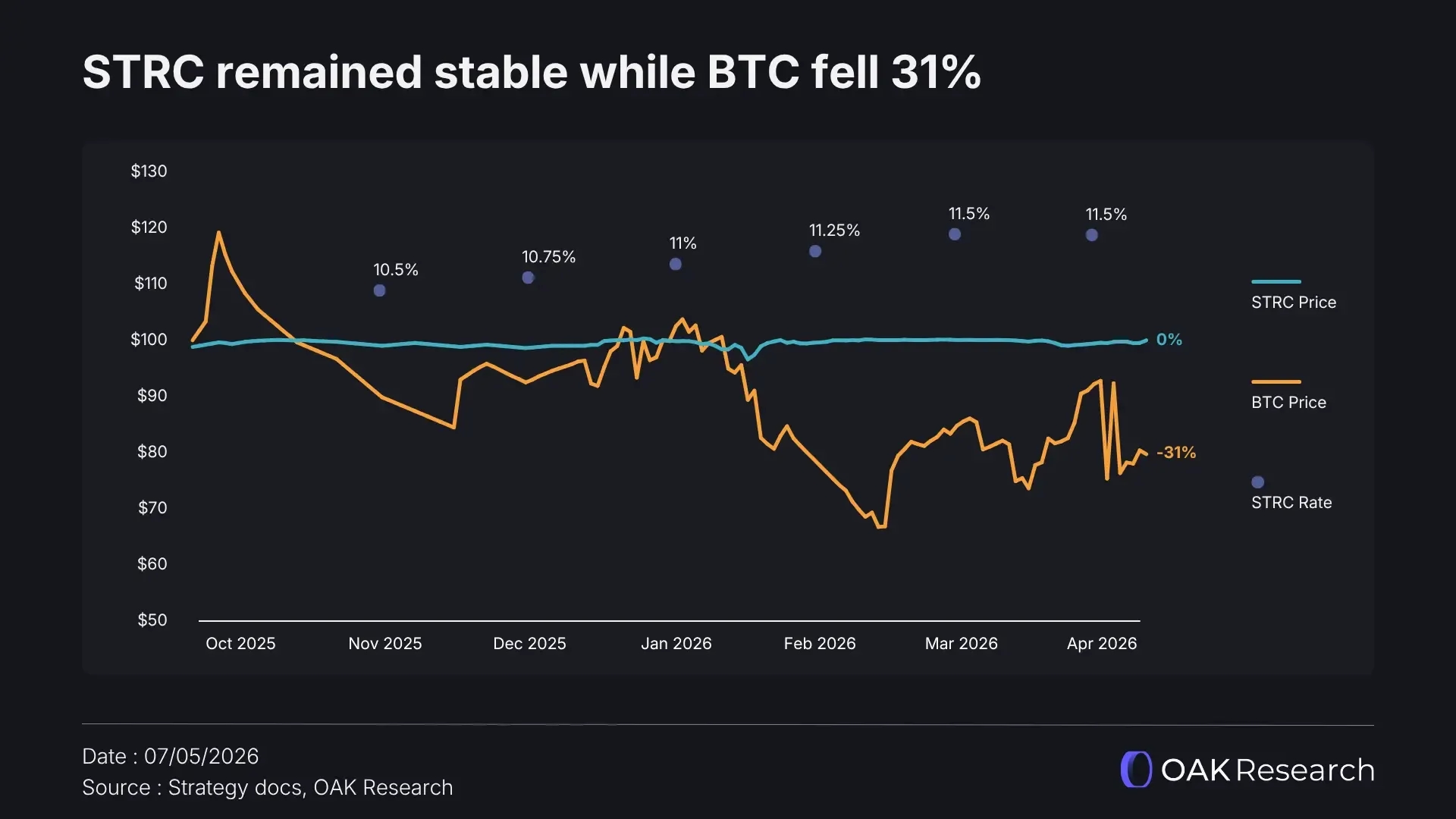
STRC’s performance during the last Bitcoin drawdown strengthened its perception by the market. Between early October 2025 and early May 2026, while Bitcoin declined by roughly 37%, STRC remained close to par and paid around 6.4% in cumulative dividends over the period. This disconnect between the trajectory of the underlying asset and the behavior of the security is the main argument in Strategy’s communication around STRC, though it still needs to be validated over much longer cycles.
As of April 30, 2026, STRC was the second-largest holding in BlackRock’s iShares Preferred and Income Securities ETF, the world’s largest preferred ETF with roughly $14 billion in assets under management, representing 2.48% of the ETF. It was also the second-largest position in the VanEck Preferred Securities ex Financials ETF, at 5.92%.
Several corporate treasuries also publicly announced STRC allocations between February and March 2026, with amounts of $80 million, $50 million, $10 million, and $10 million. Strategy estimates that around 3 million households benefit from STRC based on aggregated brokerage data, and around 120,000 accounts hold it directly at the retail level.
The functioning, and therefore the success, of the STRC model rests on three simultaneous conditions, each representing a vulnerability that needs to be highlighted.
The first is continuous access to STRC capital markets. If the market were to durably refuse to absorb issuances at $100 or above, Strategy would lose its accumulation channel that does not directly dilute MSTR.
The second is maintaining an mNAV above the MSTR breakeven threshold, around 1.22x as of Q1 2026. This is the main channel for covering dividends. If the mNAV durably falls below this threshold, the arithmetic reverses: issuing MSTR shares to fund STRC dividends becomes dilutive in BTC per share. Strategy must then rely on the cash reserve or partial Bitcoin sales.
Strategy’s historical communication on this point needs to be nuanced: while Michael Saylor has repeatedly stated that the company would never sell Bitcoin, SEC filings and public statements from Phong Le explicitly reserve the company’s right to do so. During the Q1 2026 earnings call, as mentioned above, Strategy recently clarified its position: the company explicitly reserves the ability to sell Bitcoin when doing so is considered advantageous, particularly to fund dividends, strengthen the USD reserve, or repurchase debt if the transaction is accretive to BTC per share.
The third factor is the evolution of the cost of capital. The dividend rate is variable and increased from 9.00% to 11.50% in eight months. If Strategy had to keep raising it to support the price, the total annual burden could reach levels that make the carry trade less efficient. The $2.25 billion reserve covers roughly 18 months of uninterrupted payments, which is a meaningful but not unlimited buffer.
Strategy nevertheless defends a specific interpretation of STRC’s real economic cost. The company emphasizes that STRC is not a loan but a perpetual, where the issuer pays SOFR plus a credit spread adjustable monthly. Strategy therefore has two options: reduce the credit spread over time, and benefit from a floor at SOFR without being able to go below it.
On this basis, the company estimates a blended cost of around 8.75% over 20 years, rather than the 11.50% currently in place. This estimate remains illustrative and depends on the actual path of SOFR, which has historically fluctuated between roughly 25 and 500 basis points.
These risks are compounded by concentration in a single volatile asset. Strategy remains a listed company whose economic value depends overwhelmingly on Bitcoin. This concentration creates a classification risk: the more the software business becomes marginal in the company’s real economics, the more Strategy may be perceived by index providers as a digital asset holding company rather than a traditional operating company.
This is precisely what fueled concerns around MSCI in late 2025. MSCI had considered excluding Digital Asset Treasury Companies from its indices, defined as companies whose digital assets represent at least 50% of the balance sheet. An exclusion of Strategy could have triggered several billion dollars of forced selling by passive funds.
In January 2026, MSCI ultimately decided not to proceed with immediate exclusion and kept DATCOs in its indices for the February 2026 review, while launching a broader consultation on how to treat non-operating companies resembling investment funds.
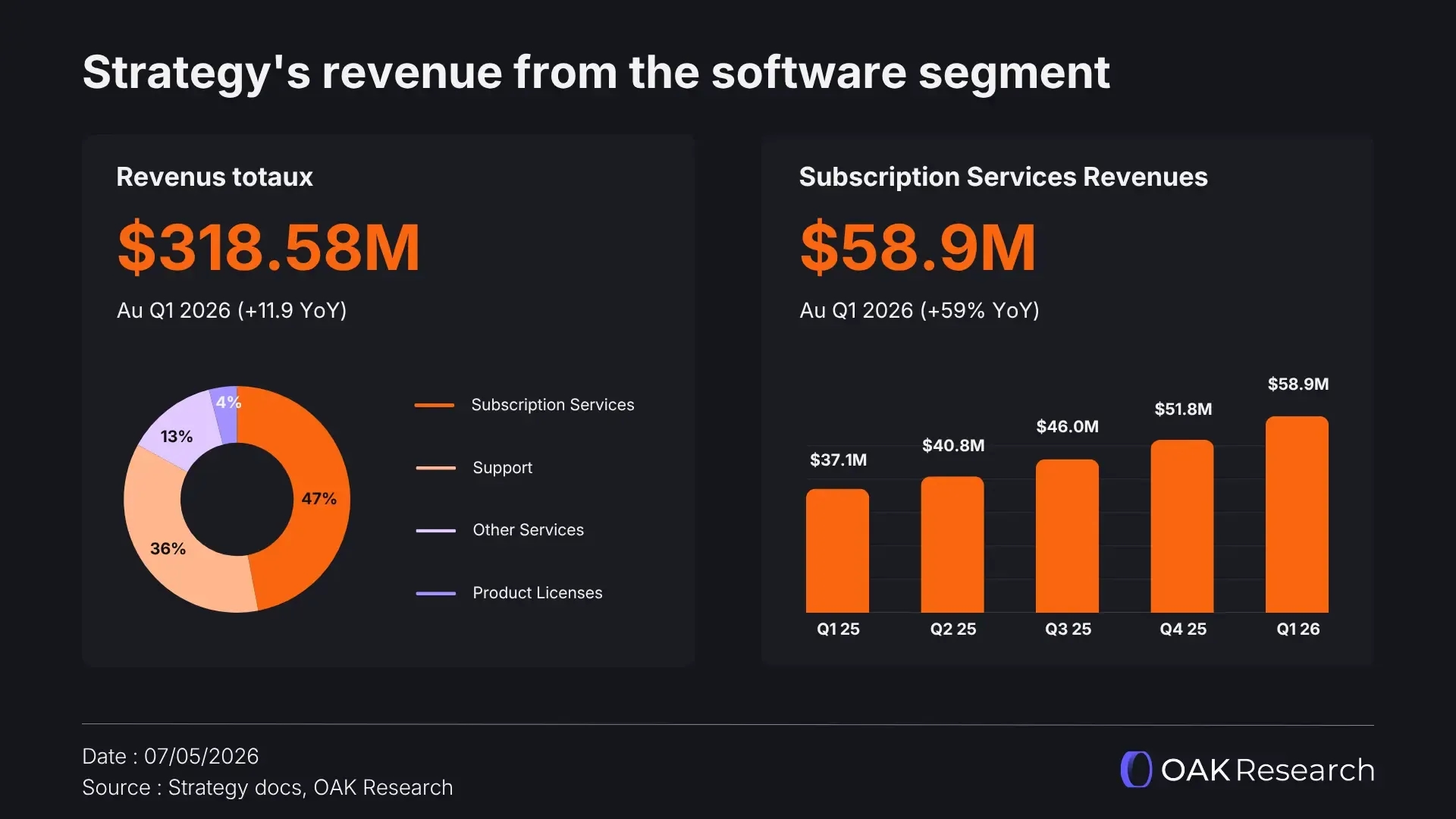
In this context, Strategy’s software business retains value beyond its direct economic contribution. Even if it represents only a limited fraction of the group’s value, it continues to support the argument that Strategy remains a listed operating company, not merely a passive financial vehicle backed by Bitcoin. This argument does not eliminate reclassification risk, but it remains central to the company’s methodological defense with index providers.
For STRC holders, the most immediate risk is not default, but a loss of confidence in the stability of the dividend. The mechanism that keeps the price around $100 is not based on any contractual obligation. Strategy retains full discretion over the dividend rate and is not legally required to maintain STRC within the $99-101 range.
A deep price break would trigger a natural arbitrage mechanism: since the monthly dividend is calculated on the $100 stated value regardless of market price, a security trading at $80 implies an effective yield of 14.4%, and a security trading at $50 implies a yield of 23%. This convexity creates a pullback force, but it is conditional on confidence in the sustainability of the dividend and available liquidity.
The problematic scenario lies mainly in a durable confidence crisis. In that case, raising the dividend rate to support the price increases the annual burden to be serviced. And if STRC durably trades below par on the secondary market, the primary issuance channel effectively closes: no rational investor will buy a security at $100 in a primary issuance if the same security trades at $80 in the market.
STRC liquidity also has a reflexive nature: it is deep as long as the security is perceived as stable and supported. It could contract precisely when it is most needed, in the event of a sustained break below par, stress on MSTR, or a sharp Bitcoin correction.
Holders also bear subordination risk. In Strategy’s capital structure, not all securities have the same priority rank. In the event of liquidation or forced distribution, creditors and more senior holders are paid first, while more junior layers absorb losses last.
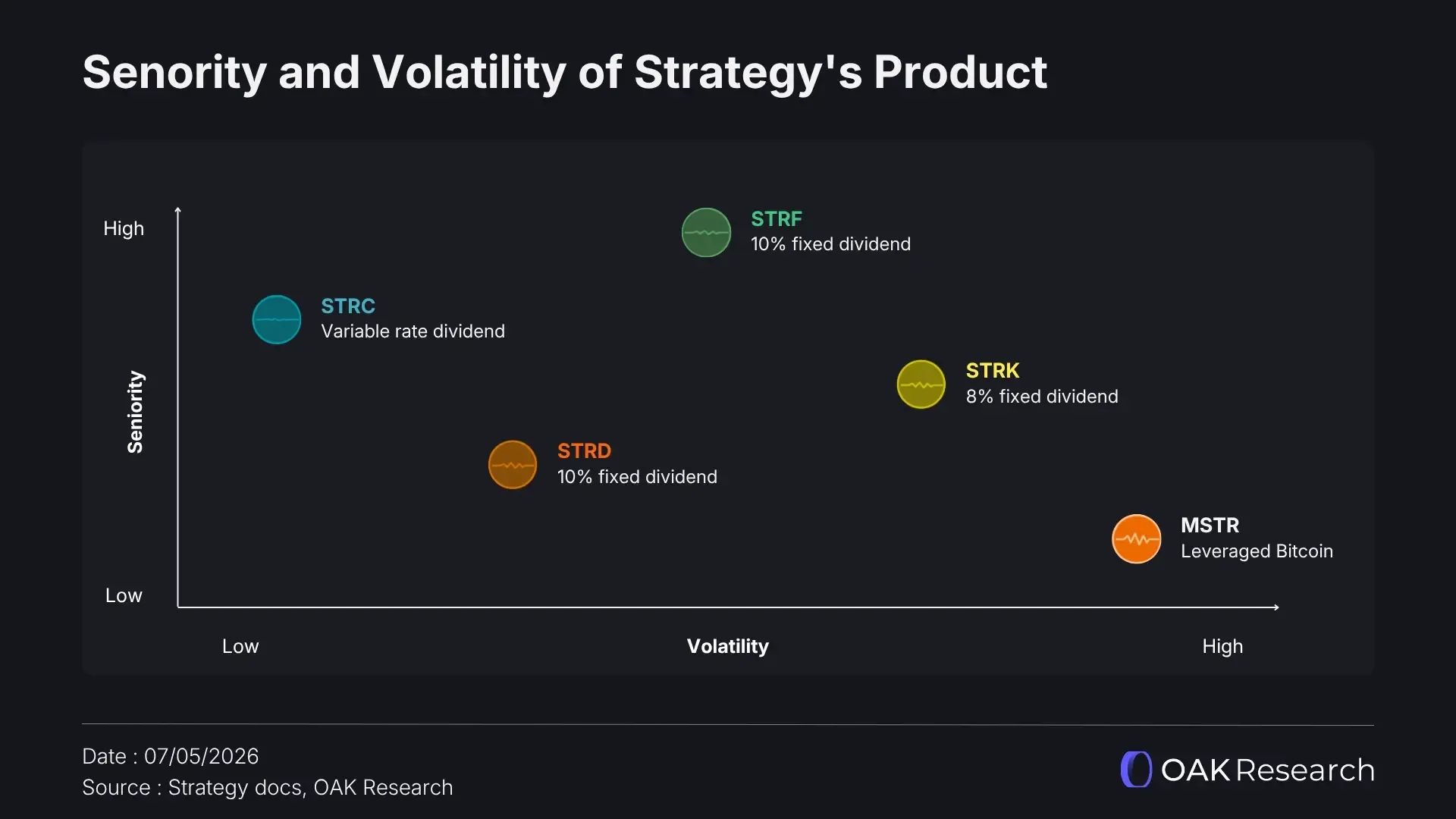
In this hierarchy, convertible debt sits above the preferreds. Within the preferred stack, STRF is the most senior, followed by STRC, then STRK and STRD, while MSTR common shareholders sit at the bottom of the structure. STRC therefore benefits from relative protection due to the existence of more junior layers below it, but it remains subordinated to convertible debt and STRF.
Finally, it is important to clarify that Strategy’s preferred securities are not collateralized by the company’s BTC: they do not provide a direct claim on specific BTC, but rather a preferential claim on the company’s residual assets according to their rank in the capital structure.
In late April 2026, Peter Schiff called STRC “the most obvious pyramid scheme that has ever existed,” criticizing the SEC for allowing it to be marketed. His central argument was that “the 11.5% yield is paid by selling more STRC shares, and money from new investors is used to pay old investors.”
This interpretation is factually incorrect. As documented above, STRC dividends are not funded by issuing new STRC. Strategy’s prospectus states that these dividends are mainly funded through MSTR common stock issuance, supplemented when needed by Bitcoin sales depending on the state of the mNAV.
A Ponzi scheme has three converging characteristics: a yield promise not backed by a real asset, opacity designed to hide the mechanics, and a principal repayment obligation dependent on incoming flows.
STRC has none of these three characteristics. Strategy holds 818,334 BTC on its balance sheet, or roughly $7.3 of Bitcoin for every $1 of STRC notional issued, although this asset does not constitute legal collateral for STRC. Holders have a preferential claim on the company’s residual assets, not a direct right to specific BTC. The entire mechanism is disclosed in prospectuses and weekly 8-K filings with the SEC. There is no principal repayment obligation.
The more rigorous critique is therefore not “STRC is a Ponzi,” but “STRC is a reflexive structure.” Its sustainability depends on the simultaneous maintenance of three market premiums: an mNAV premium on MSTR, a confidence premium on STRC, and a growth premium on Bitcoin. As long as these three conditions hold, the structure can remain accretive for common shareholders. If they deteriorate together, the mechanism enters a much more constrained regime: ATM issuance shuts down, the cash reserve is consumed, the cost of capital rises, and BTC sales begin.
Schiff does, however, make one mathematically valid point: each additional tranche of STRC issued proportionally increases annual obligations to be serviced, and therefore requires more Bitcoin performance to remain economically neutral. If Strategy fully executes the 42/42 plan and increases STRC notional from $8.5 billion to around $30 billion, annual dividends would rise above $3.4 billion, assuming the rate stays unchanged at 11.5%.
At that level, covering the burden through MSTR dilution would require market conditions materially more favorable than today. This is where the critique remains analytically relevant.
Strategy’s BTC Breakeven ARR is currently around 2.3%. At this point in time, if Bitcoin grows at a pace above that threshold, the company could theoretically cover its dividends indefinitely by selling that fraction of its reserve, even without relying on capital markets. The fundamental issue therefore remains a bet on Bitcoin’s long-term performance.
STRC is the most sophisticated financial instrument issued to date by a Bitcoin Treasury Company. It combines features associated with fixed-income products, cash dividends, targeted low volatility, and deferred tax treatment for certain U.S. investors, with a stabilization mechanism that resembles a listed cash-like product, or a stablecoin, without actually being one.
For Strategy, it solves the fundamental constraint that convertibles could not address: raising capital at scale without principal repayment maturity. But this capital is not neutral. It transforms a portion of the Bitcoin exposure into senior preferred dividends, which must be paid before residual value flows back to common shareholders.
This logic now extends beyond Strategy itself. Other Bitcoin Treasury Companies are trying to replicate parts of this architecture, such as Strive, which launched SATA as a digital credit instrument inspired by the STRC model. The economic principle is the same: for a company structurally bullish on Bitcoin, it can be rational to raise capital at a fixed or quasi-fixed cost and convert it into Bitcoin if the underlying asset is expected to appreciate faster than the cost of capital. This is the carry trade logic applied to Bitcoin Treasury Companies.
The model’s sustainability is not fraudulent by design, it is reflexive in operation. As long as the mNAV remains above the breakeven threshold (around 1.22x in Q1 2026), STRC stays close to par, and capital markets remain accessible, the flywheel can operate accretively. If these conditions deteriorate simultaneously and durably, the issue will not be an immediate collapse, but a transition to a more constrained regime: reduced issuances, higher cost of capital, consumption of the USD reserve, and partial Bitcoin sales, potentially damaging market confidence and feeding back into both STRC and MSTR common stock prices. This is the risk attached to STRC’s yield.
The risk profile also depends on the investor’s jurisdiction. For a U.S. taxpayer benefiting from Return of Capital treatment, STRC offers a tax-deferred yield that significantly improves the perceived net return. For a European investor, the equation is different. The same instrument therefore does not offer exactly the same risk/reward profile depending on whether the holder benefits from this tax advantage.
Ultimately, everything rests on the same variable: Bitcoin’s trajectory. The real question is whether the model can remain economically viable with a capital charge now approaching $1.5 billion per year. For the equation to hold, Bitcoin must continue to appreciate sufficiently, and MSTR must maintain an mNAV above its breakeven threshold, which depends on the capital structure, so that common share issuance remains the most accretive channel for funding dividends. Below that threshold, Strategy has explicitly indicated that it would favor other trades, including partial Bitcoin sales.
Kinetiq (KNTQ), Bitcoin (BTC)

Bitcoin (BTC), Ethereum (ETH)

Bitcoin (BTC), Ethereum (ETH), Zcash (ZEC)

Bitcoin (BTC), Ethereum (ETH)