


Market Briefing 13: Bitcoin (BTC) Breathes as Expected, Altcoins Struggle but One Signal to Watch on TOTAL3


Bitcoin (BTC), Ethereum (ETH), Derive (DRV)
Published on

Derive accounts for nearly 75% of on-chain options notional volume, with $14.2 billion traded since January, 2.6 times its total for 2025. But the real question isn't whether it dominates its sector. It's whether its liquidity constitutes a genuine moat, just like Hyperliquid's in perps.
In the first article in this series, we traced five generations of failures in the on-chain options sector and showed that the problem was never really technical. Protocols built AMMs, order books, vaults, and even options without expirations, but they all faced the same problem: nobody could attract professional market makers.
Derive, formerly Lyra, is the only protocol to have overcome this obstacle. The 2026 numbers speak for themselves: $14.22 billion in options notional volume since January, 2.6 times the full-year 2025 total; 88.1% of premiums paid on on-chain options platforms; and a record September with $3.43 billion. Derive already surpassed $1 billion in notional volume in the first week of October alone.
This trajectory obviously brings another story to mind. Perp DEXs had existed since 2017 and remained marginal for years, until Hyperliquid took the sector from 3% to more than 13% of centralized exchange volume in a single year. It wasn't the interface or the token that made this happen, but the ability to attract liquidity and, above all, retain it.
That's exactly what we explained in our research on the “AWS of liquidity”. Hyperliquid first built infrastructure capable of supporting an on-chain order book, then bootstrapped its liquidity with HLP until leaving became difficult, before opening that liquidity to builders with Builder Codes, CoreWriter, and HIP-3.
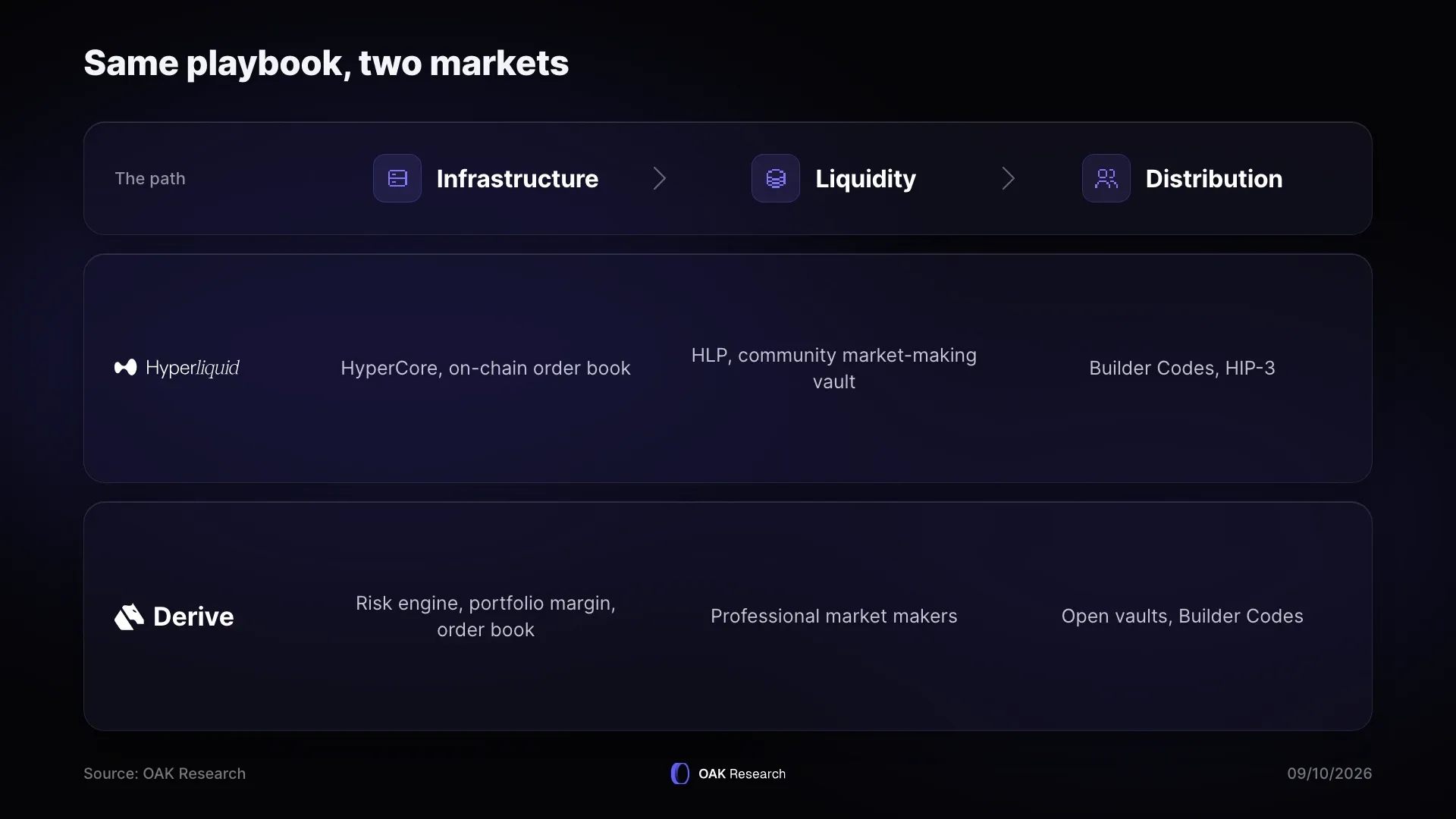
Our thesis is that Derive is following the same sequence, but in a market where every step is harder. And it just passed a major milestone on October 6, 2026, with its V3 migration: abandoning its own blockchain for a zero-knowledge application that settles directly on Ethereum, with the stated ambition of becoming the options engine that other applications plug into.
We'll therefore examine the three components supporting this thesis: the risk engine, which makes market making viable; the order book and RFQ system, which determine where liquidity comes from; and V3 with Builder Codes, which determine who will bring in users. But above all, we'll answer one question: can Derive follow in Hyperliquid's footsteps, this time for options?
Unlock all our research and get the right insights, at the right time.
Liquidity is the name of the game in on-chain finance. Protocols emerge, attract liquidity through incentives, and then watch users migrate as soon as a better opportunity comes along. If this already happens in perps or lending, imagine how much worse it gets with options, where three product-specific constraints compound the problem.
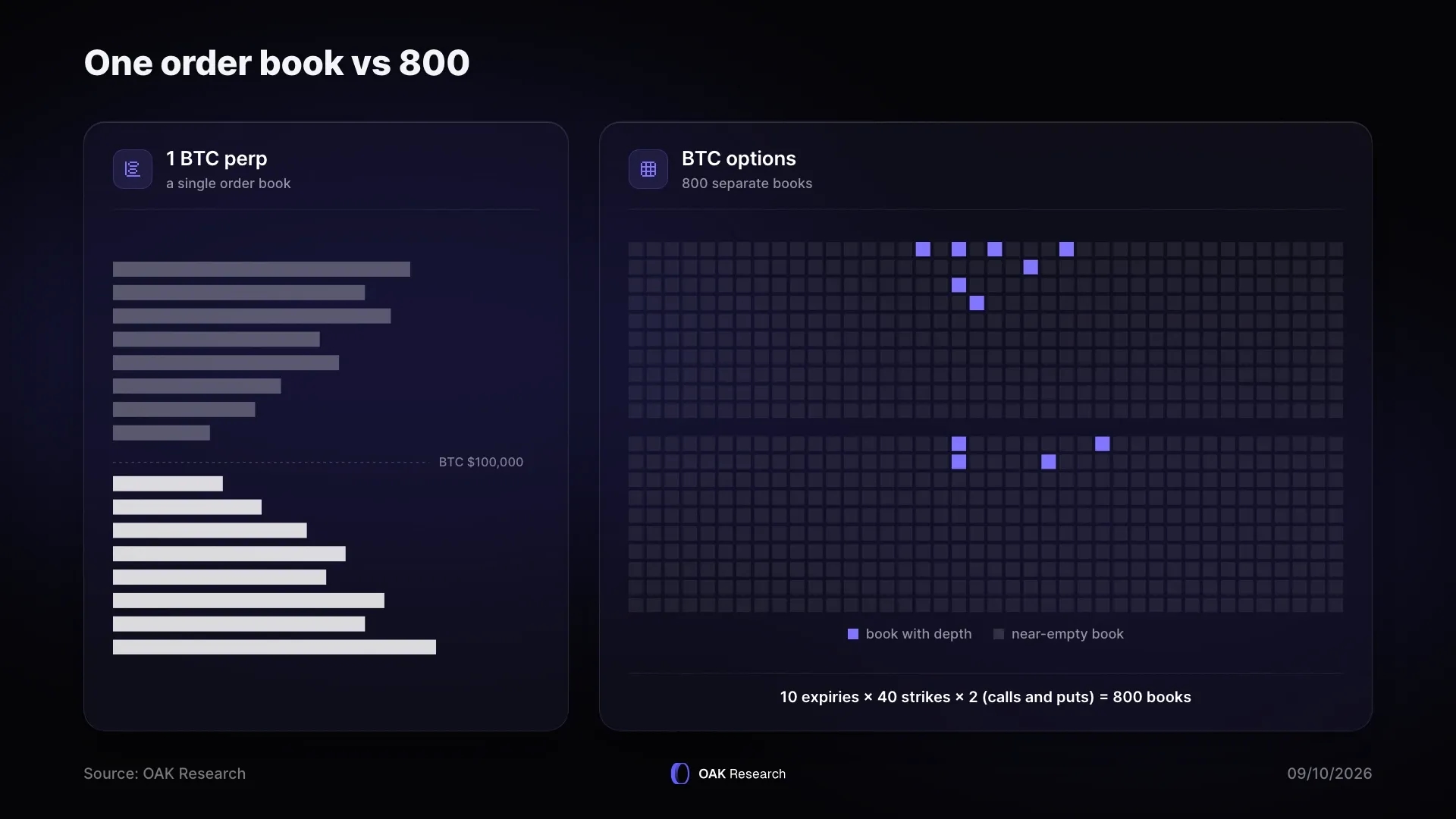
First, liquidity is fragmented. A BTC perp has one order book. A BTC options market has roughly ten expirations multiplied by around forty strikes, doubled for calls and puts, or approximately 800 separate instruments. The same liquidity that would make a deep perp market ends up spread across 800 tiny order books.
Second, you have to price a variable nobody can directly observe. A perp needs a spot price, which an oracle provides. An option needs implied volatility for each strike and expiration, updated with every market move. A professional market maker therefore recalculates quotes continuously, and every pricing error is immediately exploited.
Finally, and most importantly, selling an option ties up substantial capital. Selling a fully collateralized BTC call theoretically locks up the full value of 1 BTC in exchange for a premium worth just a few percent of the position. No professional operates this business at that price.
Derive's story is essentially five years of trying to solve this problem. In August 2021, Lyra launched an options AMM on Optimism. With no market makers interested, the protocol became the counterparty itself, using depositors' capital, an options pricing model based on Black-Scholes, and automatic hedging of its directional exposure through Synthetix.
In June 2022, Avalon introduced partial collateralization, allowing option sellers to write four to five times as many options with the same capital. Then, in January 2023, Newport moved hedging to GMX perps and replaced synthetic collateral with cash.
But the AMM still ran into the same ceiling that held back perp AMMs for years: it simply wasn't efficient enough to handle large position sizes. In 2023, the Derive team publicly acknowledged turning down orders for options on 1,000 to 10,000 ETH because it couldn't absorb them.
So at the end of 2023, Derive changed course. It was time to stop trying to replace market makers and actually bring them in. That was the entire ambition behind V2: a conventional order book, off-chain matching for speed, and on-chain settlement for custody, all on an OP Stack blockchain. More importantly, this is where the real subject of this article begins.
In December 2023, Derive deployed V2. The protocol moved away from the AMM as its main source of liquidity and switched to a conventional order book, with off-chain matching for faster execution and on-chain settlement for custody, all on a blockchain built with the OP Stack. This was a major step toward a more professional technical stack.
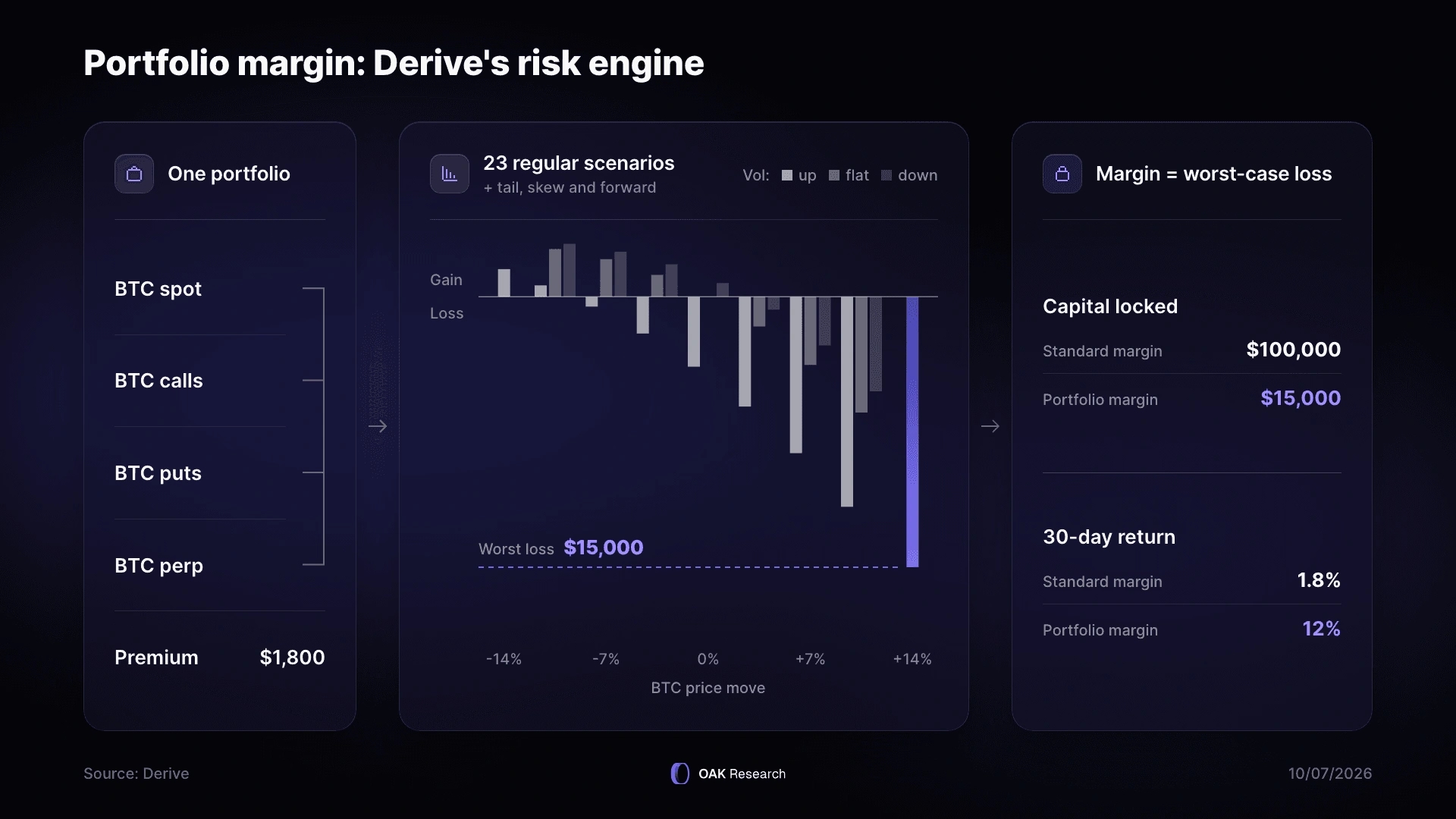
But the most important milestone came in February 2024, with the missing piece the industry had needed since 2019: portfolio margin. To be clear, Derive offers two margin calculation modes. Standard margin, used by default, evaluates each position in isolation. Portfolio margin, which users have to enable, evaluates the entire portfolio, runs it through a series of market scenarios, and uses only the worst modeled loss. This second mode is the one that matters to market makers.
The main grid includes 23 scenarios combining price and volatility shocks, ranging from −14% to +14% for BTC. Eight extreme scenarios, skew shocks, and a forward scenario are added, and the worst of those four results becomes the collateral requirement. Beyond this calculation, the risk engine also handles position valuation using price and volatility oracles, additional margins to cover risks the scenarios don't capture, and liquidations.
Note: V3, deployed on October 6, 2026, adds risk universes that isolate assets from one another: Prime for BTC and ETH, a dedicated HYPE universe, an Alt universe for SOL, XRP, ZEC, and DOGE, and an RWA universe for tokenized gold. A portfolio-margin subaccount can now hold multiple currencies, although worst-case losses are still calculated currency by currency and then added together. We'll cover this in an upcoming dedicated article.
In our view, this technical detail marks the real turning point in Derive's evolution. As we explained in the first article, a new risk engine that only requires option sellers to post a fraction of notional value as collateral can massively increase returns and finally make the activity genuinely attractive.
Let's revisit the BTC call seller example we've discussed several times, with BTC trading at $100,000. If the position had to be fully collateralized, the seller would lock $100,000 to collect a $1,800 premium, or a 1.8% return over the month. That doesn't interest any professional. With an engine that covers only the worst plausible move before liquidation, the same trade ties up only a fraction of the notional, and the return rises to around 12%.
The benefit is even clearer with a real portfolio. A market maker who sells an ETH call and buys an ETH perp as a hedge would, in a conventional system, need collateral on both positions, even though the risks partially offset each other. The portfolio engine only considers net risk, making it possible to hold positions across hundreds of strikes and expirations simultaneously, with a single hedge offsetting the whole portfolio.
In other words, for once, the risk engine doesn't make the product better for the trader. It clearly makes it better for market makers, because their business finally becomes profitable. This is the prerequisite for everything that follows, and it also explains the V2 architecture. Running such a risk engine on Ethereum was too expensive, so Derive decided to build its own blockchain. Not to improve order book performance, since matching was off-chain anyway, but specifically to host its risk engine.
The rest followed quickly: Lyra rebranded as Derive in August 2024, DRV launched in January 2025, and Derive made a $27 million acquisition offer for Synthetix in May 2025, eventually withdrawing it after criticism from both communities. By then, the protocol had had the right architecture for almost two years, yet volumes remained modest. So what was missing was no longer technical.
It took until October 2025, more than four years after Lyra's launch, for a publicly identified institutional market maker to agree to quote on Derive. That was FalconX, and the details of the announcement are worth examining because they reveal a lot about the balance of power. FalconX did not place its collateral on Derive Chain; it kept it on its own side, with its position represented on-chain as fxUSDC. Derive therefore had to adapt its product to the market maker's constraints, not the other way around.
Then there are the direct incentives paid by Derive, which are anything but symbolic. Its institutional program distributes up to 500,000 USDC in rebates and 1 million DRV per 28-day period, allocated according to a market-making score rewarding market coverage, quote quality, and RFQ responsiveness. The largest liquidity providers can also earn negative maker fees of up to −0.005% on options, meaning the market maker gets paid to quote instead of paying to trade.
Timing played an important role in attracting that first market maker, too. The October 10, 2025 crash, which triggered around $19 billion in cascading liquidations (and probably more in reality), dried up two major sources of institutional yield: the basis trade and pre-launch token farming. Sometimes one person's loss is another person's gain.
Derive CEO Nick Forster recently summed this up on the Bankless podcast, explaining that selling options had become one of the few ways to generate sustainable yield at scale. In other words, demand from option sellers arrived on its own at the exact moment the infrastructure was finally ready to accommodate it.
Derive's liquidity currently comes from two channels. The central order book, populated by professional market makers quoting the volatility surface. And RFQ, where a trader requests a price for an entire structure, sometimes involving multiple legs, and market makers compete to respond. The latter handles large orders: institutional block trades go through this channel.
The first channel is the central order book, populated by market makers quoting continuously. The institutional program specifies that, to receive rewards, a market maker must display a minimum size of $500 per quote on options with deltas between 1 and 98. Performance is assessed using random snapshots of the order book taken within fifteen-minute windows.
There are also eligibility requirements: more than $50 million in notional volume over 28 days and a market share above 2%. In other words, this isn't about placing a few opportunistic orders. It's about continuously quoting the entire surface.
The second channel is RFQ, or request for quote. Instead of trading through the order book, a trader describes the structure they want to execute, sometimes with multiple legs, and submits it to all market makers, who compete to quote it. Execution is atomic: either all legs execute together or none do, avoiding a situation where a strategy is only partially executed. This is where large institutional trades take place.
Derive scores market makers based on the difference between their quoted price and the worst price the trader was willing to accept, as well as their response speed, with the highest score awarded for an initial quote in under five minutes. Most importantly, on every executed RFQ, the winning market maker receives a 1.2x score multiplier, while other respondents retain a 0.5x multiplier. The protocol therefore rewards quoting even without winning the trade, which is exactly what's needed to ensure traders receive multiple competing prices for their requests.
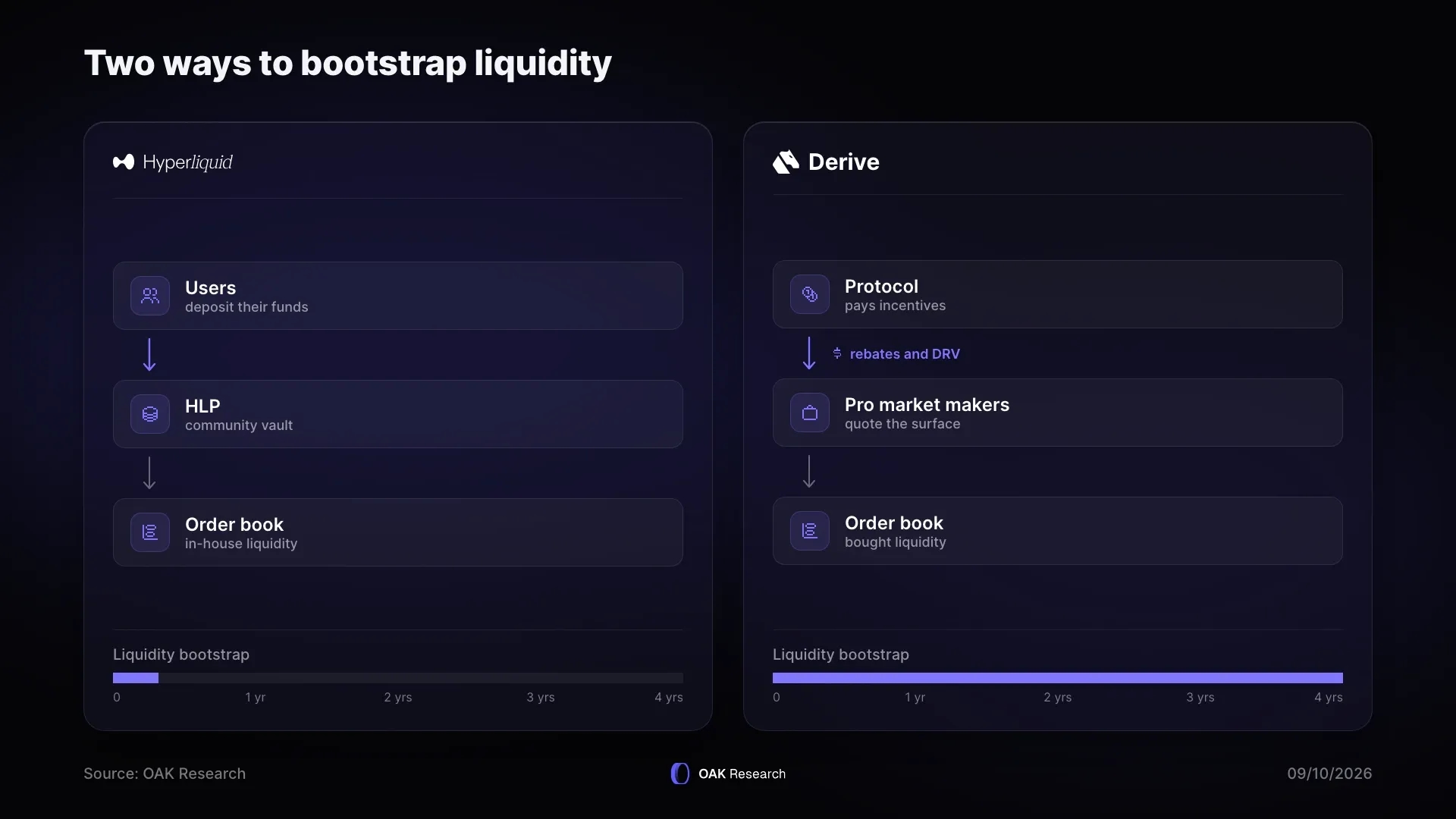
This is where the comparison with Hyperliquid gets interesting. Both protocols have solved the same problem in opposite ways. To address its empty order book, Hyperliquid created HLP, a community vault anyone can deposit into that acts as the protocol's market maker. The liquidity came from users themselves in just a few months, even before professional market makers became interested.
That model works because a perp is a linear instrument traded on a single market: a relatively simple algorithm can do the job. With options, this is precisely what failed for five years, from Hegic and Lyra V1 to Ribbon's vaults. A passive pool cannot reprice an entire volatility surface in real time without being systematically arbitraged.
So Derive had to take the other route, a much longer and more expensive one: build the risk engine first, then pay professionals to come in. Hyperliquid bootstrapped its liquidity internally in a matter of months; Derive had to buy it externally over four years. That's the clearest summary of the difference in complexity between perps and options.
This year's figures make Derive's success pretty clear. As of September 25, cumulative options notional volume had reached $14.22 billion, already 2.6x the whole of 2025. September set a monthly record with $3.43 billion, including $453.3 million on September 21 alone. In terms of dominance, as of September 25, Derive accounted for 88.1% of on-chain options premiums and 74.9% of notional volume.
Two points are worth making about these figures. First, the gap between its share of premiums (88.1%) and its share of daily notional volume (74.9%) is no small detail. Premium is the money actually paid to purchase options, while notional measures the theoretical size of positions. A protocol trading lots of options with strikes far away from the current price can post high notional volume while generating little premium. Derive therefore captures an even greater share of the sector's economic value than its headline volume suggests, which is a good sign.
Second, and this is the most important caveat, volume growth doesn't automatically translate into revenue growth. During the record-setting week of September 21-25, notional volume increased 19.6%, but fees fell 11.8%, and total revenue for the week was just $120,200. Fees relative to notional dropped to 1.19 basis points in September, the year's lowest level.
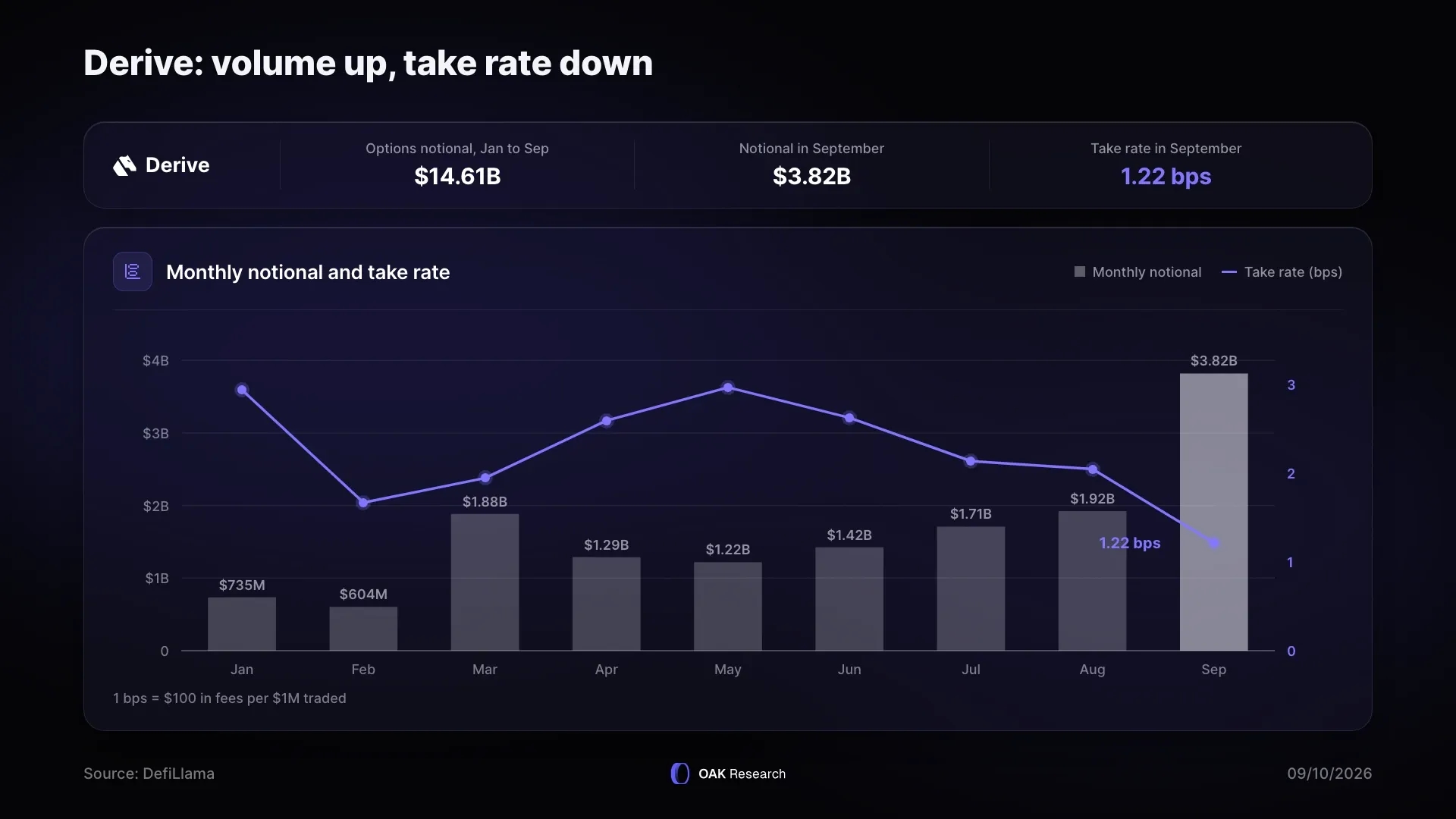
However, volume growth is not translating into revenue. During September's record week, notional volume rose 19.6% while fees fell 11.8%. The explanation lies in the fee schedule: options fees are capped at 12.5% of the premium, which pushes them down when trading shifts toward far-out-of-the-money strikes, and on RFQs the cheapest leg of a structure is entirely free. As the client base becomes more professional, Derive mechanically earns less per dollar traded.
The explanation comes down to the fee schedule. On the order book, a taker pays a base fee of $0.50 plus the lesser of 0.03% of notional or 12.5% of the option premium. That 12.5% premium cap is crucial because it drives down fees relative to notional whenever traders move into options with strikes far from the current market price, where the premium is low compared with the notional.
Then there's how structures are treated: in RFQs, legs are grouped by category, the most expensive pays the full fee, the cheapest is entirely free, and the second and third receive a 50% discount. In other words, a two-leg spread pays nothing on its second leg. The more professional the client base becomes, using complex structures and far-out strikes, the less revenue Derive generates per dollar traded.
Finally, Derive also offers perps, but they serve a different purpose. Their open interest reached $94.9 million on September 21, around one-twentieth of options open interest. They're not there to compete with Hyperliquid, but to let a trader hedge directional exposure from the same account, which is exactly what a market maker needs.
On October 6, 2026, Derive shut down its own blockchain. V3 compiles margin, settlement, and permissions into RISC-V binaries, executes and proves them off-chain using the SP1 Hypercube zkVM, then bundles operations into batches verified on Ethereum using a PLONK proof. Verification costs are fixed at around 400,000 to 500,000 gas units per batch, whether it contains one trade or one million.
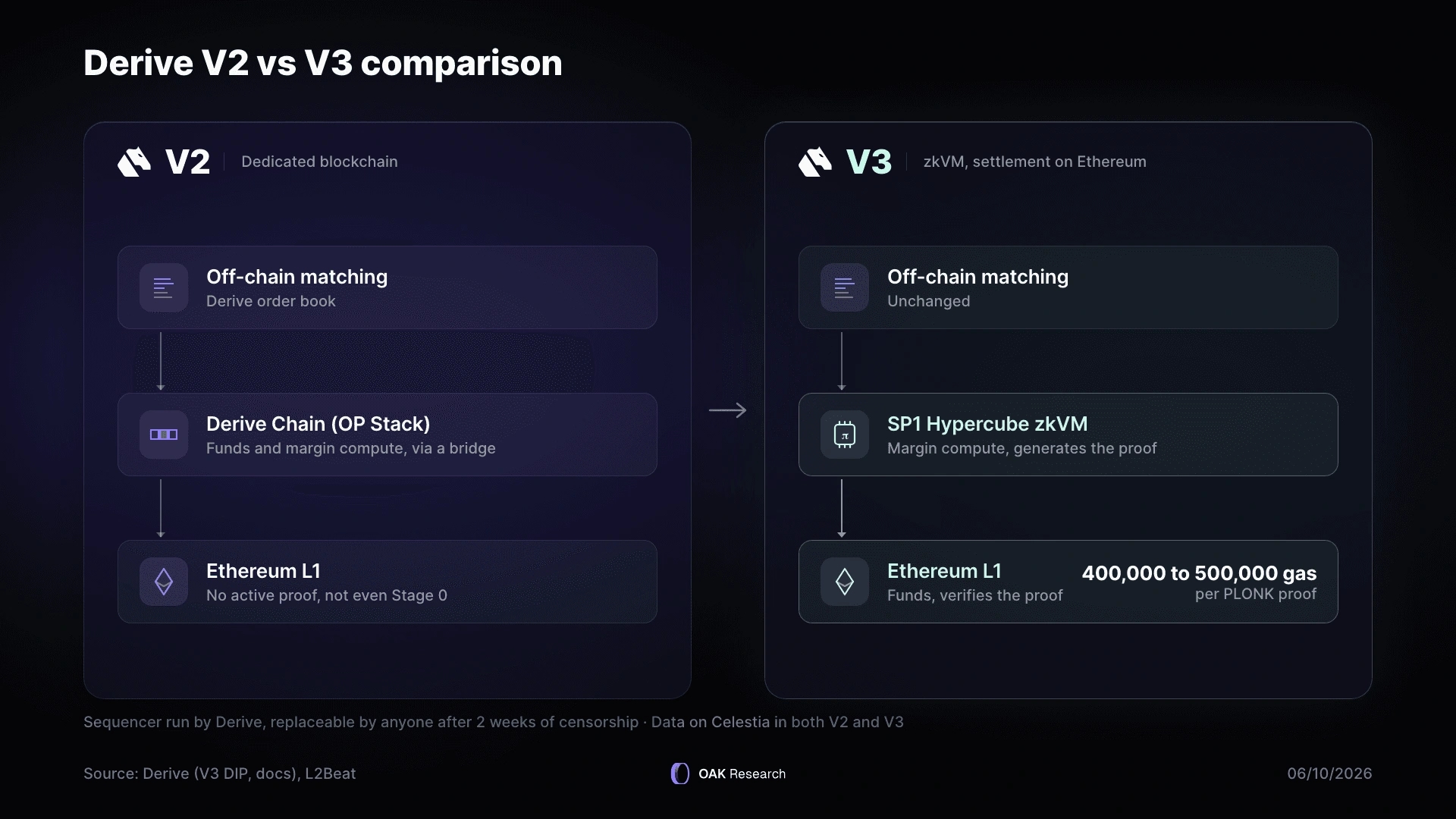
For an integrator, this boils down to one API and a single settlement venue, with no bridge to manage. Other features include one-click vault deployment, allowing anyone to become a strategy curator and collect management and performance fees; borrowing against non-cash assets such as ETH or HYPE; and session-key controls for trading desks.
Builder Codes have been around since February 2026. The principle is identical to Hyperliquid's: a builder submits users' orders with its own identifier and an optional extra_fee, which is paid directly to the builder every four weeks. No exclusivity, no permission, no minimum volume. The API Broker program runs alongside this, paying back 10% to 50% of net fees based on 28-day volume and stDRV holdings.
Conceptually, this is pretty much the same thesis we discussed for Hyperliquid. A protocol's real strength isn't being a single front end where it innovates and tries to keep all the users. It's being a back end - infrastructure and liquidity - that others build features and markets on top of, while doing the marketing work to attract users.
This is even more valuable for options than for perps. As we showed in the first article, the main barrier to options adoption is the user: the vast majority of crypto traders have no financial background and don't know what an options chain is, with bids, asks, marks, implied volatility, and Greeks for every strike.
But if a wallet or familiar interface can offer users a way to “protect your ETH below $3,000” or “earn yield by agreeing to sell at $6,000,” then they no longer need to know they're buying a put or selling a covered call. The complexity becomes the builder's and the risk engine's problem.
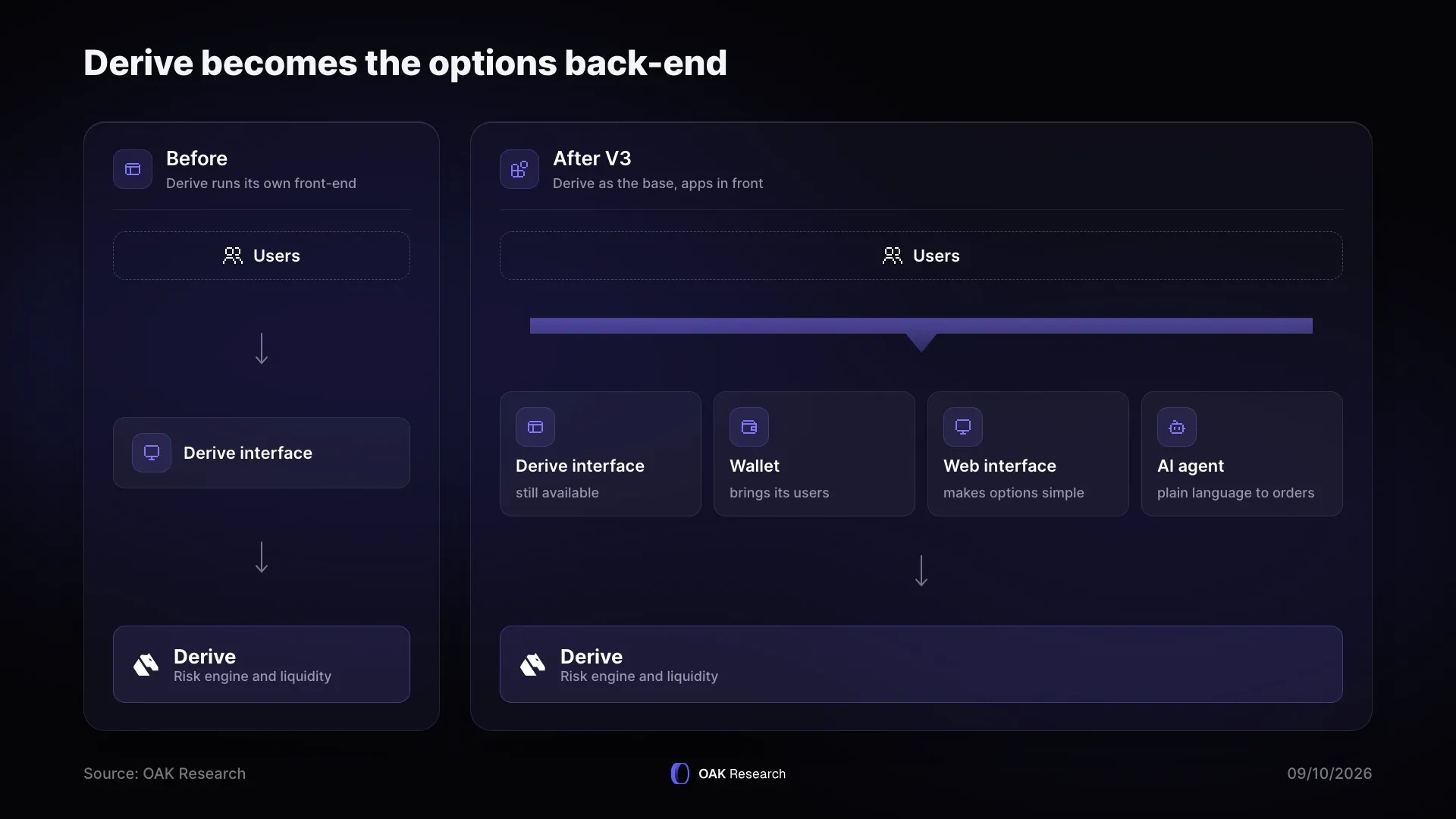
We've seen this with Hyperliquid. When Phantom used Builder Codes to integrate perps into its wallet, it generated around $20 million in builder code fees in less than a year from users who had never even opened Hyperliquid. That's precisely what Derive could do with its own Builder Codes.
Let's be upfront: adoption is still in its infancy. But that's also why it's worth discussing today. Remember, it took months for people to recognize the value of Hyperliquid's Builder Codes (launched in October 2024, but only really discovered in June 2025 when Phantom and others adopted them).
Dream, a mobile app that completely abstracts away options complexity, is currently the most advanced builder, to the point where DefiLlama now tracks its builder-fee revenue on Derive as a separate line item. LEVR, meanwhile, is building a 0DTE experience on Derive and timed its mainnet launch to coincide with the resumption of V3 trading. Derive is also openly courting teams building yield vaults, fixed-payoff structured products, mobile applications, and agent strategies.
Nick Forster has publicly set the bar: an external team should be able to launch a product on Derive in about an hour. The question is how many teams will actually do it, and that's the main thing to watch in the coming months.
Derive has developed the most advanced infrastructure in on-chain options, built around its risk engine, portfolio margin, and settlement system. That's what has earned it its leadership position, with nearly 75% of notional volume. But that position could be challenged at any time by new protocols that leverage five years of accumulated experience to build a serious competitor.
One of the only protocols to have built infrastructure powerful enough for liquidity to become virtually impossible to dislodge is Hyperliquid. By adding distribution, particularly through Builder Codes, it has reached a point where building on top of Hyperliquid is now more profitable than trying to rebuild a competitor from scratch.
That is exactly the threshold Derive is aiming for, in a sector where liquidity is even harder to attract and retain, as we've explained throughout this article.
Even though liquidity is an even greater challenge for options than for perps, Derive has a valuable advantage. Derive V3 is simply the most advanced infrastructure ever deployed by an on-chain options protocol. And its real strength isn't even that: it's that the infrastructure is now open to any external developer.
It's important to distinguish the two effects. The capital efficiency created by the risk engine helps retain market-maker liquidity. In other words, it ensures quotes are available. But it doesn't bring in any traders. Distribution brings traders, and that's exactly what Builder Codes enable.
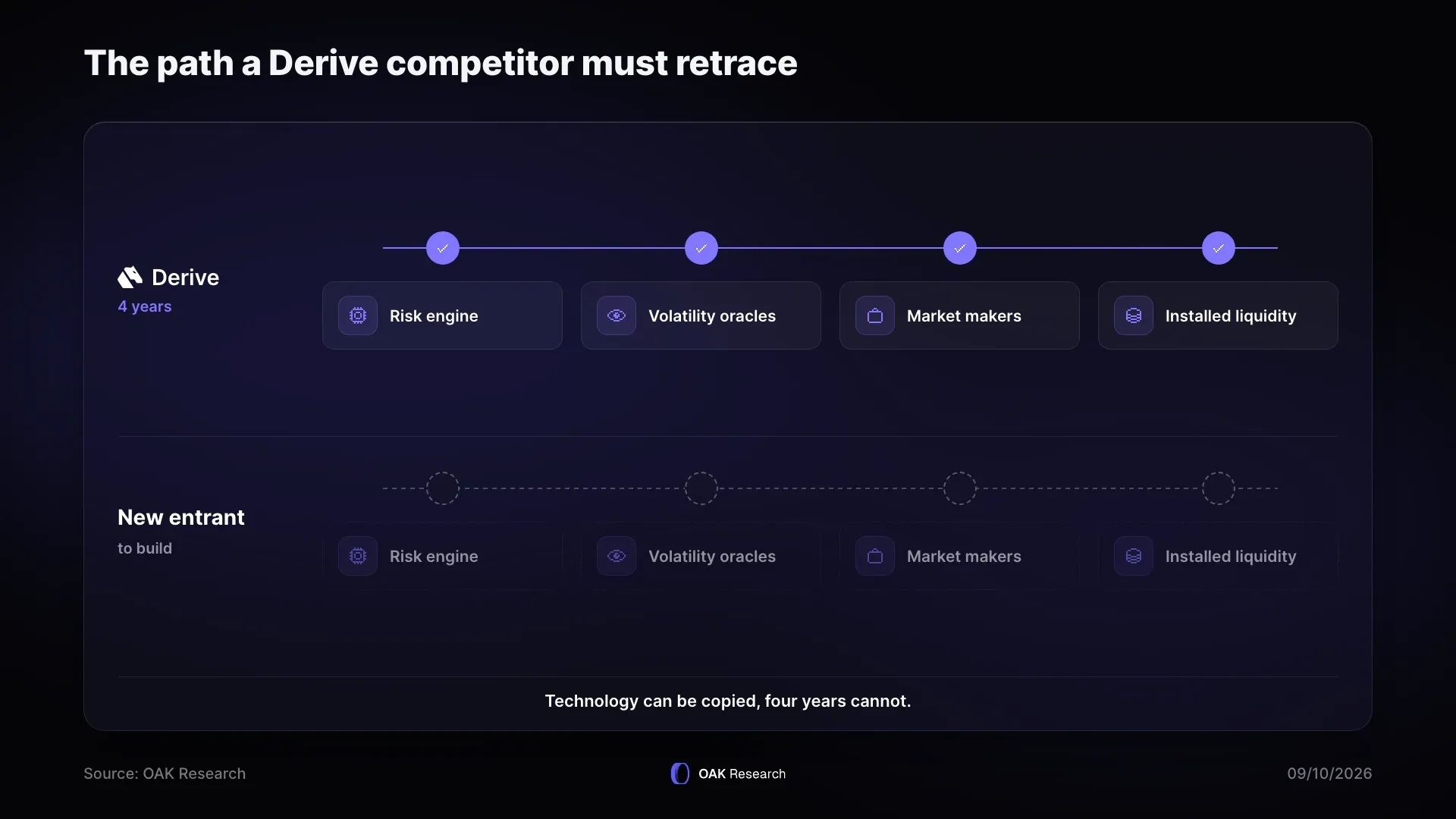
And that's where the reasoning comes full circle. For a developer who wants to offer options to users, building their own exchange means recreating everything Derive spent five years building: a risk engine, volatility oracles, and, most importantly, convincing market makers to quote hundreds of instruments at a loss during the bootstrapping phase.
If the flywheel starts spinning, we know how it works. The more productive market-maker capital becomes, the more strikes and expirations market makers quote. The deeper the liquidity, the more sophisticated order flow arrives, and the more market-making opportunities emerge. Builders bring in flow Derive would never have captured alone. That flow reinforces liquidity, making the platform more attractive to the next wave of builders.
By connecting to Derive, the developer gets all of this immediately and can focus on what they do best: their product and their users, while getting paid for the flow they bring.
If the flywheel gets going, the mechanism is familiar. The more productive market-maker capital becomes, the more strikes and expirations they quote. The deeper the liquidity, the better execution gets, and the more attractive it becomes for a builder to connect. Each builder then brings flow Derive would never have captured alone. That flow creates more opportunities for market makers, who provide better quotes, further deepening liquidity and attracting the next builders.
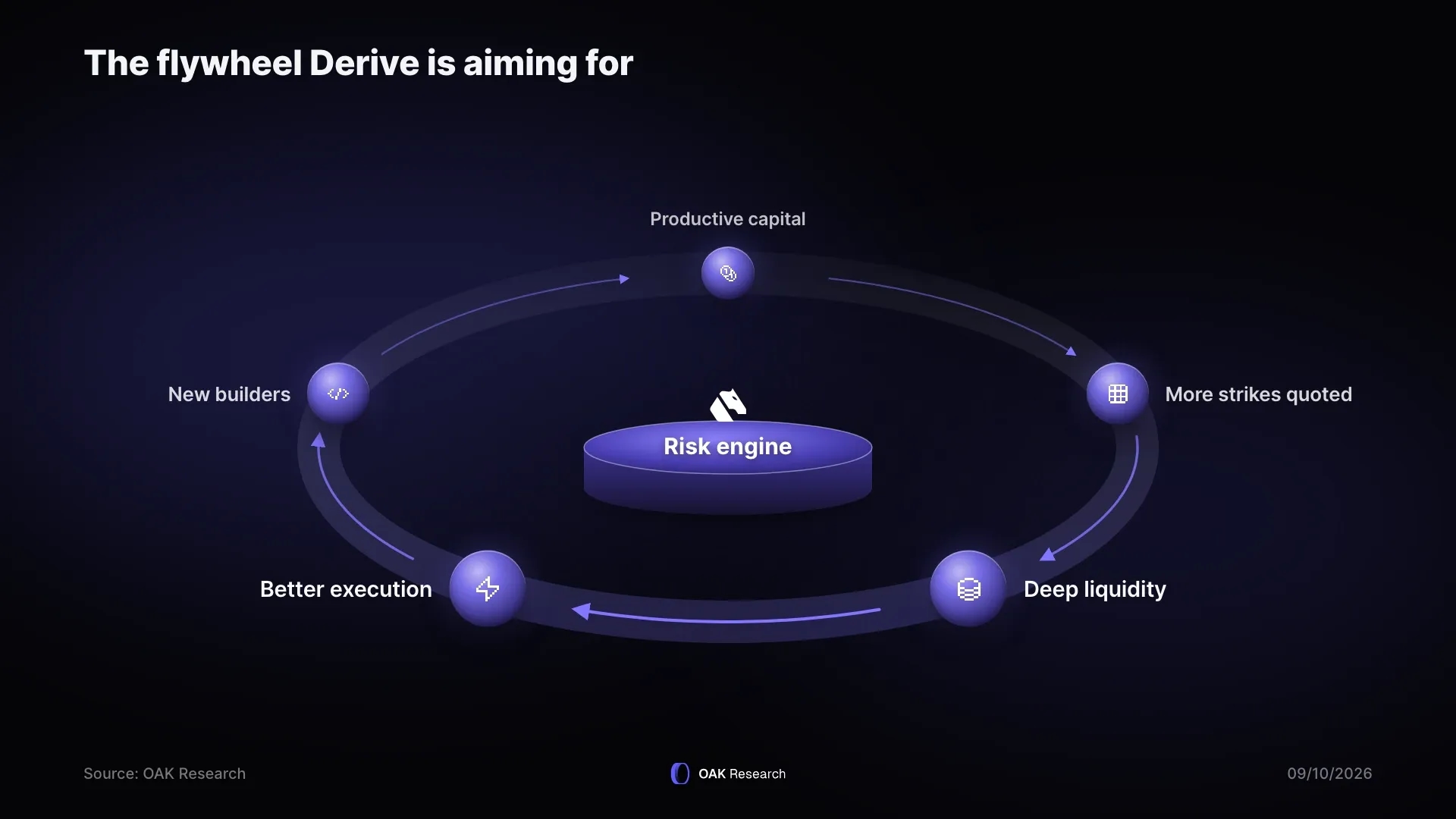
Over time, this accumulation could turn Derive's current lead into an advantage that's hard to catch up with: not because the technology would be impossible to copy, but because a competitor would need to rebuild the liquidity, pricing history, and builder network all at once. That's exactly what protects Hyperliquid today.
For Derive, though, this flywheel is still a hypothesis. The market makers are here, but they're being paid to show up. Builders are starting to arrive, but you can still count them on one hand.
As we've seen, infrastructure can be replicated. What can't easily be replicated is a market with liquidity, pricing history, and professional market makers. But does that mean Derive is untouchable? Can we really say that Derive's moat is its liquidity and risk engine?
There is, however, a strong piece of evidence supporting the thesis. In November 2025, Derive listed HYPE options before Deribit and became the reference venue for that market. On assets that centralized platforms don't cover, or cover too late, Derive is the leading venue. That's exactly what V3's risk universes are designed to scale.
And what if the next Hyperliquid isn't Derive, but Hyperliquid itself? That question entered the debate on October 7, the day after the V3 migration. At a conference, Jeff Yan discussed options as a potential next major product area for Hyperliquid, with the idea of hedging spot and perps in the same order book. Several outlets framed their headlines that way, DRV dropped shortly afterward, and the reaction was immediate: if the player that won perps goes after options, what's left for Derive?
First, a caveat about what was actually said. Jeff didn't actually say he wanted to launch options. He said that if he were to focus on a sector currently underrepresented on-chain, it would be options. He noted that options are huge in traditional finance and virtually nonexistent on-chain, making this an interesting problem to solve.
HIP-4 has been deployed since February 2026 and already allows anyone to launch outcome markets and bounded instruments resembling binary options. Dozens of teams are building on it, and yet, as big of Hyperliquid supporters as we are, the reality is that none has taken market share away from Derive.
There's an irony here, too. If Hyperliquid were to directly enter this market one day, it would have to go through exactly the journey described in this article: build a risk engine capable of handling nonlinear risk, find volatility oracles, and convince market makers to quote hundreds of instruments during a bootstrapping phase when order flow is mostly toxic. Its order book and delta liquidity would be a considerable advantage for hedging, but they don't replace a margin engine or the four years Derive spent attracting market makers.
That doesn't mean Derive will keep its 88% market share. That's actually highly unlikely, and the team doesn't claim otherwise. But in a market everyone expects to grow severalfold, losing half your market share while increasing your volume fivefold would still be an enviable trajectory. The real risk isn't that a competitor shows up. It's that the market doesn't grow.
Currently, 35% of protocol fees fund open-market DRV buybacks, and a governance proposal published on September 24 aims to raise that share to 50%. At the current pace, that remains modest: a full year of buybacks at 50% would represent around 0.43% of market capitalization, while weekly revenue was running at roughly $120,000 in late September.
Yet the token tripled in September, climbing from $0.14 to $0.45, valuing the protocol at around 83 times annualized revenue. So the market is pricing in future growth, not current revenue. Add to that a history of dilution: in September 2025, when market capitalization had fallen to $28.5 million, the DAO voted to create another 500 million DRV, a 50% increase in supply, with 46% allocated to contributors, reversing a previous commitment not to issue any more tokens.
Gain legitimacy and visibility
Reach a qualified audience through in-depth analyses and reports. Get in touch to discuss partnerships, project showcases, or any professional inquiry.
Derive has accomplished the hardest part and still needs to prove the most important one. The hard part was bringing professional market makers to a market where five generations of protocols had failed. The important part is turning that liquidity into a lasting competitive advantage, and that will come down to builders.
Three indicators will settle the question over the coming months: how liquidity behaves now that trading rewards are paused, the number of third-party applications actually launched on V3, and the share of volume coming from users who aren't professional trading desks.
The perp market leader's stated interest in options also validates the broader category thesis: a market that's supposedly dead doesn't attract the attention of the sector's best-positioned player. But it's also a reminder that Derive's 88% market share is no given. So far, it's simply the result of a lack of serious competition.
Reminder
DeFi remains a high-risk environment. Smart contract exploits, depegs, poor private key management, or protocol failures can always lead to losses. This analysis is not investment advice: always do your own research and only commit what you are prepared to lose.
Bitcoin (BTC), Ethereum (ETH), Derive (DRV)

Bitcoin (BTC), Ethereum (ETH), Hyperliquid (HYPE), Derive (DRV)

Bitcoin (BTC), Ethereum (ETH), Derive (DRV)

Bitcoin (BTC), Ethereum (ETH), Derive (DRV), Hyperliquid (HYPE)

