


Market Briefing 6: Bitcoin surges toward $82,850, the level that will decide the bull run


Bitcoin (BTC), Ethereum (ETH), Hyperliquid (HYPE), Ethena (ENA)
Published on

At the heart of Ethena’s governance, a proposal is currently being debated: activating the fee switch to redirect part of USDe’s revenues toward ENA buybacks. In this opinion piece, we explain why this would (at this stage) be a mistake, despite strong community enthusiasm and the obvious political appeal for some members of the governance.
We are writing this article in a specific context: an ongoing governance vote is taking place for the election of Ethena’s Risk Committee, for which OAK Research has applied. Our primary intention is to see the protocol succeed, and to support it as effectively as possible through the next stages of its development.
We also know that the position we are going to defend in this article may be controversial, as it runs against the prevailing view regarding the activation of the fee switch and the implementation of ENA token buybacks. Nevertheless, we believe this position is structurally beneficial for Ethena in the long run.
Ethena’s growth in 2025 was undeniable: USDe became the third largest stablecoin in the market, notably driven by the Aave - Ethena - Pendle partnership. However, the last quarter of the year exposed weaknesses in Ethena’s structure and in some of the initiatives that were rolled out. While protocol integrity was never questioned and Ethena functioned exactly as intended, this period helped clarify where strategic focus should be.
With the Risk Committee voting period now underway since February 3, it is therefore essential to address a topic that has become central in discussions: why the fee switch should not be activated in the near term, and why this criterion should not be a priority in the votes of ENA holders.
In this article, we will present the reasoning behind our position and analyse why implementing ENA token buybacks could introduce unnecessary short-term risks: both by putting USDe in a more complex position as competition intensifies, and by placing additional pressure on ENA’s price rather than strengthening its long-term value proposition.
A common misconception about Ethena is that its growth is primarily tied to the ENA token. In reality, Ethena’s adoption, revenue generation, and strategic advantage are driven by its core product: USDe.
USDe functions as the economic engine of Ethena. It is used as trading collateral across major CEXs and on Hyperliquid, where its yield allows traders to achieve better capital efficiency while earning returns on the margin of their positions. This yield-bearing property is Ethena’s primary moat, and one that is not currently offered by most other stablecoins in the market.
Yield generated through USDe (funding rate rewards, USDe mint fees, and yield on the stablecoins backing USDe) accrues to the protocol and enables the development of additional products, such as savings instruments and structured yield strategies. These use cases expand USDe’s utility across trading, savings, and yield farming, without requiring users to take direct exposure to protocol volatility.
By contrast, ENA acts primarily as an incentive and coordination layer rather than a foundational demand driver. ENA is used to bootstrap liquidity, align incentives with partner protocols, support governance, and distribute rewards through points systems and airdrop programs.
While these mechanisms are essential for early-stage expansion and ecosystem alignment, they do not independently generate sustained demand for Ethena’s products nor recurring revenues for the protocol. Instead, they reinforce the adoption and retention of USDe.
What users need to understand about Ethena today is relatively straightforward:
Protocol revenue figures attributed to Ethena are often highlighted as evidence that the protocol “generates a lot of cash.” In reality, these revenues are distributed to sUSDe holders and scale as a function of total USDe supply in circulation. They are therefore product-derived cash flows, directly tied to stablecoin utilisation, rather than discretionary surplus the protocol can deploy freely.
For this reason, potential buyback mechanisms funded from these revenues should not be evaluated in the same way as those implemented by protocols such as Hyperliquid, where token buybacks are funded by trading fees that belong directly to the protocol.
In the current market environment, product strength and cash-flow durability matter far more than short-term token price dynamics. Moreover, the overwhelming majority of tokens continue to decline as the market attempts to establish a “fair” valuation for altcoins. This context leads directly to the central argument of this article.
ENA’s role is primarily to serve as an incentive and coordination tool, rather than a cash-flow-bearing asset. Token emissions are designed to fund rewards within programs that bootstrap liquidity, support new initiatives, and attract capital to USDe-related strategies.
This necessarily results in dilution for ENA holders and stakers. This is the cost of financing growth and attempting to attract sticky capital. Yes, it is frustrating, but it is necessary to prioritise the core product rather than betting on immediate value accrual to ENA or temporary hype around a potential price rebound.
More generally, from a strategic standpoint, here is what the protocol should seek to avoid:
Timing is therefore extremely important in the current setup. ENA still faces several quarters, if not years, of significant emissions ahead (more than $300 million in 2026 at current prices). In a context where altcoins never truly exited their bear market, this will inevitably translate into sustained sell pressure.
Implementing a fee switch with the objective of “strengthening” ENA would not even be enough to offset these emissions. The hypothetical amount of ENA repurchased (which we will discuss in the next section) would represent only a fraction of the amount issued.
In practice, this would amount to burning capital to repurchase a token whose short-term trajectory remains structurally negative. This is a difficult conclusion, but a necessary one.
Despite strong product performance during periods of stress, USDe has experienced a significant decline in circulating supply. Since the major 10/10 event, USDe has lost roughly $8 billion in market capitalisation and appears to have found a bottom around $6.5 billion.
Obviously, several factors help explain this decline:
The central point is that USDe is perceived as riskier than most other stablecoins, and this risk premium is historically compensated by the attractiveness of its yield. Yet it is precisely this yield that made USDe attractive to users and enabled it to become the third largest stablecoin in the industry.
We believe that this is not the right time to introduce an ENA buyback mechanism, as broader market conditions do not support it. In the current environment, such a move would risk triggering a negative spiral, affecting both USDe and the protocol itself.
Rather than strengthening the ecosystem and trust in ENA, premature buybacks would undermine the protocol’s core economic mechanism by prioritising short-term token support and an artificial narrative, creating a negative spiral of weaker USDe demand, lower revenues, and diminished long-term protocol resilience.
TLDR: Buybacks divert a portion of protocol revenue → USDe yield declines → interest in USDe weakens → USDe supply contracts → protocol revenue falls → buybacks become less sustainable, and the cycle repeats.
The best way to frame this issue is to build a forward-looking scenario using the available data. In January 2026, Ethena generated $29.2 million in revenue through USDe, a figure slightly below its annual average. Using an optimistic projection of this number over a full year leads to estimated annualized revenues of approximately $350 million.
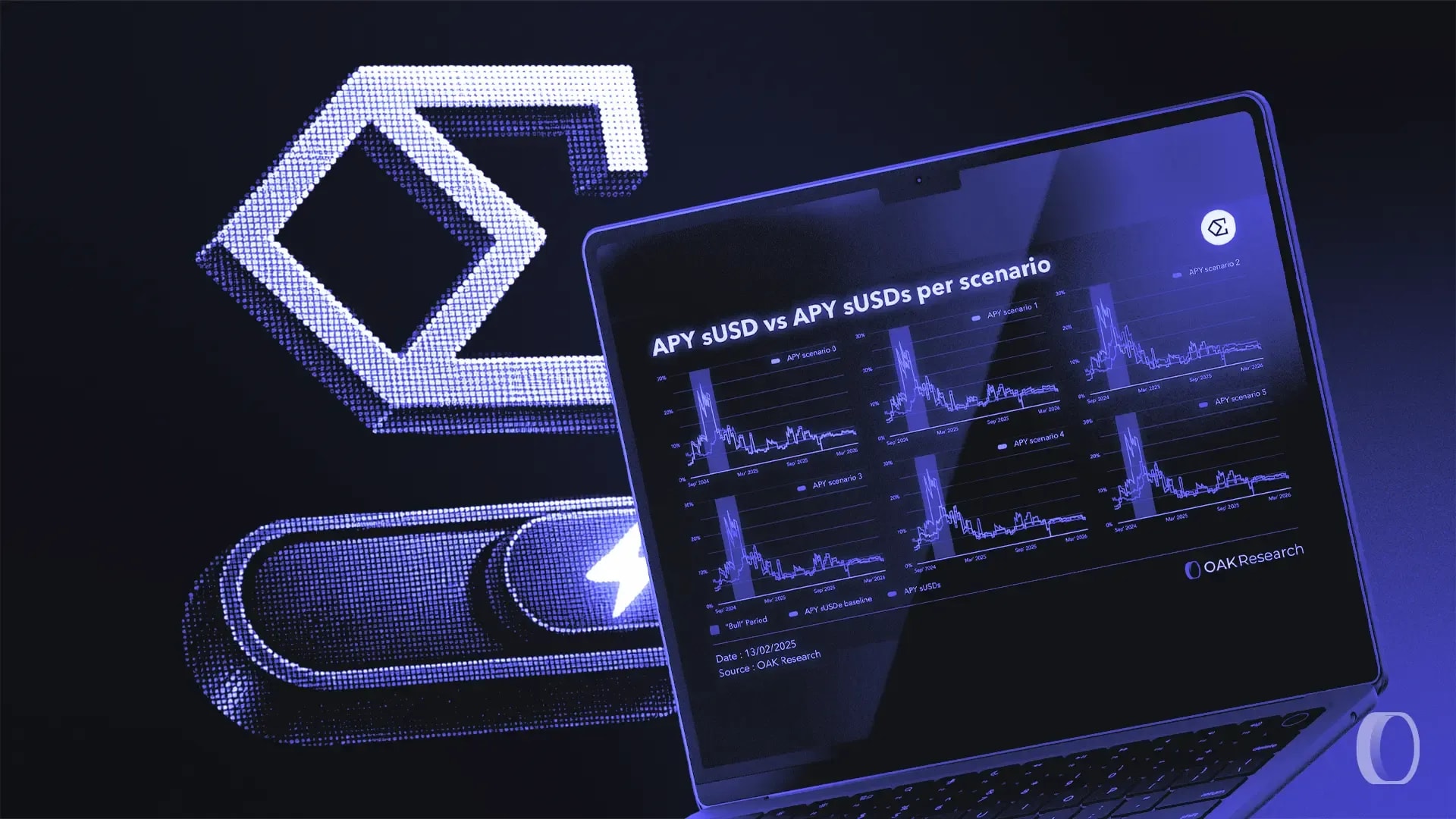
Implementing a fee switch would mean diverting a portion of these revenues, currently distributed to sUSDe holders, toward ENA buybacks in an attempt to support the token price. Since the exact share of revenues that would be allocated remains unknown, we propose the following scenario.
| % buyback | 0 | 5 | 10 | 15 | 20 | 25 | 30 |
|---|---|---|---|---|---|---|---|
| estimated sUSDe APR in % (30D average) | 4.53% | 4.30 | 4.08 | 3.85 | 3.62 | 3.40 | 3.17 |
| buyback amount in dollars (1y) | 0 | 17,520,000 | 35,040,000 | 52,560,000 | 70,080,000 | 87,600,000 | 105,120,000 |
| % supply buyback (1y) | 0 | 1.67 | 3.34 | 5.01 | 6.68 | 8.35 | 10.02 |
Under the most likely assumption, where 20% of revenues are allocated to buybacks, this would correspond to roughly $70 million worth of ENA repurchases. This represents approximately 6.6% of the total circulating supply, which remains meaningful in absolute terms.
However, the impact on sUSDe yield would be significant: it would decline from 4.5% to 3.62%. Such a reduction would materially weaken sUSDe’s competitiveness relative to alternatives such as Sky’s sUSDS (4% APY), Maple’s syrupUSDC (5% APY), or USDC supplied on Aave (3.8% APY).
Most importantly, Ethena plans to issue 3.07 billion ENA over the coming year, representing approximately $375 million at current prices. Even under a generous assumption where 30% of generated fees are allocated to ENA buybacks (around $105 million per year), this would not be sufficient to offset even one third of the annual token emissions.
While our perspective may reflect a particular strategic bias, it is important to incorporate broader community sentiment into this discussion. We reached out to several Ethena community members to gather their views on the protocol’s current positioning and the considerations about the future of the protocol.
“I thought the communication from the Ethena team was pretty poor from August-September onward: from around the time the second DAT announcement and the 10/10 crash until now.”
“The final status of Converge has never been mentioned. All of this slowly fractured what was once a strong community with tons of support. Ethena products require a complex web of trust. USDe is based on trust in the competence of the team's technical and risk management capabilities which has always been strong. The growth of USDe is heavily reliant on YT/PTs which requires trust in future distributions being timely and calculated honestly - all of the crazy multipliers, very long seasons that add new ways to earn points, and likelihood of changes to distributions at end of seasons make it impossible for people to judge the risk of holding/farming USDe.”
“Product lines should be expanded toward areas that have potential to generate real value for ENA. Partnerships with big name players to "look good" were a great growth strategy for Ethena in early days but do not come with enough economic incentives to maintain even the current Ena valuation.”
“Yes, I watch Ethena announcements like a hawk. G has been quiet since ADL which I view as bullish as I’m hoping he comes out with some banger announcements when the time is right or I’m a delusional bull. Also, I’d like clarity on stake ownership in Based - This really shouldn’t be a black box for a publicly traded token.”
“Multicoin Capital taking a position in Ethena was encouraging in light of the terrible Ethena price action and hopeful they can hit >$20b in USDe supply when the market returns and >$50b over 2 years assuming OI can get to $200-300b in that time frame. While Theia research Monte Carlo simulation on USDe suggest a very different outcome, I’m hopeful I’m on the right side of the OI Ethena can capture”
“I’m with G on buybacks and reckon that capital is currently best spent on customer acquisition as they still have plenty of wood to chop to grow their TVL but seems my retail counterparts typically reward buybacks. “
“I think G is a once in a decade founder and see a maniacal drive in him to succeed from what I’ve seen in his interviews. Hope he and his team dont squander a $10b+ opportunity over millions in personal gains.”
“Great execution all round tbh, hesitant to criticize too much because the groundwork laid was stellar - the only disappointment is not backing the token with the fundamentals; I know Ethena is not Hyperliquid, and the margins are much smaller, you can't just say 'oh copy HYPE!'; easy when there's $3m/day of FCF coming through the door. But ENA token still feels a bit like a representation of 'buying a representation of the future value of the protocol but we'll figure out what that really is later'. Current sENA points from partners isn't cutting it, clearly.”
“I think ENA price up benefits USDe supply directly; ppl farm more. The inverse is much looser and less of a clear relationship, so you don't get the flywheel (hate that word), it keeps false starting and stalling because only half of the relationship has enough torque to push it round the bend. I think HyENA shows that the product is evolving, and the progress there has been steady despite ppl dunking on it initially because it's not been overnight sensation (growth is there, compound that enough and you can't lose). Again though the feeling amongst people is that you're getting some representation of future value that isn't defined at all, when there are other tokens on the market you can allocate to where your role is very defined.”
“Vesting is the biggest dunk ppl have about Ethena, that it's totally hamstrung by investors and team dumping monthly and the schedule never ends. Again, not everyone can be HYPE, it's all v easy when you have $1bn annualized FCF, but I think when people have that choice of ENA with the brutal vesting, the undefined upside, vs. HYPE where they slashed the vest, defined the upside very clearly, you're going to see flows from ENA to HYPE, which really hurts the ability to draw in more USDe via farming incentives being worth much less (ENA price down)”
“For the time being, ENA is still a farm token. There is no fee switch from USDe yield. Most people hold USDe related tokens to farm ENA airdrops and dump it. Which means there are a lot of sellers (farmers + private unlocks) and a few buyers.”
“Even though everyone is praising their execution, they clearly lack basic communication skill with their community. While they might be doing god’s work on the institutional and BD side of things, they’re not caring enough about their retail users and aren’t public enough. Apart from Guy, I would not be able to name a single other team member and that’s problematic. They should add more humanity and clarity about why Ethena matters, what’s the outlook for the upcoming months and why people should hold USDe apart from getting ENA to dump.”
“Imo they should learn from Pendle which is doing an amazing job on the side of things, with a product that’s way more complex.”
It was after gathering this feedback, sensing frustration within some members of the community, and observing Ethena’s recent evolution that we ultimately decided to submit our application to join the Ethena Risk Committee.
Our objective is to contribute across several areas: enhancing transparency within governance processes, clarifying the role of ENA within the Ethena protocol, strengthening communication channels with the community, and systematically incorporating token holders’ feedback. At the same time, we intend to support initiatives that reinforce the security framework and trust assumptions underpinning USDe.
We are not viewing this 6-month mandate as a political opportunity. Our goal is not to rely on hyped narratives to secure the election, but rather to implement changes that will impact the protocol beyond a single term. Our motivation is to play a role in Ethena’s long-term success. For that reason, we have avoided leaning on the “fee switch” narrative as a main argument for this election, as we believe allocating protocol revenue toward this initiative at present would represent a net negative for the ecosystem.
The proposed Risk Committee members on OAK Research’s side are all aligned on the vision for the long-term success of Ethena, beyond our participation. While we may not represent the largest stakeholders within the governance arena, we bring crucial understanding of current market structure, risk dynamics, and the operational mechanics of the Ethena protocol.
For the last part of this article, we want to bring everyone up to speed on what Ethena has announced over the past few months and understand why people got lost in all the announcements before concluding the article.
We believe that the current doubts about Ethena come from the misunderstanding of what Ethena’s product actually is.
Ethena initially launched as a synthetic dollar protocol, offering yield through a delta-neutral strategy. During its 2024 peak, yields reached up to 20% APY, driven by elevated OI, attracting investors willing to take risk on a new stablecoin design and farm ENA.
By late 2024, Ethena began a strategic shift beyond being a pure stablecoin issuer. This evolution was confirmed in the 2025 roadmap, with the introduction of Converge, a partnership with Securitize aimed at building institutional-grade blockchain infrastructure to meet growing TradFi demand.
In mid-2025, Ethena launched StablecoinX, a DAT focused on accumulating ENA. This served a dual purpose: reducing structural sell pressure on ENA while offering institutions exposure to the stablecoin sector (besides CRCL equity).
Throughout 2025, Ethena also deepened its role within the Hyperliquid ecosystem. While it ultimately lost the USDH auction (you can learn more about this event in the article that we released in September), it later launched Hyena, an HIP-3-powered DEX enabling traders to use USDe as collateral while earning yield on posted margin, directly reinforcing USDe’s utility as productive collateral.
Besides the initiatives described above, other products were also announced to boost Ethena’s revenues and allowed the team to expand its influence in the crypto ecosystem:
In general, these developments were a net positive for the Ethena protocol: trying things, seeing what works and what doesn’t, slapping incentives on top of these initiatives to see what sticks. This is what you do as a young company.
However, the ENA role within these initiatives remains unclear. The sunsetting of Converge was never announced and it created a lot of frustration with $200M+ of capital leaving Ethena after the end of Terminal.
StablecoinX buybacks were not completely transparent and some people started asking the question if they were even real.
What Ethena needs most right now is:
This is precisely what we aim to bring should we be elected.
It is important to clarify that we are not opposed to the principle of a fee switch, nor to the idea of an ENA buyback mechanism. On the contrary, in the long run, such a mechanism is necessary to align the economic value generated by the protocol with the value captured by its token.
However, we believe that the current timing makes this a poor decision. As outlined throughout this article, USDe remains Ethena’s core product, and yield is the key driver of its adoption. It is this yield that makes USDe attractive to users and positions it as a potential reference yield-bearing collateral for trading venues and savings products.
Introducing a buyback mechanism today risks weakening USDe precisely where it needs the most strength. At a time when its competitive edge is being questioned, diverting part of the yield to support ENA buybacks would make USDe less attractive relative to other yield-bearing alternatives. The question is therefore simple: is it really worth attempting to support the token at the risk of undermining the product that sustains the protocol itself?
This concern has already been raised in Ethena’s governance discussions. In November 2024, Blockworks highlighted a key priority: ensuring that sUSDe maintains its status as a high-yield stablecoin, consistently outperforming competitors such as sDAI. We strongly agree with this assessment.
From our perspective, this is precisely where the Risk Committee should focus its efforts. If an ENA buyback mechanism is to be activated, it should be designed in a hybrid and conditional manner: enabled only during periods when sUSDe yield clearly exceeds industry benchmarks (such as sUSDS, USDC on Aave, or equivalent references), and disabled when it does not. A static, unconditional buyback would be both inefficient and potentially harmful.
Ethena has always positioned itself as an innovative protocol. We are convinced that it can also innovate in how value accrual mechanisms are designed and implemented. We have already begun working on frameworks to explore adaptive, yield-aware buyback models, which we intend to propose should we be elected to the Risk Committee.
More broadly, governance decisions should not be driven by short-term narratives or token optics. Rebuilding trust, improving transparency, and reinforcing USDe’s competitiveness should remain the priority. This is the approach we are fighting for, and the one we aim to bring to Ethena’s governance with intellectual honesty and a long-term vision.
If you wish to support this vision, ENA and sENA holders are encouraged to allocate their voting power to OAK Research, in order to contribute to a more resilient and sustainable future for Ethena. If you already voted, you can still change your vote or add us as another one of your choices.
We would like to thank all those that voted in favor of us so far, we truly value your support. We believe that OAK Research makes sense for Ethena. Thank you for reading this article.
Bitcoin (BTC), Ethereum (ETH), Hyperliquid (HYPE), Ethena (ENA)

Ethena (ENA)
Ethena USDe (USDE), Ethena (ENA)

Ethena (ENA), Cap USD (CUSD)


