Market Briefing 12: Crypto at the Bottom of Its Range as the Bond Market Tightens


Bitcoin (BTC), Ethereum (ETH), Hyperliquid (HYPE), Derive (DRV)
Published on

Hyperliquid is breaking activity records, yet its revenue and HYPE buybacks have fallen sharply. From the rise of HIP-3 and tradeXYZ to new builders and our “AWS of liquidity” thesis, we look at why this divergence may be far less worrying than it first appears. The real question now is whether Hyperliquid can bring enough of that growing activity back into HYPE’s value capture.
Before we get into this article, a bit of context is important. We decided to start writing it at the very beginning of August, when we noticed that HYPE was at the center of what felt like a collective FUD campaign. As is often the case in this kind of environment, HYPE had just gone through a difficult July, down 15% while the rest of the market was moving higher.
Influencers, KOLs, analysts and specialized media outlets were all trying to explain the underperformance. We kept reading that the upcoming arrival of KYC would kill Hyperliquid's "decentralization," that VCs were unstaking large amounts of HYPE to sell them, that tradeXYZ was close to leaving the ecosystem and becoming independent, and so on.
None of those arguments seemed particularly relevant to us, so we decided to write this article and share our view on what was actually happening. Except that, in the meantime, we went on vacation. Don't blame us, it was about time we got some rest. As for HYPE, it gained 45% during that week off. Pretty bad timing on our side.
We therefore had two options: drop the article and move on, or finish it with a bit more context and a few new pieces of information, even though HYPE had already started massively outperforming the market again. You already know which option we picked. After discussing it with members of our Discord, we went with option two. Enjoy the read.
For nearly a year and a half, Hyperliquid has probably been one of the easiest protocols for us to defend on fundamentals. Volumes kept increasing, revenue followed closely, almost all of that revenue was used to buy back HYPE and, in a market where the vast majority of tokens slowly bled toward zero, HYPE stood out as an exception.
That backdrop helped HYPE reach an all-time high of around $77 in June 2026, even as BTC remained 50% below its October 2025 peak. HYPE then corrected by roughly 30% from that high. Nothing particularly unusual after such a strong rally, you might say, but the timing is what makes it interesting. The decline happened more or less at the same time as protocol revenue started falling as well.
We reached a point where HYPE's P/E ratio was almost as high as it had been when the token traded above $70. In other words, looking only at that metric, buying HYPE at $55 was roughly as "attractive" as buying it above $70 back in June.
Note: HYPE has rebounded since this section was written, so the P/E ratio has logically moved well above its late-July level. It currently sits around 42x.
Put that way, it obviously does not sound very reassuring. At the same time, revenue, and by extension buybacks since the two are directly linked, had become the main metric the market used to track HYPE's valuation. So when both revenue and price start falling at the same time, investors naturally begin to worry. But if we are bringing this up today, it is because the reality is much more nuanced than it first appears.
When we look at what is actually happening on Hyperliquid, we are almost tempted to reach the opposite conclusion. HIP-3 markets are breaking records, open interest keeps reaching new highs, the platform is becoming a reference venue beyond crypto for commodity traders, the number of traders and open positions keeps growing, and technical upgrades are shipping almost every week.
That is the paradox we want to focus on today. Hyperliquid is growing activity much faster than it is growing revenue, and at first glance that looks like a problem for HYPE. Our view is that this is mainly the short-term cost of a strategy Hyperliquid has been following for a long time, one we have described for more than a year through our "AWS of liquidity" thesis.
Hyperliquid was never meant to remain just a DEX. The real bet is to build the infrastructure, the liquidity and the trading engine, then let other players plug in their own products and users. That strategy is now starting to work at scale, but it also creates a fairly simple issue: the more value is created by third parties, the more of that value Hyperliquid has to share with them.
→ Not familiar with our "AWS of liquidity" idea? You can read our July 2025 thesis on Hyperliquid's real vision beyond being a simple perp DEX here:
Trade 100+ perps with up to 40x leverage on a fully decentralized exchange.
The starting point is fairly simple. Hyperliquid has never been more important in the perp market, yet the protocol is making less money today than it was a few months ago. The question is why, and more importantly, whether that is actually a problem.
In the third quarter of 2025, Hyperliquid generated roughly $356.7 million in revenue. That figure then fell to $295 million in Q4, $217.5 million in Q1 2026 and finally $201.8 million in Q2. In less than a year, quarterly protocol revenue declined by roughly 43%.
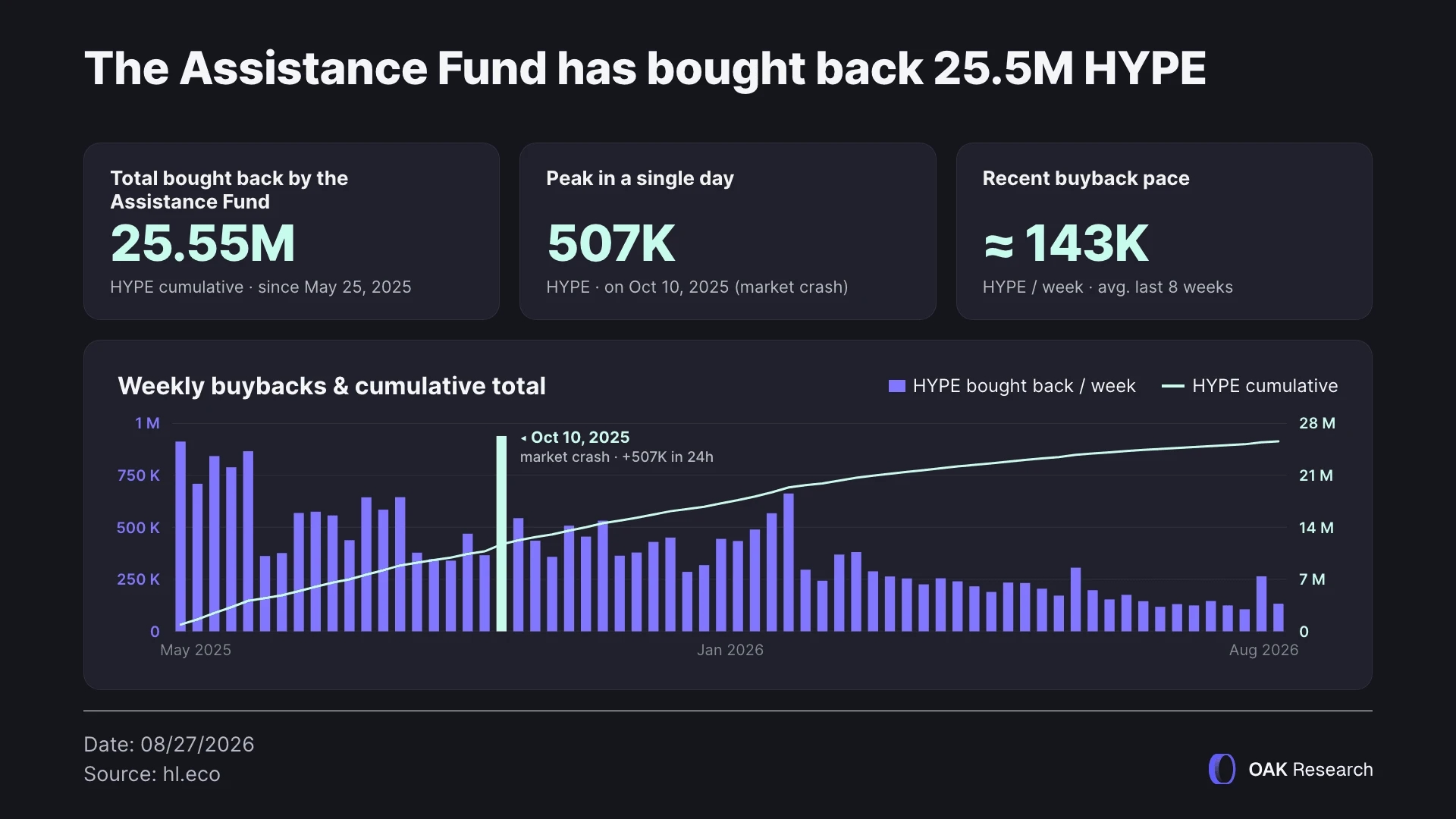
Because buybacks are directly tied to revenue, they logically followed the same path. The Assistance Fund bought back nearly $290 million worth of HYPE in Q3 2025, compared with roughly $149 million in Q2 2026. Given how much weight we place on this mechanism when assessing the token's valuation, this is clearly not a number we can just brush aside.
What makes this even more surprising is that the decline has absolutely nothing to do with collapsing activity. Quite the opposite. Open interest moved above $11 billion in July, its highest level of 2026, while Hyperliquid accounted for roughly 9% of all open perpetual positions globally, including centralized exchanges, compared with less than 7% at the end of May.
The explanation for this divergence between activity and revenue is actually fairly straightforward: the success of HIP-3 markets. They accounted for barely 2% of total platform volume at the beginning of 2026 and now represent roughly half of all activity. While crypto markets were largely lifeless, traders shifted toward tokenized traditional financial markets, including stocks, indices and commodities.
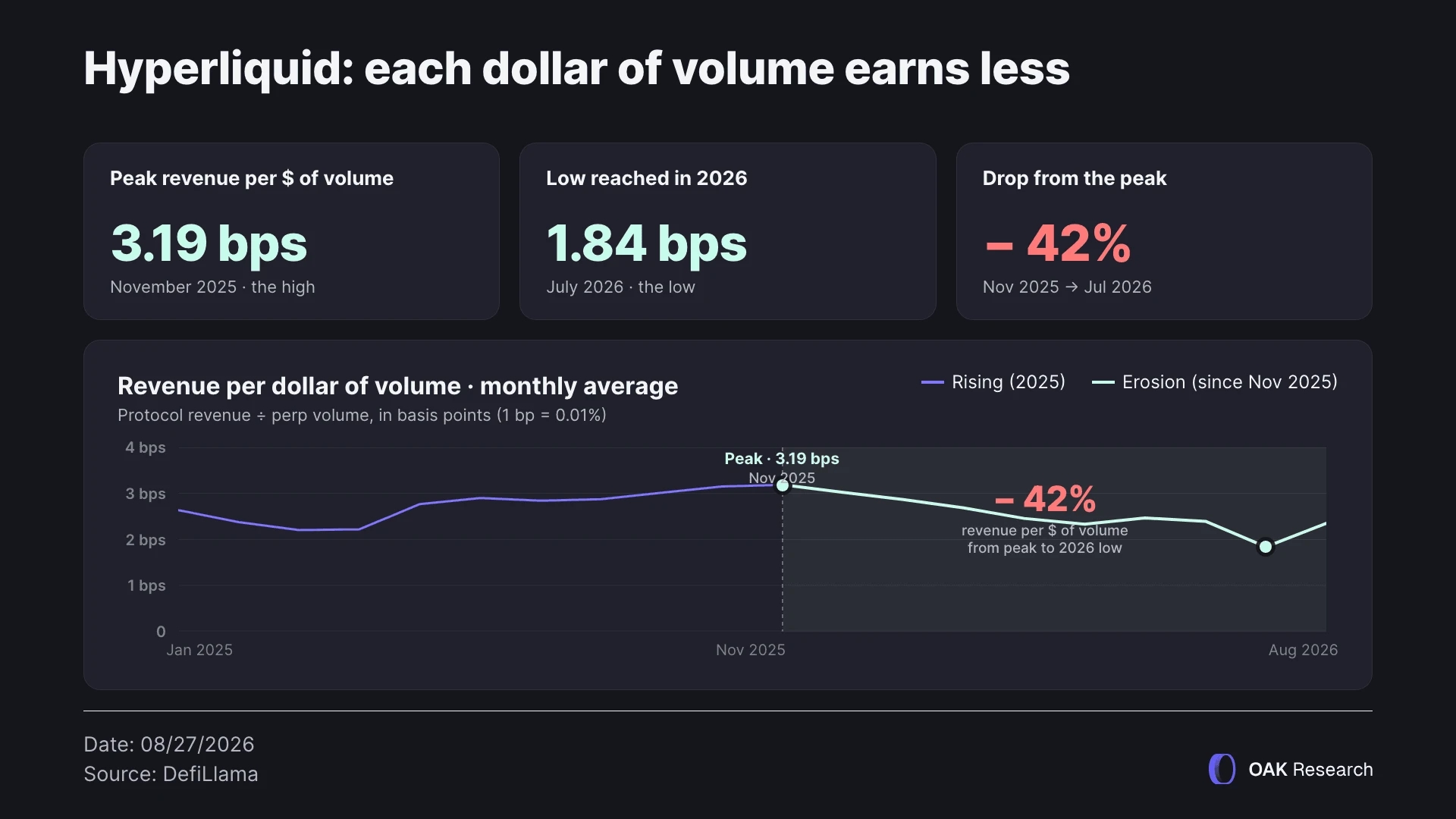
This is where we think one of the most important metrics in this entire analysis appears, and one we will increasingly need to keep in mind when looking at Hyperliquid: the revenue-to-volume ratio. Activity keeps growing, but Hyperliquid is retaining proportionally less revenue from that activity. Cost of revenue, meaning the share distributed to builders and deployers, increased from less than 6% of gross revenue in Q2 2025 to around 18% today.
It would be easy to criticize HIP-3 markets and say they are responsible for weakening this metric, but the reality is not that simple. In their standard configuration, users on a HIP-3 market pay roughly twice the fees of a native perp market, and those fees are then split 50/50 between the protocol and the deployer. In other words, under the base model, Hyperliquid does not really lose revenue.
The "problem" starts when these markets use mechanisms designed to accelerate growth, especially Growth Mode. It reduces protocol fees by 90% to make a market more competitive and help it gain adoption. In that case, Hyperliquid deliberately accepts much lower revenue for every dollar of volume traded.
That is why gross volume is becoming a less useful metric on its own. One market can generate more volume than another while producing far less revenue for Hyperliquid because of its fee structure or deployer setup. As HIP-3 takes a larger share of activity, this revenue capture ratio, meaning the amount of revenue captured for each dollar of activity, will need to be tracked alongside both volume and absolute revenue.
At first glance, this might look like a negative development. In reality, we tend to think Hyperliquid would have made a mistake by trying to maximize short-term revenue at all costs.
For more than a year now, we have argued that Hyperliquid's real moat is not simply being a perp DEX that works. It is the infrastructure, and above all the liquidity it has managed to concentrate around it. Once you have a deep enough order book, tens of thousands of traders, professional market makers and all the technical functionality that comes with them, it becomes much easier to convince companies to build on your infrastructure than to ask them to recreate all of that somewhere else.
Liquidity has always been the lifeblood of DeFi. For years, protocols fought each other with incentives and marketing to attract liquidity that previously belonged somewhere else, always with the risk that the next newcomer would eventually suck it away again. It is an endless cycle that Hyperliquid has deliberately chosen not to play. Instead, the protocol treats its infrastructure and liquidity as open resources that anyone can use to build freely and generate activity whose value is then shared between the builder and Hyperliquid.
That is exactly the logic behind Builder Codes, CoreWriter, HIP-3 and now HIP-4. Hyperliquid builds the rails, then gradually lets other teams decide what they want to run on top of them. Those teams bring their products, their users and sometimes their own frontend, and in return they keep a share of the revenue they generate.
This strategy is ultimately very similar to what many major technology platforms did before Hyperliquid: accept lower revenue per user or per transaction in order to expand the network as quickly as possible, until it becomes so difficult to replace that total activity more than makes up for the lower take rate.
In Hyperliquid's case, we think that trade-off makes a lot of sense. We would much rather see the protocol earn 30% or 50% of activity that would never have existed without an external builder than 100% of a much smaller market where the team has to build every product itself, only to risk seeing that activity eventually move to an independent builder anyway.
Of course, this only works if the additional activity eventually becomes large enough. For now, there is at least one example that shows just how far this model can go, and its name is tradeXYZ.
There is one example that perfectly illustrates this strategy: tradeXYZ. The team did not try to build a Hyperliquid competitor with its own blockchain, its own matching engine, its own market makers and airdrop-based incentives to convince traders to move over. Already close to the ecosystem, tradeXYZ understood the importance of HIP-3 early on and chose to build tokenized markets directly on Hyperliquid's infrastructure.
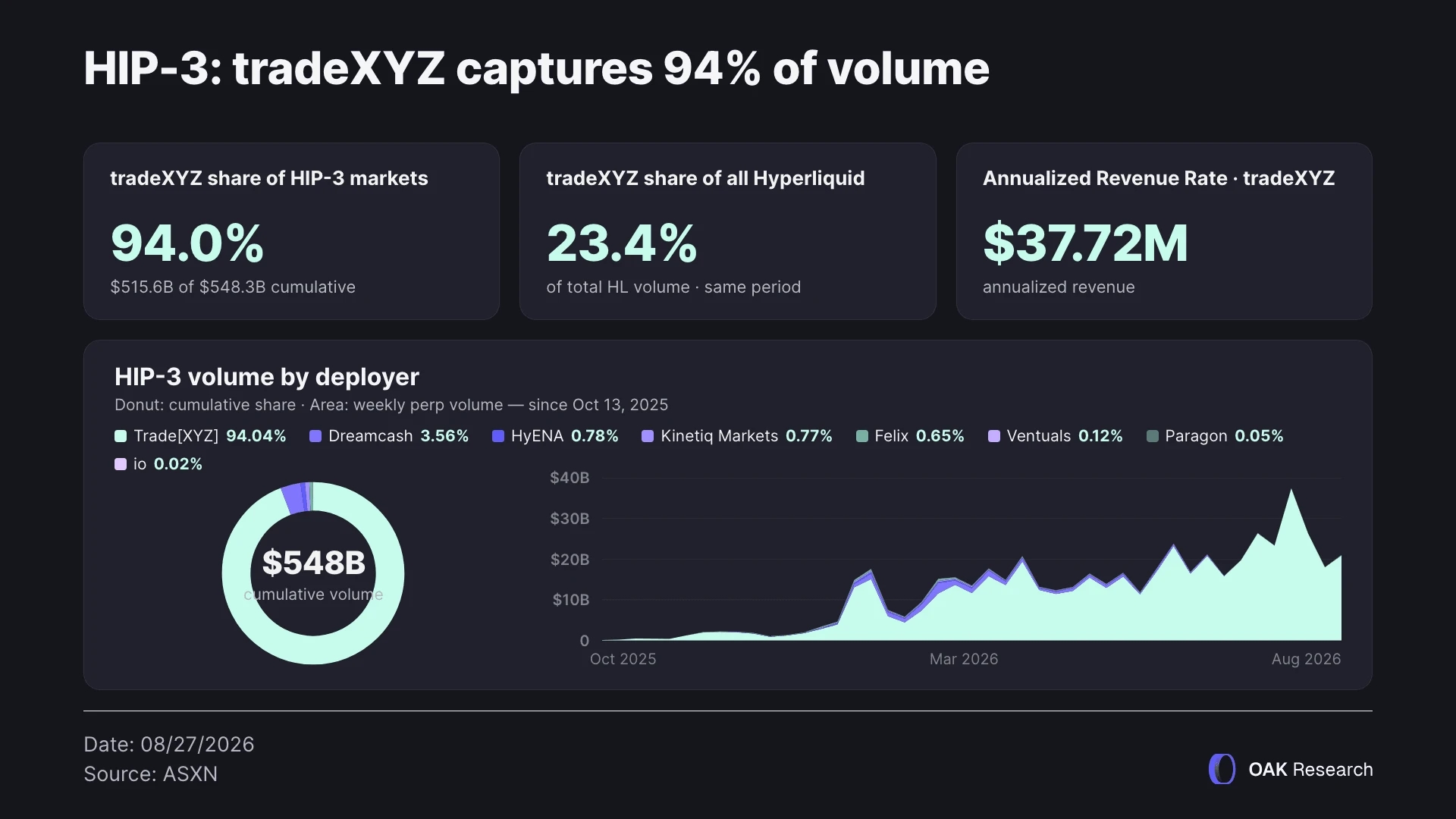
And it worked. HIP-3 markets now account for roughly half of the platform's total volume, with open interest above $4 billion. Most of that growth comes from tradeXYZ, which has established itself as the go-to deployer for trading stocks, indices, commodities and other traditional assets directly from Hyperliquid.
This is the clearest demonstration that Hyperliquid's model can work. The tradeXYZ team understood that there was far more to gain from using Hyperliquid's existing liquidity than from trying to recreate it somewhere else. Instead of spending years building a new exchange and subsidizing market makers and users until the order book became deep enough, the team focused on what it actually does well: launching new markets, finding interesting assets to trade and building a product around them.
Hyperliquid, meanwhile, gets activity that it probably could not have developed nearly as quickly by itself. It gives up part of the revenue to tradeXYZ, but in return it gets users, volume and capital that strengthen the entire infrastructure. The larger tradeXYZ becomes, the more attractive Hyperliquid becomes to the next builder looking to tap into the same liquidity. This is exactly the kind of flywheel we want to see when we talk about a moat built around infrastructure rather than a single product.
Of course, that success also has a downside. tradeXYZ now accounts for an enormous share of HIP-3 activity. More than 90% of HIP-3 open interest sits on its markets, which means Hyperliquid has become fairly dependent on one player in this vertical. That also explains why almost any issue involving tradeXYZ immediately becomes a HYPE story.
We saw it recently after the SK Hynix incident, then with rumors that tradeXYZ could leave Hyperliquid and become independent. More speculative theories followed, including claims around links between the team, Unit, Jeff Yan and various ecosystem identities. Hyperliquid and tradeXYZ communicate very little, so that vacuum inevitably gets filled with speculation, but we have not seen anything serious enough to give those theories much weight.
As for the idea that tradeXYZ might leave, our view is pretty simple: both sides have far more to gain from staying together than from splitting up. Hyperliquid obviously needs tradeXYZ given how much of the platform's activity now comes from its markets, but the reverse is just as true. tradeXYZ's success also depends on the liquidity, traders, collateral and infrastructure Hyperliquid spent years building. Leaving would mean giving up part of that advantage to try to recreate it somewhere else, with no guarantee users would follow.
There has also been a lot of focus on the failure of other HIP-3 deployers, as if that alone proved there was something wrong with the model. HyENA, Felix, Ventuals and other projects could just as easily have failed while trying to build their own DEX somewhere else. Crypto is full of protocols that launch, attract a few million dollars and then disappear once incentives are no longer enough. tradeXYZ obviously had a real advantage because of its proximity to Hyperliquid, but the team also executed properly.
The real question is whether tradeXYZ will remain an exception or become the first example in a much longer series. If Hyperliquid can convince other companies that they too are better off using its liquidity rather than rebuilding it elsewhere, the current dependency on tradeXYZ will naturally dilute over time.
That is exactly what makes the developments of the past few weeks so interesting. We are starting to see other players use HyperCore to build completely different products without going through tradeXYZ.
We published our first research around this idea in July 2025. At the time, Hyperliquid was still almost always described as a perp DEX with an excellent product, and we already believed that definition would eventually become far too restrictive.
A year later, it is even harder for us to look at Hyperliquid that way. The developments announced over the past few weeks do not necessarily look related at first glance, but they all tell the same story: the team keeps making its infrastructure usable by more companies, across more markets and with fewer constraints.
The first example arrived on August 10 with the launch of xStocks on HyperCore. Five tokenized assets were available at launch: Nvidia, the S&P 500, the Nasdaq-100, SK Hynix and Micron, directly as native spot markets on HyperCore's order books. More assets are expected to be added over time.
This is interesting because Hyperliquid already had strong demand for these assets through tradeXYZ. Until now, however, that demand was mostly expressed through perpetuals. xStocks now adds the ability to hold a spot tokenized asset backed 1:1 by the underlying security, something users had been waiting for for a long time.
That obviously opens the door to new strategies, including basis trading between spot and the corresponding perp, but the point that matters most for this article is elsewhere. A lot of people expected tradeXYZ to be the player that eventually brought spot stocks to Hyperliquid. Instead, another company came in and used HyperCore to do it.
That is exactly what we want to see. If the infrastructure itself is the product, Hyperliquid does not need tradeXYZ to build every vertical. One company can dominate perpetuals, another can provide spot assets, and a third can come tomorrow with a completely different product while benefiting from the same liquidity.
A few days after the launch of xStocks, Jeff Yan proposed an extension to HIP-1 called scaleWei. The name is not exactly exciting, but the feature is much more interesting than it sounds. As a reminder, HIP-1 is the standard for native spot tokens on HyperCore.
Put simply, scaleWei would allow a deployer to proportionally modify or distribute balances across token holders, with the operation handled atomically at the HyperCore level. In the case of a tokenized stock, this could be used to properly handle a stock split, reverse split, redenomination, certain conversions or distributions. The feature was proposed in response to builder feedback and should still be viewed as a proposed HIP-1 extension rather than something permanently deployed in its current form.
There is also an important nuance around dividends. xStocks do not currently pay a traditional cash dividend directly to holders. Net dividends are reinvested into the underlying asset and reflected through their own multiplier mechanism. scaleWei therefore absolutely does not mean Nvidia is suddenly going to pay USDC dividends to Hyperliquid users.
What matters to us is the direction. After allowing companies to create derivatives markets through HIP-3, Hyperliquid is now adapting its spot standard to handle operations that barely existed in crypto because they are specific to real financial assets.
It is a fairly natural extension of Hyperliquid's long-standing "House of All Finance" vision. Launching a synthetic perp on a stock is one step. Allowing a tokenized asset to live natively on an order book, be used as collateral and properly support the various corporate actions that come with holding a real stock is far more ambitious.
Another announcement received much less attention, even though it probably fits our original thesis even better. Hyperliquid opened access to its low-latency non-validating node to professional infrastructure providers.
Until now, a team that wanted to connect directly to the Foundation's node had to stake 10,000 HYPE and reach Tier 1 maker rebates, which requires accounting for more than 0.5% of weighted maker volume over 14 days. In other words, the best access was mostly reserved for market makers already large enough to meet those conditions. Qualified infrastructure providers can now offer that access to their own clients at a reference price below $1,000 per month.
On paper, this is probably less exciting than tokenized stocks or a new HIP-3 market. Yet this is exactly the kind of development we want to see if our reading of Hyperliquid is right.
Good infrastructure has no reason to reserve its best tools for companies that are already the largest players. It should instead gradually reduce the cost and complexity of building on top of it. If a new market maker, desk or builder can access sufficiently high-quality data without locking up hundreds of thousands of dollars in HYPE and becoming one of the platform's largest market makers first, the barrier to entry falls dramatically.
The easier Hyperliquid makes this kind of resource to access, the more rational it becomes for a new company to build directly on HyperCore instead of going elsewhere and recreating the entire environment from scratch.
This is probably the development that interests us most in the context of the FUD we saw at the beginning of August. It actually goes much further than that, because as you probably know, one of the oldest criticisms of Hyperliquid was that regulators would eventually come down on the protocol and the party would be over.
Going back to the August FUD, one of the biggest concerns was the appearance on testnet of a system allowing a HIP-3 deployer to restrict access to its DEX to a list of approved addresses. For some people, the conclusion was that Hyperliquid had finally folded under regulatory pressure and was preparing to introduce KYC, abandoning its historical model in the process.
We had originally planned to explain why we thought that interpretation was completely wrong and looked at the problem backwards. In the end, we barely need to, because the events of the past few days have provided much clearer clues.
On August 19, Donald Trump publicly said that CFTC Chair Michael Selig was working to bring Hyperliquid to the United States in a "fully compliant and legal fashion." No details were given about what structure could make that possible, but the statement is already remarkable for a platform that is still not officially available to US users.
In the days that followed, Blockworks' Shaunda Devens spotted a deployer on the Hyperliquid testnet called "Kraken HIP-3 test DEX." It activated a whitelist system for ten wallets and tested several controls that can cancel orders, force-reduce positions or move collateral. A validator called "Kraken Exchange Validator" was also registered.
Before going too far with the theories, one thing needs to be clear. There is nothing proving Kraken is actually behind these tests, since anyone can create and deploy a testnet market or validator under whatever name they want. Still, if the "Kraken HIP-3 test DEX" really does belong to Kraken, it would probably be the clearest possible example of our thesis.
It would mean Hyperliquid would not need to transform the entire protocol, introduce KYC everywhere and reshape itself around US regulation. A regulated company such as Kraken could simply use HyperCore to deploy a HIP-3 DEX, then manage its own KYC, customers, geographic restrictions and compliance while still benefiting from Hyperliquid's infrastructure.
That completely changes how we should think about the regulation debate. Hyperliquid could remain a neutral, permissionless infrastructure while allowing specific deployers to build permissioned environments on top whenever a jurisdiction or product requires it. Once again, Hyperliquid would not build the product itself. It would simply provide the infrastructure and liquidity.
Between tradeXYZ for TradFi perpetuals, xStocks for spot equities, third-party providers for low-latency access and potentially regulated exchanges for compliant market distribution, our comparison with AWS feels much less theoretical today than it did a year ago.
Let us go back to the beginning of this article and the reason we decided to write it a few weeks ago. Hyperliquid can become the best financial infrastructure in the world, the Nasdaq of blockchains or whatever else you want to call it, but none of that matters much to a HYPE holder if all the economic value ultimately gets captured by the companies building on top of it.
For a long time, the market valued HYPE as an extremely simple cash machine: users trade, a certain amount of volume is generated, the platform takes fees and the Assistance Fund uses those fees to buy back HYPE. In our view, that simplicity played a big role in making HYPE easy for the broader market to understand, value and ultimately find attractive.
But once Hyperliquid chose to become an infrastructure rather than just an exchange, that simplicity disappeared. The protocol accepts sharing part of the fees with builders in exchange for the activity they bring, which means every dollar of volume no longer generates the same amount of revenue for Hyperliquid.
To anyone who sees this as a loss for Hyperliquid and a bad sign for the token, our answer is that the math is simply more complicated than looking at volume alone. But in any case, we still believe the "AWS of liquidity" strategy is far more valuable than remaining an independent perp DEX that tries to build everything itself.
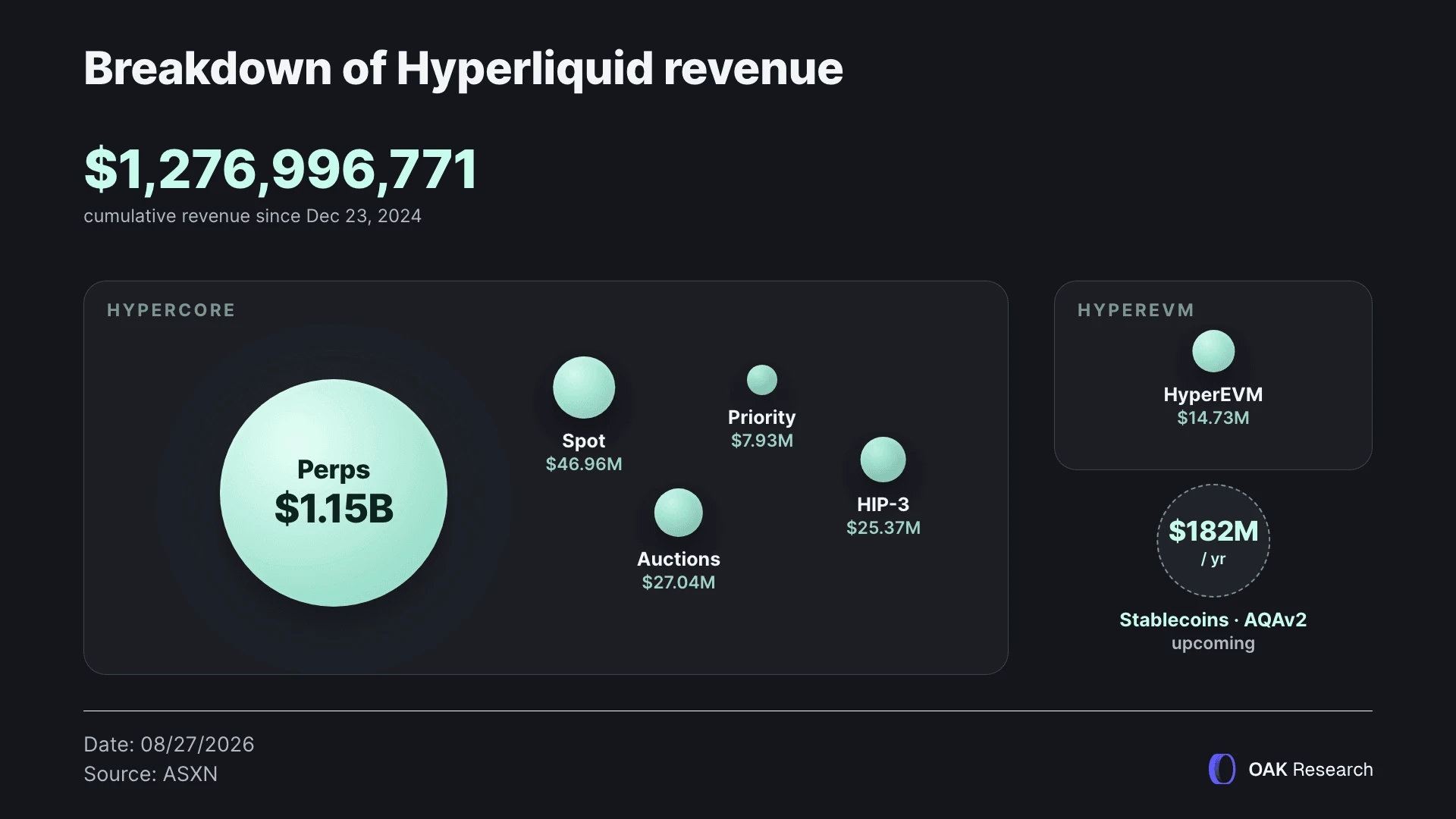
HIP-3 is a good example. When crypto entered a bear market and investor interest dropped, traders shifted toward traditional financial assets such as gold, oil, stocks and indices. Where did they go? Hyperliquid. In July, those markets sometimes generated more activity than the platform's traditional crypto perp markets.
It would be a mistake to assume all of that volume simply cannibalized crypto trading. The market environment was extremely weak, and traders going long Nvidia or short oil would almost certainly not have opened a Solana position instead if HIP-3 markets had not existed. HIP-3 genuinely expanded the range of products available on Hyperliquid, increased total platform volume and therefore created protocol revenue. Even with a lower take rate, Hyperliquid earns money on activity it simply would not have had without HIP-3.
The Builder Codes equation is even easier to defend. When a wallet, terminal or third-party frontend brings Hyperliquid a user who would never have opened app.hyperliquid.xyz directly, sharing part of the fees with that builder is not lost revenue. It is new revenue Hyperliquid probably would never have captured otherwise.
And if the Kraken hypothesis is eventually confirmed, the logic becomes even more obvious. A US user who cannot legally access Hyperliquid today generates exactly zero dollars of revenue for the protocol. If a regulated exchange eventually lets that person access certain markets built on HyperCore and shares part of the fees with the infrastructure, Hyperliquid may earn a smaller percentage of each transaction, but a smaller percentage is still far better than zero.
This is exactly what we wrote in black and white in our article last year, and the thesis has only become more relevant with every month that has passed since. We are not worried about the divergence between growing volume on Hyperliquid and falling revenue, as long as the protocol can multiply its sources of activity and revenue enough to make the equation favorable for HYPE despite this dilution.
And on that front, recent developments are pretty encouraging. HIP-1, xStocks, priority fees, which represented 6.7% of Hyperliquid revenue over the past 30 days, HIP-3 markets, HIP-4 markets, Builder Codes reaching all-time highs in volume, and of course AQA v2 with more than $180 million in annualized revenue all suggest that things are moving in the right direction.
If you are not familiar with AQA v2 or why we believe it is one of the biggest game changers in Hyperliquid's economics, you can find our premium breakdown in the Alpha Feed. You can try OAK Premium free for 7 days and get -25% off your subscription with the code "LILIAN25".
In short, markets can generate fees. Builders can bring in new users. Deployers can pay to launch assets. Professional traders can pay for priority. Capital sitting on the platform can generate yield on its own. And tomorrow, other services will probably be added to that list. For both the protocol and the HYPE token, that is by far the best long-term setup we can think of.
Trade 100+ perps with up to 40x leverage on a fully decentralized exchange.
Bitcoin (BTC), Ethereum (ETH), Hyperliquid (HYPE), Derive (DRV)

Bitcoin (BTC), Ethereum (ETH), Derive (DRV), Hyperliquid (HYPE)

Hyperliquid (HYPE)

Bitcoin (BTC), Ethereum (ETH), Hyperliquid (HYPE), Ethena (ENA)