


Market Briefing 6: Bitcoin surges toward $82,850, the level that will decide the bull run


Bitcoin (BTC), Ethereum (ETH), Hyperliquid (HYPE), Ethena (ENA)
Published on

Ethena spent the last three years testing almost every growth lever available to a crypto protocol and every narrative: a proprietary chain, a stablecoin ticker bid on the industry's hottest protocol, a fee switch three years in the making, an in-house perpetuals exchange, a Stablecoin-as-a-Service offering, and now a Nasdaq-listed treasury vehicle. While many of these initiatives made a lot of noise and positive feedback, we decided to take an honest look at what worked, what didn’t, and offer our opinion on Ethena.
Before exposing our reasoning, a few disclosures are needed for transparency regarding OAK Research’s relationship with Ethena.
Now, let’s take a look at the various initiatives Ethena launched, or was a part of and see how these initiatives are doing today.
Converge was announced on March 17, 2025 by Ethena Labs and Securitize as an EVM-compatible settlement layer built to bridge institutional finance and DeFi, using USDe and USDtb as gas tokens and staked ENA to secure a permissioned validator set. The partner roster was impressive: Pendle, Horizon, Ethereal, Morpho, and Maple Finance signed on early, with custody handled by Copper, Fireblocks, Komainu, and Zodia.
By April 2025 the team had confirmed an Arbitrum-and-Celestia tech stack and a mainnet target of end of Q2 2025, according to Securitize CEO Carlos Domingo.
After the initial hype, we saw new native protocols joining this initiative by launching complementary solutions to what TradFi would have expected to see on a blockchain designed for their products. The native protocols included Ethereal, Terminal, and Strata.
However, the Converge mainnet never shipped. Converge's own X account had gone silent since August, and neither Ethena nor Securitize took time to explain the delay or confirm the sunset of this initiative.
Terminal Finance, the Ethena-incubated spot DEX built specifically as Converge's designated liquidity hub, had by then attracted more than $280 million in pre-launch deposits. On November 29, 2025, Terminal announced it would not launch at all, writing that "the Converge chain never went live as expected, and a launch doesn't appear to be planned for the near future." The team chose to return all deposits rather than force a pivot, letting depositors keep their accrued sUSDe yield.
Ethereal, one of the original partners, pivoted to its own independent chain deployment rather than waiting on Converge's mainnet, and recently rebranded to Meridian to launch its own solution on Robinhood Chain.
Strata Markets, a risk-tranching protocol, pivoted from offering the tranching on USDe only to all types of yield-bearing stablecoins. USDe is still its largest market with over 74% of its TVL concentrated in Ethena’s synthetic dollar.
Gain legitimacy and visibility
Reach a qualified audience through in-depth analyses and reports. Get in touch to discuss partnerships, project showcases, or any professional inquiry.
USDe's yield has never been a fixed number. Since inception, Ethena’s yield represented the state of the crypto interest as per USDe’s yield design, it reflected what perpetual futures traders were willing to pay to stay long Bitcoin and Ethereum. However, since October 10, 2025, Ethena’s thesis needed a change.
Crypto markets absorbed an estimated $19-20 billion in forced liquidations that day, the largest single-day deleveraging event on record, more than nine times the previous largest liquidation event. Funding rates across BTC, ETH, and major altcoins flipped negative or averaged near zero. For many, this was the biggest liquidation confirming the deep bear market for crypto. Recovery since has been partial at best: by early November 2025, BTC funding had only crept back to "modestly positive" levels, nowhere near the funding regime that prevailed before the crash.
Before the crash, sUSDe's APY averaged 6.58% in the weeks running into October 10, 2025, and fell to an average of 4.15% in the period since, a roughly 37% decline in average yield. As of this publication, sUSDe's APY sits at just 3.91%. USDe's circulating supply peaked at $14.82 billion on October 4, 2025, days before the crash, then fell to a trough of $3.75 billion by April 28, 2026, a 74.7% collapse from peak. Supply has only partially recovered since, sitting at $4.39 billion today, still 70.4% below the October 2025 peak.
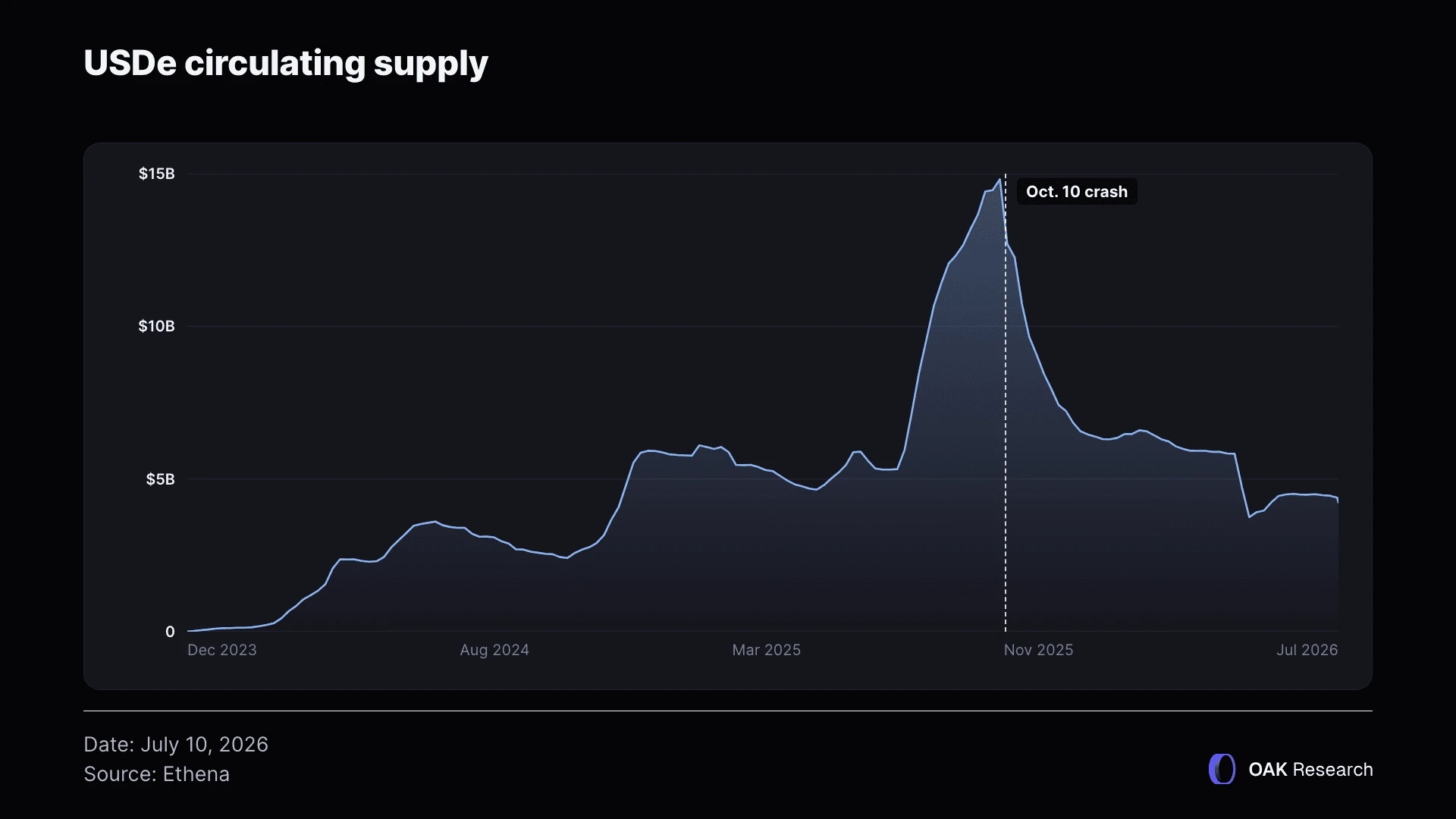
Since this catastrophic event, Ethena’s founder Guy Young admitted that Ethena’s model needed to change and that since that date the protocol continued to exist with a design flaw. Guy Young stated directly that "since 10/10 Ethena was poorly positioned for what has been a material regime change," and that the company has spent the months since building infrastructure to access alternate collateral sources specifically. While this change was needed, it also pulled Ethena further away from its original thesis betting on the delta neutral yield the crypto market has provided in the past.
Ethena announced the expansion of yield sources in its blog post on April 6th, 2026. At the time, the delta neutral yield represented around 11% of Ethena’s reserve. As of the day of publication of this article, this strategy represents around 1% of USDe’s total backing. The new yield verticals that were announced are:
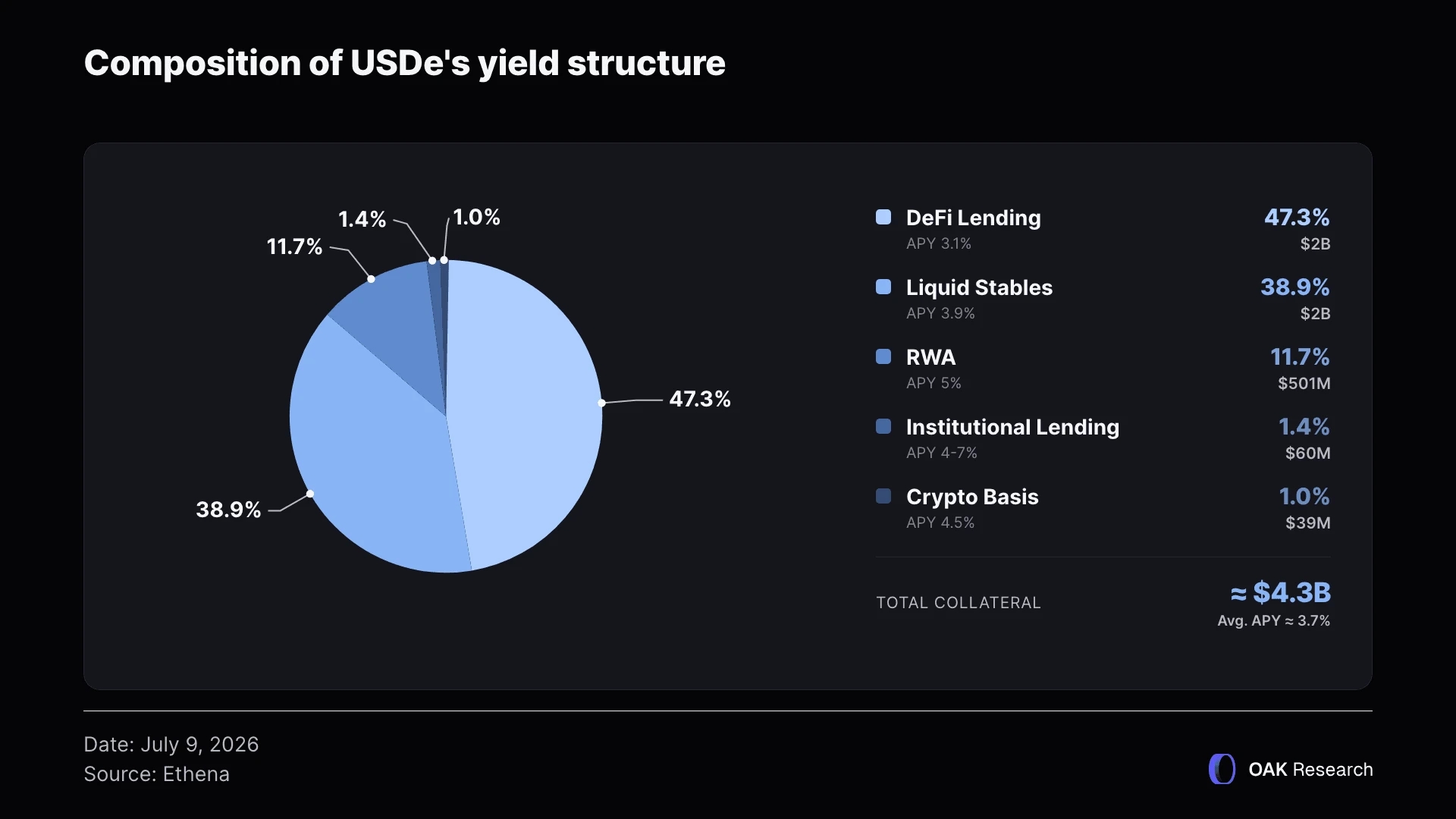
Even with these changes, today the two biggest sources of yield for Ethena come from DeFi lending and holding liquid stablecoins that pay T-bill yield to their holders such as USDC, USDtb, RLUSD, and PYUSD.
While staking USDe used to be an acceptable risk/reward that allowed people to generate substantial yield, it is not the case today anymore. Most crypto participants still view Ethena as a risky bet that carries substantial risk, translating into a reduced USDe supply and overall a preference for stablecoins backed simply by T-bills or cash.
In September 2025, Hyperliquid ran a validator-governed contest to select the issuer of USDH, its native stablecoin. Ethena's pitch was aggressive: back USDH entirely with USDtb, return nearly all reserve revenue to the Hyperliquid community, and inject at least $75M to cover USDC migration costs. Given that one of the participants of the election was quite close to the Hyperliquid community, neither Ethena nor Paxos, who had two of the strongest bids, won the election.
On September 11, 2025, Guy withdrew Ethena's bid ahead of the scheduled validator vote, citing direct pushback that Ethena wasn't a Hyperliquid-native team, ran too many product lines, and wasn't committed to a single exchange partnership. Native Markets ended up winning the bid. On May 14th 2026, less than a year later, USDH has been sunsetand USDC has become the main stablecoin used on Hyperliquid.
Hyperliquid's own community did not consider Ethena "native" enough to trust with its flagship stablecoin, despite Ethena's scale advantage over other bidders. Ethena pivoted afterward to deploying its own HIP-3 DEX, HyENA, that we will cover later in this article.
Trade 100+ perps with up to 40x leverage on a fully decentralized exchange.
HyENA, Ethena's USDe-margined perpetuals exchange built on Hyperliquid's HIP-3 framework, launched December 9, 2025 through the Ethena-backed Based team. It was a genuinely strong debut: more than $50 million of volume in its first 48 hours made it briefly the second-largest HIP-3 venue, with USDe collateral earning up to 12% APY as an added incentive. Since its volume peaked on February 5, 2026 and has been almost entirely downhill since.
As of July 7, 2026, daily volume sat at $1.81 million, a 98.2% decline from peak.
Another thing we noticed and that led us to publish this research piece is the HLPe vault on Hyena. Per Hyena’s docs, the vault manager was supposed to seed the vault with $5 million of its own capital. However, as this research is published, the HLPe liquidity sits below the $2 million mark, which leads us to believe that Hyena will likely be sunset in the near future given the lack of interest and the absolute dominance of the HIP-3 markets by TradeXYZ.
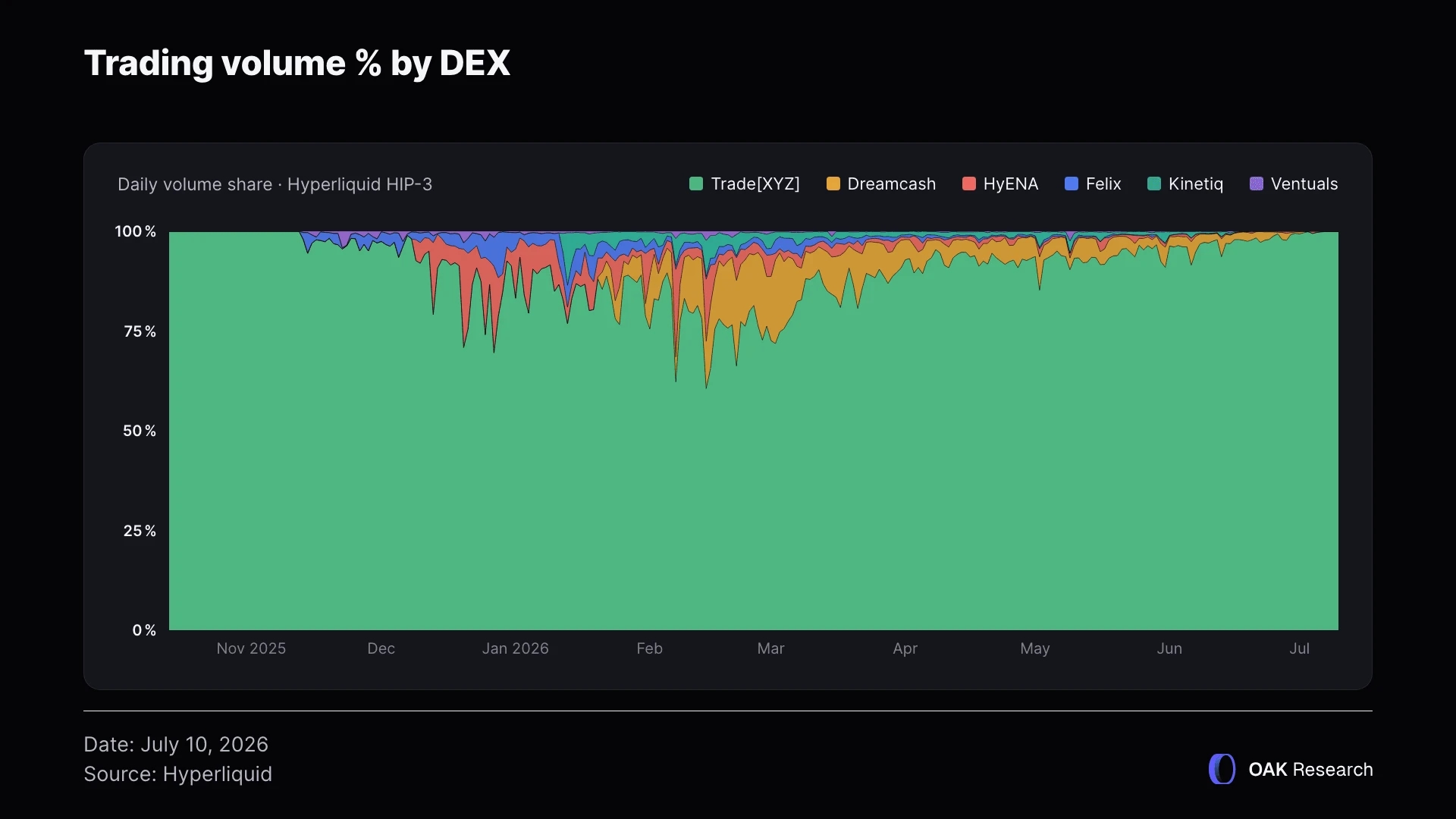
TradeXYZ, the framework's first and dominant deployer, has captured 91.1% of cumulative derivatives volume across all seven HIP-3 deployers since November 2025, versus HyENA's 1.1% and a combined 7.7% for everyone else.
Two other deployers have simply given up: Felix shut down its HIP-3 markets on June 19, 2026 after roughly $3B in cumulative volume across its commodity perps, citing an unwinnable competitive position against TradeXYZ's earlier launch and liquidity advantages. Ventuals wound down its OpenAI and Anthropic pre-IPO markets between June 15 and 19, 2026 after roughly $650M in volume and redeeming HYPE collateral 1:1.
The pattern across HIP-3 as a whole looks less like a competitive market and more like one dominant venue that will continue to eat its competitors.
After losing the USDH bidding war, Ethena tried to get a share of the most dominant trading venue on the market with Hyena. Unfortunately, this venture also took a heavy hit due to a Hyperliquid-aligned player that consistently dominated every other initiative. It has become one more casualty of a winner-take-most dynamic on a chain Ethena doesn't control, following a nearly identical pattern to what happened with USDH.
Once again, a venture that made sense but that might not have received the attention it needed besides the launch of heavy incentives.
Ethena's response through the first half of 2026 has been to lean hard into TradFi rails rather than double down on crypto-native DeFi integrations. Coinbase Ventures bought ENA on the open market in June 2026 ahead of an Ethena-powered savings product rolling out to Coinbase's users. Anchorage Digital was named collateral manager for Ethena's institutional lending activity in early June, part of an April 2026 pivot toward overcollateralized institutional lending intended to diversify USDe reserves away from perp-basis reliance.
Janus Henderson, which manages more than $480 billion, announced a tokenized CLO fund partnership and a strategic ENA investment in June, and reporting later that month described USDe being integrated into BlackRock's Aladdin platform with BUIDL becoming the primary asset for Ethena's white-label products.
It is definitely a pivot that was needed for Ethena and the right direction to take to generate yield, secure institutional partnerships, and get integrations in products outside of crypto.
However, it is difficult to see how the ENA token will accrue value from these partnership as a one-time open market purchase of ENA token does not translate into sustainable demand for the token. The amount of tokens purchased was not disclosed either, so it’s pretty difficult to assess the real impact behind these partnerships.
It would be great to see if there is a real demand on the institutional side for this product and whether the clients of the CEXs and Asset Managers are willing to allocate a portion of their portfolio to get exposure to USDe’s yield. We will cover the transparency efforts in the last part of the article.
In 2025 Ethena launched yet another growth lever: a "Stablecoin-as-a-Service" whitelabel stack that lets other chains and apps issue their own branded, yield-bearing dollar using Ethena's infrastructure and reserve rails, rather than building a stablecoin from scratch. So far, three protocols and chains decided to opt for this:
In total, these whitelabel stablecoins represent around $300 million in total market cap. It is however worth noting that most of the revenue generated by the yield backing these stablecoins go to Ethena’s partners and not to Ethena directly.
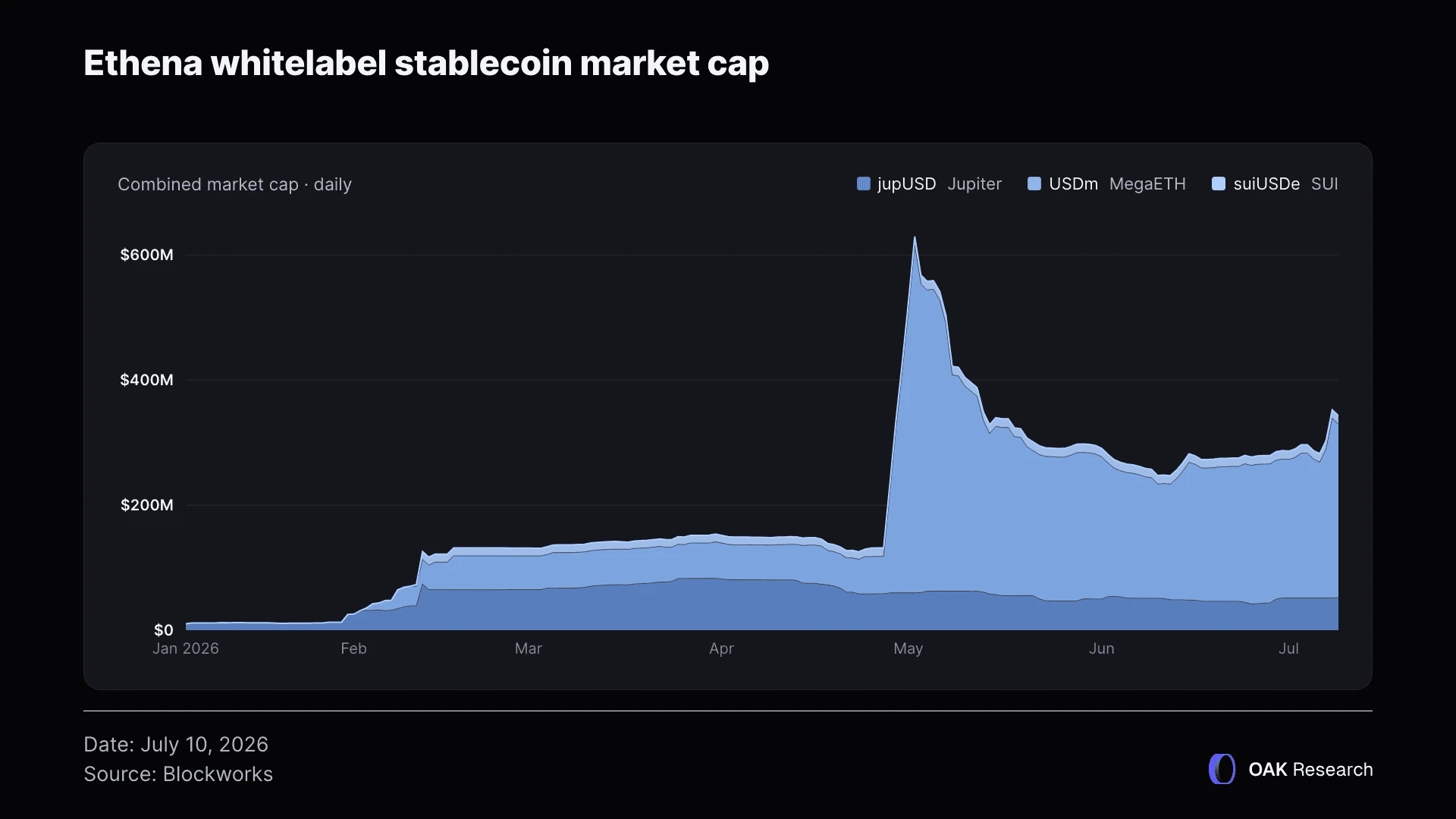
Stablecoin-as-a-Service is a genuine, live product with real partners and real circulating supply. While at the launch, this was a highly anticipated revenue venue, the liquidity remains quite modest. It could be compared to what Paxos did with Paypal’s PYUSD or USDG that took a long time to materialize into stablecoins with $1B+ market cap. We don’t consider this a failed initiative, but it’s important to take into account what it actually brings to Ethena.
Most stablecoins are backed by USDtb, a stablecoin issued in partnership by Ethena and Securitize, backed by Blackrock’s BUIDL.
Wintermute first proposed a fee switch for ENA holders in November 2024, with the Risk Committee setting three activation thresholds: USDe circulating supply above $6B, cumulative protocol revenue above $250M, and USDe integration on four of the top five derivatives-volume CEXs.
On September 15, 2025, the Ethena Foundation confirmed all three thresholds had been met, with USDe supply having crossed $13.7B at the time. ENA holders were briefly excited about run-rate yield projections as high as 15% on staked ENA. The proposal never followed. During the Risk Committee election in February 2026, Kairos Research had promised to work on the fee switch activation during their mandate. This term ends in August, and so far the only proposal around the fee switch and various models around its potential activation was posted by OAK Research with no comment from any member of the Risk Committee.
In this proposal we stated that activating the fee switch for Ethena today would be a mistake, since a buyback mechanism today risks weakening USDe precisely when its competitive position is being questioned.
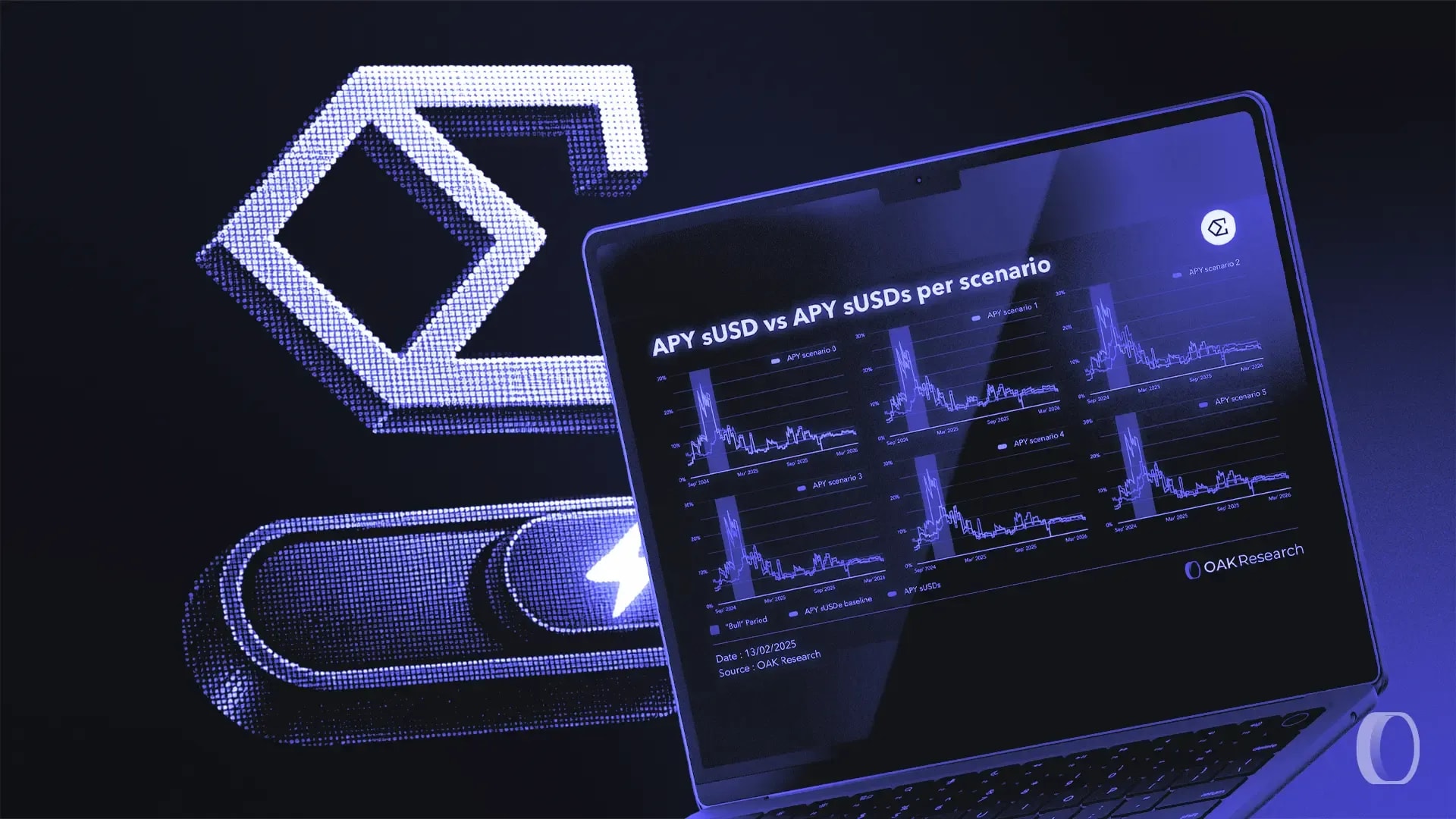
The March 2026 quantitative follow-up modeled six buyback scenarios and found the same conclusion holds even under the best-designed mechanism: compressed sUSDe/sUSDS spreads limit daily buyback volume to a "derisory" roughly $59K a day, under 1% of ENA's trading volume, and the buyback reserve itself would start essentially empty and struggle to fill under anything but bull-market conditions.
Later commentary from our fellow researchers from 4Pillars echoed our logic approvingly: dividends that are too small to matter create more disappointment than not having them at all.
Whether or not the Risk Committee ultimately activates the switch this year, the fact that Ethena confirmed it had earned the right to reward ENA holders back in September 2025 with no further comment or explanation as to why the fee switch was never flipped, creates further uncertainty that weighs on Ethena and ENA directly. A statement from Guy or Ethena as to why this matter was never followed upon would bring the much needed clarity with a better understanding of the current priorities.
This being said, in our opinion the first iterations of the fee switch might come from StablecoinX rather than Ethena directly. We will cover this later in the article.
We were bullish on Ethena before the initial hype around the protocol. We supported Ethena for several reasons: we believe their team is great and can achieve a lot in a short amount of time; we believe Ethena brought the innovation crypto needed and tried several things that were not done before; we believe that their connections and BD efforts is precisely what brought them to the current status.
Ethena is broadly recognized as a great protocol and a great team. We do not take the opposite side in this research piece, but clearly see valuable lessons in what Ethena has achieved so far.
One of the most interesting patterns seems to emerge along our analysis: Ethena has found itself a product market fit along other stablecoin issuers. Last year Ethena was the largest holder of PYUSD, the Paypal-issued stablecoin that paid additional rewards to its holders and partners that decided to hold it.
As of today, Ethena is scaling into USDG, the Global Dollar initiative by Paxos. One of the reasons for this new integration is the launch of the Robinhood Chain, that is part of the USDG consortium. USDG progressively takes more space in USDe backing and we would not be surprised if this percentage continues to grow.
Besides the stablecoins backing USDe, Ethena has become the prime asset for DeFi looping. Users deposit USDe as collateral, borrow another stablecoin that is then swapped to USDe to get a bigger yield on deposits. This strategy instantly brings inflows and liquidity to various chains and protocols that decide to integrate USDe and implement looping.
What Ethena has achieved is great: USDe did not depeg, it was integrated on major DeFi protocols, and Ethena has signed deals with most of the major institutional actors in the space.
Another thing that Ethena can be proud of is its transparency dashboard. After many iterations, we believe that it is top class in showing where assets are actually held, verified in real time. It is something that a lot of onchain stablecoins can take as an example for their proof of reserves.
We can’t help but notice a pattern in Ethena’s announcements and integrations. It feels like Ethena wants to be a big part of every major narrative: institutions entering the space with Converge, Hyperliquid-driven hype with USDH and Hyena, and the stablecoin run with its whitelabel offering. However, most of the initiatives are not followed upon, and are sunset or left behind.
Ethena has, as we previously stated, two products that truly matter: USDe, and ENA. Today, USDe’s yield is not competitive enough for the space to adopt it as the go-to stablecoin. ENA is used for incentives and new launches without a proper role within Ethena’s ecosystem.
As neobanks are running hot on every single chain with new deployments, never ending cashback and Visa-tiered cards, Ethena might be tempted to enter this space with USDe as the main currency of the bank along with ENA staking to access higher tiers and better rewards that would most probably paid in ENA. The main argument here would be the use of USDe as cash inside the app where your deposits would become productive and generate yield automatically.
Ethena was able to bootstrap a lot of its success through ENA distributions through various point programs on new initiatives. For whatever the next product is, we hope that it will not involve further dilution for current ENA holders and that now that Ethena has established itself as a protocol able to serve both institutional and crypto demand, the need for points and incentives will go away.
As stated before, ENA continues to mark new ATLs as the market continues to go through a deep bear market. Activating the fee switch today to create short-term rally around ENA would be a mistake that needs reworking, that would create even more uncertainty in the long term.
To be completely straightforward, earlier this year we reached out to Ethena to become the community liaison and provide more transparency, understanding in how Ethena operates, and overall the current protocol roadmap. While our proposal was not accepted, we do believe that some stuff we proposed in it could be implemented for Ethena going forward. The points outlined here are our own perception of what could be done better and improved because we think that pointing out certain flaws within protocols without offering solutions would be a dishonest job.
Across every initiative covered in this piece, a pattern repeats. Ethena and its partners are consistently loud at launch and consistently silent when the initiative is sunset. Converge was announced with a detailed roadmap, a named tech stack, and a mainnet target. When it missed that target, neither Ethena nor Securitize published anything explaining the delay. Converge's X account has been inactive since August, and it was Terminal Finance, a third party that had raised $280 million in deposits waiting on Converge, that ended up telling the market the chain was not coming.
HyENA’s story is quite similar. The HLPe vault manager committed publicly to seeding the vault with $5 million of its own capital. That commitment is now sitting below $2 million with no update from the team on why, or whether the shortfall will be addressed before the venue is wound down. We do however believe that if Hyena is wound down, Ethena will issue a public statement as people might need to withdraw their funds and the 500K HYPE will need to be unstaked.
The fee switch is the clearest case because it involves a governance commitment rather than a new product. Ten months later, the only public proposal analyzing what activation would actually do to USDe came from an outside party, not from Ethena or the committee currently in power.
Contrast this with how Ethena communicates when a partnership lands. The Coinbase Ventures purchase, the Janus Henderson deal, and the BlackRock Aladdin integration were each announced a few days apart from each other. That is not a criticism of those announcements, as they were handled well. Ethena knows how to communicate clearly when the news is good, but the follow ups on the actual impact or the communication if an initiative doesn’t work out, are never clearly shared.
A simple fix would cost Ethena little: a standing post-mortem where any initiative that misses its own stated timeline gets a dated public update within a set window, the same way the launch itself got one. The learnings and the mistakes that might have been made should be acknowledged in order to avoid repeating them.
We have no idea how Hyena was deployed or how the 500K HYPE tokens were acquired. We don’t know how many ENA tokens were distributed on Hyena. We don’t know how many ENA tokens Janus Henderson acquired and what the terms are for them to hold it. We don’t know how much revenue the Whitelabel Stablecoin solution actually represents or where it goes. We don’t know the expenses Ethena has or how it’s financed.
These are the first questions that come to mind when we think about the latest developments within Ethena and what the protocol actually does with its strategic reserve and where the yield actually flows.
This point is one of the most important ones. We have seen USDe deployments on Hyena, Robinhood Chain, and Solana where simply holding USDe allowed users to perceive the yield that Ethena generates. Before, in order to benefit from this yield people had to stake USDe with a lock up period if they wanted to get their USDe back or use DEXs to swap sUSDe for USDe with a small loss. Today, simply holding USDe grants you the same rights as staking it natively on Ethena.
There are two solutions here:
1 - USDe becomes a yield-bearing token by default. This solution is less likely as it could become a regulatory hurdle for USDe adoption.
2 - USDe is yield bearing in certain cases, but sUSDe offers better yield. Ethena might strike deals with chains, CEXs or protocols where USDe is yield-bearing by default. However, sUSDe should benefit from this type of mechanism: the redemption should be instant (up to a certain threshold), or sUSDe should get a higher portion of yield generated by Ethena.
Users that natively stake USDe on the protocol would benefit from taking a more significant redemption risk, risk of potential depeg on sUSDe, and a lower yield depending on the market conditions.
Today the difference between sUSDe and USDe on other chains and protocols has become more blurry than before. Clarifying the difference and giving an advantage to USDe takers would be a step in the right direction.
We have seen the value that a native and aligned protocol brings to Hyperliquid. More builders, strong support for the native token, easier dialogue and more partners that get integrated. While StablecoinX is a DAT and not a protocol, it is still involved in onchain activities and new profit launches for Ethena.
The two most interesting ones are in our opinion the Stablecoin Harness initiative allowing anyone to simply connect to USDe yield through an API key and integrate Ethena’s yield-generating engine; and the DVN operation on LayerZero for USDe crosschain compatibility.
The revenues from these two products should flow directly towards buying the ENA token, and create a sort of a buyback mechanism through new Ethena integrations without the need to take away USDe’s yield. While the DVN revenue still looks rather small (only a few dollars) per Token Terminal, the Stablecoin Harness initiative could represent a substantial share of revenue that flows directly towards ENA buybacks.
If StablecoinX succeeds in generating enough capital to make a dent in ENA’s buying pressure, we might see positive returns for ENA along with it. We will closely monitor the revenues generated by this DAT in the next planned reportings to see if this is the case.
Unlock all our research and get the right insights, at the right time.
Now that this analysis is over, we do believe that ENA might be nearing its bottom and as the market sentiment picks up, ENA might benefit from better yields on USDe, a potential fee switch activation, and a better risk tolerance from market participants. It does not mean, however, that the improvements suggested in this piece should be brushed off until the market recovers. As we go through the deep bear market territory, protocol improvements for the better times are crucial.
We believe that Ethena has an exceptional team that is capable of becoming one of the most important protocols in crypto through its partnerships and current TradFi partnerships. USDe is available on every major CEX, is available as collateral for trading, is the primary looping asset in DeFi, and is able to continuously adapt to the current market conditions.
It is important that the protocol stops throwing new ideas at the wall to see what sticks and starts consolidating on what was announced and showing metrics of success. We believe a better transparency is the right step forward and more explanations either from Ethena directly or from Guy Young like he used to do in the past.
USDe growth and ENA should be the two primary focus points for Ethena. Kind of stating the obvious here, but Ethena has enough partnership announcements and integrations to create a sustainable demand for USDe, while integrating ENA in other protocols. What Ethena had with Converge was quite beneficial for ENA stakers as all protocols allocated a portion of their supply to ENA stakers. The same could be done with protocols already live where Ethena’s integration is driving growth.
Ethena could negotiate a portion of supply allocated to ENA stakers where the treasury grows and ENA stakers could get a right to these tokens if Ethena allows them to claim it. But this might be a separate subject we might cover in our future research.
Bitcoin (BTC), Ethereum (ETH), Hyperliquid (HYPE), Ethena (ENA)
Ethena USDe (USDE), Ethena (ENA)

Ethena (ENA), Cap USD (CUSD)

Ethena (ENA)


