A Zoom on MegaETH, the blockchain that raised $9.2 million in seconds
MegaETH (MEGA)
Published onUpdated on

While scalability has long been the bottleneck of DeFi, MegaETH marks a break with its promise of a "real-time" blockchain capable of reaching 100,000 TPS and 10 ms latency. In this article, we offer an overview of the main protocols currently under development or already established on MegaETH.
MegaETH presents itself as the first so-called "real-time" blockchain. In practice, its highly scalable architecture allows it to achieve a block time of 10 milliseconds and up to 100,000 transactions per second. In doing so, the MegaETH user experience approaches Web2 standards in terms of latency and fluidity.
In reality, the stake goes beyond simple execution speed: this scalability profoundly changes how applications can be conceived. Where latency constraints previously imposed structural compromises, MegaETH clears the way for native use cases impossible to design on slower infrastructures. Certain application building blocks, notably in trading, gaming, or real-time interactions, are radically changing dimension.
While scalability promises held up on testnet, the network currently processes more than 30 transactions per second only on rare occasions. That said, it is worth emphasizing that MegaETH has only just launched, with a limited number of native applications currently live on the blockchain.
In this analysis, we invite you to explore the MegaETH ecosystem and discover the main applications, their value proposition, and their interest for you as an on-chain finance user.
In addition to this review, we recommend using the Megabunnish tool, developed by Joestarcrypto. It offers a visual mapping of the MegaETH ecosystem, with the ability to filter and personalize tracked projects to effectively structure your monitoring of this ecosystem.
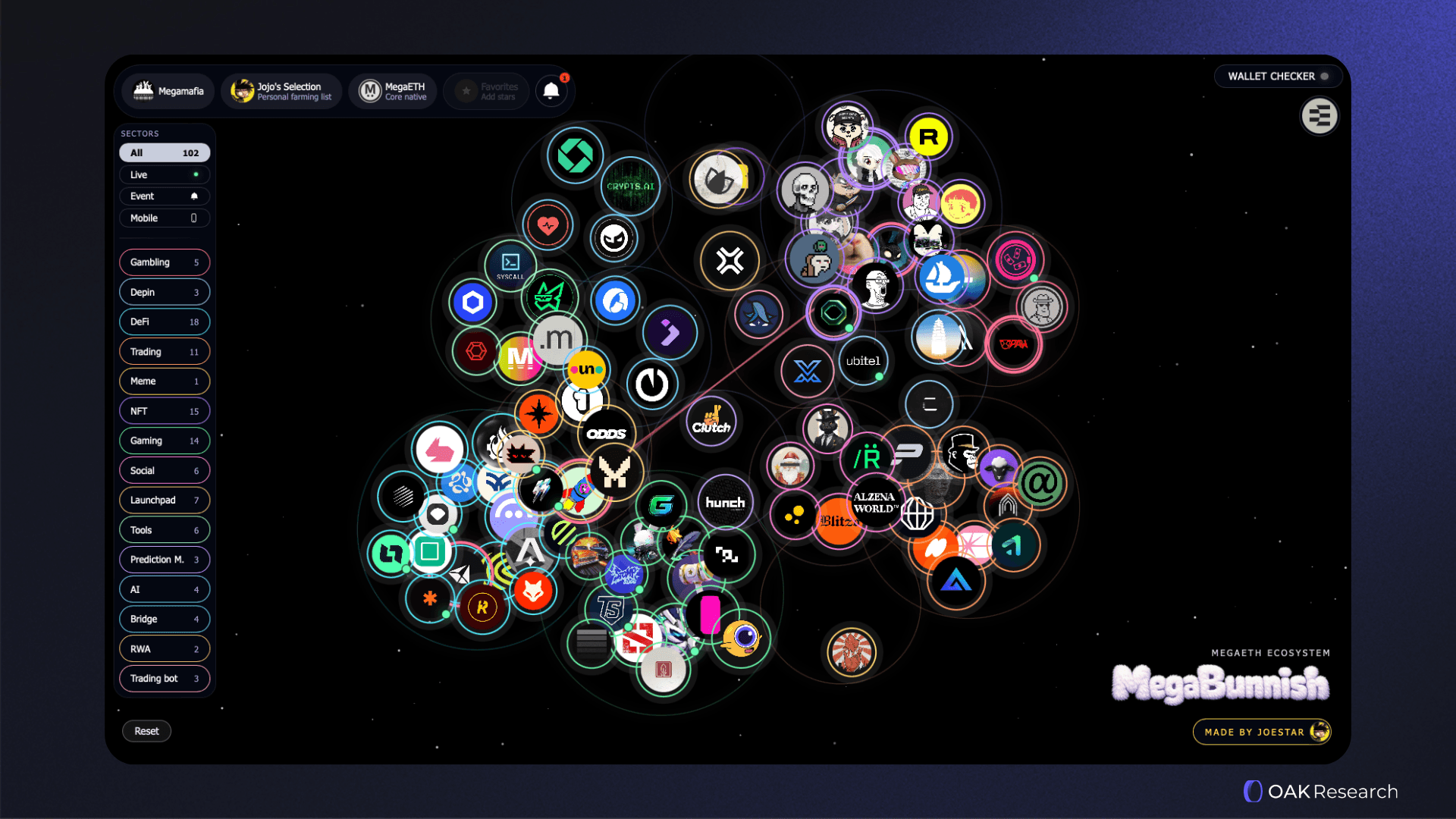
The "Megamafia" brings together applications officially highlighted by the foundation. In contrast to the massive subsidy strategies of typical schemes, MegaETH selects few projects but bets on their real differentiation and their ability to exploit Layer 2 scalability as a competitive advantage.
MegaETH does not finance them directly but offers them an environment, a network, and visibility to develop within a tight-knit ecosystem. This filtering creates a scarcity effect where the selected projects concentrate attention, liquidity, and innovation simultaneously.
At the origin of the "Tap Trading" concept, often copied but rarely with success, and backed by a $7.5 million raise, Euphoria is now establishing itself as one of the most important applications in the ecosystem.
The principle is intentionally minimalist but particularly addictive: the user clicks on a square corresponding to a price range for BTC, ETH, or SOL, with a predefined stake. If the price reaches the chosen zone, the position is a winner. Otherwise, it is a loser. The chart updates every 10 milliseconds thanks to MegaETH's infrastructure and the RedStone oracle.
The format offered by Euphoria is often summarized as a "TikTok of trading." The strength of this model lies in its quasi-instantaneous resolution and the elimination of complexity inherent to traditional trading. The interface becomes intuitive, fast, almost playful, while relying on a demanding technical infrastructure based on a CLOB system.
Another strategic element: Euphoria, like other projects evolving on MegaETH, is a mobile application. Native smartphone applications remain rare in crypto, even though the smartphone is now the primary access point for users. Adding to this ease of use, Euphoria ticks all the boxes for a product that works with non-native users of the crypto ecosystem.
As a result, the "Tapathon" organized by Euphoria and launched last February 16 has become one of the most important events in the MegaETH community.
To better understand how Euphoria works, which introduces a new primitive into the crypto trading space, we spoke with Casey Craig, the project's founder. We will notably try to understand why MegaETH offers an environment conducive to this kind of application, which is difficult to replicate elsewhere.
Why did you choose to build on MegaETH?
Euphoria is fundamentally a real-time UX product. Tap Trading only feels this fun and intuitive when feedback is immediate, not tap a square and wait two seconds for confirmation then tap again.
We needed an environment where we can treat trading interactions as instant, frequent, and consumer-native so it had to be extraordinarily fast and cheap. It was necessary from both the UX and protocol perspectives.
From a technical point of view, what is the on-chain footprint of a single action on Euphoria? According to testnet data, to what extent do you anticipate Euphoria's activity saturating the network or, conversely, demonstrating the real scalability of MegaETH's throughput (TPS)?
Every tap generates two onchain transactions. We don’t expect Euphoria to “break” the network. Our bet is the opposite really, that this category of consumer app is what validates Mega’s performance and scalability claims. Our testnet results so far are a positive indicator of this. The network’s been fast, stable, and we’ve not seen egregious gas consumption that would hinder us on many other chains. It’s not a fun experience to place a $1 tap and pay $0.10 in gas.
Behind every click, there is a counterparty. How is liquidity managed on Euphoria? Do you rely on an internal Market Making (MM) model, or do you plan to open liquidity pools where users themselves can act as a counterparty to the protocol?
We work with two market makers presently and longer term we expect to open the system to third party liquidity from additional market makers or LP participation.
Euphoria relies on RedStone Bolt for real-time data feeds. Can you explain why such precision is essential for your Tap Trading model, while traditional options platforms can tolerate higher latencies?
Tap Trading is highly sensitive to time and price granularity because positions are short duration, close to spot outcomes where milliseconds can change whether the price crosses a boundary.
Traditional options platforms can tolerate higher latency because they generally trade much longer expiries and execution doesn’t rely on instant boundary crossing on very short timeframes.
The ranking system for the Tapathon has generated significant engagement. Do you intend to maintain this competitive dynamic on the mainnet and, if so, do you envision a reward system to value the performance of the best traders?
More to be announced on this in the future but the competitive dynamic and rewards right now are definitely not a one off. Social features like leaderboards and competitions are a core part of how we make trading feel social and fun and there’s much more where this came from.
Derivatives trading is often perceived as having an insurmountable technical barrier for the general public. Euphoria seems to want to break this wall through gamification. Do you plan to make the blockchain invisible (account abstraction, gas fees, signatures) to onboard users unfamiliar with crypto?
Yes, it’s essential to our thesis. We want non crypto-native users to experience Euphoria like a “regular” consumer app. It’s an app that happens to run on crypto rails, not a “crypto app”.
We’re using Privy for embedded wallets so users can sign up with whatever method is most comfortable, like an email address or social account for non-natives or your preferred wallet like MetaMask or Phantom for the crypto savvy.
Transactions are gasless, balances are denominated in USD, and onboarding to Euphoria is seamless whether you’re coming from fiat in your bank or crypto on nearly any chain or exchange.
HelloTrade also adopts a mobile-first approach. The project is led by two former BlackRock employees, notably involved in the launch of the IBIT spot Bitcoin ETF, which exceeded $2 trillion in volume in 2026, as well as BUIDL, the ecosystem's largest tokenized fund which now accumulates $2.3 billion in on-chain AUM.
With this expertise, the HelloTrade team offers an application allowing for the trading of stocks, ETFs, commodities, and crypto assets, all while relying on MegaETH's extreme scalability to guarantee fast and fluid execution.
The idea of using blockchain as a quasi-instantaneous management infrastructure for financial transactions, accessible globally and at lower cost, is still underestimated. Yet, financial institutions aim to migrate their products to the blockchain and the first successes of the industry, notably around HIP-3 and tradeXYZ (though possibly fueled by the prospect of an airdrop in the latter case), suggest that real demand exists on the side of crypto users.
This explains why the application raised $4.6 million and is now among the most anticipated in the still-nascent MegaETH ecosystem.
Rocket is an application that deeply rethinks the concept of prediction markets, popularized by players like Polymarket or Kalshi.
On Polymarket, for example, bets are unidirectional: a position is taken on the outcome of an event, then held until resolution or sold. Performance therefore depends heavily on the final result, which can flip at the last moment.
Rocket takes a different approach. You bet in one direction, then gains and losses are redistributed progressively according to market evolution. It is thus possible to correctly anticipate a trend over time and be a winner without necessarily being right about the final outcome, which is clearly a differentiator from usual schemes.
In practice, this "Redistribution Market" operates a continuous redistribution every five seconds between opposing positions. The goal is to improve informational efficiency and bring the product closer to the real rhythm of market expectations.
It is important to emphasize that the protocol works with a unified margin, where all positions share the same collateral, allowing for more advanced strategies and better capital efficiency.
Rocket is therefore not just a simple competitor to Polymarket. The project is creating an entirely new category. It is this unique positioning that makes it one of the most anticipated applications on MegaETH, with $1.5 million raised to date.
Cap addresses a central issue of stablecoins: maintaining an attractive yield in varying market contexts.
Take the example of Ethena. The protocol offers two stablecoins:
These models, however, involve arbitrage between tokens depending on the context.
In contrast to these propositions, Cap opts for a single token, cUSD. Its yield is generated by several operators using various strategies, with security reinforced by the economic infrastructure of EigenLayer and Symbiotic.
This flexibility allows for dynamically adjusting allocation between different strategies according to market conditions. If the environment changes, the stablecoin adapts without the user needing to perform the arbitrage themselves.
This proposal allowed the project to raise $24 million, including $15 million through a public raise, and to reach $200 million in total value locked during the pre-launch on Ethereum, even though an incentive campaign is still ongoing.
→ Re-read our Early Bird on Cap Money:
WorldMarket is a Super App developing the "Capital Sink" concept. The idea is simple: in theory, perpetual funding rates and on-chain lending rates should converge. In practice, this is not the case due to the lack of a unified risk management engine capable of handling loans, spot, and derivatives simultaneously.
WorldMarket solves this problem by introducing Atlas, a risk management engine capable of overseeing loans, spot, and derivatives under a coherent logic, with unified liquidation management.
In the event that the protocol's ambitious model proves functional, it would open the door to unprecedented strategies in DeFi.
The most emblematic example is the Leverage Basis Trade: borrowing up to 10x, buying 50% in spot, and selling 50% in perpetuals. In the background, the position is treated as delta neutral by Atlas, protecting it from liquidations related to price variations while capturing the funding.
WorldMarket therefore fuses previously separate blocks of decentralized finance. By unifying loans, spot, and derivatives, the protocol creates new arbitrage opportunities and could, eventually, profoundly change how the market works.
The first lending protocols pooled capital in a single reserve, exposing it uniformly to the same level of risk. In this model, it is impossible for lenders to offer their own terms or create a truly dynamic market.
Isolated markets arrived later, but at the cost of high liquidity fragmentation. Borrowers had to compare different offers themselves to find the best terms, which added friction.
Avon proposes a different approach: integrating lending/borrowing into a CLOB (Central Limit Order Book) architecture, a model commonly used on perpetual contract markets like Hyperliquid. This type of infrastructure allows for a much more efficient connection between supply and demand.
Avon is the first to apply this model to the credit market. Each lender can create a personalized and isolated strategy, then publish it in the order book. When a borrower looks for a loan, the system automatically selects the most competitive offer according to their criteria.
This mechanism truly puts players in competition and allows for dynamic discovery of interest rates and collateralization ratios, adjusted in real time thanks notably to MegaETH's scalability.
Theoretically, the model could deeply transform the on-chain credit market. However, its actual effectiveness will depend on its adoption.
Brix tackles a field still largely neglected by the crypto industry: exposure to emerging markets.
While the majority of protocols concentrate their efforts on the tokenization of assets linked to US Treasury bills, Brix adopts a radically different logic. The project targets funds exposed to emerging economies, where yields can reach much higher levels, sometimes between 10% and 50%.
The goal is to broaden the range of available yields and tradable markets on-chain, while allowing these assets to be used as collateral or a source of liquidity.
Concretely, Brix could allow for exposure to strategies currently reserved for traditional macro desks, such as a leveraged Turkish carry trade. In parallel, these assets could also be used as collateral in other DeFi protocols, creating new capital efficiency loops.
In this sense, Brix does not just import an existing product. The protocol attempts to integrate into DeFi pockets of yield historically absent from the ecosystem.
The main challenge, however, will remain regulatory: the tokenization of assets exposed to emerging jurisdictions raises specific constraints. This is why the project's ability to structure these products within a robust legal environment will be decisive for its long-term viability.
When a new blockchain emerges, applications often seek to quickly attract significant capital by offering very high yields, with the goal of creating deep liquidity and an immediate attraction effect.
However, this model has a structural limit. It mainly benefits a few large wallets that capture initial allocations and then sell quickly. Liquidity withdraws, and the cost is frequently borne by average users or public investors.
Blackhaven offers a decentralized alternative to this logic. The protocol sets up a treasury open to everyone, where users can deposit capital in exchange for RBT (Reserve Backed Token), a token backed by assets held by the treasury.
This liquidity is then deployed within various MegaETH protocols to generate fees and capture points or rewards related to incentive campaigns. Deposited MEGA tokens can also be staked and used in the Proximity Market, a pillar of the MegaETH economic model, comparable to what Jito represents on Solana. All income feeds the treasury and mechanically strengthens the value of RBT.
To manage RBT volatility, Blackhaven has implemented the BAM (Backing Arbitrage Module), based on the following model:
The goal is to ensure progressive growth of the treasury and protocol liquidity, governed by holders of the HVN token, whose ICO has been announced.
Notable point: the founder of Blackhaven is also the creator of Olympus DAO. In the past, Olympus made DeFi history with its innovative treasury model but suffered from excessive dependence on inflation. In effect, Blackhaven takes the mechanisms that have proven effective while seeking to correct the imbalances observed in previous cycles.
To simplify, Blackhaven can be seen as a form of "on-chain Strategy," more complex, decentralized, and equipped with an actively deployed treasury to generate yield.
Supernova aims to create the first order book based (CLOB) interest rate market in DeFi, an essential link for institutional adoption.
The problem is simple: many players, particularly institutional ones, prefer fixed rates to have clear visibility on their yields or borrowing costs. However, on protocols such as Aave or Morpho, rates are inherently variable.
In this context, Supernova introduces a market allowing for the negotiation of this rate exposure. On one side, traders can speculate on their evolution. On the other, lenders and borrowers can hedge their position to recreate the equivalent of a fixed rate.
Take two examples:
Unlike Pendle, which relies on yield tokenization with maturity dates, Supernova uses MegaETH's speed to offer a true order book. This allows for much more flexible management without the constraints of liquidity fragmented by expiration dates.
Other Megamafia applications are also highly anticipated, even if the information available about them remains limited at this stage.
According to information available at the time of writing, Blitzo would be a mobile payment application aiming to make every transaction viral, tokenizable, and monetizable.
The concept seems to sit at the intersection of Stripe and Pump.fun, with a social and speculative dimension integrated directly into the act of payment. The concrete execution remains to be specified, but the ambition is to transform payment into a programmable and potentially financial primitive.
Dorado Games aims to create an entirely trustless casino, relying on liquidity positions and game theory mechanisms verifiable on-chain.
The goal is to eliminate any dependence on an intermediary. Rules, probabilities, and fund management would be directly written and audited on the blockchain.
Ubitel proposes an original model: offering a globally accessible internet connection in exchange for verifiable computations, secured by the phone's TEE (Trusted Execution Environment) technology.
The principle relies on using mobile computing power, with proofs executed in a secure environment to guarantee the process's integrity.
Such a model requires an infrastructure capable of processing a high volume of real-time interactions, which explains its grounding on MegaETH.
Hunch revisits the prediction market popularized by Polymarket on mobile, orienting it toward a faster, more social, and more engaging experience.
The application bets on an accelerated resolution mechanism, with shorter cycles, to offer more sustained dynamics than traditional formats.
Telis is a bridge that claims to be able to pay users to transfer their funds from one blockchain to another.
The model relies on using WorldMarket, which we presented previously, to generate yield via funding rates or arbitrage strategies. Bridge-related flows are exploited to capture these opportunities, and then a portion of the generated value is redistributed to the end user.
Telis had already tried to implement this model on Hyperliquid. But despite encouraging performance, the infrastructure did not allow it to operate at scale. At this stage, only MegaETH seems to offer the necessary performance level.
Even if Megamafia concentrates a large share of innovative projects, certain protocols outside this circle also deserve attention.
They mostly benefit from reduced visibility because they do not have the foundation's direct support. But they consequently offer a potential asymmetry: being less visible, they are often underestimated by a large part of the community.
Lora offers a product close to options, allowing for exposure to an asset's upside without liquidation risk, unlike perpetual contracts.
How Lora works is simple: liquidity providers deposit assets (e.g., ETH) into a vault. Users can then buy exposure by paying continuous fees as long as the position remains open.
For the liquidity provider, the capital is locked and remunerated by fees. If the price goes up, they pay out part of the performance. If the price goes down, they pay nothing. Their income comes from continuous fees, which compensate for the risk taken.
For the user, it is possible to obtain leveraged exposure by mobilizing little capital, without liquidation risk, as long as fees are paid, regardless of volatility. Ultimately, their position closes only if they decide so or if they can no longer afford the cost.
This mechanism can also serve as a hedge. For example, a user who deposits BTC into a lending protocol to borrow ETH could use Lora to offset fees or cover interest.
Lora targets investors with little capital or those uncomfortable with complex derivatives. In summary, the product combines the simplicity of spot exposure with some benefits of leverage, without the brutal risk of liquidation.
Tulpea tackles a recurring problem in DeFi: the absence of under-collateralization. Today, the majority of on-chain loans require excess collateral, which severely limits capital efficiency.
This model protects the system, but it stifles capital efficiency and mechanically excludes a large portion of potential borrowers. Tulpea attempts to introduce a different logic by relying on tokenized real estate.
The operation relies on a two-tier architecture:
Borrowers contribute between 20% and 30% of the capital needed to acquire a property. In return, they receive REBTs (for Real Estate Backed Tokens) representing their economic share in the asset.
A significant portion of these tokens is subject to a vesting period: they are unlocked as debt is repaid and rent is collected. In parallel, these REBTs can also be used as collateral within other DeFi protocols.
On the other side, lenders finance the remaining balance via the purchase of ABDTs, "Asset Backed Debt Tokens" corresponding to the tokenized debt. These securities are structured into different risk tranches, each associated with a distinct yield / exposure profile.
Initially, property selection and credit issuance will be operated by Tulpea Core. However, the stated goal is a progressive transition toward decentralized governance via a DAO.
In essence, Tulpea recreates a complete banking architecture, but native to the blockchain: structured matching between lenders and borrowers, backed by tokenized real assets and orchestrated by decentralized programmable mechanisms.
BadBunnz has established itself as the emblematic NFT collection of MegaETH, whether through its graphic footprint or its strong community vertical. This traction has not, however, remained confined to the NFT segment: the project team has successfully capitalized on this community base to develop three applications, each with its own ambition.
Bad Bunnz's approach is interesting: rather than depending on external financing, the BadBunnz ecosystem relies on its community and its brand to build progressive vertical integration.
Prism constitutes the central piece of the Bad Bunnz ecosystem, with the explicit ambition of becoming MegaETH's super app.
From a single interface, users can access perpetual markets via WorldMarket, exploit DeFi opportunities via Avon and its MegaVault, perform swaps (cross-chain or not), trade on a Launchpad, and interact with prediction markets thanks to the first direct integration of Polymarket within MegaETH.
In practice, Prism's strategic interest indeed lies in the consolidation of these different tools. Where DeFi traditionally imposes fragmented navigation between protocols, Prism seeks to aggregate several building blocks within a unified environment.
Information available on this protocol remains limited, but BunnzPaw seems to target the gacha and on-chain tokenized trading card segment.
The project would emphasize engaging game mechanics, with a strong community and social dimension.
Faster is the launchpad developed by BadBunnz. It is directly accessible from Prism, which reinforces the ecosystem's coherence and strengthens its presence within MegaETH.
In practice, Faster relies on a bonding curve system, where payments are exclusively made in ETH with integrated slippage protection.
Once the bonding phase is finalized, the token is automatically listed on Prism with pools intended to stimulate liquidity and activity. In parallel, creators and traders can accumulate Prism Points through their activity.
We had the opportunity to discuss with the Bad Bunnz team to get their opinion on the MegaETH launch, the upcoming challenges for Layer 2, and, of course, to learn more about the project's future.
Why did you choose MegaETH to develop?
Concretely, we have followed all new blockchain launches over the last two years. We have become experts in this field, which allowed us to easily evaluate the factors that contributed or not to a project's success, from tokenomics to fundraising to communication, and so on. To that end, we seemed to see many green flags on MegaETH's side, notably through its clearly competent team. All this indicated a healthy environment to develop our project.
The launch of MegaETH generated colossal expectations, especially during the ICOs, but operational success seems more nuanced for now. How do you analyze this gap between the initial investor fervor and current network activity? Is it, in your opinion, a simple necessary "organic growth" phase?
In our opinion, there are several reasons for this observation. If we go back a bit, the November public sale took place in a context of BTC over $100,000 (and a MEGA token at over $5 billion FDV market cap in pre-market), which contrasts sharply with the current state of the market.
In parallel, the mainnet launch objectively involved several mistakes: the absence of a 1:1 bridge with USDm (which is the hub of the ecosystem) which led to very significant slippage for individuals who wanted to bridge large amounts, or even the refund of the pre-bridge because of a communication issue, even though $500M had been deposited in record time.
All these factors mean that, in the end, the MegaETH launch took place with very little liquidity to pour into its ecosystem. Nevertheless, this has the merit of leading to organic growth, without opaque deals with VCs to pour hundreds of millions of dollars onto the network, which generally has the effect of creating "fake hype" in the short term. That is not the case here, and it seems to us to be a very good point.
Many applications on MegaETH are still at the exploratory stage. What is your vision for the ecosystem's development in the medium term? With Prism establishing itself as the Layer 2 "Super App," do you already have concrete ideas for integrating Bad Bunnz and creating synergies with other dApps?
Indeed, the fact that major dApps were not launched at the same time as the mainnet or shortly after is part of the problems currently considered, and Euphoria is a good example. However, we think the MegaETH ecosystem should become more interesting in the coming weeks and months.
Regarding Prism, the goal is indeed to group innovative narratives and apps behind the same storefront while maintaining a coherent synergy. In this regard, we are precisely the first decentralized application in the ecosystem to integrate Polymarket NATIVELY. In practice, users will be able to bet on Polymarket with any token from MegaETH, which translates into a real technical breakthrough serving the user's UX. It is also planned that we integrate perps, lending, and many other things. To summarize, the goal is to be able to do everything from Prism with a top tier UX.
Finally, as for the synergy of our offer with Bad Bunnz NFTs, it is a no-brainer. We have already announced point boosts for holders, and other surprises are coming!
If the MegaETH launch favors global mutual aid, the long term will require differentiation. What is your strategy so that Bad Bunnz is not just one project among others, but a strong alternative to the dynamic imposed by MegaMafia-supported dApps?
In reality, Bad Bunnz is already a different project in many ways. We are not aware of any NFT project having developed several dApps simultaneously as we do.With the exception of a few collections, most NFT projects developed on MegaETH are directed toward art, which, in our opinion, is no longer sufficient in 2026.
Currently, we have the largest mindshare on MegaETH with Prism and Bad Bunnz, whether in crypto or elsewhere. In reality, it is all about distribution, which is objectively our strong point. And this, in addition to significant technical capabilities and an understanding of the market and narratives well beyond what can be observed on average.
While the NFT market is going through a period of global disinterest, Bad Bunnz manages to maintain some traction. Do you think this success rests on a true community fiber unique to MegaETH, or is it mainly an investor exposure strategy in the hope of a future ecosystem airdrop?
As we said previously, we think people have understood that Bad Bunnz goes well beyond a simple NFT collection: it is also a way to bet on a team of builders developing several applications, notably Prism.
Despite everything, and this is a very important point for us, our NFT collection remains the central point of the Bad Bunnz ecosystem, much like Pudgy, a project where the initial NFT collection has managed to remain at the center of its offer despite the many side projects developed later.
MegaETH presents a density of experimentation rarely observed at such an early stage. Programmable payment, dynamic prediction markets, order book based lending, adaptive stablecoins, tokenized real estate: each vertical is approached with an attempt at real differentiation rather than simple replication of countless existing models.
The project's positioning is also notable on an economic level. In contrast to strategies centered on massive allocations to funds and dilutive airdrops, only 2.5% of the total MEGA token supply is reserved for mainnet users. The goal is clear: give more space to users than to institutional investors.
In this context, understanding the ecosystem's applications in depth constitutes a necessary step to identify the building blocks likely to durably structure MegaETH and to position oneself discerningly on potential airdrops.
MegaETH (MEGA)


Pyth Network (PYTH)

Hyperliquid (HYPE)