
Alpha Recap #10: JupUSD Launch, Pendle Opportunity and Superchain Buybacks


Optimism (OP), Jupiter (JUP), Pendle
Published on

One of crypto’s earliest major value propositions was giving projects a new way to raise capital from the public. After the historic ICO boom and the market excesses of 2017, that trend gradually lost momentum. Today, new initiatives are emerging to finally address that need, and among them, MetaDAO clearly stands out. Here is our analysis of crypto launchpads, with a special focus on MetaDAO and the futarchy revolution.
Since the ICO boom of 2017-2018, the crypto industry has faced the same problem: launching a token is easy, but knowing which projects truly deserve attention and capital is much harder. Still, the 2017-2018 cycle clearly demonstrated the power of the ICO model, with more than 2,100 offerings and $13.5 billion raised.
But it also vividly exposed the model’s flaws. More than 57% of the tokens issued in 2017 were already considered dead by 2022, highlighting the scale of the selection problem. On top of that came a concentration issue, since at the time just 5% of ICOs accounted for more than 60% of the capital raised.
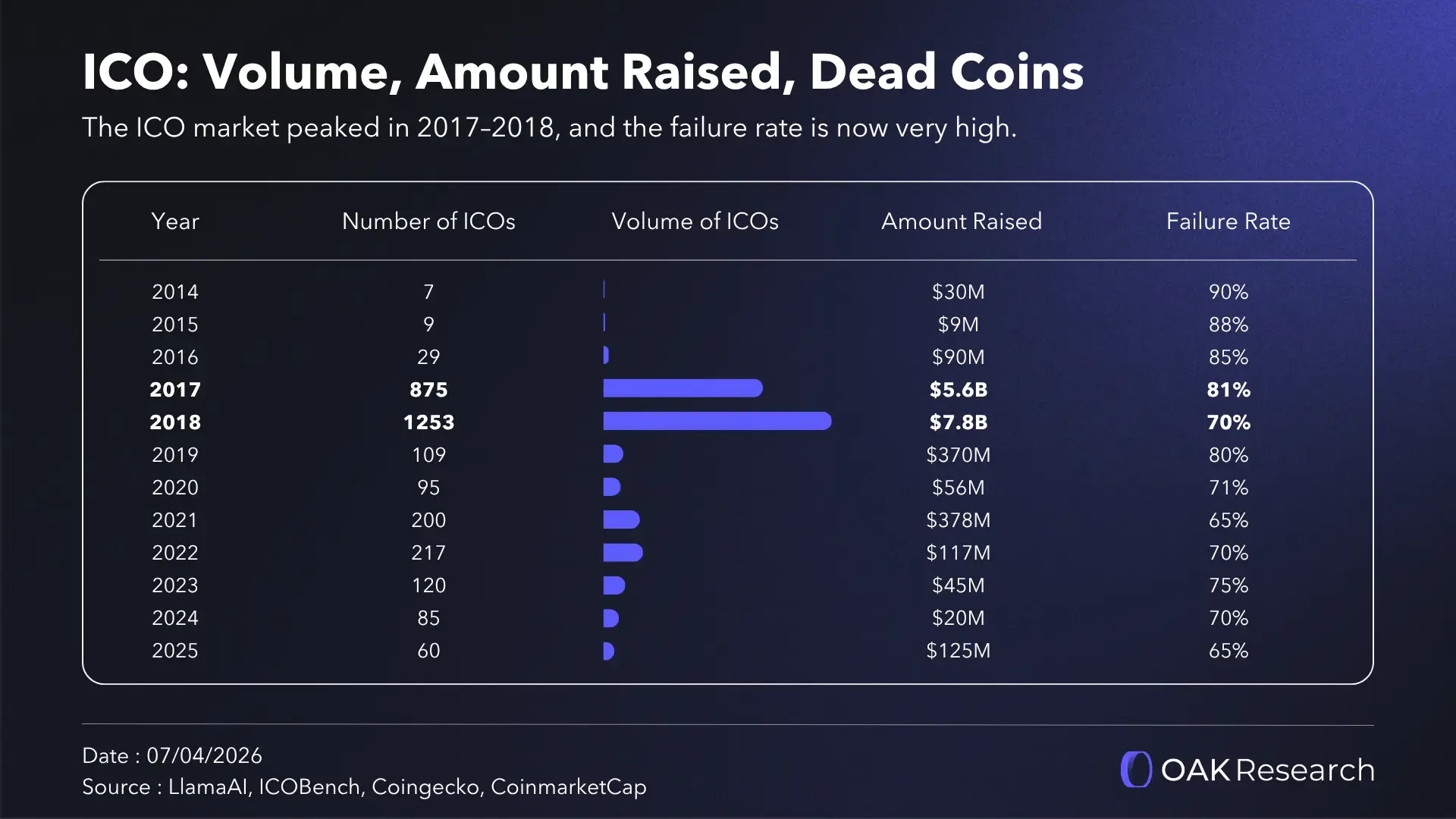
Previous waves showed that an “open” market generates friction largely because of the lack of structure: limited team transparency, weak fundamentals, information asymmetry, unfair token distribution, and so on. The result is that a significant share of projects fail, destroying the value of their token after launch or, worse, simply abandoning ship without delivering anything.
The problem with ICOs was therefore not really the project financing mechanism itself, nor the fact of launching a token in the first place, but rather the way everything was structured. As failures piled up, participants became increasingly unwilling to take on that risk, which was starting to look more and more like gambling rather than genuine investing.
The proliferation of launchpads over the past few years is precisely aimed at solving this crisis of confidence around public fundraising, by addressing a simple demand: apply a filter to project selection, clarify execution including allocation, vesting, and distribution, and secure the token launch.
The regulatory constraint also needs to be addressed, as it plays an accelerating role here. In Europe, MiCA imposes a demanding operational framework, with a standardized white paper, stronger accountability, and transparency requirements.
In the United States, the SEC’s new direction has been more supportive of innovation since 2025 and is trying to bring more clarity to the regulatory perimeter surrounding tokens that may be treated as securities. This search for balance is giving rise to a market that is becoming more professionalized, where compliance, risk mitigation, and operational clarity are becoming decisive.
All of this has pushed the market to fragment into a range of architectures, each targeting a different point of friction: project selection, participant quality, regulatory compliance, transparency, accessibility, liquidity, and so on. It is within this framework that we can analyze the emergence of new platforms and understand how some of them, like MetaDAO, are trying to tackle the market’s core problem differently: how to select the projects that truly deserve capital.
The multiplication of launchpad platforms since 2024 makes a unified reading of the market necessary. Rather than classifying them by technology or by protocol, it makes more sense to analyze them through their economic and operational logic.
Today, five major models can be identified. Each one seeks to solve a specific dimension of the selection problem, whether it is regulatory compliance, participant quality, information aggregation, or liquidity management.
The first category includes platforms operated by centralized exchanges. These players re-internalize distribution and bring token sales closer to the standards of traditional finance: systematic KYC procedures, structured due diligence, standardized documentation, and coordination with exchange listings.
In this model, selection is entirely controlled by the operator. Coinbase and Kraken illustrate this institutional approach, where priority is given to regulatory compliance and legal security.
| Criteria | Coinbase Token Sales | Kraken Launch |
|---|---|---|
| Positioning | Fully vertically integrated institutional reintermediation. Compliance-focused. | Hybrid structure: CEX curation + on-chain execution via Legion. |
| Sale mechanics | Fixed-price sale. Fill-from-the-bottom allocation. Listing synchronized with TGE. Penalty for short-term sellers. | Fixed-price sale. Merit-based allocation, with a preferential round of around 80% and a lottery round of around 20%. Guaranteed minimum allocation + anti-concentration measures. On-chain settlement via Legion, including deposit, vesting, and distribution. Listing synchronized with TGE. |
| Curation | Centralized selection and due diligence handled by the exchange. KYC + geographic restrictions. Limited deal flow. | Selection and due diligence led by Kraken. KYC + geographic restrictions. Merit-based scoring via Legion, including on-chain analysis and anti-bot filters. Qualitative participant filtering. |
| Tokenomics | None, no native token. Incentive structure based on compliance. | None, no native token. Incentive structure based on reputation. |
| Governance | Centralized | Centralized |
Activity on CEX-operated launchpads remains limited for now, but it offers an initial view of the model.
On Coinbase’s side, the MON token sale for Monad is, at this stage, the only operation completed so far. The offering raised $187.5 million, with a negative 6-month ROI of around 0.81x and an ATH ROI over the same period of 4.29x, but the track record is still too short to draw conclusions about the model’s average performance.
It is worth noting that Coinbase’s acquisition of Echo in October 2025 for around $375 million could reshape this model over the medium term. The planned integration of Sonar, Echo’s public sale product, directly into Coinbase would introduce a more open allocation mechanism aimed at retail users, which would alter the positioning described here. No precise integration timeline has been announced to date.
On Kraken’s side, the Launch program began with the sale of Yield Basis (YB), a project tied to the Curve ecosystem. That first sale raised $2.5 million and has shown historical performance of around 0.75x, with an ATH above 3x. The model stands out because of its integration of Legion infrastructure, which adds a participant scoring and filtering layer. As with Coinbase, the sample remains too small to draw firm conclusions.
The main advantage of these models lies in their institutional credibility. Project selection, regulatory compliance, and immediate liquidity at the time of listing provide guarantees that the on-chain ecosystem still struggles to replicate. In return, this architecture relies on full centralization of the selection process and remains heavily dependent on the regulatory environment and the reputation of the exchange operating it.
The second category includes platforms where distribution remains non-custodial and executed on-chain, but access is filtered through reputation mechanisms and data analysis. The goal is to fix two historical shortcomings of launchpads: Sybil attacks and the concentration of allocations in the hands of a small number of players.
Here, participant selection relies on behavioral scores and on-chain signals designed to identify users who are genuinely active within the ecosystem. Two players are positioned around this approach: Legion, which combines a direct launchpad with an infrastructure layer used by third parties, and Cookie, which initially relied on community engagement to structure access to allocations before pivoting its model toward analytics tools and a multi-airdrop farming system designed for $COOKIE stakers.
| Criteria | Legion | Cookie Launchpad |
|---|---|---|
| Positioning | Reputation-based model built on on-chain data and social contributions. Anti-Sybil behavioral scoring. Meritocratic participant filtering. Hybrid B2C + B2B architecture. Curation can be externalized, for example through Kraken. | Community-driven launchpad built on social engagement, or “Attention Capital”. Technical infrastructure provided by Legion. In 2026, a strategic pivot toward analytics and audience segmentation. |
| Sale mechanics | Fixed-price on-chain sale. Execution via smart contracts. Allocation determined by on-chain reputation. Vesting and distribution at TGE. | Initial model: allocation through Snappers / Stakers / Public pools. Participation conditional on social engagement or $COOKIE staking. Current model: launchpad activity sharply reduced. Platform reoriented toward marketing campaigns, airdrops, and analytics. |
| Curation | Meritocratic curation via Legion Score. Aggregation of on-chain and social signals. Anti-Sybil filtering. Reputation-based allocation. Score exportable in B2B settings. | Initial model: selection based on community engagement. Logic based on proof of social involvement. |
| Tokenomics | No native token. Access to sales based on Legion Score. | Initial model: $COOKIE staking used to access allocations. Current model: campaigns and airdrops. |
| Governance | Centralized | DAO + founding team |
On Legion’s side, the platform has conducted around fifteen sales since 2024, raising approximately $36.3 million. Observable performance remains similar to that of centralized exchanges, with an average ATH ROI close to 3x and a more moderate current ROI of around 0.8x.
The main interest of the model lies above all in its dual architecture: Legion acts both as a launchpad and as an exportable reputation infrastructure, used in particular by Kraken for its sales program. Reputation-based filtering is meant to improve the quality of participating capital and limit opportunistic behavior. The main limitation remains the still limited number of deals, which does not yet make it possible to assess how the model behaves across multiple cycles.
On Cookie’s side, the launchpad was launched in late 2025, with Vooi as its first deal. Originally, the platform relied primarily on its community, using engagement campaigns and airdrop programs to attract participants to token sales. Since then, the project has shifted direction and focused more heavily on its analytics tools and on an airdrop system reserved for $COOKIE stakers.
Today, the launchpad occupies a secondary place in the protocol’s activity. Cookie’s evolution illustrates a limitation of this type of approach: when distribution relies on community engagement and attention dynamics, the ability to maintain a steady flow of public sales becomes structurally uncertain.
The third category includes platforms that replace traditional human curation with signal aggregation mechanisms. In these models, project selection no longer depends solely on a team of analysts or on the reputation of a specific player, but on indicators produced by the market itself: investor reputation, on-chain data, or automated analysis of information.
Two players illustrate this approach. Echo, now integrated into the Coinbase ecosystem, structures pooled investment rounds around lead investors and extends them into the public market through Sonar, an infrastructure designed to organize open sales for retail participants.
Kaito, for its part, initially relied on its analytics tools to power the Kaito Capital Launchpad, where informational signals generated by its platform guided project selection. The project has since evolved that model into Kaito Studio, which places greater emphasis on automated analysis and the exploitation of signals detected by its AI systems in order to identify projects gaining traction across the ecosystem more quickly.
| Criteria | Echo / Sonar | Kaito Studio |
|---|---|---|
| Positioning | Infrastructure for pooled private fundraising. Groups led by lead investors through on-chain SPVs. Positioned for qualified investors. Public extension through Sonar. Acquired by Coinbase. | Launch platform powered by AI agents. Machine-to-machine curation. |
| Sale mechanics | On-chain execution under pre-negotiated terms. A single SPV aggregated by the lead investor. Uniform allocation, with no auctions and no size advantage. Unified pipeline: hard cap, vesting, Echo ID KYC. | Sales integrated into Kaito’s research environment. Allocation guided by Kaito’s AI-driven analytical signals. |
| Curation | Curation through internal diligence and lead investors. Selection structured by professional investors. Filtering based on private legal and economic standards. | Selection by AI agents based on sentiment analysis and real-time on-chain data. |
| Tokenomics | No native token. SPV infrastructure + Sonar public sales. Incentives defined by the issuer, including vesting and bonuses. | Native $KAITO token used for governance. No direct allocation utility. Informational incentive through access to signals and AI analysis. |
| Governance | Centralized. SPV selection and structuring handled internally. | Centralized, with proprietary analytical models. |
Echo was acquired by Coinbase in 2025, becoming one of the capital formation engines of the Base ecosystem. Echo has completed 34 sales for around $204 million raised, with an average current ROI of about 2.14x and an ATH ROI close to 5.21x.
Among the models covered so far, Echo has historically delivered the strongest returns for investors. The most recent example is Plasma, launched in summer 2025: the token still offers a return above 2x today despite current market conditions, and it represents the best ATH ROI of all ICOs conducted on the platform, reaching 33x relative to the issue price.
The model is built around on-chain SPVs led by lead investors. Sonar extends that model by organizing the transition from private fundraising to structured public sales.
These results should still be qualified. A large share of projects has not yet reached TGE, and among the tokens that are actually listed, 12% are above issue price while 88% are below it. That said, nearly all of them delivered significant returns between their issue price and ATH. Out of the 10 projects launched and listed, only one shows a negative historical return for investors.
As for Kaito, its historical activity is based on the Kaito Capital Launchpad, which accounts for 16 sales and around $36.2 million raised. Aggregate performance appears more modest, with an average current ROI around 0.60x and an ATH ROI close to 2.72x.
The platform has since evolved toward Kaito Studio, which relies on the analytics tools developed by Kaito and on the use of its AI models to identify projects that are gaining traction across the ecosystem.
Unlike the Capital Launchpad, which already used this data to filter participants and structure allocations, Kaito Studio puts AI-driven analysis at the center of both project selection and project visibility. The goal is to identify emerging signals more quickly in an environment where narratives and attention flows shift very rapidly.
This approach nevertheless introduces a limitation: selection depends on proprietary analytical models whose criteria remain difficult to audit, which reduces the transparency of the selection process and exposes users to interpretation errors.
The fourth category includes fully permissionless AMM infrastructures. Unlike traditional launchpads, these protocols do not attempt to select or validate projects before launch. Their role is simpler: provide a technical framework in which an asset can immediately find a market price.
Here, price and initial liquidity are formed directly through exchanges between buyers, sellers, and liquidity providers. Selection therefore does not happen through a team, a score, or an analytical mechanism, but through the market’s own reaction.
These infrastructures are designed to remain neutral. They provide the tools needed for market formation without filtering the projects that choose to use them. Protocols such as Uniswap v4, PancakeSwap, and Aerodrome illustrate this approach, each offering its own variation of a model centered on liquidity and price discovery.
| Criteria | Uniswap v4 (Hooks) | PancakeSwap (CAKE.PAD) | Aerodrome (Ignition) |
|---|---|---|---|
| Positioning | Permissionless AMM infrastructure. Customizable hooks. Native Continuous Clearing Auctions. Market-based price discovery. No curation or filtering whatsoever. | Retail-oriented AMM launchpad on BNB Chain. CAKE.PAD and IFOs integrated into the AMM. Participation through CAKE deposits. Segmented pools and structured access. Community-oriented positioning. | Liquidity-first model rooted in the ve(3,3) design. Main liquidity hub on Base. Positioned as infrastructure rather than distribution. Fast access to market depth. Slipstream integration. |
| Sale mechanics | Permissionless auction integrated through hooks. Algorithmic price discovery based on supply and demand. Liquidity automatically injected into a v4 pool. | Subscription through CAKE deposits. Single participation window. Pro-rata allocation through an overflow mechanism. Automatic refund in the event of oversubscription. | Aero Launch phase for pool creation and liquidity bootstrap. veAERO vote-directed emissions. Aero Ignition phase for post-TGE support. Programmed liquidity. |
| Curation | No curation or due diligence. Fully permissionless access. No legal or technical review. Responsibility shifted to the market. Absolute neutrality. | No formalized structured curation. No public regulatory due diligence. Discretionary selection by the team. Unpublished criteria and limited transparency. | No formal curation. Free pool creation. Indirect selection via veAERO voting. Liquidity directed by community support. Quality depends on incentives and voting dynamics. |
| Tokenomics | No specific incentive layer. UNI token not involved in auctions. No additional value capture. Incentives defined solely by the project. | Participation through direct CAKE deposits. Fees charged on refunded amounts in case of oversubscription. No specific reward for stakers. | AERO token is central. veAERO votes direct liquidity. Competition to capture emissions through bribes. Incentives embedded into pools. Model centered on sustainable market depth. |
| Governance | Oversight limited to the core protocol. Launches and pools are permissionless. No moderation or project selection. | Hybrid governance, with 1 CAKE = 1 vote. Proposals submitted subject to a minimum threshold. Team veto and interruption powers. IFO selection remains under internal control. No community governance over project filtering. | ve(3,3) governance through veAERO holders. Votes direct emissions. Permissionless pool creation. Upgrades and critical parameters handled by the team. Hybrid model: DAO for incentives, team for operations. |
The challenge, then, is not to select projects upstream, but to allow the market to quickly set a price and create liquidity.
Uniswap v4 pushes this logic very far with fully permissionless infrastructure, where hooks allow different launch mechanics to be integrated directly into pools. PancakeSwap, for its part, adopts a more structured approach through IFOs and the CAKE.PAD module, which introduces gated access through the CAKE token. Aerodrome, meanwhile, follows a liquidity-first logic: emissions and incentives are mainly used to direct liquidity toward newly launched assets in order to stabilize their market after launch.
This segment pushes the permissionless logic to its extreme. The creation of a token no longer goes through prior selection or platform validation. Protocols simply provide tools that make it possible to turn almost instantly an idea, a meme, or a social interaction into a tradable asset.
In many cases, these systems rely on bonding curves that make it possible to create a market and provide initial liquidity from launch. The selection of new assets no longer depends on prior analysis or organized curation. Instead, attention, virality, and community dynamics are what determine whether a token attracts capital. Capital moves very quickly from one token to another, and in the end it is the market’s reaction that decides which ones survive.
| Criteria | Pump.fun | Clanker | Flaunch |
|---|---|---|---|
| Blockchain | Solana & Base | Base, with Farcaster integration | Base, with Uniswap v4 industrialized design |
| Issuance model | Bonding curve, with migration to a DEX at around $69k market cap | Deployment through a Farcaster bot. Automatic token creation. Liquidity through an AMM. | Uniswap hooks, with a fixed price for 30 minutes before free market trading |
| Value capture | 1% trading fee + 6 SOL migration fee | Captures a portion of Uniswap LP fees | 100% of fees go to creators, with automatic buybacks |
| Governance | Centralized, tied to Alliance DAO | Integrated into Farcaster | Permissionless, decentralized through hooks |
The most emblematic memecoin launchpad remains Pump.fun, which has become the dominant infrastructure in this segment. The platform claims more than 11 million launched tokens and nearly $470 million in annual revenue, which gives a sense of the scale this market has reached.
This complete openness comes with a trade-off, however: the majority of launched tokens disappear quickly or end in rug pulls. To improve incentives, the platform has gradually introduced various revenue-sharing mechanisms with creators.
Alongside this retail-oriented model, Clanker developed in a more specific niche: tokens tied to the AI agent economy on Base, especially through the Farcaster ecosystem. Activity there grew rapidly, with some agents generating several million dollars in fees within just a few days. A portion of those revenues is captured by the $CLANKER token, notably through buyback mechanisms in the market.
Flaunch, finally, takes a more technical approach by building on Uniswap v4 hooks. The protocol seeks to minimize the value captured by the infrastructure itself by redirecting all trading fees to creators or to buyback mechanisms. The goal is to better align incentives between the platform and the communities launching their assets.
Despite their diversity, all of these models aim to solve the same problem: selecting the projects that truly deserve capital. Yet each of these approaches introduces its own biases.
| Model | Limitation |
|---|---|
| CEX launchpads | Selection centralized by the exchange. Limited transparency around the selection process. Risk of discretionary arbitrage. |
| Data-driven models | Selection based on reputational scoring. On-chain and social signals can be optimized or manipulated. Risk of artificially amplified engagement. |
| Signal-based launchpads | Dependence on attention dynamics and market narratives. Difficulty distinguishing real traction from speculation. |
| AMM launchpads / memecoin platforms | Complete absence of curation. No qualitative filter upstream. Very heterogeneous project universe. |
In the end, despite their differences, these architectures share a common limitation: selection remains imperfect. Decisions are based either on centralized teams, on reputation systems, on analytical algorithms, or on the market’s raw reaction.
It is in this context that a radically different approach emerged. Known as “futarchy,” it proposes delegating selection not to operators or attention signals, but to prediction markets where participants directly commit capital to express their expectations.
MetaDAO stands apart from the other players in the segment by introducing a purely economic signal based on futarchy. While most platforms rely on internal curation, reputation-based filtering, or analytical signals, MetaDAO delegates the funding decision to internal prediction markets. The decision to allocate capital is based on the “wisdom of crowds,” where participants directly commit capital to bet on future performance.
The platform therefore does not present itself simply as a launchpad, but as a DAO whose main function is to organize these prediction markets and turn their signal into capital allocation decisions. The principle is simple: when participants are required to commit their own capital, the market’s aggregated signal becomes a more robust selection mechanism than traditional systems.
The protocol’s architecture is built on Solana, a choice that is consistent with the nature of the model, since prediction markets require fast execution and the lowest possible transaction costs. By relying on Solana’s infrastructure, MetaDAO seeks to create an environment where market prices can evolve rapidly and reflect collective expectations as efficiently as possible.
This makes MetaDAO one of the most original models in the benchmark. The platform does not select projects, it simply organizes the conditions that allow the market to decide.
MetaDAO is also exploring a Futarchy-as-a-Service model, allowing other protocols in the Solana ecosystem to experiment with decision markets based on futarchy. Several projects, including Sanctum, ORE, and Drift, have already tested this model for certain governance proposals. Adoption remains experimental, however, and for now coexists with more traditional governance systems.
The launch process on MetaDAO is organized in three phases: prediction market, economic signal, and then sale execution. When a candidate project wants to raise funds, it is not immediately offered to investors. It first enters a system of prediction markets where participants bet on the economic impact that its acceptance would have on the MetaDAO ecosystem.
Two derivative markets are opened simultaneously: the PASS market, which anticipates the future value of the $META governance token if the project is accepted, and the FAIL market, which anticipates that same value if the project is rejected. Participants commit capital to express their expectations. The observed price in each of these markets therefore reflects the collective estimate of the economic impact of the decision.
It is the comparison between these two markets that produces the signal. If, by the end of the betting period, the time-weighted average price of the PASS market exceeds that of the FAIL market by a certain threshold, generally around 3%, the proposal is automatically approved and the sale can move forward. Otherwise, it is rejected or postponed.
Once this filtering phase is complete, the sale itself remains fairly standard. Deals are conducted under predefined parameters: fixed ticket, hard cap, and fair distribution. MetaDAO’s distinctive feature does not lie in the sale structure itself, but in the stage that comes before it. The real selection mechanism takes place before the fundraising, at the level of the prediction markets.
Unlike solutions that rely on internal teams, reputational scores, or analytical signals, MetaDAO fully delegates this function to internal prediction markets. Participants can commit capital to express their expectations about a project’s future trajectory. Positions taken on the PASS and FAIL markets translate into prices representing the aggregated probability that the launch will create or destroy value for the ecosystem.
This mechanism first allows incentives to be aligned, since those who influence the signal must bear the associated financial risk. But it also reduces decision capture by limiting the influence of opinions that are not exposed to risk. Finally, another important point is that it enables dynamic pricing: if new information appears, market prices can immediately adjust.
The native token, $META, structures the entire incentive system of the protocol. It serves both as a weighting mechanism in prediction markets and as a value capture tool for the DAO.
$META holders can commit their tokens in prediction markets in order to express their expectations about candidate projects. The greater the commitment, the greater the influence on market price. Decision-making power is therefore directly correlated with the risk taken.
In addition, the protocol captures revenue through several sources. The prediction markets generate fees on trades and on bet resolution. Since late 2025, MetaDAO has also been collecting revenue from liquidity pools associated with launched projects, notably through the Futarchy AMM and certain pools deployed on Meteora. A portion of the funds raised during ICOs, as well as project tokens, is now injected into these pools, allowing the protocol to capture fees on the trading volume generated after launch.
A share of this revenue is redistributed to participants who commit their tokens, creating a meritocratic system in which those who correctly anticipate project trajectories are rewarded.
MetaDAO has implemented a hybrid governance architecture in which futarchy operates only at the curation level, while the protocol’s broader parameters remain subject to more traditional governance.
The DAO does not vote directly on whether to accept or reject a project. That role is delegated to prediction markets. Governance, however, retains responsibility for defining the system’s rules, market parameters, fee structure, redistribution mechanisms, and so on.
The idea is therefore to distinguish between two layers of decision-making. The first concerns the protocol’s strategic choices and remains governed by the DAO. The second concerns the selection of individual projects and relies on the economic signals produced by the prediction markets.
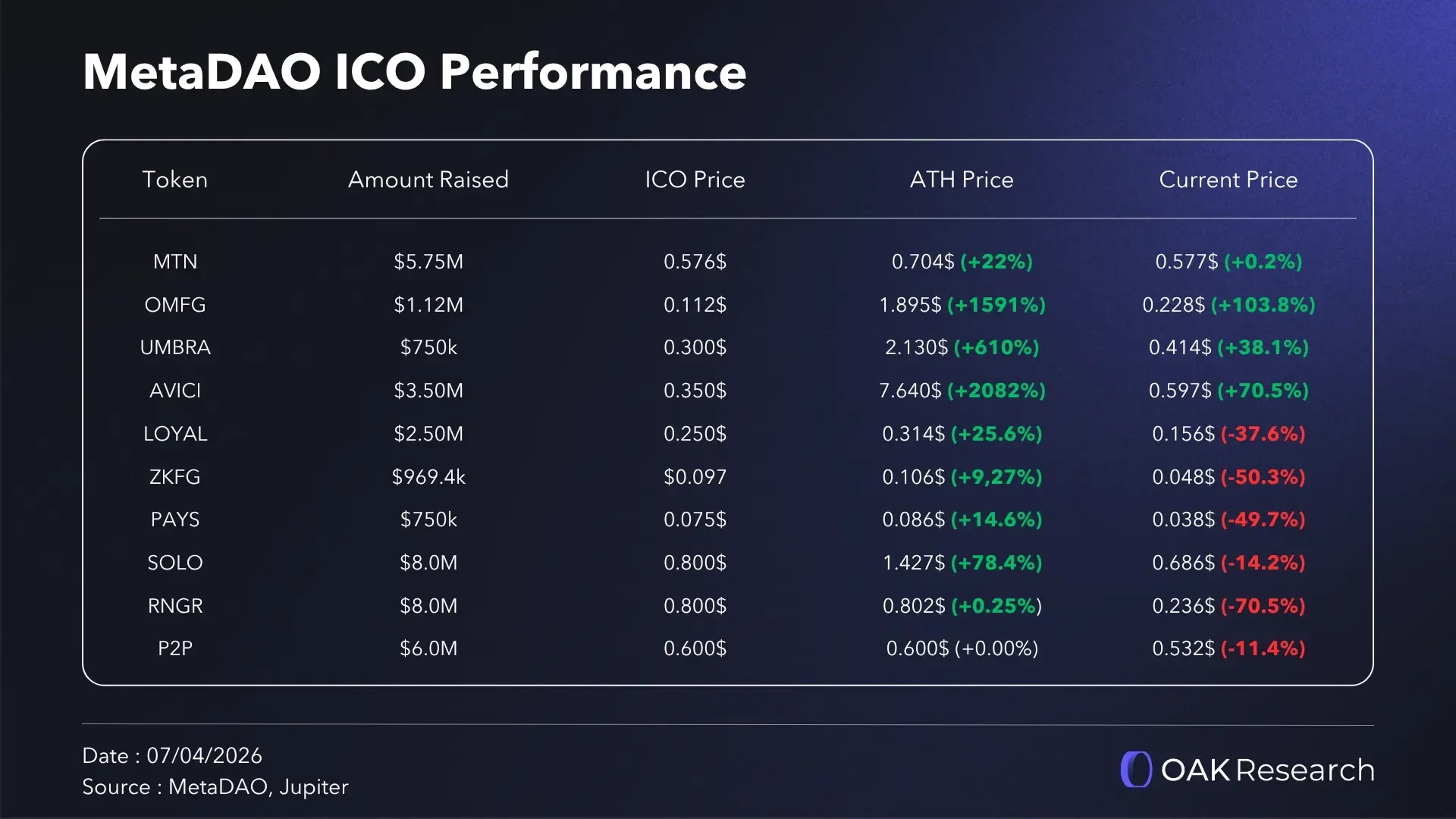
MetaDAO’s activity remains relatively recent, but it is showing performance that is clearly above the market average. Since launching in 2025, the platform has conducted 9 sales, all on Solana, for a cumulative total of more than $27 million raised.
The current 6-month ROI is in line with the market average at 0.83x. By contrast, the ATH ROI over the same period reaches 6.49x, well above its competitors, driven by major successes such as Avici, Umbra, and Omnipair.
Q4 2025 also saw the emergence of a new revenue source for the protocol with the Futarchy AMM, which generated more than $1 million in revenue for the protocol in Q4 2025 alone.
The futarchic ecosystem built around MetaDAO also expanded. The number of protocols using this model rose from two to eight over the same period, for a combined market capitalization exceeding $200 million.
MetaDAO’s main advantage lies in its selection mechanism. By integrating prediction markets, the platform introduces a system where skin in the game becomes the primary source of influence, reducing the classic biases of curation, namely arbitrary decisions and conflicts of interest.
The choice of Solana also represents a meaningful operational advantage, since prediction markets require fast execution and low transaction costs to function efficiently, conditions that the network’s infrastructure is able to provide.
That said, the model depends heavily on liquidity and participant activity. When markets are deep and active, the signal produced can reflect a genuine aggregated probability. But when participation is low, prices can become volatile or manipulable. Futarchy therefore does not eliminate the curation problem, it transforms it into a market quality problem.
We can also point to the sector bias visible in the deal flow. A large share of launched projects belongs to the market infrastructure category, or “Internet Capital Markets,” which creates a strong correlation with a specific niche of the Solana ecosystem and therefore a lack of diversification for participants.
Despite these limitations, MetaDAO currently represents one of the most ambitious experiments in token launching. Rather than selecting projects itself, the protocol organizes a system in which the market decides. If markets become sufficiently liquid, this model could turn into one of the most advanced forms of decentralized curation.
Optimism (OP), Jupiter (JUP), Pendle

Maple Finance (SYRUP)

Hyperliquid (HYPE), Veranta (AVNT), APEX


