
Pyth Network (PYTH): A $50 billion institutional pivot
Pyth Network (PYTH)
Published on

Sponsored Content
This content was written as part of a commercial collaboration. Although the OAK Research team conducted a preliminary assessment of the project presented, we disclaim any liability for losses or damages resulting from decisions based on this article. Cryptocurrencies involve high risks, and this content is provided for informational purposes only and does not constitute investment advice.
Oracles are among the most important protocols in on-chain finance, yet for years they have been unable to properly monetize their business. That is changing. With the arrival of traditional players, the development of on-chain trading platforms, and the success of RWAs, the demand for high-quality data has skyrocketed. In this analysis, we’ll help you understand how the oracle industry is transforming and to what extent their revenues are taking off, using Pyth Network as a prime example.
Oracles are probably among the most important infrastructures in the crypto ecosystem and on-chain finance. If we had to summarize it simply, the role of an oracle is to receive or record data, process it, make sure it is high quality, and make it usable for its clients. In short, they are the infrastructure that acts as a bridge between the outside world and the blockchain world.
→ If you want to dive deeper into oracles, we recommend reading our analysis on the different types of crypto oracles and their roles:
If oracles did not exist, it would be impossible for a lending protocol to know when to liquidate a user. It would be impossible for an exchange to correctly determine the price of a position. It would be impossible for a prediction market to know the outcome of an event its users have bet on.
Their importance is so systemic for the ecosystem that one could easily assume they are the most profitable category of companies in the industry. This is also what many people have kept repeating since the beginning of decentralized finance, giving the main oracle tokens an important place in their portfolios. Yet for several years, the exact opposite happened.
Chainlink now secures tens of billions of dollars in assets, Pyth provides prices used by a huge share of decentralized derivatives exchanges, and hundreds of protocols depend on their data every day. Despite this, the revenues directly generated by their activity have historically remained close to zero.
Despite how paradoxical this may seem, the reason is actually simple. During the first phase of DeFi's development, oracles mostly behaved like public goods. Data was distributed for free or almost for free, costs were absorbed by teams, foundations, or token emissions, and the priority was above all to accumulate integrations.
At the same time, it is fair to say that decentralized finance protocols were, for a long time, only experiments or bets on the future, with no certainty that they would one day succeed in generating money. Asking them to pay a high price to access data, even if it was a central requirement for their product, was simply not realistic.
The second one oracle wanted to try to monetize its data by applying a higher price, a new competitor appeared to offer the same service for free. In short, for years, oracles did not even really try to generate money from their activity, however important it was.
However, as you can imagine, if we have decided to talk about this today, it is because this situation is changing. Chainlink, Pyth, RedStone, and API3 have each transformed their models, and the numbers prove that it is working. In September 2025, Pyth launched Pyth Pro, its first institutional subscription product. Less than a year later, it had generated 122 paying accounts and more than $2.5 million in gross revenue.
But this transformation raises a second question, which is perhaps even more interesting. When an oracle finally starts making money, who actually captures that value? To understand the oracle business model, we need to separate three things the crypto industry has long tended to confuse: network utility, business profitability, and value capture by the token.
This is what we propose to explore together in this analysis. Enjoy the read.
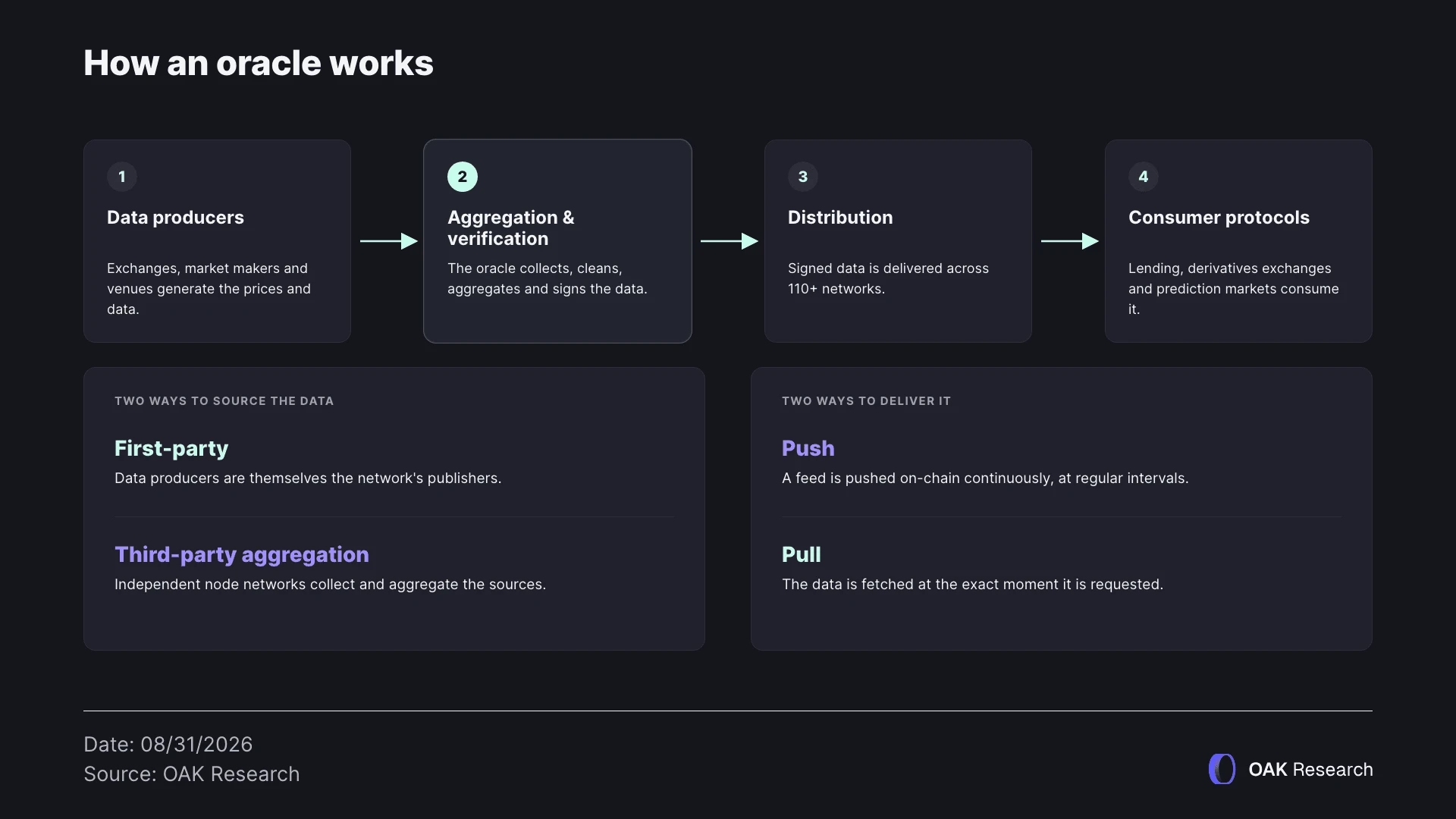
To understand why oracle monetization took so long to emerge, we first need to briefly revisit how they work. A blockchain is a deterministic environment, meaning it can verify what happens within its own state, but it cannot simply query an external API to know how much a stock is worth, what the EUR/USD rate is, or which candidate just won an election.
The oracle is precisely the layer responsible for retrieving this information, verifying it, aggregating it when several sources exist, and transmitting it in a format usable by on-chain applications. In the case of financial data, this work can include collection from exchanges or market makers, timestamping, normalizing different markets, rejecting abnormal data, cryptographic signing, distribution across multiple blockchains, and ensuring that information remains available during periods of high volatility.
In other words, behind the relatively simple word “oracle” lie several activities that, in traditional finance, would be handled by different players. The role of market data provider (Bloomberg, LSEG/Refinitiv, S&P Global Market Intelligence, FactSet, or ICE Data Services), index administrator (S&P Dow Jones Indices, MSCI, or FTSE Russell), data redistributor (Nasdaq TotalView, aggregators like Databento and dxFeed), and settlement layer (DTCC, Euroclear). An oracle like Pyth represents all or part of this chain (sourcing, aggregation, indices, distribution) in a single product, which explains both its ambition and the difficulty of comparing it to a single existing player.
The way this work is performed then varies depending on the protocol. Chainlink historically developed through networks of independent nodes responsible for aggregating multiple sources, while Pyth positioned itself from launch around a so-called “first-party” model. This means that the companies directly producing the data become publishers on the network themselves. This is why Pyth contributors today include players such as Jane Street, Jump, Optiver, Cboe, and Binance.
A second important distinction concerns “push” and “pull” architectures. The first is a more traditional architecture in which the oracle continuously sends a data stream to the blockchain, at regular time or price intervals, even when no one needs it at that exact moment. The “pull” system used by Pyth is more subtle because it means that the user or application retrieves updated data at the exact moment it needs it.
This distinction is not only technical, it is also economic, which is why we are mentioning it in our case study. By shifting part of the publication cost to the end consumer, the pull model makes it much easier to multiply the number of supported data feeds and blockchains. Above all, it was the first model to create a measurable on-chain revenue line for an oracle, allowing Pyth to monetize more quickly than Chainlink. Pyth went from 545 feeds in January 2025 to more than 3,000 in 2026, distributed across more than 110 networks.
That being said, players in the oracle industry have gradually developed several ways to generate revenue. Some rely directly on selling data, others on the services surrounding it, while one last, slightly different category corresponds more to a financing mechanism than to a true business model.
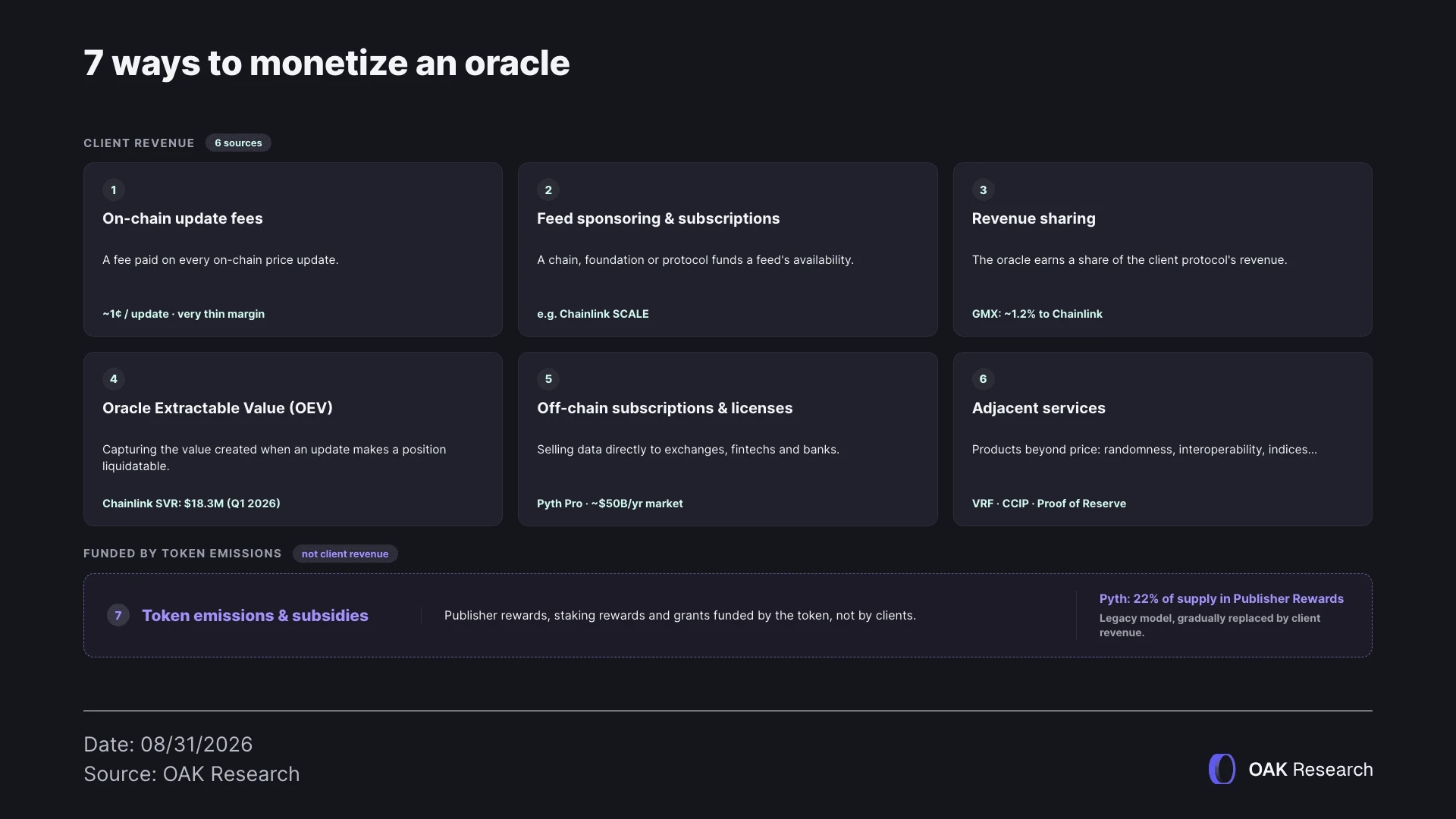
The historical difficulty of the sector then becomes much easier to understand. A price published on-chain behaves almost like a public good. Once it is present on the blockchain, it is difficult to prevent other users from reading it. At the same time, each new oracle had an incentive to offer its data for free in order to win integrations, while on-chain finance protocols themselves rarely had enough revenue to pay for access to these services.
It should also be said that “crypto” data is fairly easy to obtain. The price of BTC or ETH can be retrieved from dozens of exchanges. Ultimately, an oracle's true ability to charge appears when the data becomes difficult to reproduce, and this is precisely what the new wave of applications emerging recently needs, from prediction markets to decentralized perps exchanges.
It is this change in the nature of the data consumed by on-chain finance that has pushed oracles to deeply transform their activity over the past three years.
Between 2023 and 2026, the main oracles stopped being price feeds and became full-fledged financial platforms. As you understood from the previous sections, this mutation did not come out of nowhere and directly responds to the economic problem oracles have faced since their earliest days.
Imagine you are leading a decentralized oracle protocol and you face the following reality: your activity currently costs more money than it generates. You then have two options to get out of it. Either you decide to sell more services or reach more clients (this is the strategy that was chosen for years, but you already know the result), or you choose to reposition toward data and clients that actually have a real budget.
This is exactly what Chainlink, RedStone, API3, and of course Pyth have done in recent years, although with sometimes quite different strategies.
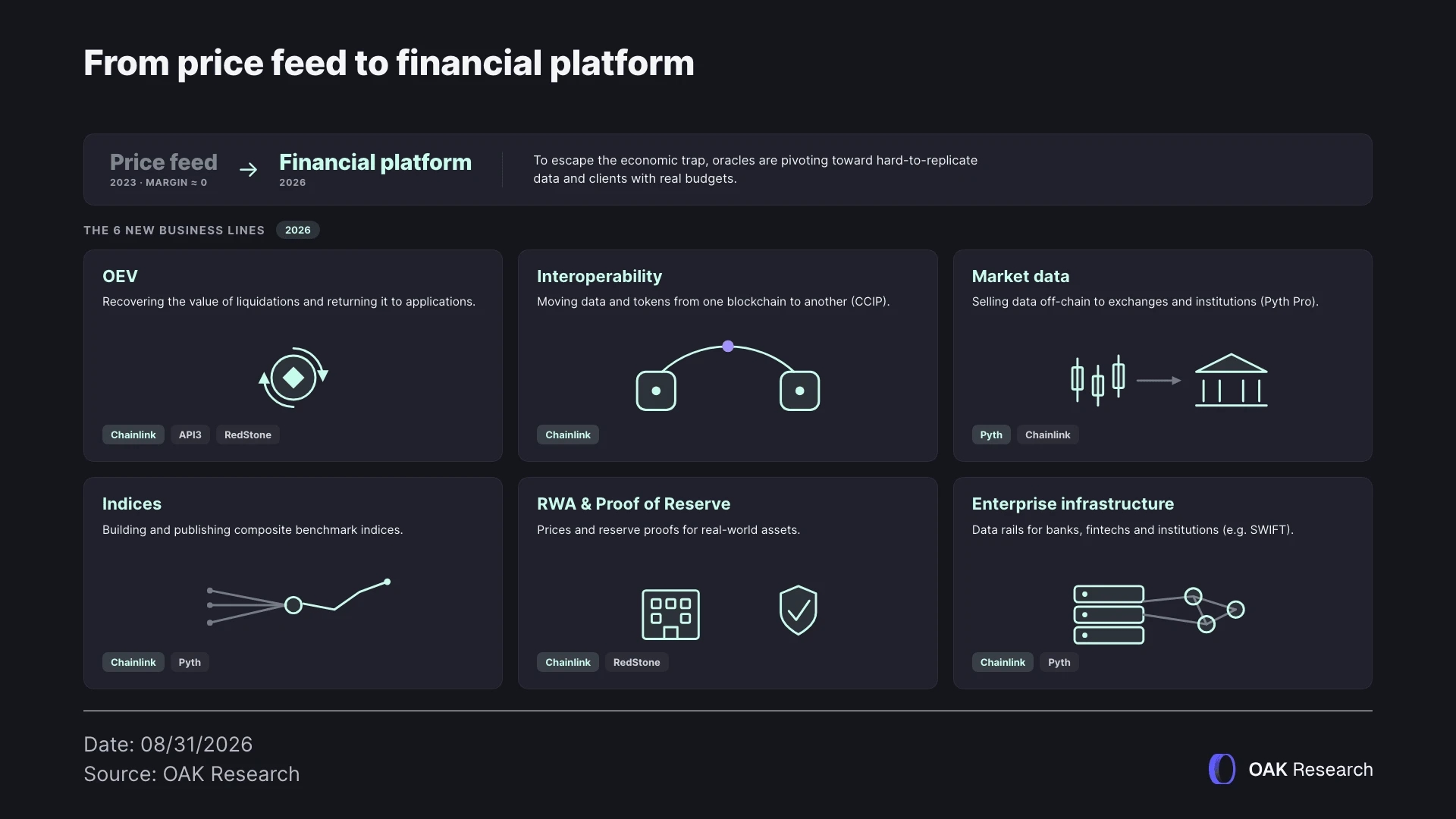
Chainlink has gradually transformed its flagship product into a complete suite of tools. Historical Data Feeds remain at the heart of its value proposition, but they now coexist with Data Streams, designed notably for markets requiring low latency, with Smart Value Recapture to recover OEV, Proof of Reserve, Automation, and CCIP for interoperability between blockchains.
The tool that best represents this evolution is the Chainlink Runtime Environment, or CRE, whose ambition is to become an orchestration layer capable of connecting different blockchain networks, external data, and traditional financial systems.
This is what has allowed Chainlink to multiply collaborations with financial institutions. Swift, Euroclear, UBS, Kinexys by J.P. Morgan, DTCC, and AWS appear among the players that have worked with its infrastructure. DTCC, for example, chose Chainlink for its Collateral AppChain, while Swift uses it in various works related to tokenized funds and corporate actions.
CCIP, which we mentioned above, has also continued to grow and now represents around $18 billion in secured transfers in the first quarter of 2026, up 319% year over year according to DeFiLlama. The network is also participating, alongside Pyth, in the on-chain publication of certain economic statistics from the U.S. Department of Commerce.
The Pyth case is the most interesting because its product range is much broader than one might think. Its strategy is to gradually control the entire market data layer needed by on-chain finance.
Pyth Lazer, the technical infrastructure developed in 2024 to provide ultra-low-latency data, is used to power Pyth Pro, the market-data product launched in September 2025 with a subscription-based model ranging up to $10,000 per month, depending on the service level.
Pyth then developed the Data Marketplace, allowing proprietary datasets from players such as Euronext FX, Exchange Data International, OTC Markets Group, SGX FX, and Tradeweb to be distributed. Nasdaq also chose Pyth to distribute TotalView, its proprietary stock market data feed showing the full depth of the order book in real time for all stocks traded on the Nasdaq Market Center.
To this are added Pyth Indices, a catalog of proprietary indices developed by Pyth to provide 24/7 access to market data on stocks, commodities, and currencies, Pyth Pro X for exchanges, Listing-as-a-Service to enable the rapid listing of new assets, and offerings specifically designed for AI agents.
In short, Pyth is increasingly moving away from monetizing the historical oracle activity, meaning transporting data from the outside world to the blockchain. The product is the data itself, its provenance, its distribution rights, its latency, and the ability to access it through a single API.
Pyth and Chainlink challengers have, for now, decided to focus on the first option in the dilemma we presented above. Their objective seems more focused on monetizing infrastructure and services specific to on-chain finance.
RedStone has positioned itself as a modular oracle capable of offering both push and pull architectures, with a strong specialization in new blockchains, liquid staking tokens, restaking, and more complex assets. The network secured around $3.6 billion according to DeFiLlama data from May 2026 and is also developing Atom, its system designed to recover OEV and redistribute part of it to protocols.
API3, for its part, uses a first-party architecture in which data providers directly operate their own nodes. Its OEV Network also seeks to transform liquidation opportunities into a source of revenue for applications rather than letting this value be captured by external actors.
Other oracles maintain more specialized positioning. Chronicle, from the MakerDAO/Sky ecosystem, stands out notably for its efficiency in terms of update costs, while UMA remains particularly used for events whose resolution requires more than a simple price, especially through its main client, Polymarket.
In short, we can see a fairly clear trend in the evolution strategy of oracles. The development of crypto-native products has allowed them to expand their integration within on-chain finance, but this ecosystem quickly became too limited. The products that are truly beginning to transform the economics of this sector are those that make it possible to access genuinely differentiated data, redistribute it, create a benchmark, or become an indispensable infrastructure for financial institutions opening up to blockchain.
Chainlink and Pyth are following two different paths that lead to the same goal. The first seeks to become the orchestration layer of the tokenized finance currently developing, while the second is instead seeking to become the reference market data layer used by the major players of this new finance.
Now that the question of the ability to generate real and meaningful revenue is close to being resolved, another has become unavoidable. A question no crypto project can escape: how can this new economic activity also benefit the token? We already saw the pivot at the end of last year, with the announcement of a reserve and token buyback mechanism by Chainlink in August 2025 and then by Pyth in December 2025.
Before truly answering this question, however, the Pyth case deserves to be studied in more detail. Its story is probably the one that best illustrates the transition from the historical oracle model (free, subsidized, and adoption-driven) to a commercial activity built around recurring revenue.
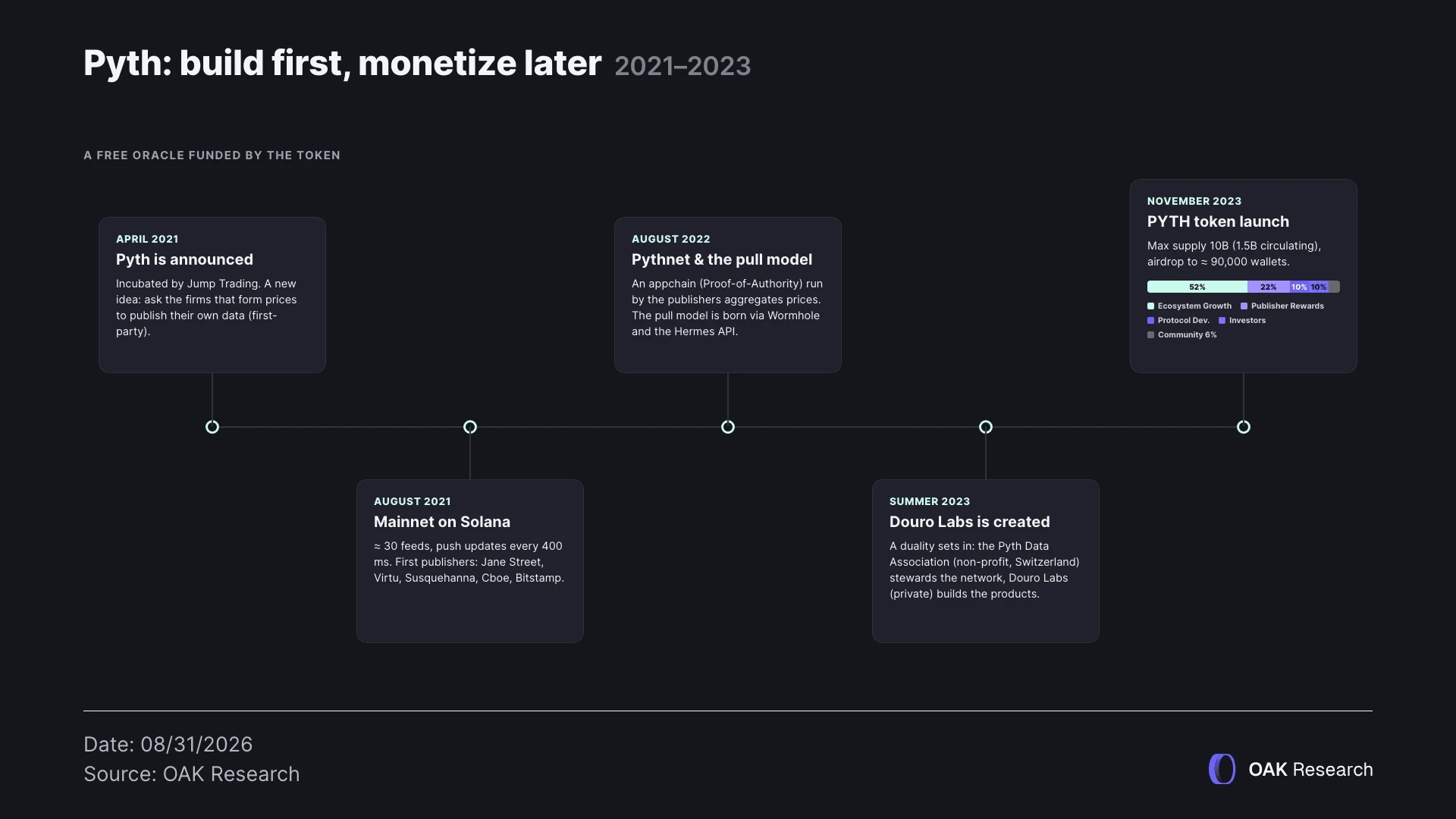
When Pyth was announced in April 2021, the project's ambition was first and foremost technical. Incubated by Jump Trading, the project's ambition was to bring a new vision to oracles: rather than asking independent operators to retrieve prices from different platforms, why not directly ask the companies that participate in price formation to publish their own data?
This principle of “first-party data” would become the main difference between Pyth and more traditional oracle architectures. When the mainnet launched on Solana in August 2021, around thirty feeds were available and several major names in trading and financial markets were already participating in the network. Jump, of course, but also Jane Street, Virtu, Susquehanna, Cboe, and Bitstamp were among the first publishers.
What was the initial vision when Pyth Network launched? Do you think it was the right approach at the time? :
”The initial vision was to bring high-quality financial market data onchain directly from the institutions closest to price formation because it didn’t exist. Looking back at early years, it was the right approach as Pyth became the dominant price feed provider on Solana.” - Michael Cahill, CEO of Douro Labs.
The transmitted data was not limited to a simple price either. Pyth's algorithm aggregates observations from its various publishers to produce a consolidated price accompanied by a confidence interval, allowing applications to have an indication of the uncertainty surrounding the published value. This is a fairly important feature for financial products most sensitive to price movements, particularly derivatives markets.
At that time, however, the business model question remained secondary. Data was distributed for free and the priority was mainly to attract the best publishers, multiply integrations, and make Pyth an infrastructure used enough to become difficult to replace.
The first version of the network ran directly on Solana with a push architecture capable of producing updates every 400 milliseconds, roughly the duration of a Solana slot. This approach quickly allowed Pyth to become the reference oracle on one of the most dominant networks in the ecosystem. However, it created an obvious problem as soon as the team wanted to deploy its products on other blockchains, because costs became enormous.
This is when Pyth's first technical pivot took place with the launch of Pythnet in August 2022. It was an appchain derived from Solana, operating in Proof-of-Authority and run directly by the network's publishers, who played a role close to that of validators. In short, data providers ran nodes and did not really stake tokens, but rather their identity and reputation.
Pythnet then became the layer responsible for receiving the different observations, aggregating them, and producing the final price before distributing it to other blockchains. This distribution was carried out via Wormhole, while Hermes served as the interface between this infrastructure and applications. Rather than asking developers to manage cross-chain messages and cryptographic proofs themselves, Hermes allowed them to simply retrieve Price Feeds through a REST API or a WebSocket connection.
The vision for Pythnet ultimately did not materialize. What led to the sunset of this network? How did you replace it? (technical and operational explanation) :
”Pythnet was an important stage in the development of the network. It allowed Pyth to expand beyond its original Solana deployment and to a 100+ blockchains. With the evolution of DeFi and onchain finance, it made sense to replace Pythnet with a more performant and scalable infrastructure to best serve a new wave of applications and exchanges.” - Michael Cahill, CEO of Douro Labs.
This is precisely when the “pull” model we described above was born. The data was prepared on Pythnet, but it was only truly written to a destination blockchain when an application came to fetch it. This architectural detail would become, a few years later, the foundation of Pyth's entire commercial model. Also remember the name Hermes, because this API, originally described as the simple free access point to data, would become the network's toll gate in 2026.
In 2023, the project's organization also began to evolve. During the summer, several historical contributors from Jump created Douro Labs, a private company founded notably by Mike Cahill, Jayant Krishnamurthy, and Ciarán Cronin. This separation is an important point in our analysis because it immediately creates a duality that we will find throughout this story: on one side, the Pyth Data Association, a Swiss non-profit entity that “carries” the network; on the other, Douro Labs, a private company developing its products. Keep this distinction in mind, because we will come back to it at length when discussing the token.
A few months later, in November 2023, the PYTH token was launched with a maximum supply of 10 billion tokens, of which 1.5 billion were initially in circulation, accompanied by a retroactive airdrop distributed to around 90,000 wallets and the implementation of on-chain governance. 52% of the tokens were allocated to Ecosystem Growth, 22% to Publisher Rewards, 10% to Protocol Development, 10% to private investors, and 6% to the community and launch.
It was an elegant way to solve the problem we mentioned earlier (how do you pay top-tier market makers when your clients are not paying anything?), but it was also a way of pushing the problem into the future. The network was not making money, it was distributing it.
2024 was the year of the first monetization experiments. On June 30, 2024, Pyth switched its last Solana feeds from push to pull. It is worth noting that this was far from a trivial technical choice, since push mode was precisely what had made the network the absolute leader on Solana (95% of secured value and all volume). From then on, protocols on the chain accessed the oracle exactly like on any other blockchain.
In parallel, Pyth began to multiply adjacent products. Entropy was launched to provide verifiable randomness to on-chain applications, while Express Relay attempted to tackle one of the phenomena we mentioned earlier: Oracle Extractable Value. Rather than leaving liquidation opportunities created by new price data entirely to searchers, Express Relay set up an auction system allowing applications to recover part of this value.
The idea was not bad and the activity was real. Express Relay notably processed $171 million in limit order volume on Kamino in the first quarter of 2025. Yet, as with a large share of crypto-native services developed by oracles at the time, usage did not really succeed in turning into meaningful revenue.
In 2025, Entropy was still generating only around $32,000 to $34,000 per quarter. Express Relay brought in approximately $60,000 to the Pyth DAO over the entire year, with activity highly concentrated in a few specific periods. At the beginning of 2026, its revenue even fell to around $2,000 per month while Douro Labs estimated the costs required to operate it at between $5,000 and $15,000 per month. When Jupiter launched its own RFQ system and removed Express Relay from a large part of its transaction flow, volumes fell by about 90%. Its gradual shutdown was finally approved in July 2026.
Solana is Pyth's birthplace. Is that still the case today? How did you approach your expansion beyond Solana and what were the reasons behind it? :
”Solana is where Pyth began, it is where its token lives, and it remains an important part of our history and ecosystem. The broader ambition, however, was always to make high-quality market data available wherever financial applications operate.” - Michael Cahill, CEO of Douro Labs.
This is a particularly interesting experience in the context of this analysis. Pyth had technically found a way to recover value that had previously escaped protocols. But it did not control the distribution of flow, which was the main thing needed to monetize the product. Yes, an infrastructure can create a perfect auction, but if the exchange or aggregator controlling the transactions decides to use its own solution, a large part of the value disappears.
The second major project of this period directly concerned the PYTH token. In autumn 2024, during the Breakpoint conference, Pyth introduced Oracle Integrity Staking (OIS). The principle was to allow holders to delegate their PYTH behind the different publishers of the network and, in the event of bad behavior, introduce a slashing logic.
The Pyth Data Association provided 100 million PYTH to fund the program's rewards, which quickly managed to attract around one billion tokens distributed across nearly 120 pools. On paper, OIS finally gave the token an economic use beyond simple governance. In practice, it would mostly be funded by emissions and never triggered a single slashing procedure.
One can obviously see this as proof of the quality of Pyth's publishers. But in an economic analysis, the observation remains that the network distributed 100 million tokens to fund a security mechanism whose punitive function was never used. From April 2026, the rewards were finally brought down to zero, even though the staking and slashing mechanisms remain technically available.
During this period, Pyth nevertheless continued to gain enormous ground in terms of adoption. Over the course of 2024, the network surpassed one hundred publishers, several hundred assets, and dozens of supported blockchains. Above all, however, it specialized in derivatives products, with perps platforms representing a significant share of the activity using its data.
This is an essential detail for understanding what comes next. Pyth had already found its technical product-market fit. Exchanges and derivatives protocols needed fast, frequent data suited to markets that operate 24/7. But the direct revenue generated by this domination remained derisory. In other words, Pyth did not have a product problem. It had a business model problem.
At the end of 2024, Pyth announced a rather discreet development that would prove decisive a few years later. Pyth Lazer was initially presented as a new ultra-fast data infrastructure capable of sending updates with different latency levels, going as low as one millisecond. What at first glance looked like a simple technical improvement would actually give Pyth something it had not truly had until then: the ability to segment its offering.
A lending protocol that wants to check the price of a collateral every few seconds does not have the same need as a trading firm that must make decisions in a few milliseconds. Above all, these two clients do not have the same budget at all. With Lazer, Pyth therefore began to have a product differentiated enough to be sold as true professional market data.
On September 24, 2025, this strategy was formalized with the launch of Pyth Pro, a subscription-based market data offering built around the Lazer infrastructure. It was Pyth's first institutional product sold by subscription, with Jump and “several major banks” among the first users. The ambition was to capture a share of the traditional financial data market, estimated at around $50 billion per year.
Pyth Lazer and Pyth Pro were, in a way, the first subscription products for Pyth, generating the beginnings of positive ARR that Pyth sees today. Is this when you realized that the system around oracle compensation needed to change and, if so, what convinced you to make the leap even though it went against the historical model? :
”The monetization model for Pyth was planned long before the Pyth Pro launch, but that product release was a critical step in packaging the product as a subscription. The early phases of Pyth optimized for adoption and product development, while the recent phases have centered around scale and monetization. Pyth Pro passed $1M of ARR in its first month, so the product market fit was immediately apparent.” - Michael Cahill, CEO of Douro Labs.
Commercial success was almost immediate. From the first month, Pyth Pro exceeded one million dollars in annual recurring revenue (ARR). The number of clients rose from 8 in the second quarter of 2025 to 28 in the third quarter, then 54 by the end of the year. It was also during this period that the nature of the data offered by Pyth began to evolve.
In August 2025, the U.S. Department of Commerce selected Pyth, alongside Chainlink, to publish certain official statistics such as real GDP or PCE across several blockchains. The announcement also had a spectacular impact on the PYTH token, which gained several dozen percent that day.
A few weeks later, Blue Ocean ATS granted Pyth access to overnight data on U.S. equities, with DeFi exclusivity until the end of 2026. Unlike a BTC price that can be retrieved for free from a dozen exchanges, this type of data constitutes a proprietary asset whose distribution Pyth can truly control.
This logic was then pushed even further in March 2026 with the official creation of the Pyth Data Marketplace. Pyth intensified its pivot and gradually became an infrastructure allowing financial institutions to directly distribute their own datasets. Euronext FX, Exchange Data International, OTC Markets Group, SGX FX, and Tradeweb were among the first announced players. On June 30, 2026, Nasdaq in turn chose Pyth to distribute TotalView, its proprietary product giving access to the order book depth of the Nasdaq Market Center.
At the same time, new products emerged around this infrastructure. Pyth Pro X was launched to specifically meet the needs of exchanges and notably counts Coinbase, Bitget, BitMEX, LMAX, Crypto[.]com, and tradeXYZ among its users. Pyth Indices, developed with MarketVector, make it possible to offer 24/7 references on equities, commodities, or FX. Listing-as-a-Service makes it possible to have a price from the very first trades of a new asset.
So yes, taken separately, each of these launches could give the impression of a succession of unrelated novelties. But taken together, it quickly becomes clear that they are part of a perfectly coherent strategy: Pyth is gradually trying to move beyond the role of a simple oracle and become a true market data platform capable of sourcing, aggregating, building, and distributing financial data.
From the end of 2025, Pyth's problem therefore began to change in nature. For four years, the priority was to build infrastructure performant and widely distributed enough to become indispensable. With Pyth Pro, the network finally began to demonstrate that it could turn this adoption into revenue. But one question then became impossible to avoid: now that money is starting to come in, where does it actually go?
The first answer came between November and December 2025 through several governance proposals. CO-PIP-9 officially gave Douro Labs the mission of distributing Pyth Pro “on behalf of the DAO” for an initial period of 24 months. In exchange for its role as commercial operator, Douro keeps 40% of the revenue generated by the product, while the remaining 60% goes to the Pyth DAO.
This split is important because it makes it possible, for the first time, to clearly distinguish the different economic layers surrounding the network. Pyth Network provides the infrastructure and the brand, Douro Labs handles a large part of development and, above all, the commercial relationship with clients, while the DAO recovers a contractually defined share of the revenue.
A few weeks later, Pyth announced its “Phase Two” and added a second piece to the puzzle with the creation of the PYTH Reserve. The initial principle is that part of the non-PYTH treasury balance is regularly used to buy tokens on the market before holding them in the treasury. The first buyback took place on January 5, 2026 with around 2.16 million PYTH, and more than 38.5 million tokens have been accumulated to date, representing approximately $2.1 million at the current exchange rate.
We have seen a number of protocols use buybacks to strengthen confidence in their token. Do you think this mechanism could become programmatic for Pyth and create constant demand for the token? :
”A reserve can create a clearer connection between commercial activity and the token, but I would not frame it as a promise of constant demand or price support.” - Michael Cahill, CEO of Douro Labs.
In just a few months, Pyth therefore equipped itself with everything it had been missing until then. First, a revenue-generating product, then a company responsible for commercializing it, then a rule allowing the DAO to recover part of it, and finally a mechanism meant to transmit a fraction of this value to the token. We will still come back a little later to the relationship between revenue and PYTH, which remains somewhat unclear.
The beginning of 2026 continued this reorganization. In March, CO-PIP-99 made the Pyth Data Marketplace an official product of the DAO, still operated by Douro Labs under the same 60% split for the DAO and 40% for the operator. Then, in April, two decisions almost symbolically marked the end of the network's historical model. OP-PIP-100 scheduled the gradual disappearance of Pythnet over the course of the year, while OP-PIP-103 reduced Oracle Integrity Staking reward emissions to zero.
The loop was finally closed, and we arrive at the end of this long transition we have been discussing since the beginning of this section: from a free model enabling expansion across all ecosystems and relying on token emissions, to a model based on the generation of real revenue.
May 2026 was the culmination of this transition. On one side, the network is now engaged in a commercial activity whose revenue is accelerating. On the other, the historical token emission schedule reached its peak with around 2.13 billion PYTH unlocked on May 19. We are talking about circulating supply moving from around 5.75 to 7.87 billion tokens, which is enough to justify the transition strategy chosen by the team.
On the other side, on May 22, Pythnet experienced an outage lasting several hours. The validator-publishers temporarily stopped producing blocks, interrupting part of the Price Feeds distributed by Hermes. During this time, Pyth Lazer was not affected. This was the moment Pyth chose to formalize the transition from its historical infrastructure (Pythnet) toward this new architecture around which the network is building its commercial activity.
And it was precisely a few days later that Pyth announced one of the most important changes in its history.
On May 26, 2026, Pyth officially unveiled the Core Upgrade. After proving that it was possible to monetize access to market data through Pyth Pro subscriptions, it is now the on-chain finance ecosystem’s turn to begin a transition. For the first time, the historical Price Feeds used for free or almost for free by hundreds of applications will become a paid product.
Access now goes through an API key and several subscriptions. The first plan starts at $500 per month for certain crypto, NAV, and index data with second-by-second updates. Professional offerings start around $2,500 per month per asset class, U.S. equity data is offered at $5,000, and the full catalog can reach $10,000 per month.
Initially scheduled for July 31, the transition was finally executed on August 26, 2026. From that date onward, even applications that had used Pyth for several years must decide whether the data is valuable enough to justify a subscription. Hermes, which we described a few paragraphs earlier as the simple free access point to Pyth data, ultimately became the “toll gate” to its new commercial model.
For major exchanges or protocols generating several million dollars in revenue, a few hundred or a few thousand dollars per month should obviously not be a major obstacle. For the long list of decentralized applications that chose Pyth precisely because its infrastructure was free, the question is much less obvious.
Especially since RedStone, Chronicle, Stork, and other competitors remain ready to use free access as an acquisition tool. Some of the largest platforms may even choose to internalize their price infrastructure. In May 2026, DeFiLlama attributed around $4.8 billion in Total Value Secured to the “Internal” oracle category, more than RedStone and Pyth.
The launch of Pyth Pro was Pyth’s most important economic experiment so far, as it proved that customers were willing to pay tens of thousands of dollars a year for access to data. The deprecation of Pyth Core via Core Upgrade was, in fact, simply the next logical step in the protocol’s development.
Naturally, several protocols had to make a choice when this announcement was made. How did you approach this announcement with your partners? What were their reactions? :
”We approached the Core Upgrade as both a technical migration and a customer-communication exercise. The important questions for existing users were what would change, what would remain compatible, how pricing would work, and what support would be available during the transition. Partners reacted well to the upgrade and it went smoothly.” - Michael Cahill, CEO of Douro Labs.
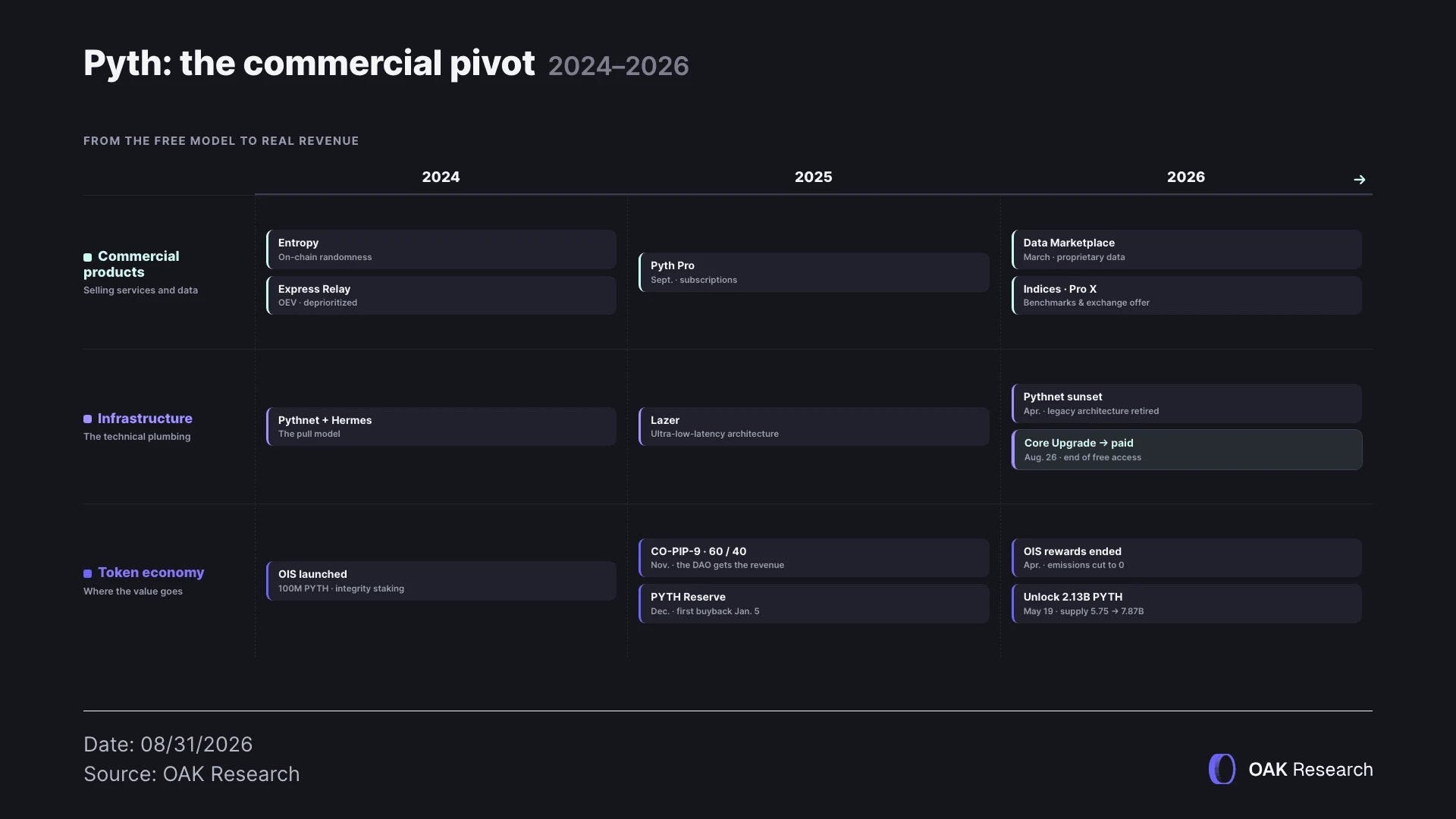
Entropy and Express Relay tested the network's ability to monetize crypto-native services. OIS tried to create additional utility for PYTH. Lazer has replaced Core as the new, higher-performance infrastructure built for a native API service. Pyth Pro turned it into a subscription. The Data Marketplace added proprietary data. The Reserve introduced a first value capture mechanism, while the disappearance of Pythnet, the end of OIS rewards, and Core's move to the paid model gradually make the exit from the historical model irreversible.
So yes, these experiments sometimes cost Pyth dearly. Express Relay required several years of development before its economics were deemed insufficient, 100 million PYTH were distributed to fund an Integrity Staking system that never triggered a single slashing procedure, and Pythnet, long presented as an essential piece of the project's architecture, is now being removed in favor of newer infrastructure.
This does not mean that these decisions were necessarily mistakes at the time they were made. The nature of a technology company is precisely to test models, abandon some of them, and replace its infrastructure when a more efficient solution appears. But it shows how deeply Pyth has changed in just two years.
Given what we have just explained here, do you consider experiments like Express Relay or the 100M PYTH allocated to Integrity Staking as failures that slowed you down, or is this normal for a young company in an industry like ours? How do you see it? :
”Failure is an important part of experimentation. It's important to take risks and try new things as you grow a business, but it's even more important to fail fast. Pyth is thriving today because we've been able to learn and adapt from failure.” - Michael Cahill, CEO of Douro Labs.
At the time of writing, Pyth presents a fairly unusual profile: that of a network whose adoption has increased considerably since our first analysis, whose revenue is finally beginning to take off, but whose historical metrics paradoxically give the opposite impression.
To measure the distance traveled, it is interesting to compare Pyth to the snapshot we gave of the network at the end of 2024.
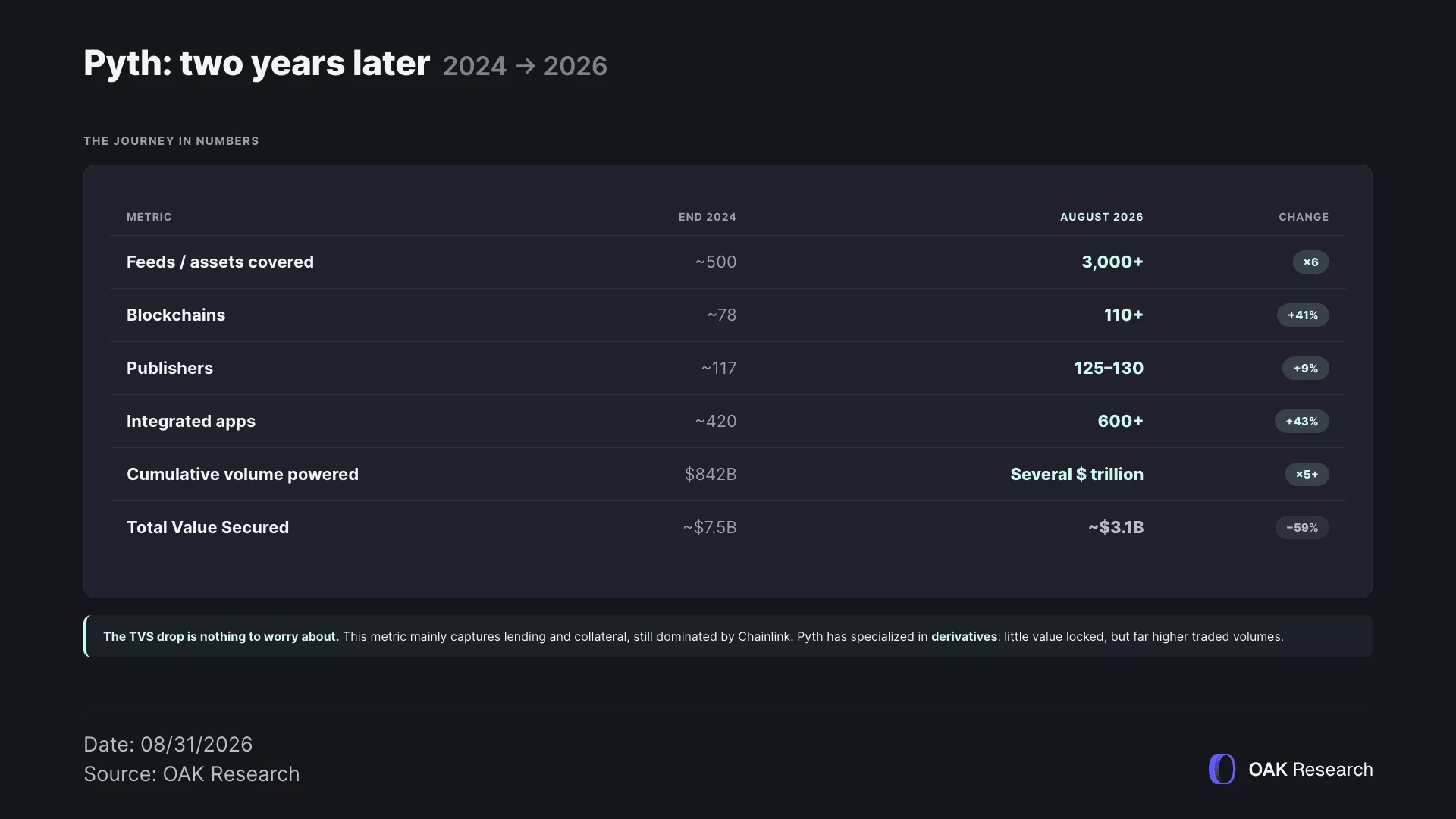
Pyth has six times more feeds, is present on more networks, serves more applications, and powers much more economic activity than two years ago. Yet its TVS has fallen from around $7.5 billion to only $3.1 billion. This paradox is not actually worrying.
Indeed, Total Value Secured measures lending protocols and assets used as collateral particularly well. This part of on-chain finance is still dominated by Chainlink, while Pyth has gradually specialized in derivatives markets, where the amounts locked in contracts are much smaller than the volumes actually processed.
This shift was already visible in our previous analysis. In September 2024, derivatives applications using Pyth had generated around $46.2 billion in monthly volume, compared with only $2.1 billion for spot decentralized exchanges.
According to the August RWA Perp Report published by Refraction Research and co-authored by Pyth, markets using Pyth’s data account for approximately 96% of the total volume of RWA perp markets (or $723.7 billion). It should be noted that this is an internally produced report and that this figure applies only to the platforms and markets covered by the RWA Markets dashboard methodology, but it provides a good indication of Pyth’s market share in this sector.
On the revenue side, the trajectory is obvious. In December 2025, Pyth's commercial products were still generating around $90,000 in monthly revenue. This amount increased to around $123,000 in January 2026, then $180,000 in February, $253,800 in March, and $455,000 in June. In July, they ultimately reached a new record of $562,557, including $538,391 from Pyth Pro, $9,500 from Listing-as-a-Service, and $14,667 from Pyth Indices.
Between September 2025 and July 2026, Pyth therefore generated $2,502,246 in cumulative gross revenue. Of this amount, $1,519,197 was attributed to the Pyth DAO, while $983,048 was kept by Douro Labs. In parallel, Pyth announced $7.49 million of ARR in July and 122 paying accounts on Pyth Pro and Indices, compared with only 54 subscribers at the end of 2025. It should be noted that the August financial report indicates an ARR increase of $2.9 million in August, for a total of $10.4 million for the year.
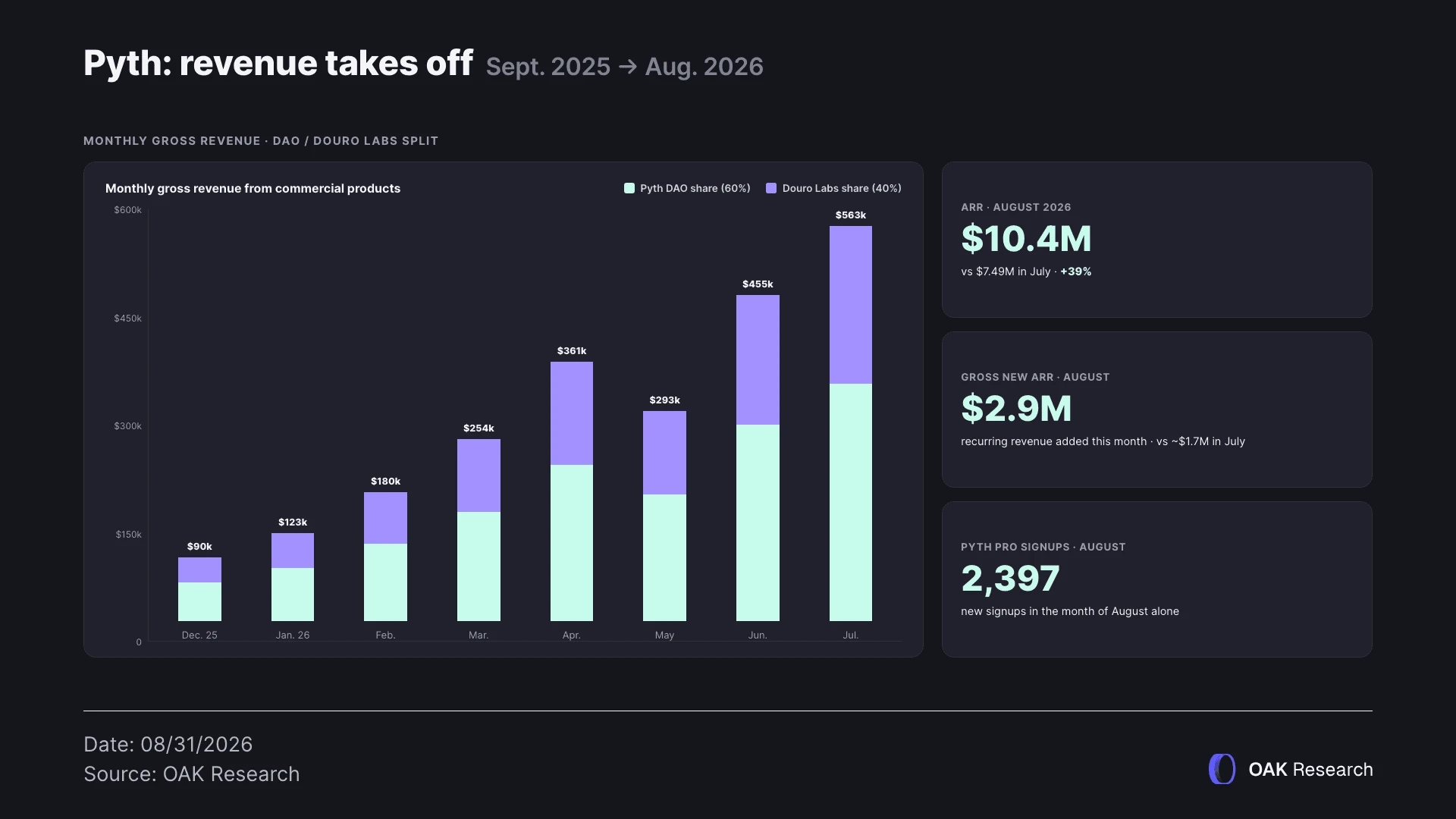
This growth is no longer coming solely from Pyth Pro. After just two months on the market, Pyth Indices already accounts for approximately $1.5 million in ARR, quickly making it one of the network’s main new sources of revenue.
According to the latest financial report, Pyth now generates approximately $10.4 million in gross revenue per year, and this is before even knowing the effect of the Core Upgrade executed at the end of August. Only 0.01% of the $50 billion market Pyth wants to address. But this is also what makes the opportunity interesting: capturing just 0.1% of this market would already represent around $50 million in annual revenue, while reaching 1% would mean $500 million.
Several fundamental metrics also remain unknown: churn, average contract duration, net revenue retention, concentration of the largest clients, gross margin of Pyth Pro and the Data Marketplace, and the real costs borne by Douro Labs. It should be noted that the monthly reports published to governance still represent a level of transparency that is fairly rare in the crypto industry.
Quickly, does this new model allow you to be truly profitable today? :
“Absolutely. Based on current revenue trajectory, Pyth is on track to become profitable next year.” - Michael Cahill, CEO of Douro Labs.
At this stage, we can mainly say one thing: Pyth has demonstrated that it can make certain users pay for its data. The question for the next two years will be how far this activity can scale. And the context is particularly favorable, because at the very moment the network is developing its new commercial model, on-chain finance is becoming increasingly dependent on the exact type of data it is trying to sell.
If we only look at Pyth's current revenue, it would be quite easy to consider that the project is targeting a market that is too large for it. A few million dollars in annualized revenue against the tens of billions generated every year by Bloomberg, LSEG, S&P Global, or ICE, the gap remains huge. But this comparison completely misses a crucial point: on-chain finance is entering an entirely new dimension.
You have seen it for yourselves if you read us regularly: on-chain finance has evolved enormously in recent years. Whether through the growing role of stablecoins in institutional strategies, and therefore the importance of lending or staking protocols, or above all through the explosion of perps exchanges and RWA trading.
All of this, and especially the last point, requires a huge amount of data whose nature is increasingly complex. Offering a perps market on BTC and ETH is obviously not as simple as offering one on Nvidia stock, the S&P 500, or oil. In reality, the closer on-chain finance gets to traditional finance, the closer oracles themselves get to the historical business of financial data providers. And even then, they go even further because, as you will see, they are tackling problems that had never existed before, notably price discovery outside trading windows.
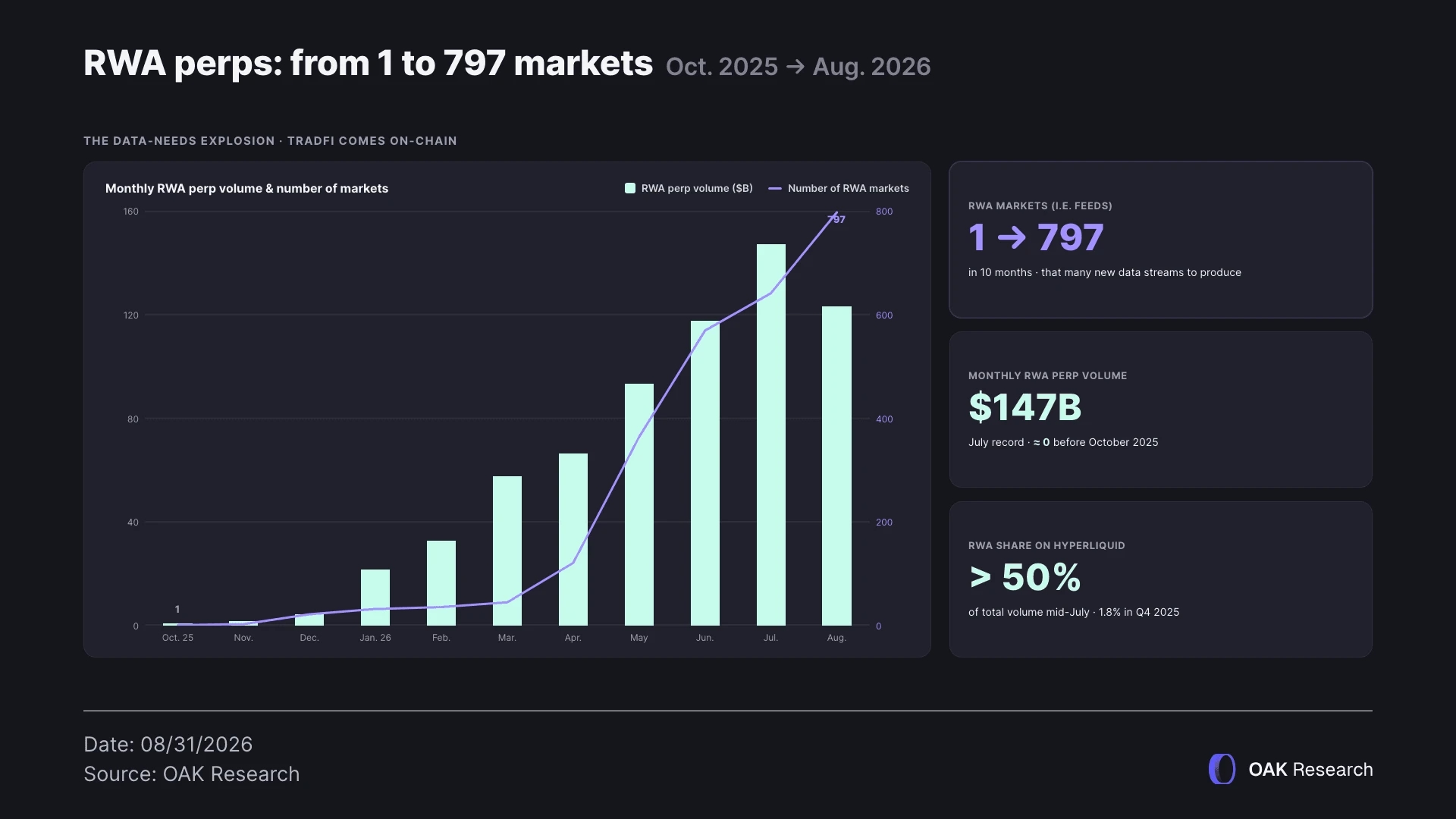
This observation is particularly clear with Hyperliquid. The share of RWA markets deployed through HIP-3 rose from only 1.8% of volumes in the fourth quarter of 2025 to 20.7% in the first quarter of 2026, then 32.2% in the second quarter. During the week of July 13 to 19, they even crossed the 50% threshold of the platform's total volume for the first time. Open interest on these markets also reached several billion dollars.
And Hyperliquid is only part of the phenomenon. According to data compiled by RWA Markets and included in the August monthly report by Refraction Research and Pyth, Hyperliquid now accounts for only 11.5% of RWA perp volume (though it still dominates open interest). Variational has seen a 30% increase in open interest in this segment, and even Binance is up 35%.
But perhaps the most interesting development is the diversification of this activity. The early RWA markets focused largely on commodities such as gold and oil, whereas growth is now shifting toward individual stocks, indices, and other traditional asset classes.
As the range of offerings in the RWA market expands, the need for high-quality data increases, making the role of a market data platform like Pyth increasingly indispensable.
This evolution also gives rise to problems that simply did not exist in traditional finance. Imagine a user wants to trade a perps market on Tesla stock on a Sunday evening on Hyperliquid. Nasdaq has been closed since Friday evening, so there is no new official trade on Tesla stock.
Yet the perpetual continues to operate. Users can buy, sell, use leverage, and get liquidated. How does Hyperliquid ensure that the price used is the right one? Obviously, using the closing price as a reference is not viable because any weekend announcement will move the valuation traders decide to assign to the stock and will therefore create anomalies.
This problem explains part of Pyth's current strategy. Blue Ocean ATS overnight data already makes it possible to extend reference hours on U.S. equities, while Pyth Indices specifically seeks to build benchmarks capable of continuing to function when traditional markets are closed.
The majority of indices currently available for U.S. stocks, major stock indices, FX, commodities, and metals are constructed directly by Pyth, while MarketVector is primarily involved when certain products require a regulated methodology or the construction of more specific baskets.
Most importantly, this need is already beginning to translate into a genuine business. After just two months on the market, Pyth Indices is generating approximately $1.5 million in ARR. Furthermore, some contracts are not based solely on a fixed subscription fee: depending on the negotiated terms, Pyth may also receive a variable portion tied to the volume or revenue generated by the markets using its indices. This gives the product a characteristic quite different from Pyth Pro, since its revenue can, in some cases, increase directly with the 24/7 market activity that it helps make
But the most interesting thing in all of this is that the direction of data flow may potentially reverse. Historically, crypto retrieves a price produced by traditional finance before transporting it on-chain. But if a perpetual on a stock continues trading for several hours while the traditional market is closed, with enough liquidity and participants, it also starts producing information.
We can already see that traditional finance players use Hyperliquid as a reference to follow stock prices over the weekend, and even to hedge their positions. In fact, on-chain finance is already participating in price discovery for certain assets before the stock market even reopens. And who is responsible for this? Oracles like Pyth.
This means that Pyth's real competitor may not only be Bloomberg or Refinitiv on the data they already sell today. The network can also try to build references specifically adapted to 24/7 finance that traditional players have so far had no reason to offer.
This is also one of the reasons why the arrival of Nasdaq TotalView, Tradeweb, Blue Ocean ATS, or Euronext FX is important. The moat no longer rests only on the ability to aggregate a price, but on the ability to legally obtain data that competitors cannot simply copy.
RWA perps markets are obviously only one example among others of this evolution. More generally, every new financial vertical that moves on-chain brings its own data needs. A tokenized stock does not only require a price, but also information on dividends, splits, market hours, or corporate actions. A tokenized fund needs a properly updated NAV, while a stablecoin backed by real assets may require information about its reserves or the value of the assets composing them.
Prediction markets are an even more interesting case because their operation depends entirely on the ability to correctly import an external event into a smart contract. A market allowing users to bet on an election, a central bank decision, or the publication of economic data has no way to determine by itself whether the event actually occurred and under what conditions.
It therefore needs infrastructure capable of retrieving this information, certifying its provenance, and transmitting it to the protocol in a format it can use to definitively resolve the market. Pyth works with Kalshi on the Commodities Hub and with Polymarket on the UP/DW markets for RWAs (stocks, gold, etc.), while Chainlink is also seeking to develop its activity in this vertical.
As these markets grow, data once again becomes a directly monetizable part of the product. A prediction market processing several billion dollars in volume obviously cannot afford to rely on an approximate source of information or infrastructure that risks failing at the moment when several million dollars must be distributed. As with perps exchanges, the client's economic importance increases its ability, but above all its willingness, to pay for more reliable data.
Pyth is also beginning to bet on another category of consumers that remains much more hypothetical for now, but is nevertheless very real in the non-crypto economy: AI agents. The idea is that autonomous software capable of managing portfolios, executing trades, or making financial decisions will themselves need continuous access to thousands of market data points.
For now, it would obviously be premature to make this a significant revenue engine for Pyth. But if this vision materializes, it would further expand the addressable market for data providers, which would no longer sell their feeds only to humans, exchanges, or smart contracts, but also to a multitude of software agents automatically consuming data.
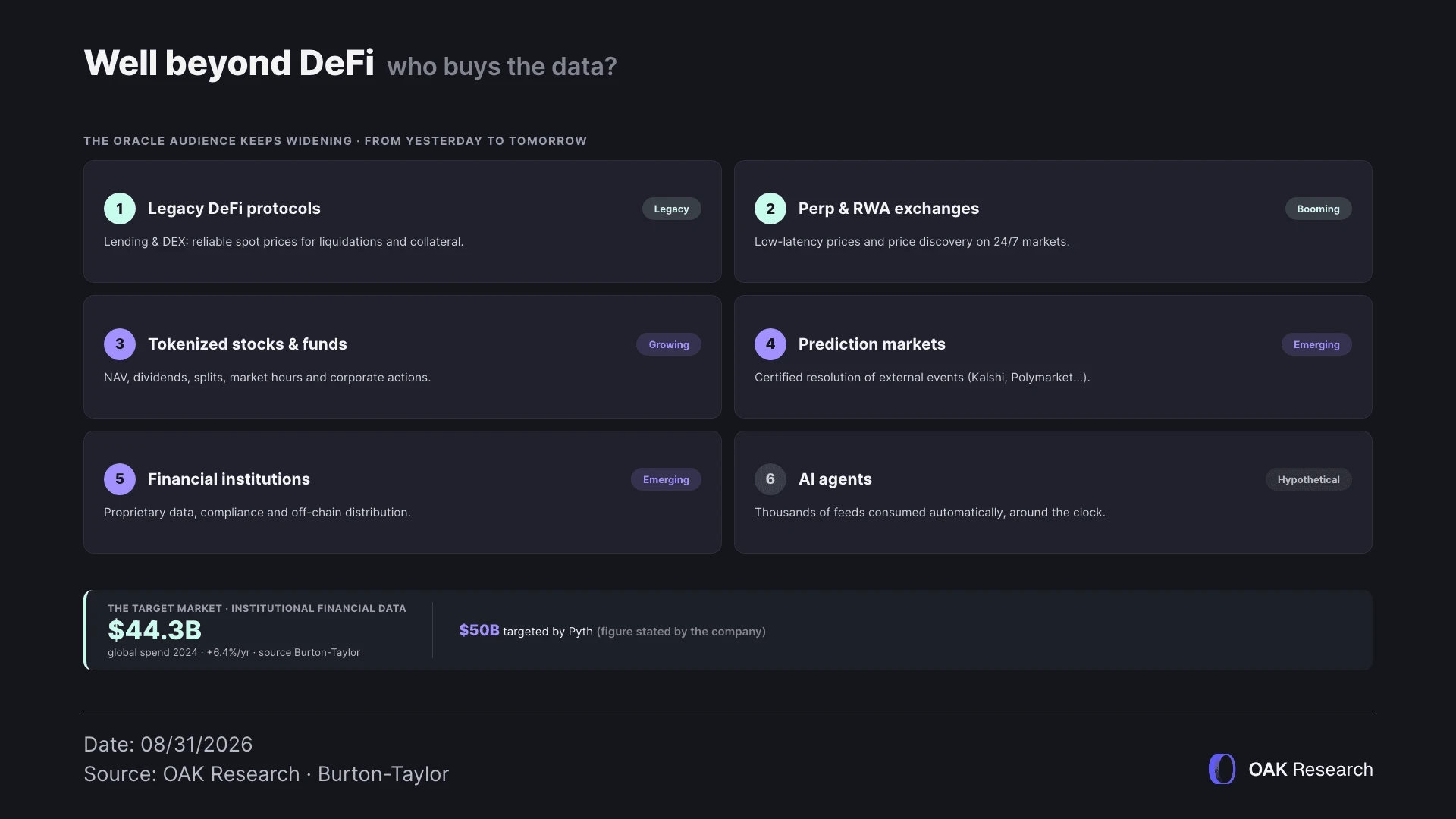
No, obviously, oracles are not going to replace traditional data providers in traditional finance. Nevertheless, throughout this article, we have seen that things have evolved significantly, from a time when oracles were unable to generate revenue in their own industry to the current trend where they are more in demand than ever.
Given what we explained above, what do you think about the role oracles could play in traditional finance, and how does Pyth intend to capture as much value as possible? :
”The term "oracle" doesn't entirely represent Pyth today, but tokenization, onchain data distribution, and decentralized markets are already shaping how traditional finance thinks about the future of the industry. Pyth is instrumental across all of those areas.“ - Michael Cahill, CEO of Douro Labs.
So let us take stock of the reality of this ongoing adoption of oracles. In our view, we need to distinguish between several levels that do not have the same maturity or the same economic importance.
The first level is currently the most concrete, especially in Pyth's case. Traditional finance players are themselves becoming data providers for on-chain markets. Nasdaq distributes TotalView through Pyth, Euronext FX makes some data available, Tradeweb contributes fixed income information, and Fidelity also participates in the Data Marketplace. In all of these cases, Pyth is the distribution layer for this data toward on-chain finance.
The second level goes a bit further because it concerns institutions directly using oracle infrastructure in their own tokenization projects. On this front, Chainlink currently appears to have the most significant lead. Swift, DTCC, Euroclear, UBS, and Kinexys by J.P. Morgan have worked with its technologies to connect different blockchains, manage tokenized assets, automate certain corporate actions, or transfer information between systems that were historically never designed to communicate with one another.
Finally, there is a third level, which would probably be the most economically interesting for Pyth but also remains the least demonstrated today. It is the possibility of seeing banks, hedge funds, or trading firms directly use Pyth Pro as a market data provider in their traditional activities, without any blockchain being involved in the process. This third category is what would truly justify comparing Pyth to Bloomberg, LSEG, or ICE and talking about a $50 billion annual addressable market.
The distinction is important because it avoids confusing integration with adoption. The fact that a traditional data provider chooses Pyth to distribute some of its products does not necessarily mean that it uses Pyth itself to manage its daily activities. Similarly, seeing a large bank participate in a pilot project around tokenized assets does not yet mean that its historical infrastructure has been replaced. The convergence is real, the first economic flows are indeed present ($10 million in ARR for Pyth), but we are still at the beginning of the process.
In any case, this is the context in which everything explained in this analysis starts to make sense and becomes particularly interesting. Pyth is gradually moving down the stack toward the data itself and is trying to control its distribution, its licenses, and sometimes even the construction of benchmarks. If a growing share of financial markets eventually operates on-chain or 24/7, the infrastructures responsible for moving information between these different environments will become extremely valuable.
And this is precisely where we must return to the question we have left aside for several sections. Because even if this vision materializes, even if Pyth succeeds in becoming one of the main market data providers for on-chain finance, and even if its revenue continues to grow, this still does not automatically mean that the PYTH token will capture that value.
This transformation of financial markets is no longer limited to the companies building the infrastructure or the traders beginning to use it. Over the past few months, U.S. regulators have also started working much more concretely on how to adapt rules designed for traditional markets to a financial system capable of operating 24 hours a day.
The shift is particularly visible at the CFTC. On May 29, 2026, the U.S. derivatives regulator published an initial framework for 24/7 trading, clearing, and settlement, explicitly acknowledging that digital-asset derivatives may be particularly well suited to continuous trading because of their infrastructure and global nature.
On the same day, the CFTC also authorized KalshiEX to list the first regulated perpetual contract on BTC. A few weeks later, it went even further by opening a consultation on extending 24/7 trading to traditional futures and on the possibility of creating perpetual contracts on physical commodities such as oil.
In parallel, the SEC is pursuing an equally interesting review of equity market structure. In June 2026, it proposed repealing Rule 611 of Regulation NMS, also known as the “Trade-Through Rule.” Introduced in 2005, the rule is essentially designed to prevent an order from being executed on one venue at a worse price than a protected quote available elsewhere. In short, this means the SEC considers that the evolution of on-chain finance provides grounds to revisit a system that has become increasingly complex and costly.
One particularly notable point in the context of this analysis is that the SEC’s official document, published in June 2026, itself cites work by Mike Cahill and Brandon Ferrick of Douro Labs on the modernization of Regulation NMS.
And it does not stop there. Douro Labs subsequently continued this policy work directly with the Hyperliquid Policy Center, an organization dedicated to supporting the interests of Hyperliquid, and perpetual markets more broadly, with U.S. regulators. In a joint comment submitted to the SEC in August, the two organizations supported the repeal of Rule 611 but, more importantly, argued that the future “best execution” framework should better account for on-chain markets.
One of their main arguments is that on-chain markets allow trading in a stock or derivative to continue overnight and over the weekend. During these periods, Douro and the Hyperliquid Policy Center argue that independent, transparent, and verifiable reference prices could be used to assess execution quality.
Of course, it would be far too early to conclude that Pyth price feeds could become an official regulatory reference in the future, and the SEC proposal has not yet been definitively adopted. Still, the direction of travel is particularly interesting and further strengthens the potential role of data providers capable of producing independent, transparent, and continuously available 24/7 reference prices.
This is probably the most important topic for Pyth now. The protocol is accumulating integrations, increasing its revenue, and attracting new institutional clients, and yet PYTH remains far from its historical highs. Beyond the general health of the altcoin market, the reason is also that nothing forces clients to hold PYTH in order to access the service. The question is how Pyth will manage to connect the performance of the protocol with the performance of its token.
For Pyth Pro and the Data Marketplace, current rules provide that 60% of revenue goes to the Pyth DAO while Douro Labs keeps the remaining 40% for its role as operator and distributor. Listing-as-a-Service, for its part, uses a 90/10 split. This explains why, in July 2026, of the $562,557 in gross revenue generated, $340,384 was attributed to the DAO and $222,173 to Douro Labs.
For PYTH holders, the key issue therefore lies mainly in the 60% going to the DAO. Originally, the PYTH Reserve used part of the non-PYTH treasury balance to buy tokens on the market. Nearly 12 million PYTH had thus been accumulated by April 23, 2026.
Since CO-PIP-104, however, Douro can directly settle the share owed to the DAO in PYTH. In July, the $340,384 owed to the DAO was therefore paid in the form of 7,662,509 PYTH, calculated on the basis of an average price of $0.044422. In parallel, around $46,000 held in USDC and SOL was used by the Reserve to buy 1,144,629 PYTH directly on the market.
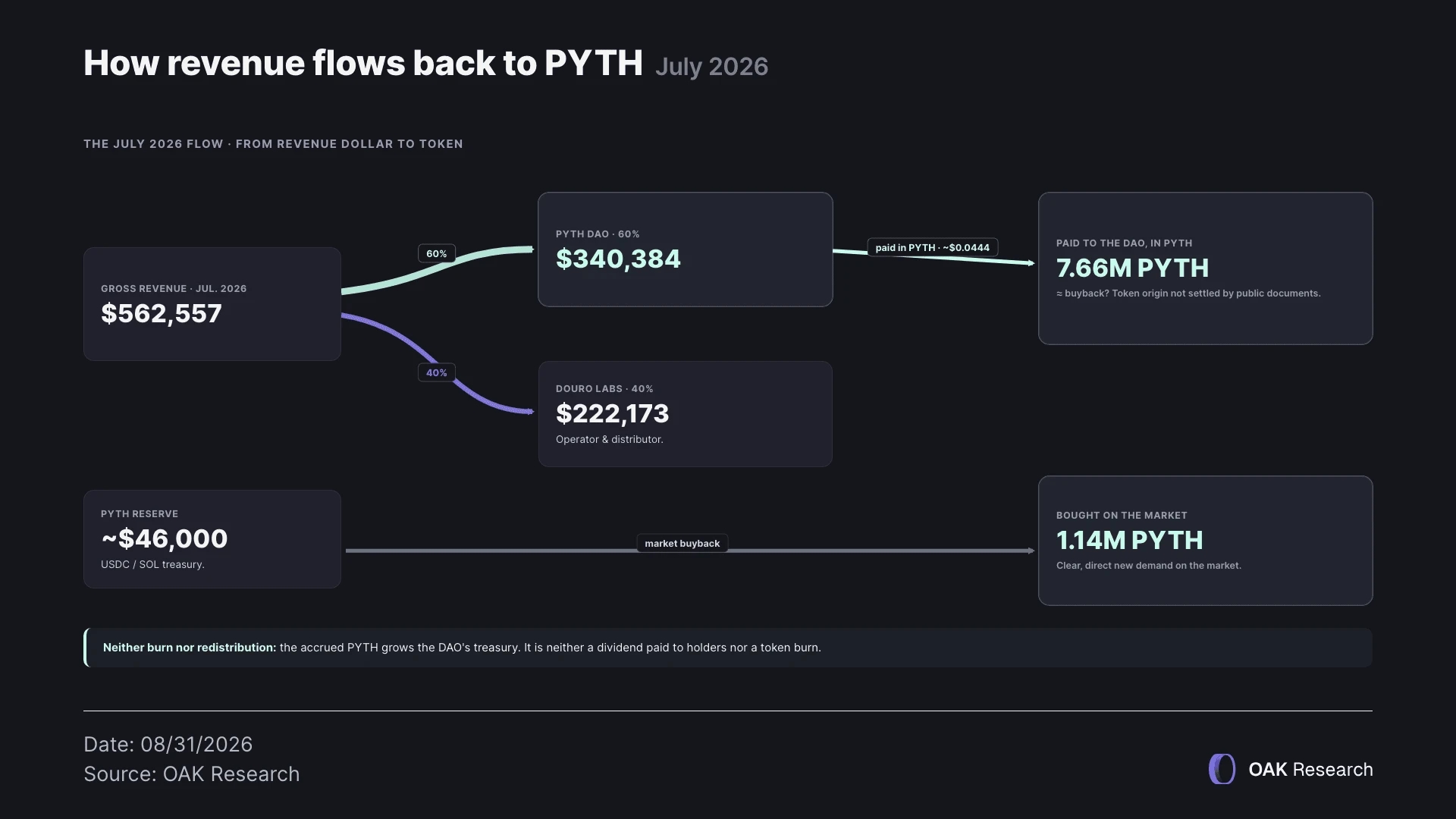
The nuance is important. The 1.14 million PYTH bought by the Reserve clearly correspond to new market demand. For the 7.66 million paid by Douro, however, everything depends on their provenance. If they were specifically bought before the transfer, the economic effect is close to a buyback. If they come from a stock of PYTH already held by Douro, the operation does not create new buying pressure. The available documents do not allow us, at this stage, to definitively settle this question.
It is also important to remember that the tokens accumulated by the DAO are neither burned nor redistributed to holders. The Reserve therefore mainly makes it possible to potentially remove part of PYTH from the market and increase the DAO's reserves, but it does not constitute a dividend or a burn.
The other limitation comes from the orders of magnitude. In May 2026, around 2.13 billion additional PYTH were unlocked, increasing circulating supply from around 5.75 to 7.87 billion tokens. By comparison, the roughly 12 million PYTH bought back by the Reserve in April remain obviously marginal.
The same observation applies to Publisher Rewards. 22% of the total supply was reserved to compensate data providers, and Pyth says that more than $50 million has already been distributed to them. This should be compared with the $2.5 million in commercial revenue generated through the end of July 2026.
This does not mean that the model cannot work. For several years, the token was precisely used to finance publisher acquisition and network growth before clients were able to pay. The real challenge now is to know whether revenue can increase enough to gradually replace these subsidies.
At $6 or $7 million in annualized revenue, the impact of buybacks remains limited. If Pyth manages one day to generate several tens of millions of dollars per year, the same mechanism could obviously become much more meaningful.
Pyth is not the only one facing this difficulty. Chainlink, despite its dominance and numerous institutional integrations, also had to create a Reserve in August 2025 in order to convert certain revenues into LINK purchases.
This mainly shows that the problem is structural. With oracles, the client generally pays in dollars or stablecoins, part of this revenue is used to finance data providers and the operator, and only a fraction may eventually be transformed into demand for the token.
This is very different from a model like Hyperliquid, where a considerable share of trading revenue is directly directed toward HYPE buybacks. The link between activity, revenue, and the token is much shorter.
For Pyth, the essential point is therefore the following: the network can continue to gain market share, Douro Labs can develop a profitable commercial activity, and the DAO can receive more and more revenue without PYTH automatically benefiting in the same proportions. Everything will depend on the growth of future revenue and the way governance chooses to redistribute it.
For several years, oracles occupied a fairly paradoxical position in the crypto ecosystem. They were indispensable to the functioning of on-chain finance, secured tens of billions of dollars, and allowed entire protocols to exist, while generating very little revenue. Their priority lay elsewhere: multiplying integrations, convincing the best data providers to participate in the network, and becoming indispensable enough to monetize that position later.
This period now seems to be coming to an end. Chainlink has gradually transformed into an orchestration infrastructure for tokenized finance, while Pyth has made an even more radical pivot toward market data distribution. With Pyth Pro, the Data Marketplace, Indices, and now the transition of Core users to the paid Pyth Pro model, the network has, for the first time, a real business model based on recurring revenue rather than token emissions alone.
The first figures remain modest compared with the stated ambitions, but the trajectory is hard to ignore. In less than a year, Pyth has gone from a few tens of thousands of dollars in quarterly revenue to more than half a million dollars per month, with 2,397 Pyth Pro signups (trials account, in August) and ARR above $10.4 million. Above all, this transformation is happening at a time when on-chain financial markets are becoming increasingly large consumers of complex, proprietary, and constantly available data.
This is probably where the real opportunity for Pyth lies. The network is no longer simply trying to transport the price of BTC or ETH to a blockchain, but to become a data layer adapted to finance operating 24 hours a day, where equities, commodities, indices, tokenized funds, and prediction markets need information that traditional infrastructures sometimes never had to provide in this way.
There is obviously still a lot to prove. The Core Upgrade will have to show how many historical users will actually accept to pay. Pyth Pro will have to retain its clients and continue increasing its pricing power. The costs associated with licenses, publishers, and commercialization will also need to allow the business to generate real margins.
And above all, we will need to keep distinguishing between three things that the crypto industry has long tended to confuse: the success of the network, the profitability of the commercial activity, and the performance of the token.
Pyth now seems much closer to having solved the first two problems than it was two years ago. The PYTH question, however, remains more open. The Reserve now creates a link between revenue and the token, but this link remains indirect and still too weak on its own to offset historical emissions.
This is probably what makes Pyth's current trajectory so interesting to follow. After spending five years proving that oracles were indispensable to on-chain finance, the network is finally entering a phase where it must prove that they can also become real profitable businesses.
And if this transformation works, the next battle will no longer be about whether oracles can make money, but about who, between operators, DAOs, and their tokens, will ultimately capture the value.
Pyth Network (PYTH)
Pyth Network (PYTH), Wormhole (W), Solana (SOL)

Hyperliquid (HYPE)

Ethereum (ETH)