Market Briefing 10: Bitcoin's Bull Run Is Back


Bitcoin (BTC), Ethereum (ETH), Derive (DRV), Hyperliquid (HYPE)
Published onUpdated on

Strategy, Michael Saylor’s company and the world’s largest Bitcoin Treasury Company, has just opened the door to selling several billion dollars’ worth of BTC. This announcement is causing concern among some market participants, as it marks a departure from Strategy’s image as a company that accumulates Bitcoin at any cost. However, this new strategy could primarily indicate that the company is seeking to strengthen its balance sheet, fund its dividends, and make its business model more sustainable in the long term.
Since its first Bitcoin purchase in August 2020, Strategy (formerly MicroStrategy) has profoundly transformed its business. Originally specialized in data analytics software, the company has gradually become what is now called a Bitcoin Treasury Company: a company whose main objective is to raise capital in order to accumulate Bitcoin.
For several years, the model remained relatively simple. Strategy raised funds through different sources of financing (issuances of common stock, convertible bonds, debt, or preferred shares), then used almost all of that capital to buy Bitcoin. As its balance sheet grew, MSTR stock gradually became an indirect way for institutional investors to gain exposure to Bitcoin.
However, the model has changed significantly in recent months with the launch of several categories of preferred shares (STRK, STRF, STRD, and more recently STRC). Unlike common shares, these securities pay investors a fixed dividend, which allows Strategy to raise capital permanently without having to repay debt at maturity as it did before.
In practice, the mechanics remain relatively similar: Strategy issues these preferred shares, distributes them to investors, raises cash, and then invests it in Bitcoin. The difference is that this new model now requires the company to pay several billion dollars in interest and dividends every year, instead of simply repaying investors’ initial capital.
Strategy must therefore no longer only succeed in accumulating Bitcoin, it must also demonstrate that its financing model remains viable over the long term.
For several months, one indicator has become central to the analysis of Strategy: mNAV (Multiple of Net Asset Value). Its principle is relatively simple. It consists of comparing Strategy’s total stock market valuation to the value of its assets, primarily its Bitcoin portfolio.
Let’s take a deliberately simplified example. If the bitcoins held by Strategy are worth $100 billion and the company is valued at $200 billion on the stock market, then its mNAV is 2. This means investors are willing to pay twice the value of the assets held by the company in order to benefit from its model and its exposure to Bitcoin.
This premium is essential because it determines Strategy’s entire ability to continue financing its growth. When mNAV is well above 1, the company can issue new common shares at a price far above the value of its assets. The capital raised can then be used to buy more Bitcoin than the dilution created for existing shareholders, which makes the operation value-accretive.
Conversely, when mNAV approaches 1, this premium gradually disappears. New share issuances can still raise funds, but they create much less value for shareholders. And when mNAV falls below 1, the situation completely reverses: each issuance dilutes shareholders more than it creates wealth.
This is precisely the context in which Strategy is operating today. For several weeks, mNAV has been fluctuating around 1, which greatly limits the appeal of continuing to finance the model solely through common stock issuances. The company therefore had to find other levers to fund its dividends, strengthen its balance sheet, and ensure the sustainability of its model. This is precisely the objective of the announcements published this week.
Trade 100+ perps with up to 40x leverage on a fully decentralized exchange.
To understand the announcements published this week, we must first understand how STRC works. It is probably the most important financial product created by Strategy since the beginning of its Bitcoin strategy. Michael Saylor himself described it as the company’s "iPhone moment", meaning the instrument capable of opening its business model to an entirely new category of investors.
Unlike MSTR, which mainly attracts investors seeking amplified exposure to Bitcoin, STRC targets a very different audience. It is primarily aimed at investors looking for a high yield, relatively low volatility, and indirect exposure to Strategy’s Bitcoin balance sheet, without directly experiencing BTC’s daily fluctuations.
In concrete terms, the mechanism is relatively simple. When an investor subscribes to one STRC share, they pay $100 to Strategy. In exchange, they receive a perpetual preferred share that entitles them to an annual dividend currently set at 12%. Unlike a bond, Strategy has no obligation to repay this $100 on a specific date. The investor only recovers their capital if they resell their shares on the secondary market or if Strategy exceptionally decides to exercise its redemption option.
However, the $100 raised is not used to fund dividends. As with Strategy’s other fundraising operations, this money is used to buy Bitcoin. This is a point that is often misunderstood: Strategy does not create STRC to pay STRC. Historically, dividends have been funded through MSTR common stock issuances when mNAV is sufficiently high, supplemented by a dollar cash reserve and, since this year, by the possibility of occasionally selling part of the bitcoins held on the balance sheet.
The entire STRC mechanism then relies on a second essential element: its price is designed to remain permanently close to $100. Unlike a traditional stock, whose price moves freely according to supply and demand, STRC includes several mechanisms designed to keep its price around its par value.
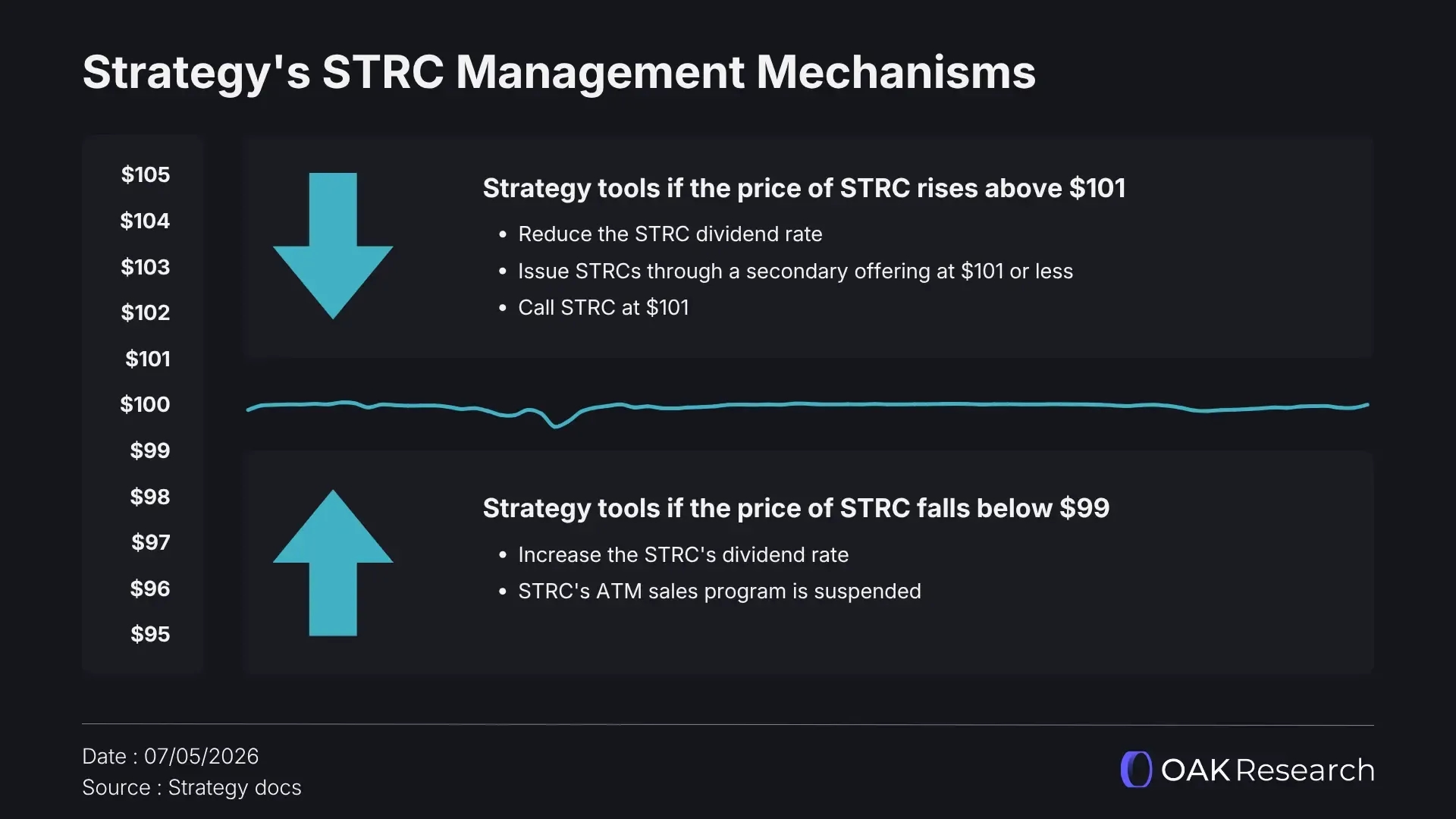
When the security trades above $101, Strategy can issue new STRC shares, slightly reduce the dividend, or exercise its redemption option at $101. Conversely, when the price falls below $99, issuances are suspended and the dividend can be gradually increased in order to make the security more attractive. The objective is to create a real "pullback force" around $100.
It is precisely this stability that allows Strategy to gradually transform its Bitcoin balance sheet into a real financing tool. As long as STRC remains close to its par value, the company can continue raising billions of dollars from investors seeking yield rather than exposure to Bitcoin. This capital is then invested in BTC, which allows the company’s reserves to grow without directly increasing its traditional debt.
In return, this model creates a new constraint. Each STRC issuance increases the amount of dividends that Strategy will have to pay every year. Today, all preferred shares represent more than $12 billion in notional value and nearly $1.5 billion in annual dividends to fund, on top of the interest on convertible bonds.
As long as mNAV remained well above its breakeven threshold, these payments were relatively easy to absorb through MSTR issuances. With mNAV back around 1, this mechanism works much less well. This is precisely the problem that the announcements published this week are trying to solve.
For several months, we had been explaining that the real issue for Strategy was no longer Bitcoin, but the financing of its model. As long as mNAV remained well above 1, the company could continue issuing common shares to finance the purchase of new bitcoins while creating value for its shareholders.
Today, that situation has changed. With mNAV now close to 1, share issuances have become much less effective and Strategy had to find other levers to fund its dividends, strengthen its balance sheet, and reassure investors about the sustainability of its model. This is precisely the objective of the new Digital Credit Capital Framework, which is built around six major announcements.
The first announcement concerns the creation of a real dollar reserve policy (USD Reserve Policy). Until now, Strategy already had cash, but no rule defined its use or its minimum level.
From now on, the company commits to permanently maintaining a reserve representing at least twelve months of interest and dividend payments, or roughly $2.55 billion today. This reserve can only be used to fund these payments, unless exceptionally authorized by the board of directors.
The objective is to reassure investors about Strategy’s ability to meet its obligations, even if market conditions temporarily become unfavorable.
Strategy also announced a change to STRC’s dividend policy. The annual yield now rises to 12%, with the objective of keeping the security close to its par value.
This decision may seem counterintuitive because it increases Strategy’s financing cost. In reality, it is mainly intended to strengthen STRC’s attractiveness among bond and institutional investors in order to preserve the credibility of this new asset category.
In other words, Strategy prefers to accept a slightly higher financing cost today in order to continue raising capital under good conditions tomorrow. This requires STRC to return toward $100 (currently, it is only at $83).
Another important development is that Strategy will now be able to repurchase up to $1 billion of its own preferred shares when market conditions justify it.
Until now, the company had focused mainly on issuing new securities. From now on, it is also giving itself the ability to reduce its cost of capital when certain preferred shares trade at a significant discount.
This logic is very similar to that used by many financial institutions, which constantly arbitrage between issuances and buybacks in order to optimize their financing structure.
The board of directors also authorized a buyback program of up to $1 billion for MSTR common shares.
Here again, the change in philosophy is significant. Until now, Strategy had almost exclusively thought in terms of issuing new shares. From now on, the company also reserves the possibility of supporting its stock when it believes that it is trading below its intrinsic value.
This additional flexibility could notably become useful if mNAV were to remain below 1 for an extended period.
This is probably the announcement that attracted the most attention from investors. For the first time since adopting Bitcoin as a reserve asset, Strategy is officially introducing a program authorizing the sale of part of its bitcoins.
In concrete terms, the board of directors authorizes the company to monetize up to $1.25 billion of BTC in order to fund its dollar reserve or finance certain security buybacks when deemed necessary.
Contrary to what some headlines may suggest, this is not a change in conviction on Bitcoin. Strategy is absolutely not calling its long-term accumulation strategy into question. However, the company now recognizes that responsible balance sheet management may sometimes require selling part of its assets in order to strengthen the solidity of the overall model.
In reality, this change had already begun a few weeks ago with the symbolic sale of 32 BTC intended to fund part of the STRC dividend. The difference is that this is now an official framework approved by the board of directors.
Beyond each of these measures taken individually, this last announcement is probably the most important. Strategy is no longer presenting these decisions as occasional adjustments, but as a real permanent capital management framework.
Until now, the company mainly relied on a logic of issuing new securities in order to buy ever more Bitcoin. From now on, it is formalizing a much broader approach integrating the management of its liquidity, its dividends, its cost of capital, its share buybacks and, when necessary, the monetization of part of its bitcoins.
In other words, Strategy is no longer only trying to accumulate Bitcoin. It is now trying to build a financial model capable of functioning sustainably, regardless of market conditions.
At first glance, this announcement may seem worrying. After all, seeing the world’s largest private holder of Bitcoin officially authorize itself to sell part of its BTC is not insignificant. Yet, after studying Strategy’s new management framework in detail, our reading is practically the opposite of the market’s.
In our view, this announcement probably marks the most important evolution in Strategy’s model since its first Bitcoin purchase in 2020. The company is gradually abandoning a logic of accumulation at any cost in order to adopt real active capital management. And contrary to what many seem to think, we believe this evolution strengthens both Strategy’s credibility... but also Bitcoin’s credibility.
In our Alpha reserved for Premium members, we will return in detail to the consequences of this announcement. We will explain why we believe the systemic risk linked to Strategy has probably decreased, why this change could benefit the entire Bitcoin Treasury Company sector, what it implies for MSTR stock and preferred shares such as STRC, but also why its timing seems particularly interesting to us as we believe Bitcoin is probably building a market bottom.
In other words, we do not see this announcement as a simple change in financial policy. We believe it could mark the beginning of a new phase for Strategy... and, to some extent, for Bitcoin itself.
Bitcoin (BTC), Ethereum (ETH), Derive (DRV), Hyperliquid (HYPE)

Kinetiq (KNTQ), Bitcoin (BTC)

Bitcoin (BTC), Ethereum (ETH)

Bitcoin (BTC), Ethereum (ETH), Zcash (ZEC)