
Lean Ethereum: the biggest overhaul of Ethereum since The Merge

Ethereum (ETH)
Published on

Yield-bearing stablecoins have profoundly reshaped on-chain finance, yet the trilemma between yield, scalability, and low volatility remains unsolved. Theo aims to change that, backed by the world's most battle-tested asset: gold. In this report, we break down the mechanics of thGOLD and thUSD, and share our perspective.
Popularized by Ethena's USDe model, yield-bearing stablecoins have fundamentally reshaped the architecture of on-chain finance. From January 2025 to today, their total supply has grown from $3.77 billion to $14 billion, a roughly 271% expansion.
This new model has unlocked primitives that were previously unthinkable: yield tranching through protocols like Strata, native yield integration into sophisticated strategies via Pendle PTs on Aave or Morpho, and productive collateral logic as pioneered by HyENA using USDe.
That said, the model has its limits. Yield-bearing stablecoins backed by institutional RWAs, primarily US Treasuries, offer some of the most reliable returns on the market, but their attractiveness remains modest. Conversely, hybrid models or crypto-native strategies tend to deliver higher yields subject to meaningful volatility, which remains a hard barrier for institutional participants who need revenue predictability.
USDe makes the problem concrete. Its yield is a function of perpetual futures funding rates, which are themselves a function of speculative demand. When that demand contracts and funding rates normalize, the yield follows. The return profile is conditional on a market environment that can't be relied upon, which makes long-term revenue modeling essentially impossible.
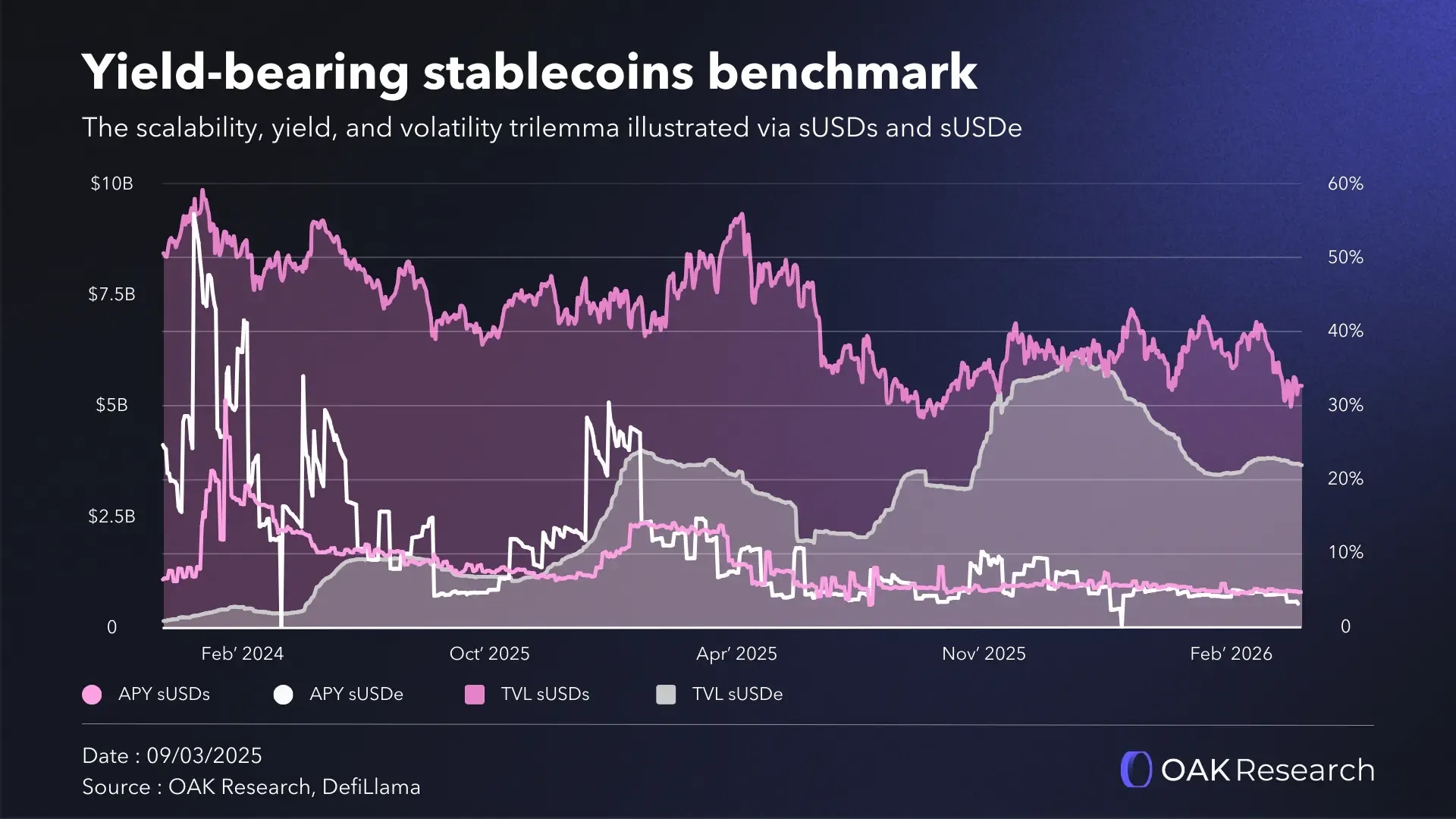
The market has been circling the same problem for two years, what's been identified as the stablecoin trilemma: yield, scalability, and low volatility. Every protocol has managed two. None has credibly claimed all three.
Theo made its name launching thBILL, a tokenized basket of US Treasury bills deployed on Ethereum and HyperEVM. Now it's taking a different angle on the trilemma, with gold as the underlying.
The starting observation is straightforward: access to gold has democratized, but exposure remains expensive. Physical gold involves storage, insurance, and transportation expenses, while financial products like ETFs layer in management fees and introduce meaningful friction. Neither is particularly appealing at scale.
Tether's XAUT and Paxos' PAXG proved the metal has a legitimate place on-chain, with both assets now sitting at nearly $5.4B in combined market cap after growing roughly 177% through 2025. But they're still just 1:1 representations of physical metal. They generate no yield, which naturally limits both their appeal and their composability.
Theo's pitch is to close that gap: the first yield-bearing stablecoin with gold as its backbone.
The architecture will feel familiar to anyone who followed Ethena. USDe paired with sUSDe, a base asset alongside a yield-generating staked version. Theo applies the same structural logic but applies it to an entirely new underlying asset: gold. The protocol is built around two complementary primitives, thGOLD and thUSD, designed to turn a historically inert asset into an on-chain source of yield.
Gold's reputation as a store of value is also its limitation. It holds its price, but it generates nothing else. Understanding how Theo changes that requires a bit of context. Gold retailers operate with a constant raw material requirement to keep inventories stocked. Rather than tying up large amounts of capital in outright purchases, they borrow gold from specialized funds, pay interest on the facility, and return it once their inventory needs are met.
Theo’s thGOLD is the tokenization of that private credit mechanism. Each token represents a share of the MG999 On-Chain Gold Fund, a secured vehicle managed by FundBridge Capital and backed by Libeara, a tokenization platform operating as a Standard Chartered subsidiary. The fund extends gold lending facilities to established sector participants, with Mustafa Gold, one of Singapore's largest and oldest gold retailers, as the primary borrower.
The interest generated by those loans flows to thGOLD holders, turning passive gold exposure into a productive asset delivering approximately 2% annually. Investors are also protected through a lien on the borrowers' gold inventory and a 20% first-loss buffer carried by the fund sponsor.
This is the first building block: a native yield directly anchored to gold, sitting on top of spot price exposure. And because thGOLD is an on-chain asset, it inherits full DeFi composability, delta-neutral strategies, lending loops, borrowing positions, use cases that are simply unavailable to non-yielding gold representations. Integrations with lending markets and derivatives platforms are already in the pipeline.
The value proposition splits clearly across two audiences:
In short, thGOLD currently stands as the only instrument turning gold into a productive, yield-generating asset on-chain. With gold up roughly 60% in 2025 and +20% year-to-date, the investor appetite for the metal is clearly there. The model, in our view, has real potential.
Theo’s thUSD is built to resolve the trilemma outlined above: the equation between scalability, security, and performance. Today, yield-bearing stablecoins broadly fall into two camps when it comes to generating returns: T-bills, or complex on-chain strategies like delta-neutral.
thUSD proposes a third path. When a user mints thUSD, Theo opens a long position on thGOLD while simultaneously opening a short position on gold futures contracts, primarily on the CME. This gold-only delta-neutral strategy allows Theo to hedge its exposure effectively and maintain thUSD's peg.
The yield is where the design becomes genuinely differentiated. thGOLD's native yield is the first source. The second comes from the gold futures curve itself. Gold futures markets typically trade at a premium to the spot price, a dynamic known as Contango. It reflects the cost of physically storing and insuring the metal.
By maintaining and rolling its short futures positions, Theo mechanically captures this premium over time, what's known as Roll Yield. Unlike crypto funding rates, which are driven by speculative positioning and can compress or flip negative, contango in gold markets reflects carrying costs that don't disappear when sentiment shifts. The resulting yield profile for thUSD is largely decoupled from crypto market conditions.
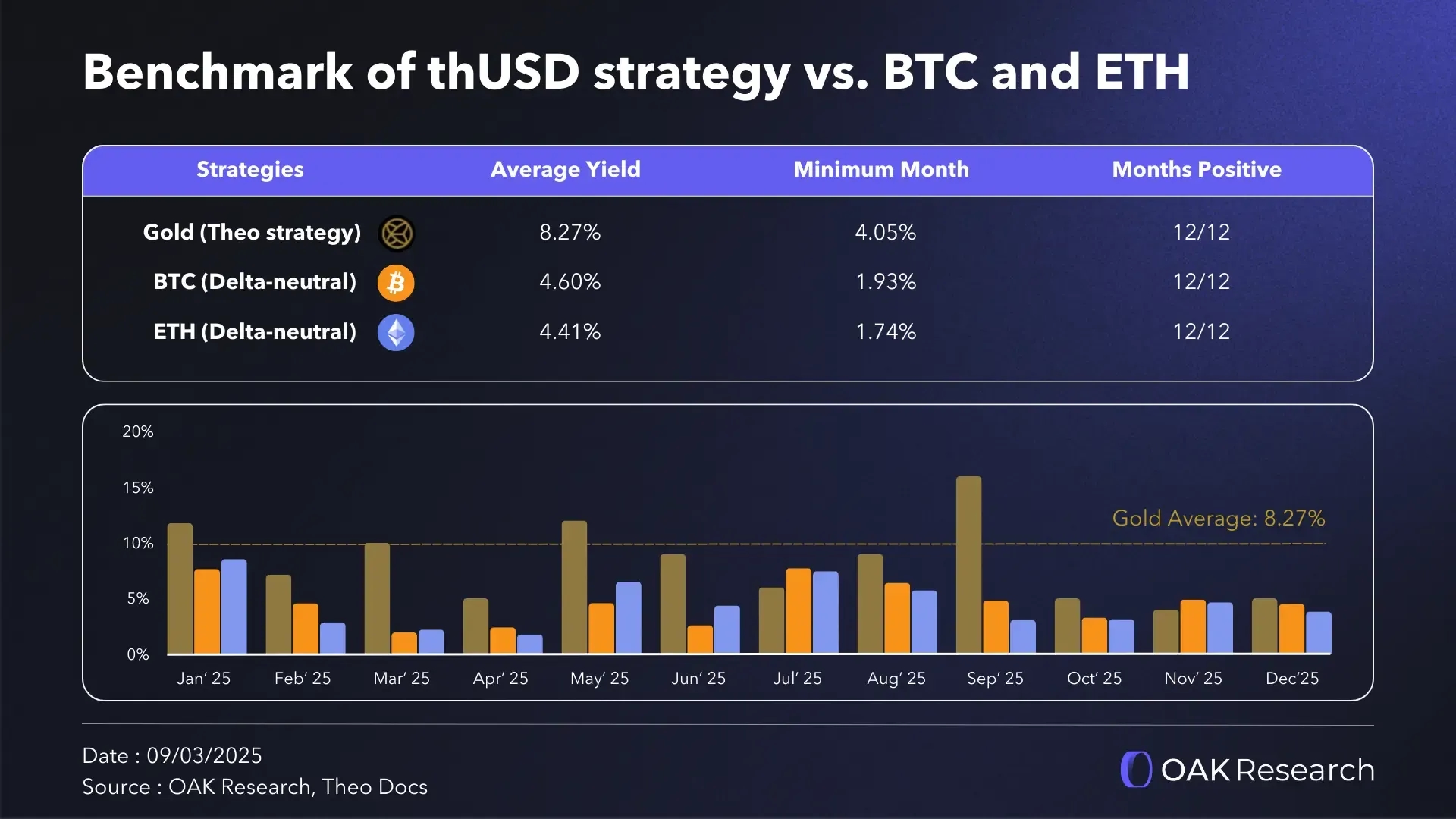
Internal backtests run over 2025 put the combination at an average return of 8.27%, with a floor of 4% even during the quietest months. BTC and ETH delta-neutral strategies generated 4.6% and 4.4% respectively over the same period. These are internal simulations, and the real yield will only be assessable once the product is live.
The scalability argument is the most important part of the thesis. USDe's yield compresses mechanically as supply grows because the crypto perpetuals market has finite open interest depth. More supply means more shorts needed to hedge, which means more pressure on funding rates, which means lower yields. That dynamic doesn't apply to thUSD, and the reason is simple: the gold market operates at a scale that has no equivalent in crypto. Open interest is 39 times that of Bitcoin.
Gold's volatility profile is also far more contained, at 14.4% annualized versus 33.5% for BTC, which smooths yield generation and offers far greater predictability. In concrete terms, thUSD has a theoretical capacity ceiling that dwarfs anything else in the crypto yield space, allowing it to maintain attractive returns without worrying about whether adoption itself becomes a headwind.
Theo takes a mechanism Ethena already validated, the delta-neutral yield strategy, and runs it on a radically different underlying. That might sound incremental but isn't, because it fundamentally changes the scalability equation.
The gold derivatives market operates at a depth that simply has no equivalent in BTC or ETH, and gold's structurally lower volatility gives thUSD a yield profile that crypto-native models cannot replicate at scale. That's precisely where the thUSD and thGOLD thesis lives: not in raw performance, but in the ability to sustain that performance as the protocol grows.
If that bet proves correct, thUSD could emerge as the most credible answer to the stablecoin trilemma, and thGOLD as a DeFi primitive in its own right.
On paper, the backtests are compelling, the thBILL infrastructure proves the team knows how to scale, and the institutional partners are serious. But this remains theoretical: thUSD has yet to face a prolonged stress environment in gold markets, nor the reality of large-scale adoption. The coming months will determine whether this architecture holds.
For now, thGOLD is only accessible via whitelist to a select group of institutional partners, what Theo calls "Phase 1." The next phase will extend the asset to new protocols and networks, while Phase 3 marks the full public deployment.
For thUSD, a pre-deposit window of up to $100M into a Genesis Vault is expected to open today, ahead of the asset's official launch.
To better understand how thUSD and thGOLD work, we asked the Theo team a few questions, including about a potential future token.
Could you tell us exactly which platforms you use to run the basis trade for thUSD, and what are the key factors behind that choice? And how scalable do you see this mechanism being, given that it offers what looks on paper like an extremely competitive yield?
For the basis trade, we run a multi-venue approach. The short leg is executed across CME for the institutional futures exposure, alongside Binance and Hyperliquid for the onchain side. The venue diversification is intentional. It gives us execution flexibility and reduces single-point-of-failure risk on the hedging side.
On scalability, the stat you cited in the piece is the right framing: gold futures open interest runs 39x that of Bitcoin. But the more important point is structural. USDe's yield compression problem is real and well-documented. As supply scales, you need more shorts, which pressures funding rates, which compresses yield. That feedback loop doesn't exist for thUSD because contango in gold markets reflects physical carrying costs e.g. storage, insurance, transportation not speculative positioning. Because those costs don't disappear when sentiment shifts, the yield profile is genuinely different at scale.
How do you plan to make thUSD a stablecoin with real value and genuine utility across the broader on-chain finance ecosystem? More specifically, can you walk us through the integrations you have in mind - things like cross-chain transferability or DeFi composability?
The goal is for thUSD to function as productive collateral across onchain finance, not just a yield instrument you hold and wait (although, that is a valid use case!). Near-term priorities include lending market integrations and Pendle, which would allow users to tranche the yield and create fixed-rate exposure - something institutional participants in particular have been asking for. Cross-chain transferability and broader onchain composability are Phase 2 and 3 priorities as the asset matures. The thBILL infrastructure gives us a foundation to move relatively quickly on this once the Genesis Program closes.
You deployed your first product, thBILL, on Ethereum but also on Hyperliquid. Are you planning to bring thUSD and thGOLD there as well? If so, how central do you see that network being to the growth of these assets?
We deployed thBILL on HyperEVM early because we saw genuine institutional and retail overlap there. For thUSD and thGOLD, we will deploy there eventually, but want to ensure ample liquidity first
If we look at Ethena's model, the fee switch is a pretty thorny issue since most of the revenue feeds back into the sUSDe yield. Long-term, if you were to launch a token, you'd likely run into the same problem. How are you thinking about accruing value to your token without ending up in that same situation?
It's the right question and one we're thinking about carefully. The fee switch tension Ethena faces is real i.e. if most revenue feeds back into sUSDe yield, there's limited room to accrue value to a token without degrading the product. We don't think the current models in the space have resolved that cleanly, and we're not going to rush an answer just to have one. What we can say is that when we do move in that direction, the structure will need to make sense for both yield holders and token holders simultaneously - not trade one off against the other. We'll have more to share there in the future