MegaETH: A mapping of the Layer 2 claiming the highest scalability
MegaETH (MEGA)
Published on

Launched a few months apart with the same promise, making the EVM radically faster, Monad and MegaETH now follow seemingly opposite trajectories. In this analysis, we revisit each project's thesis, the promises made, and the current state of both networks.
In the autumn of 2025, two public token sales took place three weeks apart.
On 27 October, MegaETH opened the sale of 5 % of its total supply on Sonar at a ceiling price of 0.0999 dollar per MEGA, a FDV of 999 million dollars. Demand reached 1.39 billion dollars, 27.8 times the 49.95 million on offer.
On 17 November, Monad in turn inaugurated Coinbase's new token sale platform, launched a few weeks after the acquisition of Echo and its Sonar platform. Monad offered 7.5 % of its supply at 0.025 dollar per MON, a FDV of 2.5 billion dollars. The sale recorded 269 million dollars of demand from 85,820 participants, or 144 %.
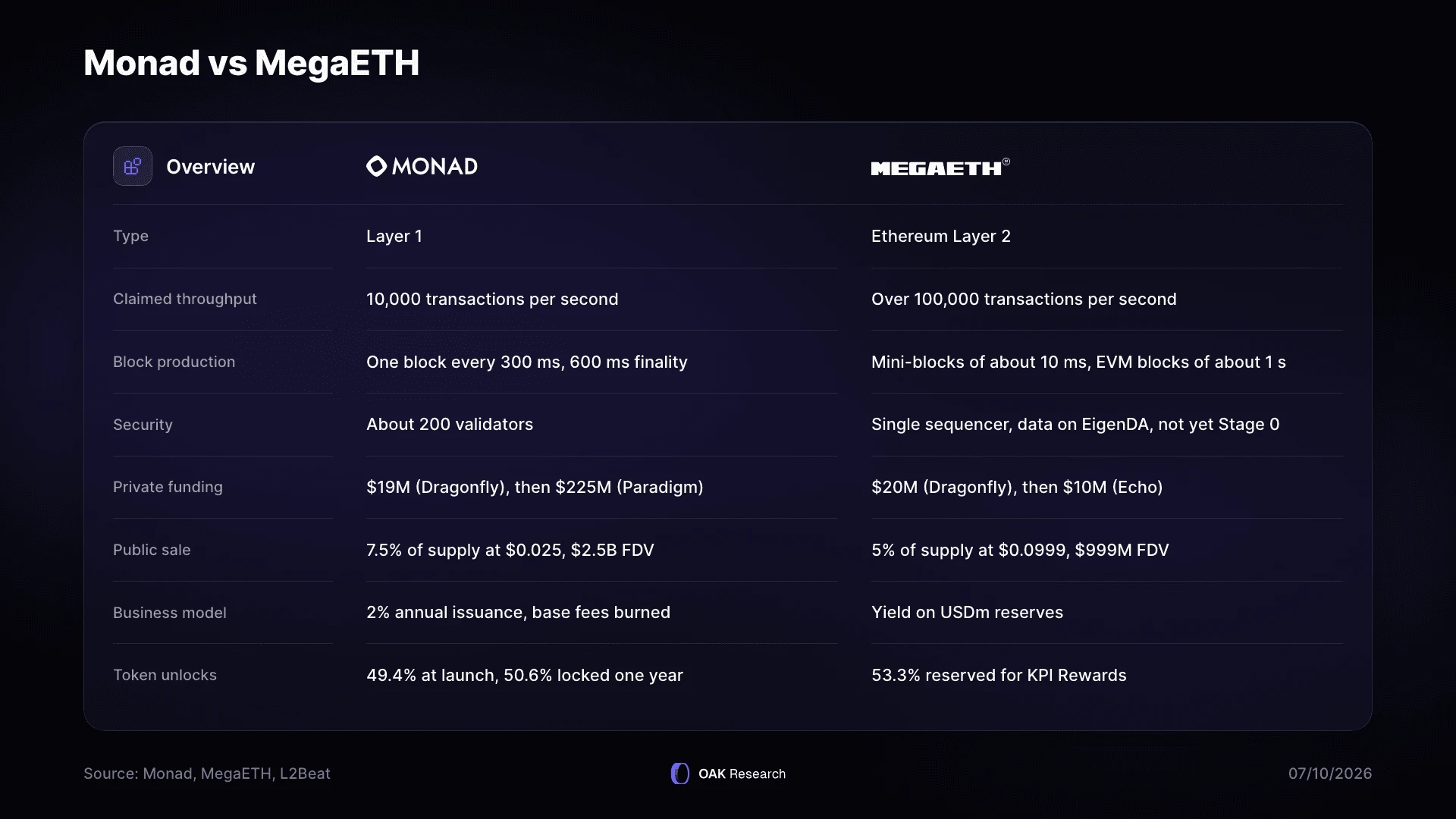
Both projects carried the same promise through two different routes, making the EVM radically faster. Monad, a layer 1, claims 10,000 transactions per second and a block every 300 milliseconds. MegaETH, a layer 2 of Ethereum that bills itself as "the first real-time blockchain", announces more than 100,000 transactions per second and mini-blocks under 10 milliseconds, when Ethereum processes around twenty per second.
While the sales were nearly simultaneous, the launches were not. Monad's mainnet and token went live on 24 November 2025. MegaETH's network opened to the public on 9 February 2026, but the MEGA token only launched on 30 April, once the network had cleared the first of the four quantified targets (KPIs) the team had tied its launch to.
Less than a year after these sales, the two trajectories look opposite. At the end of September 2026, Monad's TVL exceeds 1 billion dollars, close to its record, and MON trades about 17 % above its sale price. MegaETH's stands at 21.7 million dollars, 91 % below its 12 May peak, and MEGA trades around 58 % below its sale price.
Should we then pit a success against a failure? This analysis revisits each project's thesis, the promises made, and the real state of both networks.
Unless otherwise stated, data is as of 30 September 2026.
Monad and MegaETH start from the same observation, the EVM is too slow for certain uses. Both networks remain compatible with it, letting developers reuse the contracts and tools they already know, but they pursue that goal with different architectures.
Monad is an L1, its own network of around 200 validators handles transaction validation and network security. To speed up processing, Monad combines MonadBFT, a consensus able to chain blocks quickly, with asynchronous execution, the order of transactions is fixed first, then they are executed optimistically and in parallel, with MonadDB as a dedicated database. Its bet is thus to combine performance with distributed validation, while staying compatible with Ethereum applications.
MegaETH is an L2 of Ethereum, it executes transactions on its own network, then relies on Ethereum for final settlement. It concentrates transaction ordering and execution on a single sequencer, while the other nodes fill specialized roles. This architecture aims for maximum responsiveness, applications can receive the result of a transaction within about ten milliseconds, well before its finalization on Ethereum.
The data needed for verification is published on EigenDA rather than directly on Ethereum. For now, this model relies on a single active sequencer. L2BEAT does not yet classify MegaETH at Stage 0, the first level of its L2 maturity framework.
This centralization is however presented as transitional, MegaETH plans a rotation of sequencers across regions, whose operators would be selected based on their MEGA stake and their performance, with delegation and slashing.
Monad's economic model is that of a classic L1. Validators are paid through an issuance of 25 MON per block at launch, about 2 % of the initial supply per year, while the base portion of transaction fees is burned. Any holder can delegate their MON to a validator to earn a share of this issuance. The project also holds a large reserve, 38.5 billion MON, or 38.5 % of the initial supply, unlocked at launch and managed by the Monad Foundation to grow the ecosystem.
MegaETH's does not rely on fees. Gas is paid in ETH, at cost. The yield on USDm's reserves, a stablecoin issued on Ethena's infrastructure and backed mainly by BUIDL, BlackRock's tokenized money market fund, covers the sequencer's costs.
Since May 2026, the net revenue from USDm has also funded MEGA buybacks, which the MegaETH Foundation accumulates rather than burns. Finally, 53.3 % of MEGA's supply is reserved for KPI-linked rewards, not tied to a schedule. Holders lock up their MEGA to qualify, and the rewards are only released when the corresponding targets are met.
These two philosophies run through all of their characteristics. Monad is an L1 launched with its token back in November 2025, secured by around 200 validators, claiming 10,000 transactions per second and a block every 300 ms. Its economic model is that of a classic L1: an issuance of roughly 2 % per year pays for security, the base portion of fees is burned, and staking is open to all through delegation. On the supply side, 49.4 % of tokens were unlocked at launch, including 38.5 % for the ecosystem, the rest staying locked for at least a year.
MegaETH, for its part, is an L2 of Ethereum whose network opened in February 2026 but whose token only launched in April, once its first quantified target was cleared. It targets more than 100,000 transactions per second through a single sequencer, with data published on EigenDA and settlement on Ethereum, at the cost of a centralization still classified below Stage 0 by L2BEAT. Its economy rests not on fees but on the yield of USDm's reserves, and its staking consists of locking up MEGA to qualify for rewards. Above all, 53.3 % of its supply is released not on a schedule, but as the network hits its targets. Both projects also raised from top-tier investors and sold part of their supply to the public, Monad at a FDV of 2.5 billion dollars, MegaETH at 999 million.
How does a fast network capture value once its block space is no longer scarce? On Monad, the base gas price rises when blocks fill up and falls when they stay underused, without being able to drop below 100 MON-gwei. As long as activity stays far from the network's capacity, this price sits at its floor, and gas fees then depend above all on the number of transactions.
MegaETH, for its part, seeks to maximize the yield generated by USDm's reserves. Monad therefore bets on transaction volume, on its token's value and on its balance sheet; MegaETH, on its stablecoin's treasury and on a token supply tied to growth.
MegaETH also plans "Proximity Markets", which would auction off certain low-latency access to the sequencer, while others would be conditioned on locking up MEGA. Still at the project stage, this mechanism aims to monetize the network's speed directly, on top of the yield from USDm's reserves.
Both bets rest on the same variable: demand.
On the technical side, both networks have delivered a significant part of what they announced. Monad has run in production since 24 November 2025 and has even accelerated along the way, since July 2026 it produces a block every 300 milliseconds and reaches finality in 600 milliseconds, against 400 and 800 milliseconds previously. The network claims a capacity of 10,000 transactions per second.
MegaETH keeps its latency promise, it produces one EVM block per second, complemented by mini-blocks roughly every 10 milliseconds. Its announced maximum throughput of more than 100,000 transactions per second has not however been demonstrated yet, during its January stress test the network reached up to 35,000 transactions per second over seven days, after a one-off peak near 47,000 TPS in prior tests.
In August 2026, Monad processed around 136 million transactions, nearly 4.4 million per day and about 51 per second on average, barely more than 0.5 % of the 10,000 transactions per second announced. That is nonetheless close to double its average since launch, around 2.5 million transactions per day.
Over the same month, MegaETH processed around 2.1 million per day, about 25 per second, 0.025 % of the 100,000 announced. Its activity stayed almost identical in September.
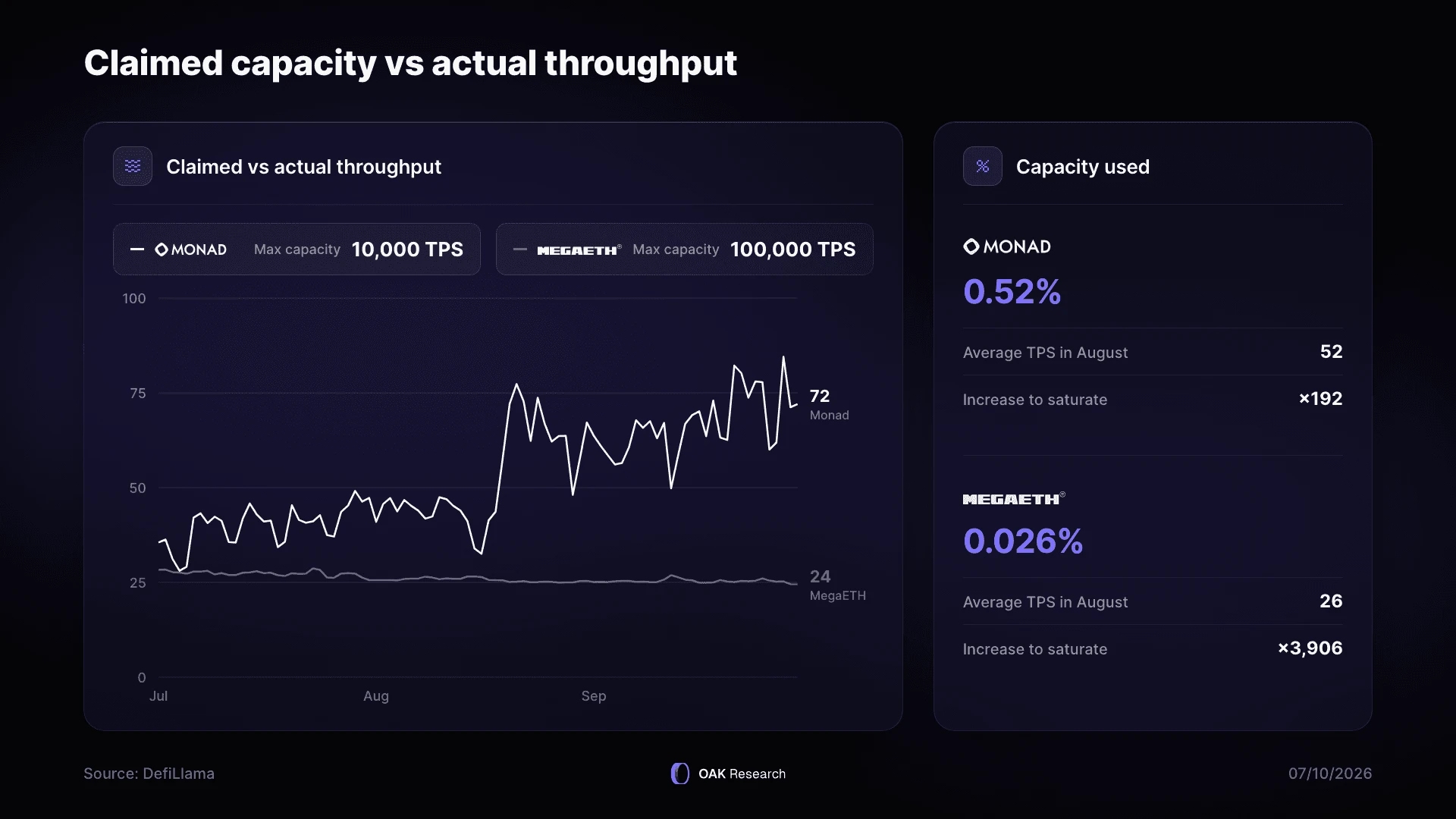
It must be noted, however, that these maximum capacities are measured or modeled on relatively simple transactions, whereas a DeFi transaction uses far more resources. These ratios therefore give an order of magnitude rather than an exact measure.
For comparison, on the most active network tracked by L2BEAT, Lighter, a chain dedicated to the derivatives exchange of the same name, processed around 3.4 billion operations over the past 30 days, some 1,300 per second on average, barely 13 % of the 10,000 transactions per second claimed by Monad.
The number of transactions says nothing, on its own, about their value. Over the past 30 days, MegaETH actually processed around 8 % more of them than Ethereum, whose activity ebbed in September, but its applications generated only about 250,000 dollars of fees. Monad's generated around 6.2 million dollars.
Related to the total number of transactions executed on each network, these fees amount to a few cents per transaction on Monad, less than half a cent on MegaETH, against around 4.3 dollars on Ethereum.
This is not the revenue actually produced by each transaction, but an order of magnitude of the economic value generated relative to recorded activity.
Monad and MegaETH are not deserted networks, their activity holds up against that of established networks. But even the most active network in the Ethereum ecosystem would occupy only a fraction of the capacity they built, and that activity still earns little. Speed was not necessarily the scarce resource, demand was.
For speed to attract durable demand, it still has to concretely improve the service provided. For a user depositing stablecoins to earn a yield, the return and the risk matter more than the speed of the deposit.
For a trader, cutting the delay to modify an order can on the other hand limit exposure to a price that has become stale. Deposits drawn by high yields show an ability to attract capital, but are not enough to validate a thesis built on performance. The criterion to examine is therefore this: if the applications deployed on these networks ran on a slower blockchain, what would their users concretely lose?
Monad today has a DeFi ecosystem on a completely different scale from MegaETH's. But the size of the capital present is not enough to understand what it funds.
DefiLlama's figures, as of end-September 2026, show the scale of the gap. Monad posts 1.03 billion dollars of TVL, 699 million of stablecoin supply, 4.23 billion dollars of spot volume and 2.50 billion of perpetuals volume over 30 days. The same indicators on MegaETH sit on another scale entirely: 21.7 million dollars of TVL, 19.2 million of stablecoins, 13.7 million of spot volume and 29.6 million of perps volume.
Related to TVL, spot trading represents over 30 days around 4.1 dollars of volume for each dollar locked on Monad, against 0.63 dollar on MegaETH.
This ratio depends heavily, however, on how capital is allocated. Deposits on lending protocols raise TVL without necessarily feeding spot trading, while the same dollar of liquidity on a DEX can serve many successive trades. The indicator is therefore not enough to judge a network's appeal, its flagship apps may meet a demand for credit or yield.
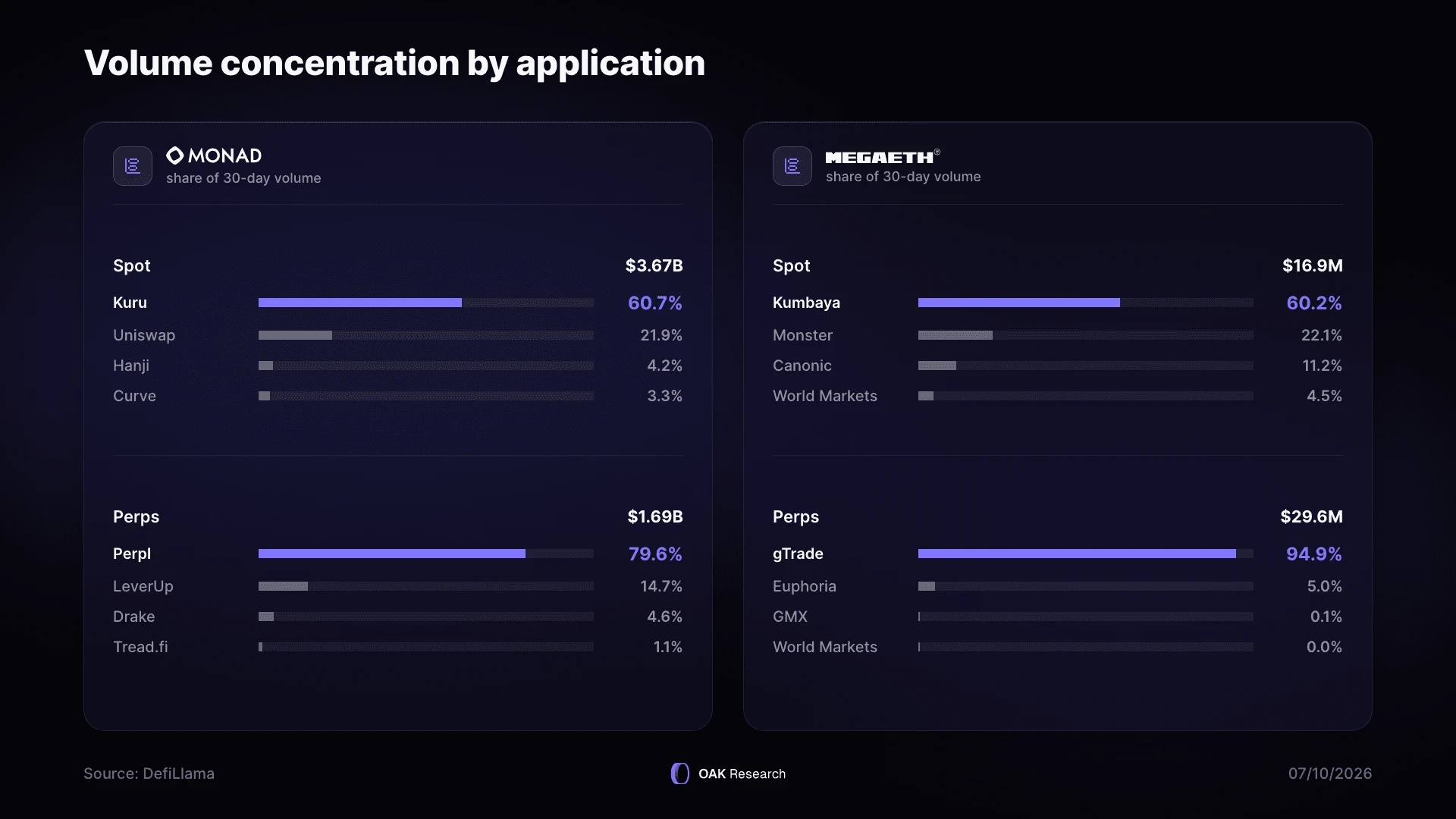
Monad's lead rests, however, on a small number of applications. Over the past 30 days, Kuru, a fully on-chain order book, concentrated nearly two thirds of the network's spot volume, close to 2.7 billion dollars. On the derivatives side, Perpl, a perpetuals platform also built on an on-chain order book, accounted for more than three quarters of volume.
These are precisely the applications for which speed matters. On an order book, market makers must refresh their prices at every market move, and slow execution exposes them to seeing stale quotes filled to their disadvantage. The ability to place and cancel orders frequently at low cost can therefore improve the terms offered to traders. This is the use case that best fits Monad's thesis.
Part of this activity is, however, supported by incentives. Perpl has distributed points since June, calculated notably on traded volume, ahead of a possible token. Its volume has moreover fallen back to less than 120 million dollars over the past seven days, under 17 million per day, against nearly 70 million on average over 30 days.
On MegaETH, perpetuals volumes clearly exceed spot. They come mostly from gTrade, Gains Network's platform, which accounted for 95 % of the network's perps volume over 30 days, around 28 million dollars. Almost all of that volume was however done over the past seven days, and gTrade is deployed on several networks, including Arbitrum, Base and Polygon, its model does not rely on MegaETH's own performance.
The application that best illustrates MegaETH's promise is Euphoria, which lets users take a position by tapping directly on a price chart carved into five-second boxes. According to the protocol, this format only works if confirmation is instant and fees below a cent. Euphoria has however processed only around 1.4 million dollars of volume over 30 days, and currently charges no trading fee.
Performance brings a concrete advantage to certain products, in particular order books and real-time trading. But these uses remain concentrated in a few applications, partly supported by incentives and, for some, still barely monetized. Outside of these uses, most of the capital mainly came looking for yield.
So far, the two networks differ mainly in their architecture and economic model. Their trajectory since launch now allows those choices to be tested against real demand, MegaETH saw a large part of the capital drawn in during spring leave again, while Monad has followed the opposite dynamic since July.
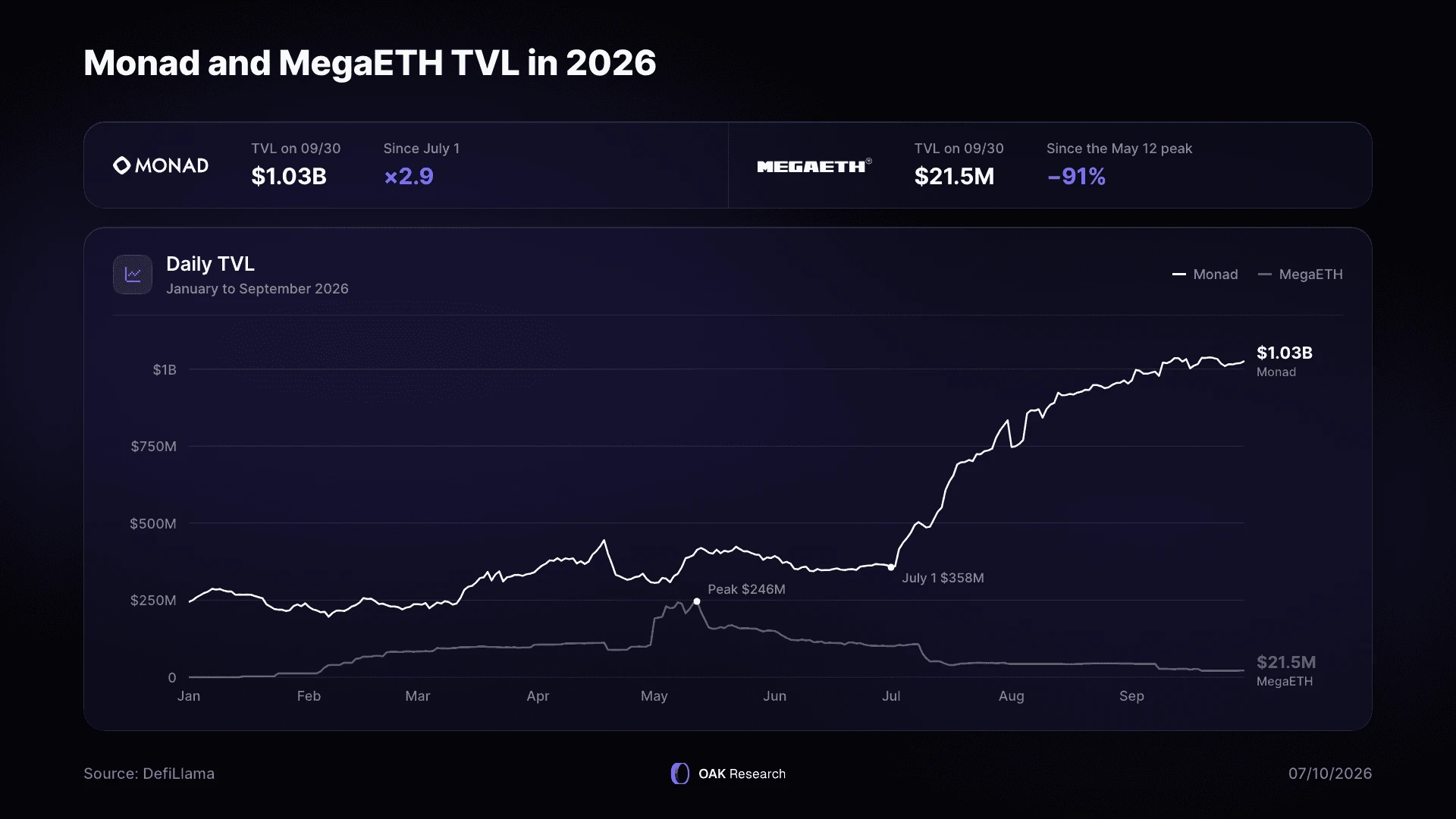
MegaETH's TVL reached its high on 12 May 2026, at 245.6 million dollars, driven by two mechanisms. The first is the Terminal points program, launched on 28 April to reward usage of the network's applications.
The second is a leverage loop on Aave: deposit USDe, borrow USDm, swap it for USDe, then start again. In early May, more than 70 % of the network's TVL was thus tied to Ethena.
Now USDm supply is also among the targets that condition MEGA rewards. By stimulating borrowing demand, the loop could encourage new USDm issuance and thus inflate this adoption metric out of yield strategies propped up by incentives.
The withdrawals then came in three waves.
The applications followed the same path. On 16 July, MegaETH ended Mega Mafia, its accelerator program, the twenty or so teams it backed had raised around 80 million dollars, but most of the applications that succeeded are no longer developed on the network.
MegaETH had taken neither an equity stake nor governance rights in these projects, betting that their founders would stay loyal, an assumption that, according to Shuyao Kong, the project's co-founder, "no longer holds". Nothing therefore held these teams back when they made other choices, GTE launched its own chain, Noise moved to Base and HelloTrade to Monad. "Very little of that value trickled down to Mega", Shuyao Kong acknowledged, announcing a refocus on applications developed in-house.
Monad has so far followed the opposite trajectory. Its TVL rose from 358 million dollars on 1 July to 1.03 billion on 30 September, a 2.9x increase in three months, at a level close to its 21 September record.
This acceleration starts with the arrival of Aave V3, on 2 July, accompanied by 15 million dollars of incentives funded by the Monad Foundation over the first year. Lending now dominates the network, Aave, Euler, Morpho and Curvance total nearly 900 million dollars of deposits, close to 90 % of TVL.
Monad is not, however, betting solely on Aave's incentives. The network is also seeking to host more institutional products, such as SoFiUSD, presented as the first stablecoin issued by a U.S. national bank and announced on Monad in August, as well as applications coming from other networks, such as HelloTrade.
This direction could extend with Aave V4, a proposal published on 28 September plans on Monad a market dedicated to tokenized equities and treasury equivalents. It is still only at the ARFC stage and would reuse the initial 15 million dollar envelope, with no additional budget announced.
As things stand, it remains to be seen how much of this capital will remain once the incentives are withdrawn, the first year of the Aave program ends in July 2027.
The presence of capital is not enough, however, to determine what it contributes economically to the network. A simple indicator is to relate the transaction fees paid to the network itself to TVL.
On the basis of the past 30 days, 1,000 dollars of TVL correspond to around 5.3 dollars of annualized gas fees on Monad, against 3.4 dollars on Ethereum, 9 dollars on Base and 46 dollars on Solana. MegaETH shows 36 dollars, but this figure is essentially down to the collapse of its TVL. The ratio can therefore only be read alongside capital retention.
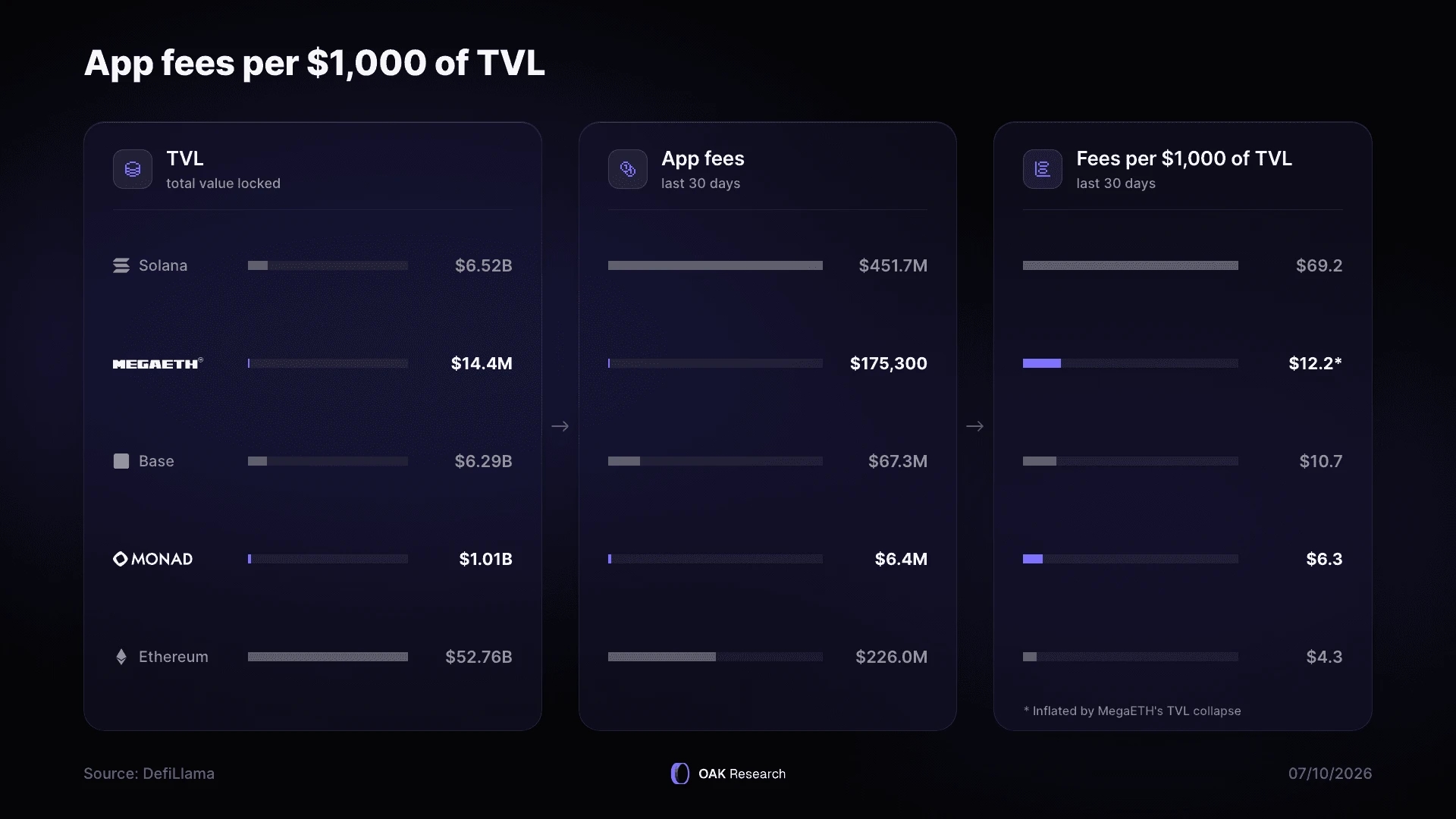
This monetization capacity must therefore be weighed against the cost of acquiring the capital. As part of Aave's launch on Monad, the Monad Foundation committed to provide 15 million dollars of incentives over the first twelve months. Related to the roughly 316 million dollars currently deposited on Aave, this envelope represents the equivalent of around 47 dollars per year for 1,000 dollars of current deposits, or 4.7 %.
This comparison is not a profitability calculation, the 15 million concern Aave specifically, while the 5.3 dollars above relate the gas fees of the whole of Monad to the network's total TVL. It nonetheless gives a sense of the order-of-magnitude gap between the subsidies used to attract capital and the transaction fees that capital generates today.
The real test will therefore be retention, how much of this TVL will remain once the incentives have disappeared?
On Monad, security is paid for by the issuance of new MON. Since the shift to 300-millisecond blocks, in late July, each block creates 18 MON, against 25 previously, around 5.2 million MON per day and close to 1.9 % of the initial supply per year.
Over the past 30 days, issuance represented around 155 million MON, close to 4 million dollars at the period's average price. Over the same time, the base portion of fees, which is burned, destroyed only around 14 million MON, some 360,000 dollars.
The burn therefore offsets only around 9 % of issuance, for each MON burned, the network creates about eleven. That said, issuance exists precisely to fund network security as long as fees are not enough to pay validators.
And fees, and therefore the burn, are rising, around 12,000 dollars per day in September, more than three times its first-half average, in the wake of the TVL increase. It would still need to multiply further to offset issuance. Yet it is not capacity that is lacking to get there, it is demand.
MegaETH, for its part, as an L2 with a single sequencer, has no validators to pay. Its model rests on the yield of USDm's reserves, which covers the sequencer's costs and funds, since May, MEGA buybacks. Now USDm supply has fallen from around 480 million dollars in early May to 17.4 million at the end of September, 3.5 % of the 500 million target set among its KPIs.
Taking the three-month U.S. Treasury yield as a reference, around 4.08 % on 25 September, this supply would correspond to around 700,000 dollars of gross annual yield, against nearly 20 million at May's level. The capacity for MEGA buybacks, fed by the revenue the Foundation receives from USDm, has therefore fallen sharply with its supply. As for gas fees, charged at cost, they amounted to only around 65,000 dollars over the past 30 days.
It must be noted, however, that MEGA's distribution is designed to limit dilution in case of weak growth, 53.3 % of the supply is reserved for rewards paid out only as the network hits quantified targets, tied notably to USDm supply. As long as these targets are not met, these tokens are not put into circulation and do not dilute current holders.
For now, the Foundation defines these KPIs and certifies that they are met; MegaETH plans for a later phase to transfer to MEGA holders the definition of the targets conditioning the next tranches.
By contrast, Monad's issuance is automatic at each block, regardless of the network's activity level. It remains to be seen how the market values these two trajectories.
As of 30 September 2026, MEGA trades at 0.042 dollar, 58 % below its sale price on Sonar. This fall accompanied the ebbing of TVL and the departure of applications, but also the roughly 96 % contraction since early May of USDm supply, whose yield funds MEGA buybacks. It also occurred without any unlock from the team or the venture funds. For participants in the December 2024 Echo round, who entered at 0.02 dollar, the current price represents on the other hand around 2.1 times the entry price.
MON trades at 0.0291 dollar, about 17 % above its public sale price. But this performance depends heavily on the point of comparison. The token has lost 38 % since its high of 27 November 2025, three days after its launch, a far sharper drop than those of BTC (-7 %) and ETH (-12 %) over the same period.
And since 1 July, while the network's TVL nearly tripled, MON rose 59 %, more than BTC (+43 %) but less than ETH (+71 %). In other words, the rise in activity did not translate into a net outperformance of the token.
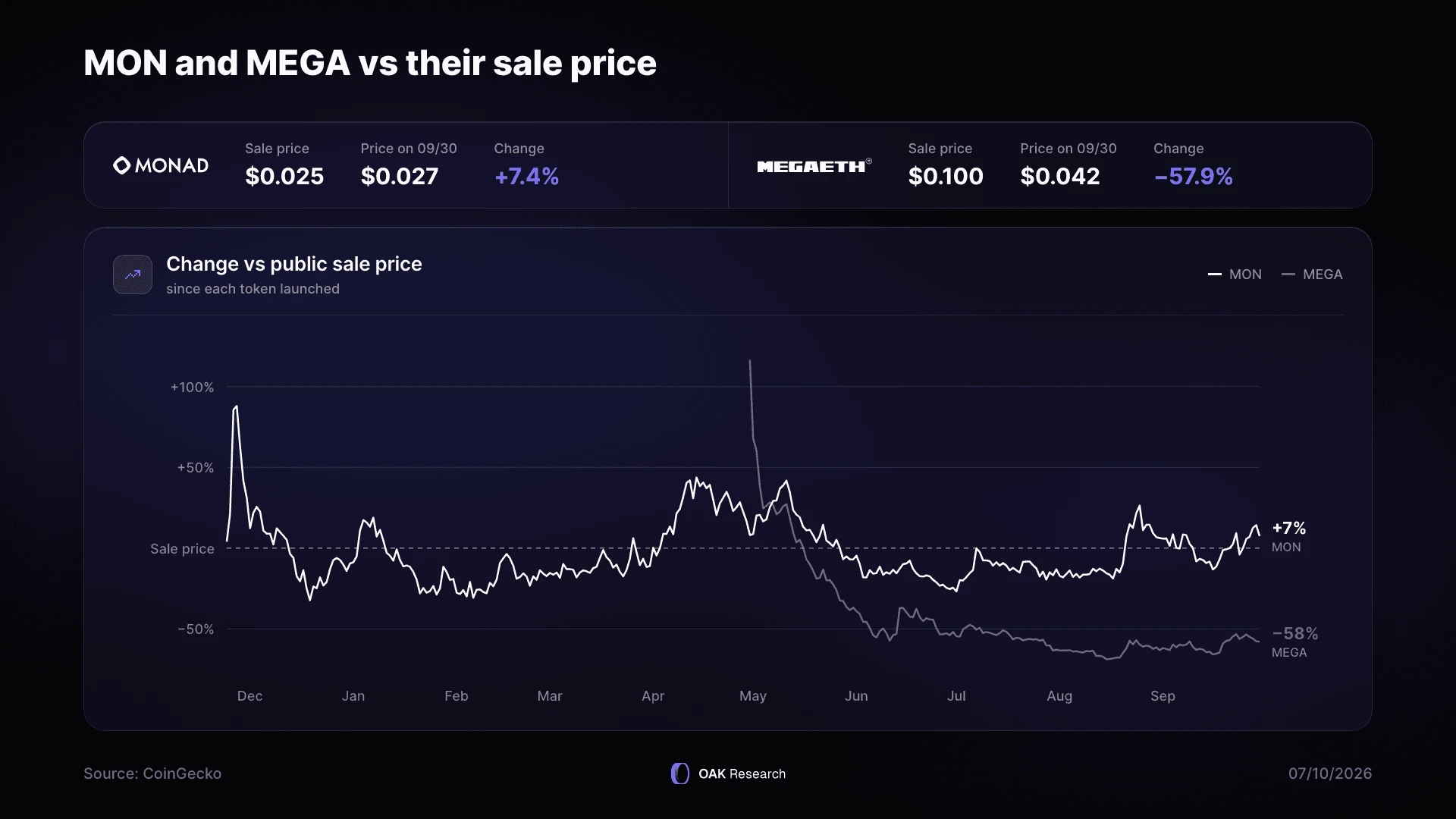
At current levels, both tokens therefore remain largely valued on future demand. At the pace of the past 30 days, the burn destroys the equivalent of around 4.4 million dollars of MON per year, while MEGA buybacks depend directly on the revenue generated by USDm supply.
The market has already sharply revised its expectations for MegaETH. It still, on the other hand, gives Monad the benefit of the doubt, even though its TVL rests partly on incentives and the burned share of gas fees offsets only a fraction of its issuance.
This benefit of the doubt will be put to the test from 24 November 2026. On the mainnet's first anniversary, around 16.6 billion MON, close to half a billion dollars at the current price, will be unlocked.
That is more than the 11.8 billion currently in circulation, a figure that nonetheless excludes the MON unlocked but held by the Monad Foundation. The team alone will receive around 10.7 billion. The rest of the team, investor and Category Labs allocations will then be released gradually through the fourth quarter of 2029.
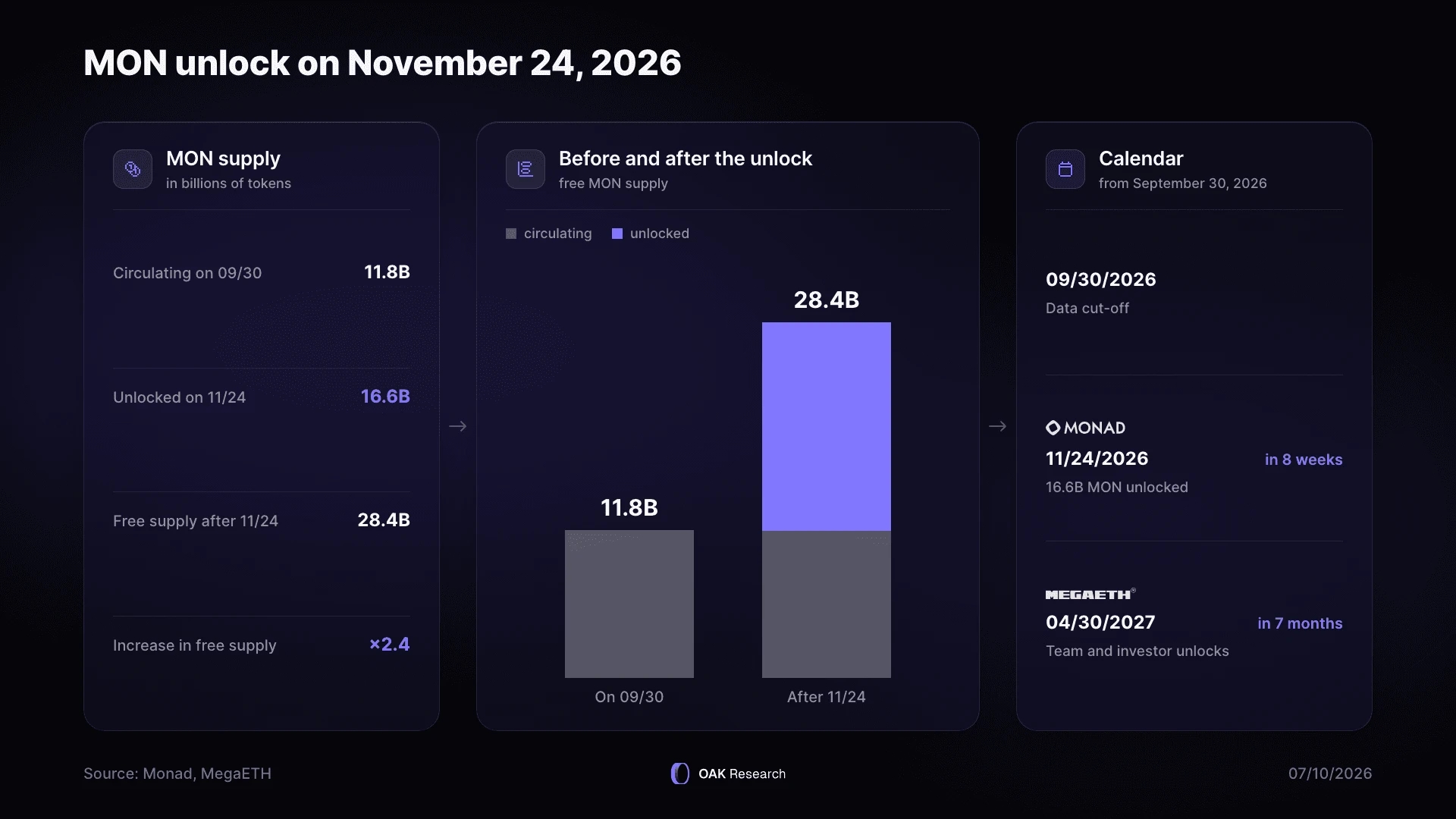
This unlock could also dilute the staking yield: around 15.5 billion MON are currently staked. If the team's 10.7 billion were all delegated, at constant issuance and other stakes, the gross inflationary yield would mechanically fall from around 12 % to 7 %, before validator commission.
At MegaETH, 11.3 % of the supply circulates. The next significant unlocks for the team and the Echo round are not expected before the end of April 2027, a year after the token's launch. Venture funds hold 14.7 % of the supply; the public vesting schedules do not plan any unlock of their allocation before the end of April 2027.
Finally, 53.3 % of the supply is reserved for rewards conditioned on hitting quantified targets. It is the only large allocation whose distribution is explicitly tied to network growth, those of the team, investors and the Echo round follow vesting schedules. The difference comes down mainly to timing, eight weeks for Monad, seven months for MegaETH.
The use cases that genuinely benefit from speed do exist. On Monad, order books concentrate most of the volume; on MegaETH, the first real-time trading applications do exploit its low latency. But this activity remains concentrated in a few applications, while a large part of the capital came looking for yield, notably thanks to incentive campaigns.
MegaETH has already experienced this, when those engines weakened, its TVL contracted. On Monad, it has on the contrary nearly tripled since July in the wake of Aave's launch.
In our view, the opposition between a success and a failure is therefore to be qualified. Both networks still share the same weakness, their economic activity remains far below the capacity built and depends, at least in part, on incentives. On MegaETH, the capital did not withstand it. On Monad, the answer is not yet known.
Value capture also remains to be proven. On Monad, the burn offset only around 9 % of new MON issuance over the past 30 days. On MegaETH, USDm supply, whose revenue feeds the network's economic model and MEGA buybacks, now reaches only 3.5 % of the target set among its KPIs. MegaETH does, however, limit its dilution when growth slows, while MON issuance continues regardless of activity.
The market has already sharply revised its expectations for MegaETH; it still gives more value to Monad's future trajectory, without the growth of its TVL having translated into a net outperformance of MON.
The coming months will provide a cleaner test, the massive MON unlock on 24 November, then the end of the first year of Aave incentives in July 2027; for MegaETH, the first team and investor unlocks from the end of April 2027. That is when we will be better able to distinguish the demand created by speed from the demand bought by incentives.