
How do oracles make money? Pyth Network case study

Pyth Network (PYTH)
Published on

Variational is preparing to launch its $VAR token with a strong promise: around 50% of the supply reserved for the community. Since December 2025, the protocol has been distributing millions of points to its users, without anyone yet knowing what they will actually be worth at launch. Here, we therefore provide an overview of Variational’s strengths, as well as a method to estimate the value of one point, notably by comparing its launch valuation with that of other perp DEXs. Here is our analysis.
Before even talking about the airdrop, we first need to understand why Variational is not just another Hyperliquid clone, but probably one of the most differentiated architectures in the perpetual DEX sector. This is what will justify, later on, not valuing it as a simple follower.
As we have repeatedly argued since our thesis on the “AWS of liquidity,” the real competitive advantage of a protocol like Hyperliquid is neither its interface nor its fees, but its ability to attract and retain liquidity. And on this point, there are two schools of thought. At least since Variational arrived.
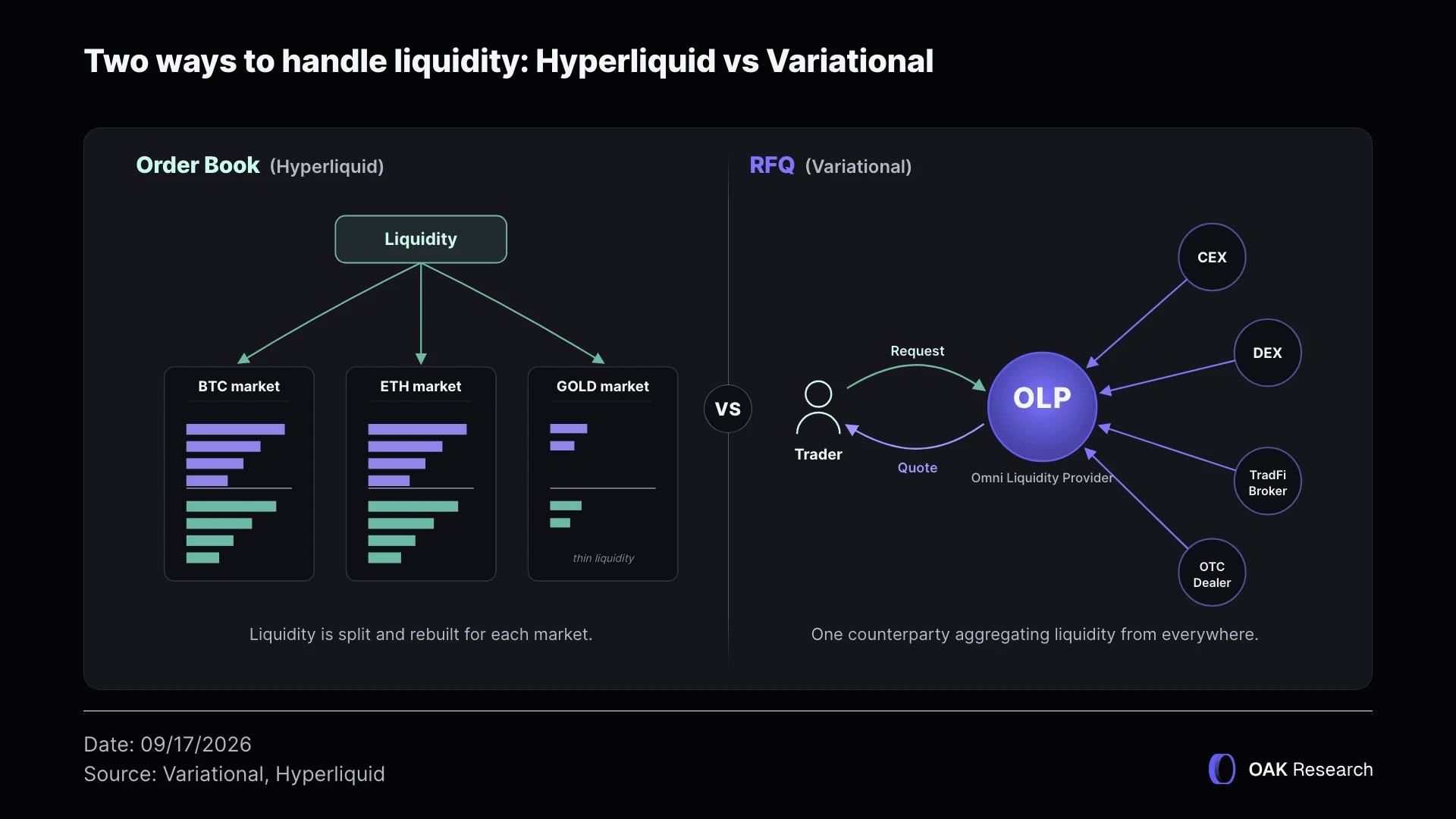
The first is Hyperliquid’s, which relies on a fully on-chain order book. It is a high-performance model that has proven itself in traditional finance and also in on-chain finance. However, we know that it suffers from the “cold start” problem, meaning that each new market theoretically has to rebuild its liquidity from scratch, notably by paying market makers.
Hyperliquid found a workaround by setting up the Hyperliquidity Provider (HLP), a method that worked particularly well to bootstrap initial liquidity. However, many competitors that tried to replicate the same strategy quickly ran into the fact that Open Interest on the platform largely exceeded the liquidity provided by the vault.
The second school is Variational’s, which approaches the problem from the opposite direction. Rather than rebuilding an order book every time, the protocol sources liquidity that already exists elsewhere, on centralized exchanges, DEXs and among TradFi dealers, to aggregate it and route it to its users. As its co-founder Lucas Schuermann summarizes, where order books have to start from scratch, Variational plugs into existing global liquidity.
Concretely, Variational abandons the public order book in favor of an RFQ (Request-for-Quote) model. The difference is important because on a classic order book, dozens of market makers constantly place buy and sell orders, and the trader takes liquidity from this publicly visible book. In an RFQ model, there is no public book: the trader (the taker) asks for a price for the size they want, and a counterparty (the maker) instantly responds with an executable quote, which the trader can accept or reject.
This mechanism, common in traditional finance and OTC markets, has two immediate consequences. First, no trading intent is visible before execution, which protects the trader. Second, execution quality no longer depends on the depth of an order book at a given moment, but on the counterparty’s ability to provide a good price.
In Variational’s case, this counterparty is unique and is called the Omni Liquidity Provider (OLP), a market-making desk operated by the founding team, which stands opposite all traders. This tool provides quotes, executes trades, then hedges its positions across other venues (CEXs, DEXs, TradFi dealers) to remain neutral.
This single-counterparty model allows Variational to maintain full control over its market-making flow. It can maintain tight spreads at all times, without relying on traditional agreements with independent market makers, the famous “retainer deals” that cost other protocols token allocations and subsidies. Variational therefore keeps this surplus for itself, which also allows it to fund highly appreciated features such as loss reimbursements or spread rebates.
This is probably the most important point to understand for the rest of the analysis. Omni charges no fees, neither maker nor taker, exactly like Lighter. But where a classic perp DEX earns revenue by taking a commission on every transaction, Variational earns revenue by capturing the bid-ask spread through the OLP. The trade settles against the internal counterparty, which captures the difference between the buy price and the sell price instead of charging an exchange fee.
The difference is subtle, but still important. Indeed, in a classic model, a large share of the value generated by trading is redirected to external market makers. On Variational, this spread remains within the ecosystem. As a result, the protocol is currently much more profitable per dollar traded than most perp DEXs. This is the real difference in its business model, and it will be crucial when valuing $VAR.
That said, this needs to be nuanced, because this revenue goes through a waterfall before reaching the protocol. According to the reports published by Variational, a significant share of gross revenue, around 43% to 78% depending on the period and around 57% on average, goes toward covering market-making and hedging costs. The rest is split between OLP depositors, the treasury and referral rewards.
This is not a problem in itself, but it is a fairly logical consequence of a zero-fee model. More importantly, this market-making cost should compress as the platform grows, thanks to better VIP tiers on exchanges, increasing internalization of flow and better conditions with hedging counterparties. In other words, the share of revenue actually captured by the protocol should technically increase with scale.
We now arrive at what we see as the strongest argument in the entire thesis, and the one that truly sets Variational apart from the competition. The RFQ model is not only an alternative to the order book; in practice, it is extremely efficient for one very specific asset category: RWAs, meaning tokenized stocks, indices, commodities and forex.
However, this advantage should not be overinterpreted. The common assumption would be that an order book is poorly suited to RWAs, but the facts contradict this. HIP-3 markets, and especially tradeXYZ, deployed on Hyperliquid’s order book, overwhelmingly dominate the category, with more than $300 billion in cumulative volume and the vast majority of on-chain RWA open interest. A CLOB therefore handles RWAs perfectly well, including continuous weekend trading, a slot where tradeXYZ is precisely the leader and where Variational’s Swaps remain closed for now due to the lack of available TradFi dealers.
The advantage of RFQ therefore lies elsewhere, on a narrower but more profitable field. On RWA pairs, no on-chain market is truly liquid enough for a classic funding rate to reflect the real cost of holding the asset, rather than the simple positioning imbalance of traders. This is precisely the problem solved by the Swap.
Variational reached an important milestone on September 1, 2026, by launching its first Swap markets on gold, the Nasdaq 100 and the S&P 500. The Swap keeps exactly the same exposure as a perp, but replaces variable funding with a stable carry of around 4.5%, benchmarked to dollar borrowing rates. It is, in effect, the on-chain equivalent of a total return swap or CFD, instruments that had until now been reserved for institutions.
To achieve this, the OLP sources liquidity directly from traditional finance dealers. And this is where RFQ becomes a real moat: this direct bridge to TradFi liquidity is simply impossible to replicate on an order book. As a result, for large orders, Variational offers the cheapest execution on the market. A $1 million order costs several times less than on a competing order book, and the gap widens as size increases. Conversely, for small orders, an order book often remains competitive, which clearly defines each model’s playing field.
The long-term thesis follows directly from this observation, and it is not the one we read everywhere. The question is not whether Variational can “dethrone” Hyperliquid on RWAs. From an infrastructure standpoint, Hyperliquid remains impossible to dethrone, and Variational actually sees it more as a source of liquidity than as a competitor, to the point where it routes part of its own flow there.
Variational’s real playing field is the segment of large institutional orders on commodities, indices and soon stocks, during market hours. A trader placing $5,000 on gold will never notice the difference, but an institutional actor placing $3 million will. And this is precisely the most profitable and stable segment of the RWA market that Variational is targeting, where tradeXYZ had so far been dominant almost by default, for lack of a serious competitor.
Two models, two playing fields, and more complementarity than direct competition. We dedicated a detailed analysis to Swaps on our Alpha Feed, for those who want to dig deeper.
Beyond this architecture, Variational stacks several advantages for users. First, zero fees, made sustainable by spread capture. Then confidentiality: the absence of a public order book means that no intent is visible before execution, protecting traders from front-running, a major argument for large wallets and professional desks.
Finally, there is an original loss rebate mechanism, which gives every losing position a chance to be fully reimbursed in USDC, funded by the protocol’s market-making revenue. More than $4 million has already been redistributed this way.
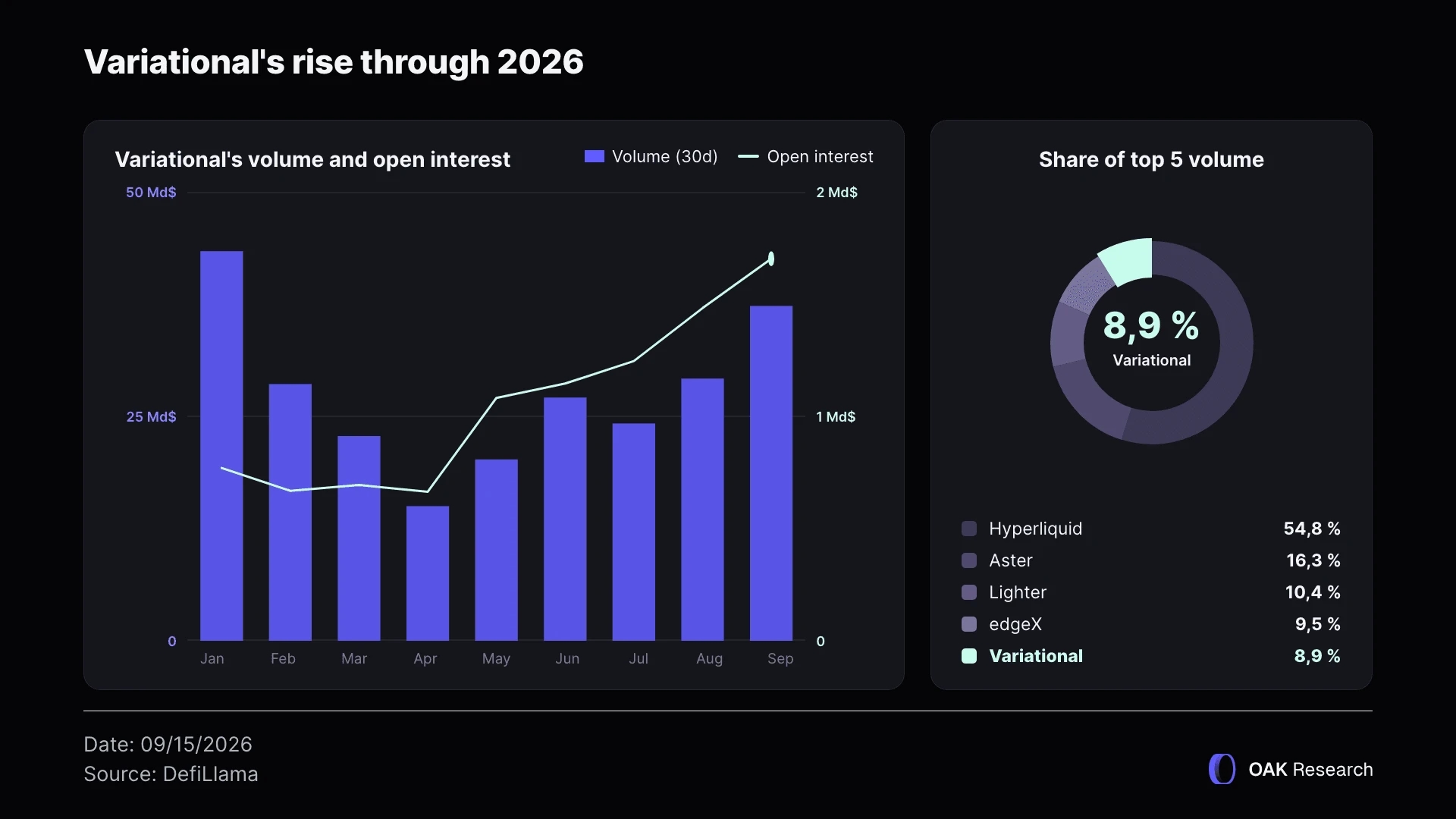
All of this would be anecdotal if Variational remained a small competitor. That is not the case. The protocol now handles tens of billions of dollars in trading volume each month and is already among the top five DEX protocols on the market. It’s also important to note that a large portion of this traction was built even before the general public had free access to it, when the DEX was in private beta.
Its credibility is also strengthened by its funding rounds. Where Hyperliquid developed without raising external capital, Variational has instead attracted top-tier investors, with around $61.8 million raised in total. The largest round, a $50 million Series A led by Dragonfly in May 2026, with Bain Capital Crypto and Coinbase Ventures, took place while the product was already operating in real conditions.
This is therefore not a bet on a promise, but a vote of confidence in existing traction. We should also add that the founding team, coming from Genesis and institutional OTC trading, has exactly the profile needed to operate a credible market-making desk.
We are not presenting Variational as a “Hyperliquid killer” (you already know our view on the latter), and it would be dishonest to ignore its gray areas. The RFQ model involves a single counterparty, the OLP, operated by the team: this is a point of centralization and opacity that a public and verifiable order book does not have. Price quality depends on the oracle and the aggregated external liquidity, and part of the model still has to prove itself once the protocol opens to the public.
But as things stand, Variational appears to us to be the first project to offer a truly differentiated alternative to Hyperliquid, rather than yet another copy.
This is also why Variational has been one of the most obvious perp DEXs to farm in our view for months, a point we have regularly highlighted on our Alpha Feed. Now comes the question that really matters to those who farmed it: how much will one point actually be worth on launch day?
To estimate the value of one point on Variational, we first need to answer a slightly more complicated question: what FDV could it have at launch? The main advantage for us is that, unlike our late-2024 analysis of HYPE, we already have a benchmark available. The perp DEX sector is now well established, with several comparable examples, allowing us to arrive at three different readings that we will present below.
Let’s start by placing Variational among its competitors. DefiLlama data, as of September 15, 2026, gives the following table. Hyperliquid is still far ahead with around $229 billion in 30-day volume, followed by Aster ($68 billion), Lighter ($43 billion), edgeX ($39 billion) and finally Variational ($37 billion).
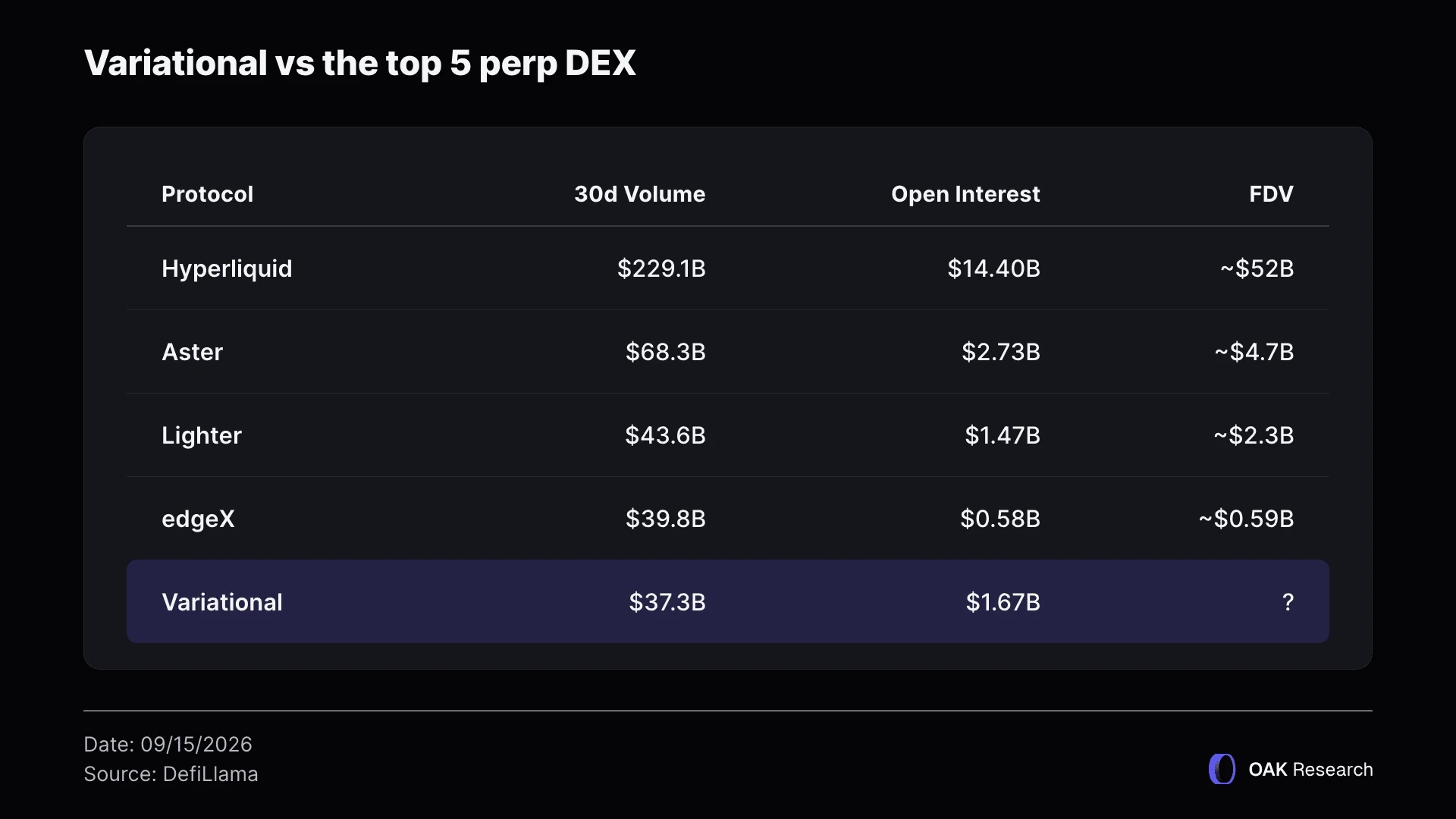
On volume, Variational therefore generates around 85% of Lighter’s volume and 55% of Aster’s. But if we look at the indicator that is hardest to manipulate, namely open interest, the conclusion flips: Variational does better than Lighter ($1.67 billion versus $1.47 billion), is far ahead of edgeX and is even approaching Aster. In other words, despite lower volume, Variational carries more open positions than Lighter, which nevertheless trades above $2 billion FDV.
This detail matters. High open interest relative to volume suggests a user base that actually holds positions, rather than simple wash trading aimed at farming points. DefiLlama data confirms this reading: Variational turns over its open interest around 1.3 times per day, a pace close to Hyperliquid’s and far above more static competitors. This is the sign of relatively healthy flow, even though it may partly result from a particularly lucrative points-farming strategy.
Now let’s move to the calculation. Since open interest is our most reliable indicator, let’s anchor the valuation to it. Variational has 1.13 times Lighter’s open interest and 0.61 times Aster’s. Applying these same ratios to the FDVs of those two comparables gives a fairly tight range: around $2.6 billion using Lighter’s multiple, and around $2.8 billion using Aster’s. The fundamental benchmark therefore points to a $2.6 billion to $2.8 billion zone.
We could be tempted to apply the same reasoning to Hyperliquid, which would imply around $6 billion FDV. However, we prefer to exclude this comparison for a simple reason. Hyperliquid is no longer just a perp DEX, as we have often repeated: it is a complete ecosystem, with its blockchain, its own order book, its spot market, its lending, its tokenization, its regulatory lobbying team and nearly $700 million in annualized revenue. This ecosystem premium simply cannot be attributed to Variational today.
The benchmark therefore suggests around $2.6 billion to $2.8 billion. But there is a second way to estimate Variational’s potential valuation, and that is simply prediction markets. On Polymarket, a dedicated market allows users to bet on $VAR’s FDV one day after launch, with more than $2.4 million in volume traded. As of September 14, 2026, here is what the market is pricing.
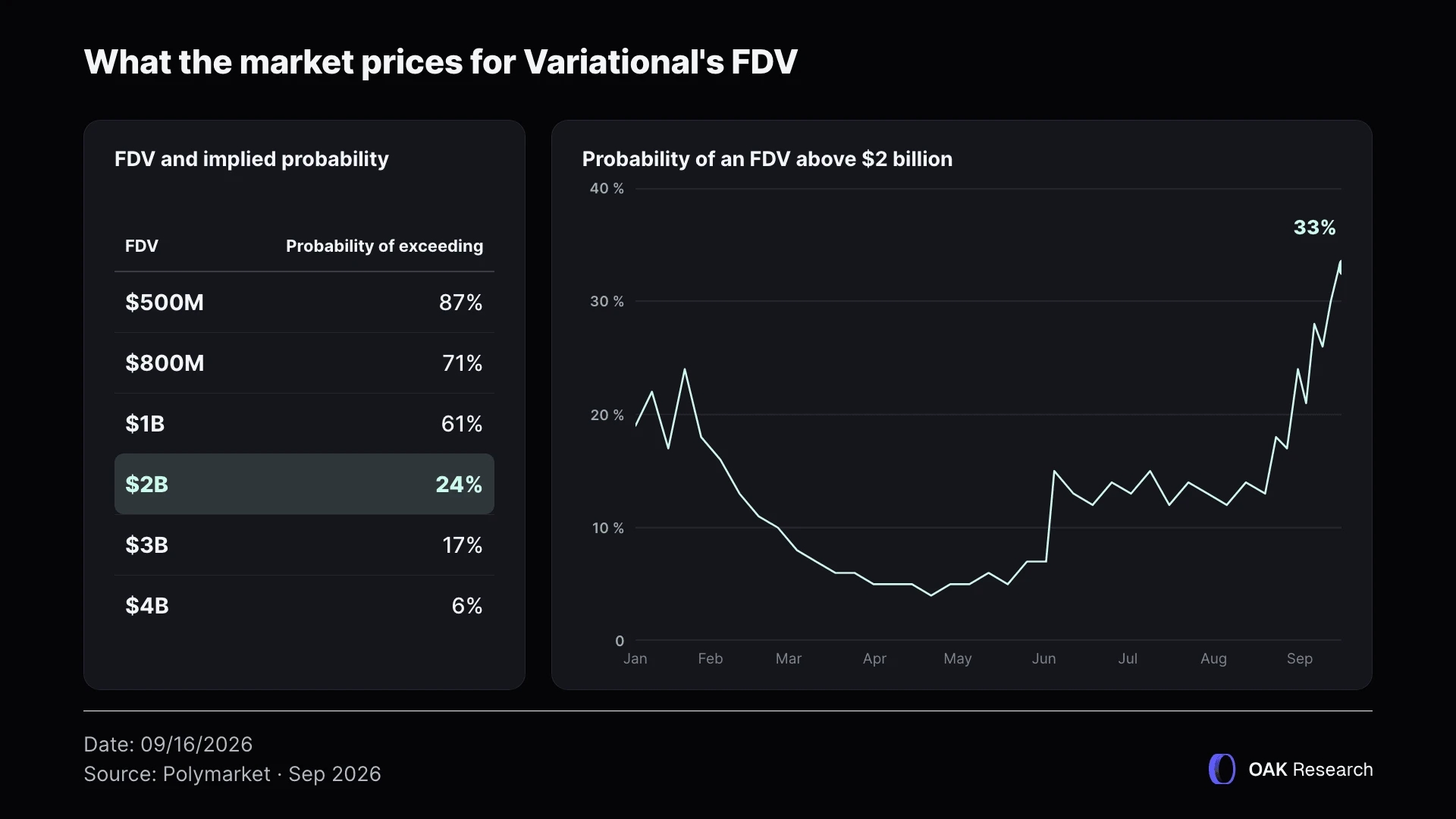
The reading is clear. The market considers an FDV above $1 billion to be slightly favored (61%), but an FDV of $2 billion is already clearly unlikely (only 24%), and a $3 billion level, despite being close to the fundamental benchmark, only gets a 17% probability. The market’s implicit median therefore sits around $1 billion to $1.3 billion, around two to three times lower than what the comparables suggest.
We therefore have two ideas that diverge somewhat: a fundamental benchmark around $2.6 billion to $2.8 billion, and a market that is pricing more around $1 billion to $1.3 billion. This gap is not necessarily a contradiction, because it corresponds to the discount the market applies to Variational, and we need to understand why.
The first reason is mercenary capital. Since the token is not live yet and the airdrop has been clearly announced, part of the current volume and open interest only exists to farm points. It is difficult to estimate what proportion this represents, but it is certain that these metrics will decline after the TGE. The market therefore refuses to value Variational based on numbers it currently considers inflated.
This is where Swaps become so important. They are a product with real use value, meaning that if they are truly differentiated, users will continue using them even after points have been distributed. In other words, post-TGE retention could be better than the market expects, with slightly less leakage than on a classic perps product.
Over the longer term, this segment of large RWA orders, the most profitable part of the market and until now held by tradeXYZ for lack of a serious competitor, represents a revenue growth vector that depends neither on farming nor on crypto volume.
The second reason is uncertainty around the value-capture mechanism. Once presented as a firm commitment to buyback and burn 30% of revenue, this mechanism is in reality worded much more flexibly in the current documentation, at the discretion of the Foundation. The direct economic link between protocol activity and the token is therefore less guaranteed than it may appear.
The third reason, finally, is structural. FDV is not market capitalization, and at launch, a low circulating supply can perfectly coexist with a high FDV, which discourages aggressive upside bets and weighs on Polymarket odds.
Our reading is therefore as follows. Based on its fundamentals, Variational deserves to be valued around $2.6 billion to $2.8 billion, in the Lighter and Aster range, and we also think Polymarket is probably a bit too conservative. But the market is pricing the uncertainty discount, and that discount is legitimate as long as the token is not live and activity has not proven itself in public conditions.
The truth probably lies somewhere between the two. For the rest of our calculation, we will therefore use a wide range of $1 billion to $3 billion, with the most defensible central zone around $1.5 billion to $2.5 billion, meaning the fundamental benchmark slightly reduced by an uncertainty discount.
Once the FDV is framed, the value of one point is calculated simply, using the following formula: “value of one point ≈ (FDV × % of supply distributed to points) / total number of points”. We therefore still need to estimate two variables: the number of points, and the share of $VAR that will actually be allocated to them.
The program started on December 17, 2025, with a retroactive distribution of 3 million points, rewarding previous activity. Since then, 150,000 points have been distributed every week, and the program is expected to end no later than the end of Q3 2026, meaning September 30.
By adding the initial distribution and the weekly distributions up to that deadline, we arrive at around 9.15 million points for the main program. On top of that, Variational launched an additional campaign on August 12, 2026, the On-Chain Trader Rewards, distributing up to 150,000 additional points to 10,000 wallets, not including referral points and tier bonuses.
We will therefore use a working assumption of 9.3 million points, meaning the main program plus the additional distributions. The final number may vary slightly depending on the last few weeks and any last-minute campaigns, but this base is much more defensible than the rounded “10 million” often seen elsewhere.
This metric is the big unknown in the equation. Variational officially states that around 50% of the supply will go to the community, but this does not mean that 50% will be automatically distributed in the airdrop. In fact, the documentation clearly states that this community allocation will be distributed over time through different initiatives.
The current points season therefore represents only part of this 50%, while the rest should be used to fund future seasons, incentives, the OLP vault and other programs that have not yet been specified. To date, no precise allocation to Omni Points has been announced, nor any points-to-$VAR conversion ratio, nor any percentage distributed at TGE.
We will therefore work with a range, as we did for valuation. Recent airdrops have distributed very different shares of their supply at launch: dYdX 7.5%, Arbitrum 11.6%, Jupiter 13.5%, Lighter around 25%, and Hyperliquid around 31%. Given the 50% community cap spread over time, an allocation of 15% to 30% to this first season seems to us like a reasonable central scenario, without being something we can present as an established fact.
By crossing our two variables, we obtain the theoretical value of one Omni Point depending on the FDV and allocation used. As a reminder, we are working here with 9.3 million points distributed in total, an FDV ranging from $500 million to $5 billion, and an allocation of 15% to 30% of the supply for the airdrop.
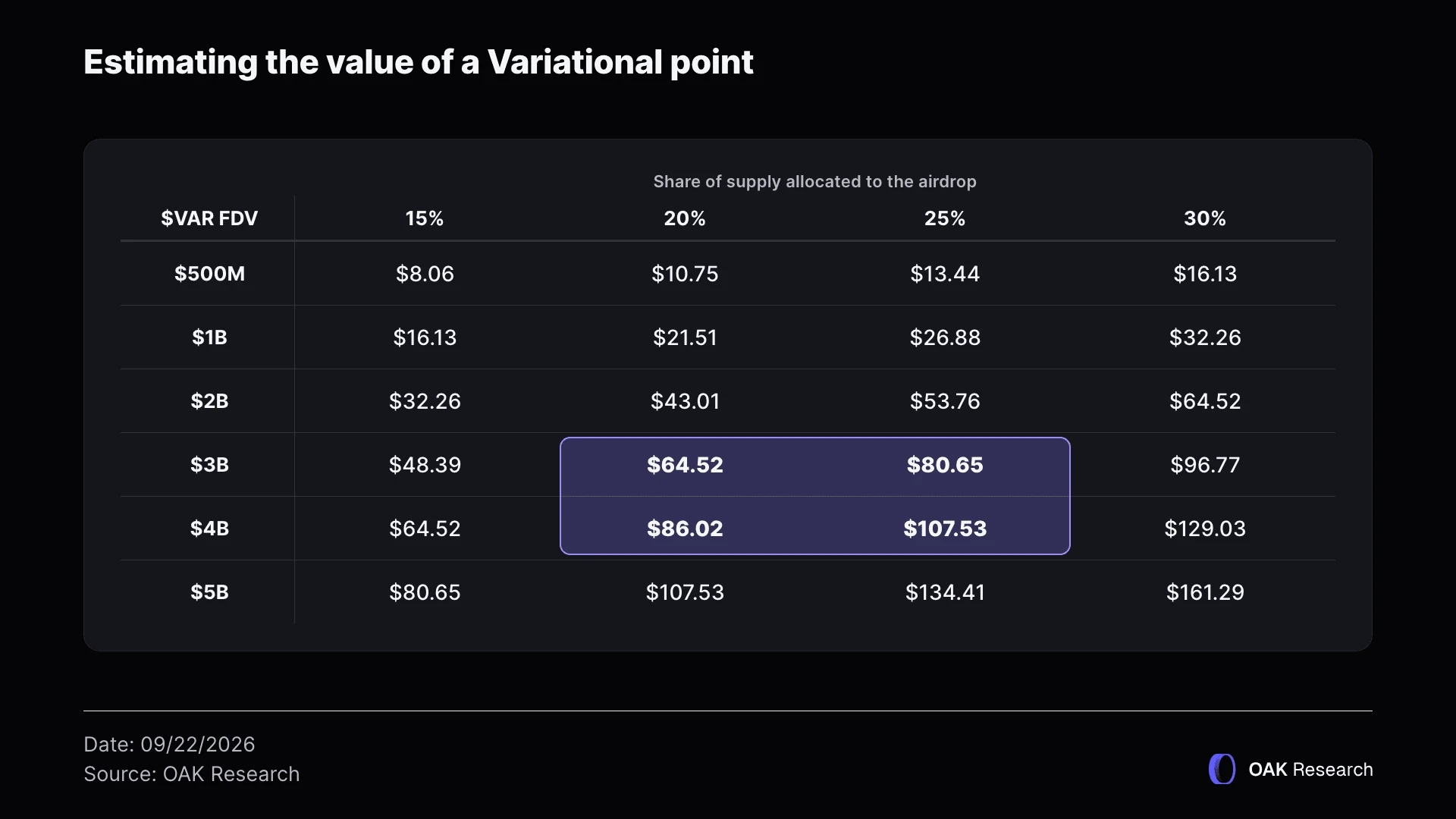
The highlighted square corresponds to the zone we currently consider the most credible. It combines an FDV of $3 billion to $4 billion with an allocation between 20% and 25% of the supply. This would therefore imply an estimated point value between $64.52 and $107.53. Note that Polymarket’s conservative scenario at $1 billion and 25% would bring this figure down to around $27, while the most aggressive scenario, at the high end of the fundamental benchmark, could push it beyond $130.
However, considering that the perp DEX sector is particularly in trend right now, that it is extremely lucrative, that Variational is in our view the only “interesting” competitor to Hyperliquid, and finally that the market is starting to regain strength and could enter a new phase of the bull cycle that would coincide with the $VAR TGE, we believe Variational’s FDV could quickly exceed $5 billion and reasonably reach $8 billion to $10 billion if everything aligns properly.
At the end of this analysis, our conviction is that Variational is not just another speculative project, but one of the few perp DEXs offering a truly differentiated architecture. It is already playing in the same league as Lighter and Aster, carries more open interest than the former, has a more profitable business model per dollar traded, and with Swaps holds a product tailored to the most profitable segment of the RWA market. On this basis, the fundamental benchmark points to an FDV of around $2.6 billion to $2.8 billion, and we believe Polymarket, around $1 billion, is currently too cautious.
This reading must nevertheless be weighed against the factors that could push the valuation in one direction or the other. On the premium side, the profitability of the RFQ model should increase as market-making costs compress, RWA expansion through Swaps opens up a huge market that is still barely exploited, and upcoming roadmap catalysts, such as the trading API or Variational Pro, are still ahead. On top of that, the project has a top-tier investor base that few competitors can claim.
On the discount side, the main risk remains mercenary capital and the almost certain decline in volume after the TGE, a pattern observed across all major perp DEX airdrops. Competition is also fierce, with Lighter and Aster already having their tokens, and tradeXYZ still dominating continuous RWA trading, especially on weekends. Finally, the value-capture mechanism remains unclear and does not currently guarantee a strong economic link between activity and $VAR.
On top of these elements, several major unknowns could by themselves completely change the calculation: the final number of points at the snapshot, the exact percentage reserved for Omni Points, circulating supply at TGE, the vesting schedule for the remaining 50% allocated to the team and investors, and of course the launch date itself. As a reminder, simply moving the allocation from 30% to 10% mechanically divides the value of one point by three.
Putting all these pieces together, the zone we consider most credible combines an FDV of $3 billion to $4 billion with an allocation of 20% to 25%, or around $65 to $108 per point. A conservative scenario aligned with Polymarket would bring this figure down to around $27, but we would be rather surprised if Variational launched that low. Conversely, if the perp DEX sector remains this strong and the TGE takes place in the middle of a market rebound, an FDV above $5 billion, or even approaching $8 billion to $10 billion, would not be absurd.
Ultimately, the $VAR airdrop will be a real-world test of the question haunting all perpetual DEXs in 2026: what share of displayed activity is truly organic, and what share is just farming that will disappear on launch day? The answer will determine which side of our range reality lands on. But if Variational retains even a fraction of its activity once public, the current gap between its fundamentals and what the market is pricing could well represent a significant opportunity.
This analysis reflects only our opinion at the time of writing and is shared for informational purposes. It does not constitute investment advice in any way. An FDV is not a guaranteed price, the market remains extremely volatile, and our scenario can be invalidated at any time. Everyone should conduct their own research and only invest what they are prepared to lose.