Why on-chain options never took off? Anatomy of five generations of failure
Published on

Options are the largest derivatives market in the world in traditional finance, yet they account for just 0.2% of on-chain perp volume. Since 2019, around thirty protocols have tried to bring options on-chain, and almost all of them have failed. A look back at five generations of failure, from Opyn to Ribbon's vaults, and at what finally seems to be changing.
Preamble
In 2025, global listed derivatives markets traded 88.65 billion options contracts, against 30.64 billion futures contracts. In other words, in traditional finance, the beating heart of derivatives markets is not the futures contract, it is the option.
In crypto, the opposite is true. Perps dominate everything, with roughly 7.9 trillion dollars traded on decentralized venues in 2025. On-chain options account for just 0.2% of that volume, or a few billion dollars of notional per month. The picture is somewhat less lopsided on the centralized side of crypto, where Deribit alone handled close to 1.9 trillion dollars of volume in 2025.
The conclusion comes quickly. Options are the most widely used instruments in finance, centralized exchanges like Deribit have captured a large share of the demand, and on-chain finance is lagging far behind. Put that way, you might assume no protocol has ever seriously tried to bring options on-chain. The reality is exactly the opposite.
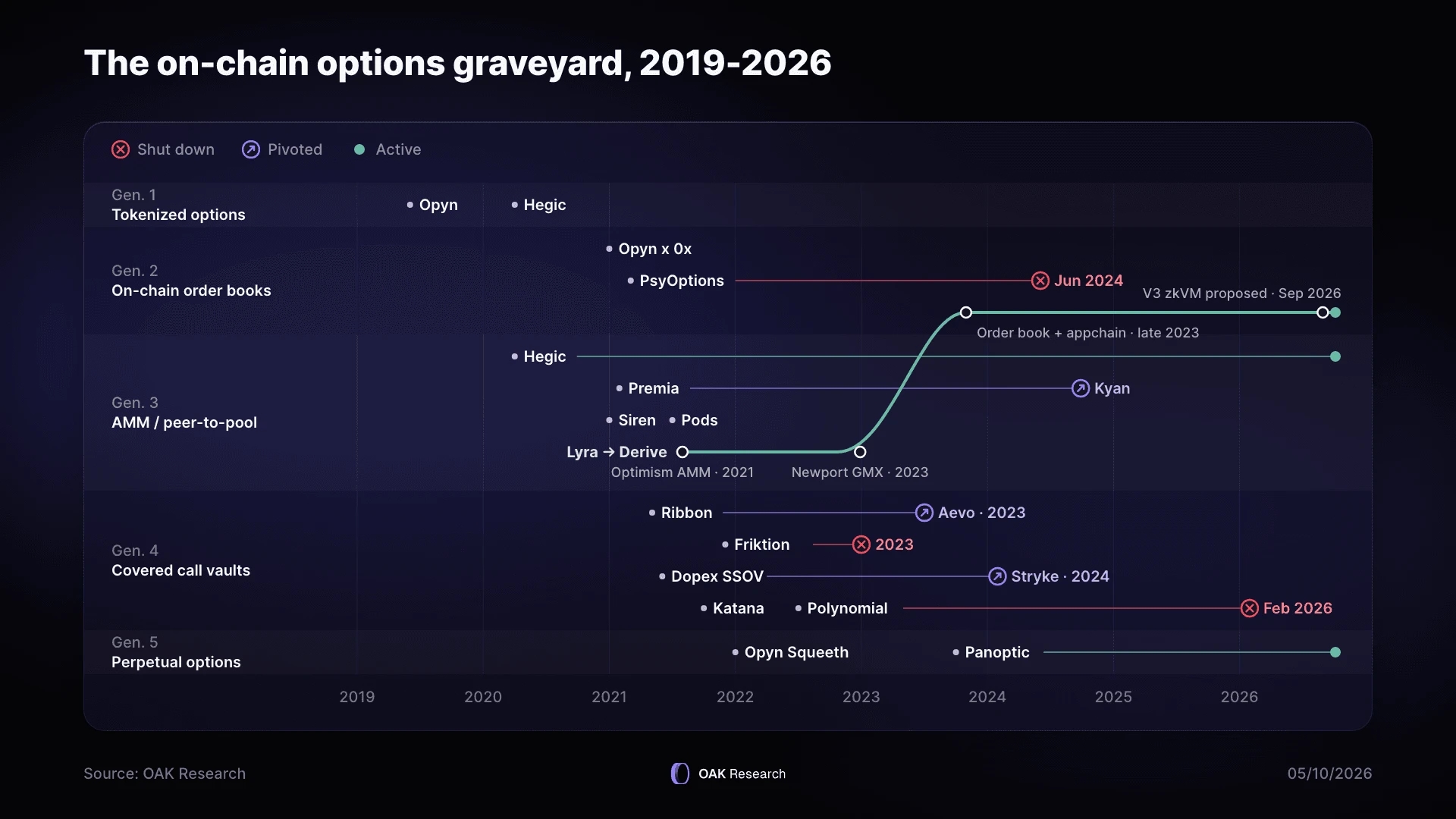
Since 2019, around thirty protocols have taken on the problem. Opyn tokenized options. Hegic put a pool on the other side of buyers. Lyra built an AMM with automated hedging. Ribbon, Friktion and Dopex industrialized volatility selling inside vaults and attracted hundreds of millions of dollars in deposits within months. Panoptic removed expiry altogether. PsyOptions built an order book on Solana. Almost all of them have shut down, pivoted, or are barely hanging on.
Meanwhile, perp DEXs went from a handful of experiments to one of the largest segments in crypto, now led by names like Hyperliquid and Lighter. And more tellingly still, Coinbase acquired Deribit for 2.9 billion dollars, the largest acquisition in crypto history, precisely because the options market has enormous room to grow.
So there is an anomaly here, and understanding why it exists is essential to properly assess what is happening today. Because since 2024, one protocol has concentrated the bulk of on-chain options volume, and the charts are finally starting to look like something. This article is not about that protocol. It is about the five generations that failed before it, and what each failure taught the sector.
Become Premium
Unlock all our research and get the right insights, at the right time.
A quick refresher on options
In case you are not familiar with options, a short refresher is in order. The best analogy remains insurance. In short, you pay a premium to your insurer (an amount every month) and in exchange you receive a right, the right to be compensated if something goes wrong.
An option works in exactly the same way. The buyer pays a premium and obtains the right, but never the obligation (that is a different mechanism), to buy or sell an asset at a price fixed in advance, up to a given date. That fixed price is called the strike, and that date is called the expiry.
With that said, there are only two forms of options. A call gives the right to buy, so you use it when you expect the asset to rise. A put gives the right to sell, so you use it to speculate on a decline or to protect an existing position. In both cases, you have to buy the option in order to gain exposure to the right it provides.
Let us take an example that we will keep throughout this article. Bitcoin trades at 100,000 dollars and you buy a call with a 110,000 dollar strike expiring in 30 days, for a premium of 1,800 dollars (i.e. you believe bitcoin will rise above 110,000 dollars within 30 days, so you put 1,800 dollars behind that view). If BTC settles at 125,000 dollars, your option is worth 15,000 dollars and you have multiplied your stake by eight. If it settles below 110,000 dollars, the option expires worthless and you lose 1,800 dollars, nothing more.
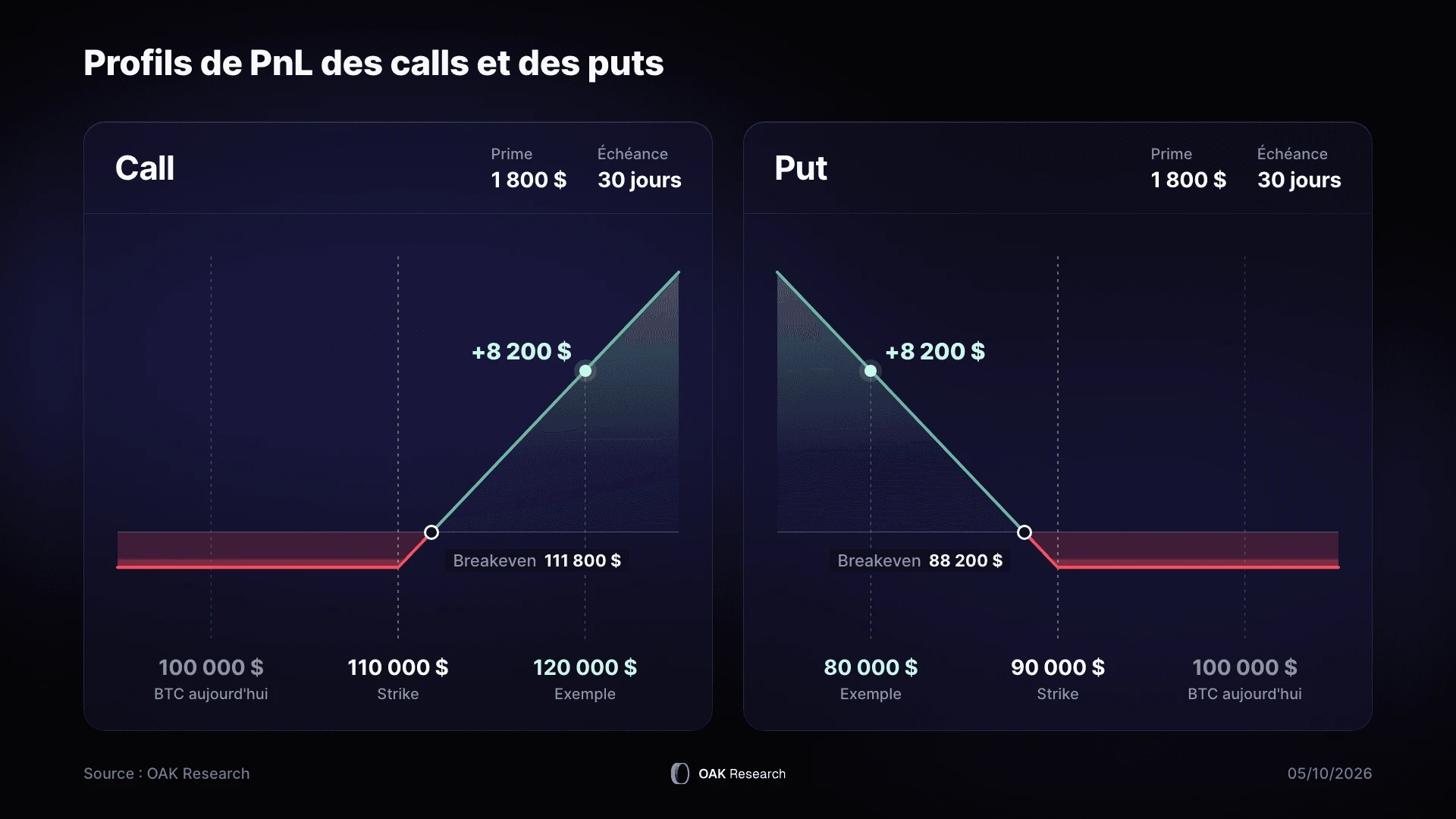
That is the entire appeal of options. You get convex exposure (rather than the linear exposure of spot or perps, where every dollar BTC gains translates into the same gain on your position), with strictly capped downside and no liquidation risk.
That apparent symmetry hides a major asymmetry, however, and it is critical to keep it in mind for what follows. Only the buyer decides whether to exercise. The buyer therefore knows the maximum loss from the moment the position is opened, since it is the premium. The seller, on the other hand, collects a known and capped amount while carrying a potentially far larger risk.
In our example, the seller of the call received 1,800 dollars and loses 15,000 dollars if BTC rises to 125,000. Selling options means winning small and often, then losing big and rarely. It is a profession in its own right, and we will see that several protocols learned this the hard way by handing that role to anonymous liquidity providers.
One last point, and it is the most important one technically. Pricing an option requires five inputs: the price of the underlying, the strike, the time remaining, interest rates and volatility. The first four are observable by everyone. The fifth is not. Implied volatility is the market's expectation of how large future moves will be, and it is what buyers and sellers are really trading.
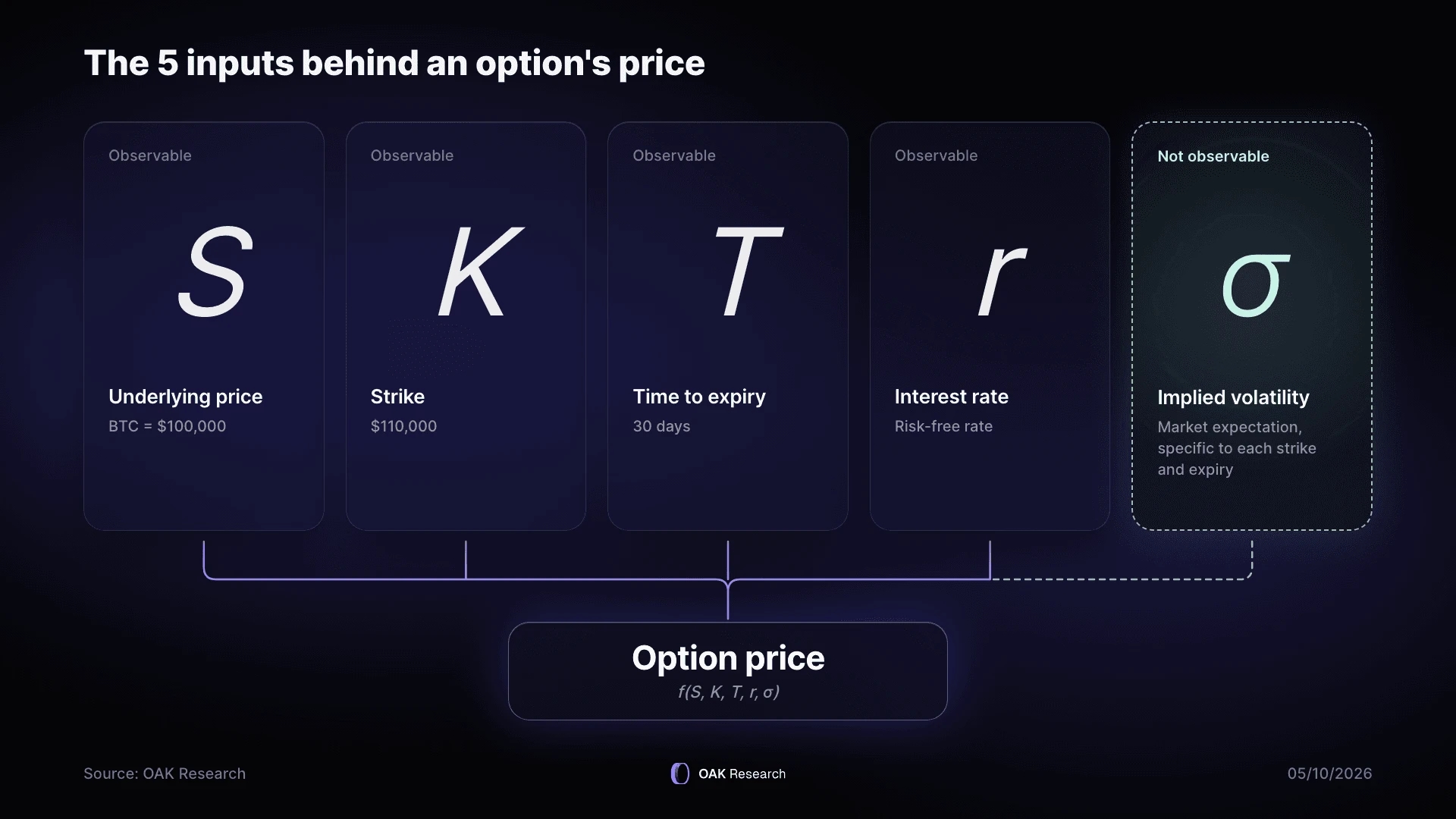
An options venue therefore needs more than a price oracle, unlike a spot DEX or a perp venue. It needs an estimate of volatility, which differs for every strike and every expiry. This is what is known as the volatility surface, and managing it is the core of the business.
Finally, there is time, which works systematically against the buyer. An option loses value with every passing day, a phenomenon measured by theta. You can be right on direction, watch the market rally, and still lose because it rallied too late or not far enough (for instance, if bitcoin settles at 109,999 dollars in our example). This possibility of being right and losing anyway is the first obstacle to mainstream adoption, and we will come back to it in detail.
That is enough for the rest of this article. If you want to go deeper into the greeks, directional and non-directional strategies such as straddles and strangles, or an overview of today's protocols, we covered all of it in our analysis published in March.
Loading post...
Why an option is far harder to bring on-chain than a perp
Before looking at each protocol that tried on-chain options, it is worth understanding the constraints they all ran into. Note upfront that none of this is specific to blockchains. These are the same constraints that exist in traditional finance, where they were solved over decades of infrastructure, clearing houses and specialized market makers. The difference on-chain is that they all arrived at once.
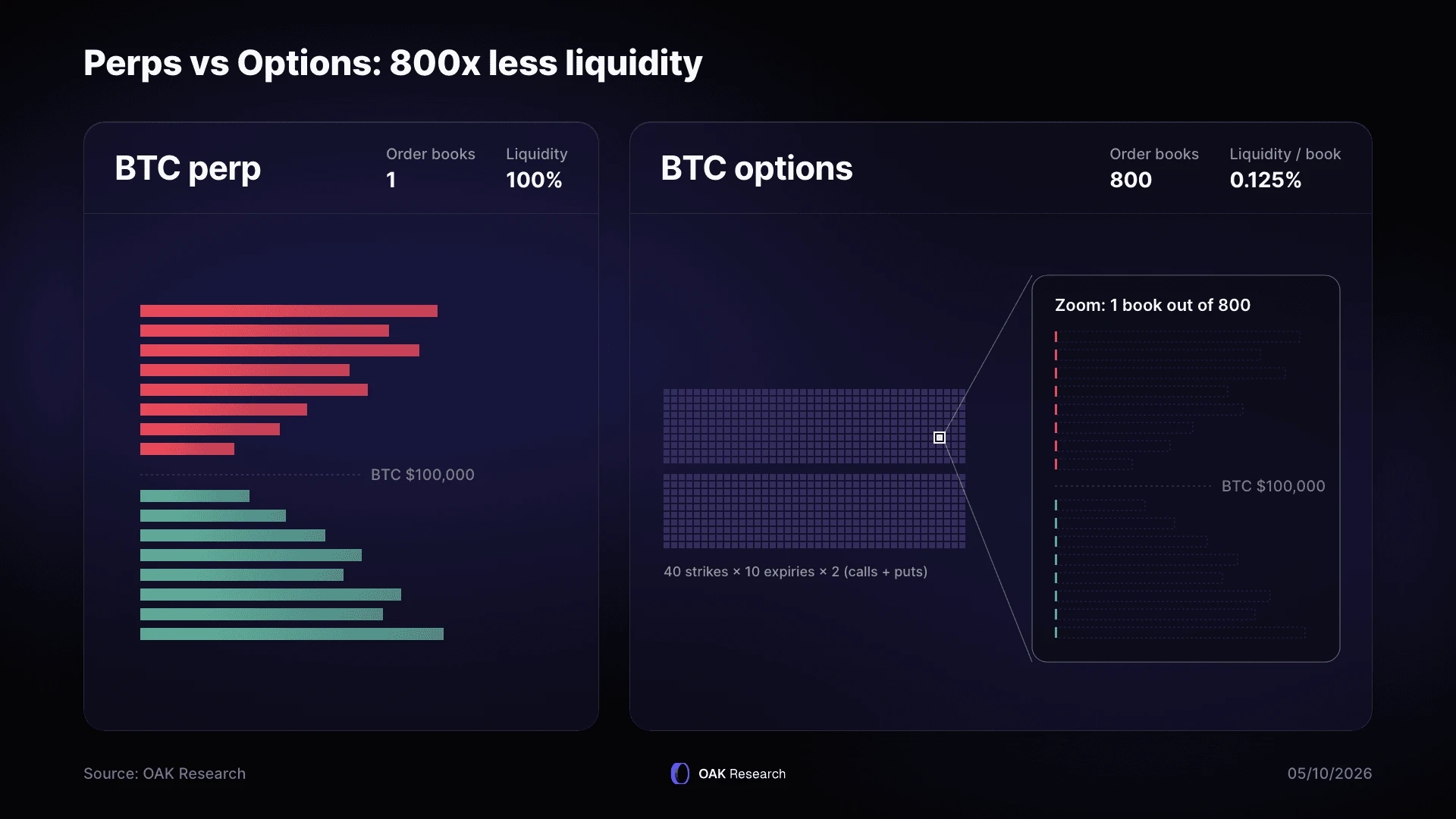
First, liquidity gets divided by several hundred. A BTC/USDC perp is a single market. Liquidity, long and short orders and market makers all gather in one order book. A BTC options market, by contrast, is a matrix. There are dozens of expiries (daily, weekly, monthly and quarterly) multiplied by roughly forty strikes, the whole thing multiplied by two since you need both calls and puts.
In other words, the same liquidity that would make a perp market deep would spread into 800 paper-thin options books. You can see why an options DEX cannot start with a handful of liquidity providers alone: it needs someone quoting the entire matrix, continuously.
This is a close cousin of the problem prediction markets face today. We compared their mechanics with options in our article on HIP-4, and went through their core liquidity problem in our full breakdown of how they work.
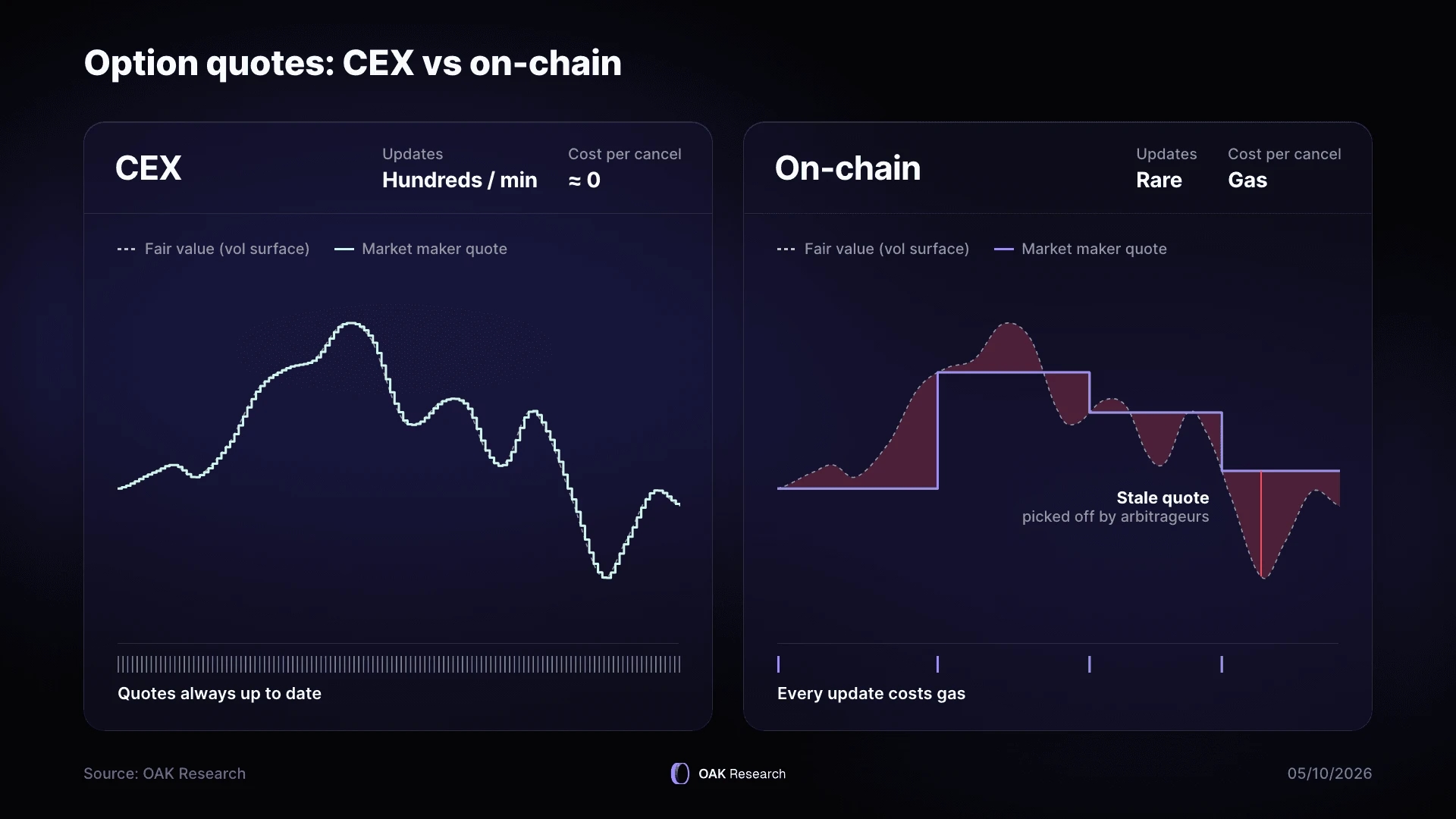
Second, you have to price a variable nobody observes. A perp only needs a spot price, which any oracle can provide. An option needs an implied volatility per strike and per expiry (the surface we mentioned earlier), which has to be repriced on every market move.
A professional market maker therefore recalculates and replaces quotes continuously, hundreds of times per minute. On a blockchain, every order cancellation costs gas, which makes the model economically impossible without dedicated infrastructure. And a pricing error in one part of the market does not simply translate into a worse PnL for traders, as it would on perps. It creates a dislocation that the most sophisticated traders will spot and exploit immediately.
Third, the seller cannot hedge easily. When a market maker quotes a perp, taking the opposite side of the trader is enough to neutralize the exposure. With an option it is far more complicated, because that exposure keeps changing. The higher BTC goes, the more the call they sold behaves like actual bitcoin, and the more bitcoin they have to buy back to stay neutral. Sell 1,000 calls near the strike and let the market move 3%, and they may have to buy back several hundred bitcoin into a market that is already rallying.
There is worse. The market maker also remains exposed to moves in volatility itself, and that risk cannot be hedged with spot or perps, only with other options. In practice, an on-chain options market maker has to hedge elsewhere, and mostly on Deribit. This is also why options always arrive after futures in the history of any market: without a deep and liquid underlying to hedge into, spreads stay wide and nobody comes to quote. Which is good news today, given how mature the on-chain perp market has become.
Fourth, selling an option ties up a considerable amount of capital. This is probably the most binding constraint of all. Take our 110,000 dollar BTC call expiring in 30 days. As a trader, you buy it for 1,800 dollars. But on the other side, someone sells it to you and collects that premium. That counterparty takes on an asymmetric commitment, because if BTC settles at 125,000 dollars they will owe you 15,000 dollars, and far more if the market runs.
The venue therefore has to make sure they can pay, and for that it requires them to lock up collateral upfront. In the first on-chain options protocols, the rule was severe: the seller had to post the full amount they might have to deliver, meaning an entire bitcoin. They locked 100,000 dollars to collect 1,800 dollars, which works out to roughly 1.8% of return over the month.
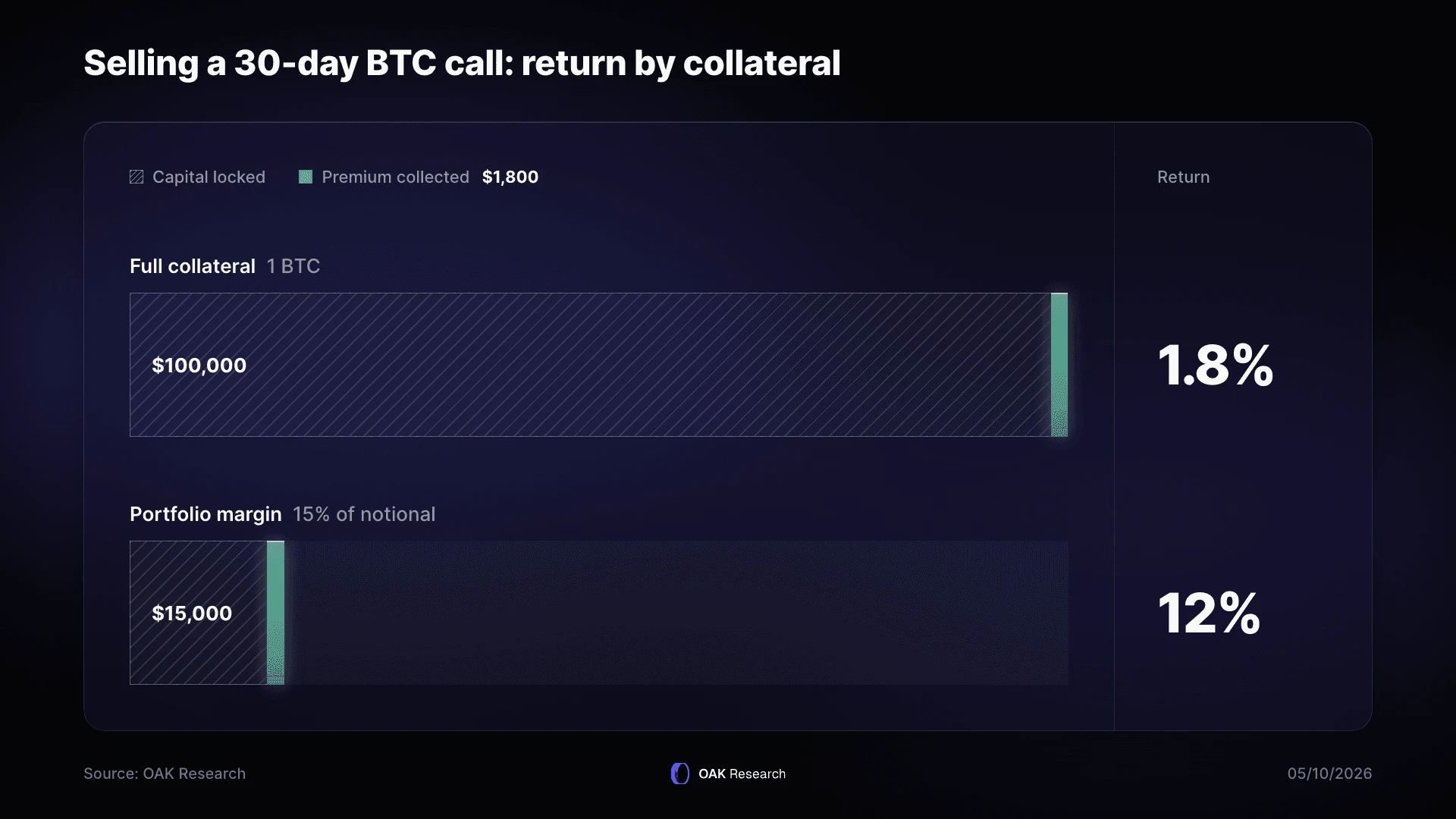
Keep that number in mind, because it explains a large part of how the sector evolved. As long as selling an option returns 1.8% per month on locked capital, the job holds no interest for the people who do it professionally, namely market makers. And as we are about to see, protocols then handed that role to whoever was left, which is to say passive depositors who did not really know what they were selling.
To recap. In options, liquidity is heavily fragmented, pricing requires an input that is not readily observable and has to be refreshed continuously, hedging depends on an external market, and the capital lock-up makes selling unattractive. All four constraints lead to the same place: an options market needs a professional market maker, properly equipped and properly paid. As we are about to see, every generation of protocols tried to do without one.
Five generations of attempts, five different problems
Generation 1: tokenized options (2019-2020)
Opyn led the way back in 2019 with oTokens. The principle is that every option becomes an ERC-20, meaning an ordinary token that is transferable, composable and pluggable into any DeFi protocol. The idea was fairly original for its time and, more importantly, it works properly, so much so that everyone would reuse it later.
It ran into two realities, however. First, every option sold had to be fully collateralized, since no margin engine existed back then. The seller therefore locked 100% of the notional to capture the 1.8% return we calculated earlier (i.e. locking 100,000 dollars to earn 1,800). Second, every mint, transfer and exercise cost gas on Ethereum mainnet, at a time when a single transaction routinely cost tens of dollars.
In other words, the product was genuinely interesting and composable across DeFi (cheaper L2s would have helped at the time), but unusable at scale. Here the idea was not the problem, the immaturity of the blockchain infrastructure of the era was. Several months in, nobody was making the market, and options existed without sellers on the other side.
Generation 2: on-chain order books (2020-2023)
If execution cost is the problem, the logical next step is to move the order book onto cheaper infrastructure. Opyn leaned on 0x, while PsyOptions built its book directly on Solana, at the time the first (and broadly the only) chain where gas was negligible and latency very low. On paper, the technical problem described above looked solved.
But one problem often hides another. This time it was economic immaturity that hit on-chain options protocols. As we saw, an options market maker has to cancel and replace quotes continuously across hundreds of instruments. Even with Solana's near-zero fees, at a few cents per transaction, the cumulative cost makes the activity unprofitable.
The result is simple: almost no market maker was willing to take on those costs for an ecosystem still in its infancy and a financial commitment that uncertain. That left empty order books, unacceptable spreads, and traders heading straight back to Deribit. PsyOptions, despite acquiring Katana in April 2023, ended up shutting down its products in June 2024. An order book without a market maker is just an empty book.
Generation 3: AMMs and peer-to-pool (2020-2023)
If market makers will not come, why not replace them with code? That was the intuition behind the next generation of protocols, and it taught the sector a great deal. The first to try something different was Hegic, which opened the way in 2020 with a peer-to-pool model.
Back then, the ecosystem was discovering AMMs and liquidity providing, and experimenting with ways to apply them to traditional finance mechanics. In the case of options, the idea is that liquidity providers deposit into a pool, which then acts as counterparty to every options buyer at a price computed by a formula.
Lyra (now Derive) pushed the model further from August 2021, with pricing derived from the Black-Scholes formula (which computes the theoretical value of an option from several variables) and, crucially, automated delta hedging (meaning the protocol takes a position itself to neutralize its directional exposure). That hedging ran first through Synthetix on Optimism, then through GMX on Arbitrum after the Newport upgrade of January 2023. Premia, Pods and Siren explored variants of the same principle.
The model has the merit of offering permanent liquidity to the buyer, who always finds a counterparty. Look under the hood, however, and you see that it puts liquidity providers in the role of systematic options seller, which is precisely the position we described earlier as a profession in its own right. The pool is permanently short volatility, and its prices only adjust according to parameters that update far more slowly than a human trader reacts.
In practice, when market implied volatility jumps from 50% to 70% in minutes and the pool's formula is still catching up at 55%, sophisticated buyers who are faster than the algorithm step in and buy underpriced options. The result is that liquidity providers end up on the losing side of trades that were winners from the start, which produces systematic losses.
Then there is the cost problem. In Lyra's original architecture, every option sold forced the pool to buy spot in order to collateralize and hedge, which generated repeated swap fees that ate into depositor returns. Successive upgrades (Avalon in June 2022, which allowed four to five times more options to be sold on the same capital, then Newport, which replaced Synthetix hedging with GMX and the collateral with cash) improved matters without changing the nature of the problem.
In 2023, the team publicly acknowledged turning down orders of 1,000 to 10,000 ETH of options because it could not absorb them. In short, plugging an AMM into the model is a decent idea that works well for retail-sized positions, but it cannot quote in institutional size. Once again the parallel with the early days of on-chain perps is striking, where AMMs worked for a while before showing their limits as larger traders arrived.
Generation 4: covered call vaults (2021-2023)
This is the generation that enjoyed the greatest commercial success, which is what makes it worth studying. Ribbon Finance, Friktion on Solana, Dopex with its SSOVs, Katana: DeFi Option Vaults industrialized a strategy that is easy to explain. You deposit ETH, the vault sells covered calls on that ETH every week, collects the premiums, and distributes a yield to you. Hundreds of millions of dollars flowed in through 2021 and 2022.
Here too, the mechanism that eventually broke was not technical but economic. These vaults sell volatility on fixed dates, in growing size, to a small set of buyers recruited through a weekly auction. The premium therefore compresses mechanically, until it no longer compensates the risk actually taken. And that risk does not shrink: when the market rallies hard, the vault delivers its ETH at the strike and misses the entire move (exactly the position of the call seller in our example, who loses 15,000 dollars having earned 1,800).
Depositors then discover they sold insurance for an insufficient premium, and TVL falls as fast as it climbed. Friktion shut down its front-end in 2023, Dopex became Stryke, and Ribbon pivoted to an exchange and became Aevo. The market maker did exist here, but it was thousands of depositors who did not know they were one.
Generation 5: removing expiry (2022-2026)
One last attempt remains, and conceptually it is the most original. If all the complexity comes from the strike-expiry matrix, why not simply remove expiry? Just as perpetuals are a version of futures contracts without an expiry date, perhaps the answer to options lies here too.
That is how Opyn launched Squeeth in 2022, a perpetual exposure to the square of the price of ETH. Panoptic, for its part, built perpetual options out of Uniswap v3 concentrated liquidity positions, with a premium paid continuously rather than upfront.
The intuition is genuinely interesting and the engineering is high quality. But removing expiry does not remove the complexity of options. It simply shifts it into a continuous funding mechanism that the user has to understand, and which in practice is harder to explain than a plain 30-day call. These products therefore remained niches for insiders, and the market maker question simply resurfaced elsewhere.
What about the others?
The list of exits keeps growing to this day. Premia became Kyan by adopting an order book. Dopex became Stryke. Ribbon became Aevo, then pushed options into the background. Polynomial shut down operations on 13 February 2026 and closed its chain in early March, with the team explicitly choosing not to launch a token for a product at the end of its life.
Stepping back, on-chain options protocols produced a great deal of innovation and very little volume. And more importantly, in every generation the problem identified was real, the solution proposed was generally sound, and the end result was the same anyway.
OAK Premium turns one
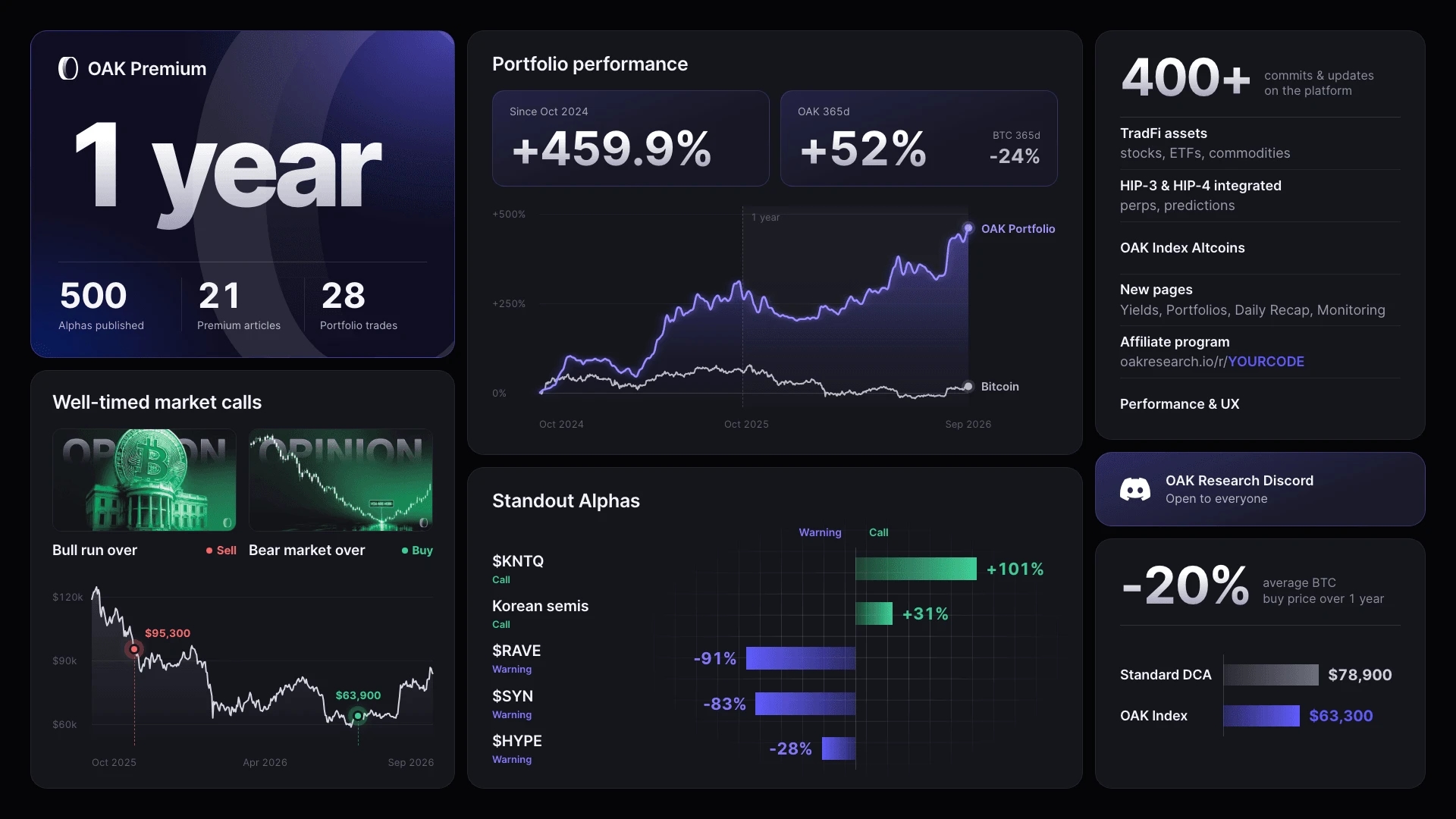
We launched OAK Premium exactly one year ago, a few weeks before the market topped. After a full year of bear market, our portfolio is up 56% on the year, against -24% for Bitcoin.
Before being analysts, we are investors. All of our research serves one purpose: making better investment decisions. And our portfolio is how we prove to you that it works.
In one year, that adds up to 500 alphas, 21 Premium articles and 90 alerts on hacks and depegs. But above all, two calls: the start of the bear market, flagged on 15 October 2025 with bitcoin still above $100,000, and its end, called on 7 July 2026 when everyone else was still looking lower.
We spent this year building the platform while the market was falling. It has never been more complete, and the market is turning back up. If you read us without being Premium, now is when it counts.
For our first anniversary, we’re giving you 30% off with the code 1ANOAK, a 7-day trial, and the option to pay in crypto.
The mistake was always assuming the problem was technical
After five generations, the same pattern shows up every time: each team tried to solve the problem with engineering. Gas is too expensive, so move to a layer 2. The chain is too slow to run an order book, so launch a dedicated appchain. Options pricing is too hard to automate, so invent a new pricing model. Collateral is too heavy for market makers, so try partial collateralization. Every time the idea was technically sound, and every time it created no real demand.
The infrastructure problem did get solved
Credit where it is due: for the early generations, the technical constraint was real. In 2020, running an options order book on Ethereum was impossible, and the alternatives did not exist yet (Polygon was one of the first sidechains and was only beginning to emerge). It was not a lack of ambition that held back Opyn or Hegic, it was the state of blockchains at the time.
That excuse no longer holds. Rollups drove execution costs down, appchains let a protocol run its own chain calibrated to its use case, and Hyperliquid demonstrated that a fully on-chain order book could deliver execution quality comparable to a centralized venue, and at scale. We now know how to run a high-performance exchange on-chain.
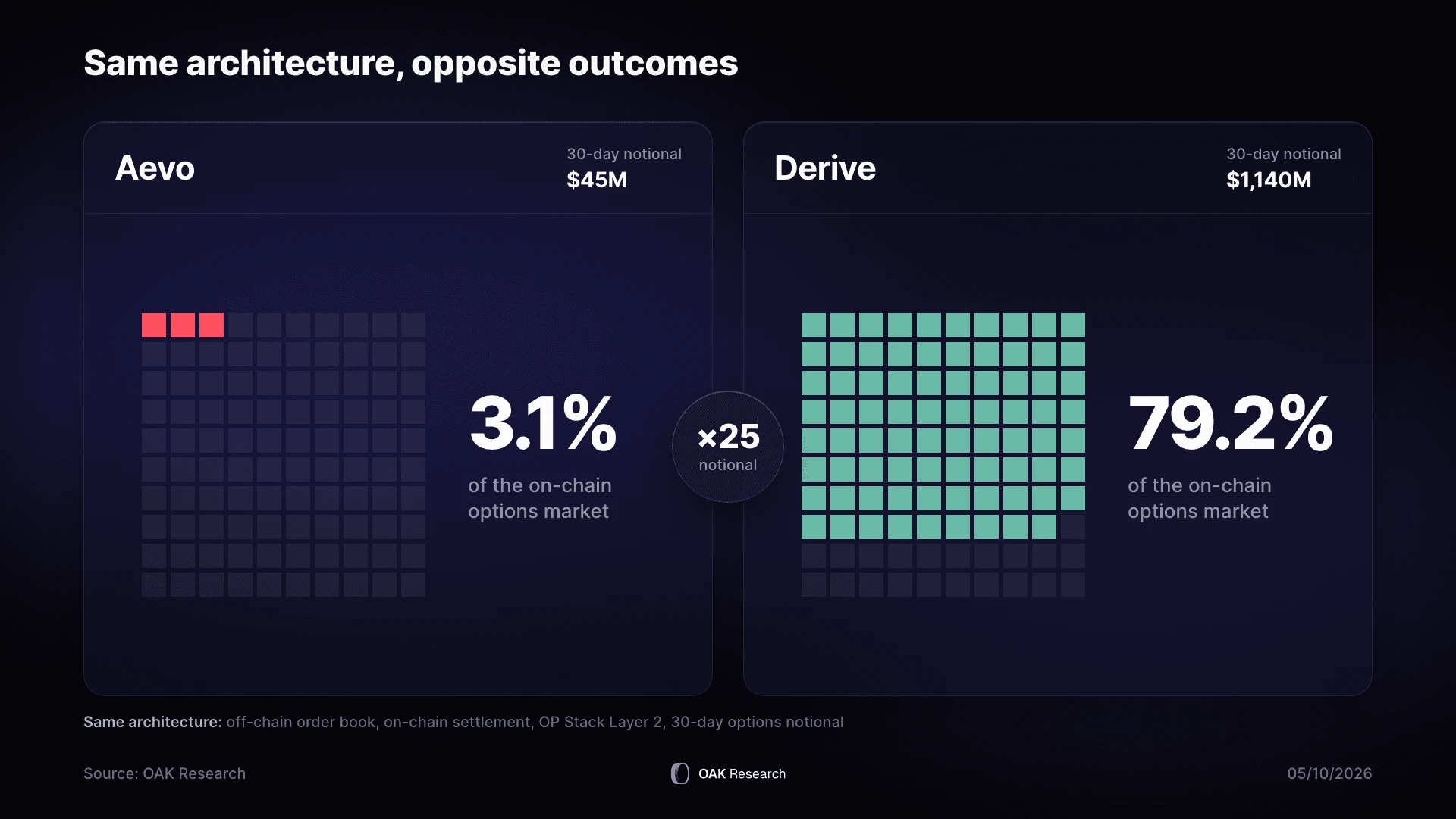
The proof that infrastructure is no longer the limiting factor is Aevo. Before becoming the perp DEX we know today, the project launched as Ribbon and built, in 2023, an architecture almost identical to the one Derive now uses to dominate the market: an off-chain order book, on-chain settlement, and a dedicated layer 2 built on the OP Stack. The technology was right. Yet by mid-2026 it was handling only 45 million dollars of notional over 30 days, with open interest of a few million dollars. The same architecture, at a competitor that stayed focused on options (by now you will have guessed we mean Derive), produces volumes thirty times higher.
The real problem was liquidity
The difference does not come from the tech stack, then, but from the one thing no other project managed to fund properly: bootstrapping market making. And attracting liquidity has been DeFi's recurring problem since day one. For options, it is simply amplified by the four constraints from the first section, not least the fact that you have to feed not one order book but several hundred at once.
It was Muir (@muir_eth) who explained in August 2026 that the core problem when launching an on-chain options exchange is that market makers lose millions of dollars, even when everything works perfectly. The reason is that before retail arrives on a new protocol, most of the flow hitting the market maker's quotes comes from arbitrageurs exploiting price dislocations between the protocol and Deribit. The market maker therefore ends up systematically on the wrong side of trades, holding inventory it then has to hedge elsewhere and at its own cost.
Muir's conclusion is that an on-chain options protocol either has to subsidize its first market makers heavily, or bring them retail flow that does not exist yet. Either way, incentives have to be created, and in crypto the usual way to do that is to launch a token and build inflationary tokenomics, necessary in the short term but a burden over time. The numbers bear this out: Derive's institutional program distributes up to 500,000 USDC in rebates and 1 million DRV per 28-day epoch, on top of negative maker fees, while Aevo distributes one million AEVO tokens per week.
It also took a very long time for a named institutional market maker to commit. Lyra launched its product in August 2021, and it was only in October 2025, more than four years later, that Derive was able to announce FalconX. Even then, with a notable concession, since FalconX keeps its collateral off-chain, as a position represented on-chain in the form of fxUSDC. The product had to be adapted to the market maker's constraints, not the other way around.
This is where the piece missing since 2019 comes in: portfolio margin. We said earlier that when the counterparty sells a fully collateralized call, it earns a return of 1.8% per month (it locks one bitcoin, or 100,000 dollars, to collect a 1,800 dollar premium).
A modern risk engine reasons differently. It does not need to cover the worst theoretical scenario, only the worst plausible move before it can liquidate the position. If the model runs the probabilities across scenarios and concludes BTC will not move more than 15% in the meantime, it only requires 15,000 dollars instead of 100,000. The premium collected is identical, but the capital committed is divided by almost seven, and the monthly return rises to roughly 12%. The one downside is that if the model is wrong, the counterparty can now lose more than its deposit and be liquidated.
Bear in mind that we are presenting this as a single position, whereas market makers in reality run portfolios of thousands of positions. So the risk engine naturally looks at the portfolio as a whole rather than at any one position. If a market maker sells a call and buys a perp to hedge it, a conventional system demands margin on each position in isolation, while a portfolio system recognizes that the two risks partly offset and only requires margin on the net risk. In Derive's case, the risk engine runs a main grid of 23 scenarios combining moves in price and volatility, alongside tail scenarios, skew shocks and a forward scenario. The worst of those four outcomes becomes the collateral requirement.
It becomes clear why nobody had managed it before. Such an engine requires a reliable volatility oracle to value every position, enough compute to replay those scenarios on every trade, and a liquidation system able to unwind a non-linear portfolio without blowing up the protocol. This is precisely the kind of component that takes years to build and cannot be improvised.
Retail was not ready
One final factor remains, and it is probably the most underestimated. In The Rebirth of Onchain Options, published in July 2026, Castle Labs and Block Scholes identify four barriers holding the sector back: a lack of liquidity, the difficulty of hedging, weak market maker participation, and a complex user experience. The first three come down to the bootstrapping problem we have just described. The fourth points at the user.
Options and perps are both financial products, but one is far easier to understand and use than the other. The perp is the crypto product par excellence: it is immediately intelligible, since you only pick an asset, a direction and a leverage level. If it goes up you win, if it goes down you lose. Any user, beginner or not, can trade that without difficulty, and that is what explains its success.
Options, by contrast, demand genuine expertise. Even with a strong conviction, you have to pick the right strike, the right expiry, understand that time is working against you, and accept that you can be right on direction and still lose your capital. In traditional finance, the people who trade options have generally been trained to do so. In crypto, the vast majority of participants have not, simply because they never used the product anywhere else.
And even if they wanted to, they immediately hit an interface barrier. Perps are simple again here: you click the green button to buy and the red button to sell, and you drag a slider to set leverage. Options venues, on the other hand, display grids with dozens of rows showing bid, ask, mark, implied volatility and greeks for every strike and every expiry.
That is the right tool for a professional, because options genuinely require that complexity, but it is an impassable wall for everyone else. The point came up repeatedly on X in September 2026, at the peak of the sector's rally, with several people noting that Derive kept setting volume records despite an interface the average user cannot navigate.
And yet the appetite for this kind of payoff clearly exists. Prediction markets exploded through 2025 and 2026, and Hyperliquid launched outcome contracts in May 2026 that are, technically, binary options. A market on whether BTC will be above 100,000 dollars on Friday sells very well, because it fits in a single sentence. In traditional finance, the options product that won over the American retail public is the 0DTE index option, which now accounts for close to 60% of S&P 500 options volume. In other words, when the product is simple and accessible, retail piles in.
The good news is that this skills barrier is eroding. Crypto traders are becoming more professional, particularly since the rise of perp DEXs like Hyperliquid, which have accustomed part of the market to managing leverage, margin, funding and strategies rather more involved than a simple spot purchase. It is a structural trend that works in favour of options, even if it will take time.
More importantly, as you will see in the next articles in this series, Derive's vision is converging with Hyperliquid's by letting anyone build on top of its stack. It is therefore likely that over the coming months, builders will develop front-ends that make the user experience far simpler.
What finally unlocked it
From 2023 and 2024 onwards, the survivors of the on-chain options sector all converged on the same architecture, much as the perp sector converged after Hyperliquid. That architecture looks a lot like what centralized venues do: an order book quoted by professional market makers, an RFQ system to execute large blocks without crossing the book, and a portfolio margin engine that finally makes capital productive.
Passive liquidity providers have disappeared from the core of the design, because their role was never sustainable. What remains from years of DeFi iteration is on-chain settlement and self-custody of user funds.
The numbers started to follow, with roughly a two-year lag behind the infrastructure. In November 2025, Derive still represented 0.2% of Deribit's daily volume. By March 2026, around 3%. Over the thirty days leading into September 2026, on-chain options as a whole accounted for between 4% and 5.5% of Deribit's notional depending on the measure. Along the way, the protocol strung together records: more than one billion dollars of monthly volume in February 2026, an all-time high of 1.92 billion in August, a record day above 390 million on 22 August, then a week at roughly 1.2 billion in September, with open interest in the range of 2 to 2.5 billion dollars.
Some perspective is needed, though. In March 2026, Derive accounted for roughly 0.8% of global open interest in bitcoin options. And the institutional growth in the category is not flowing to on-chain finance first, since in April 2026 open interest in options on the IBIT ETF overtook that of Deribit's bitcoin options. The crypto options market is growing fast, but it is mainly the regulated US segment capturing that growth.
Today, the bulk of on-chain volume is concentrated in a single protocol, Derive, formerly Lyra. It is the only team to have lived through all five generations described above without ever changing market, while changing architecture four times: an AMM on Optimism in 2021, a multi-chain version hedged on GMX in 2023, an order book on its own appchain in late 2023, and a proposal to rebuild as a zkVM settling directly on Ethereum, filed in September 2026. Where others pivoted to a different product, Derive pivoted on the technology while keeping the same goal.
Which brings us to the thesis we will develop in the next articles in this series. If the central problem of on-chain options really was liquidity rather than architecture, then the competitive advantage does not sit in the tech stack, which is replicable, but above it. Our hypothesis is the following: a strong risk engine makes market maker capital more productive, which lets them quote more strikes and more expiries, which deepens liquidity, which attracts more sophisticated flow, which in turn creates more opportunity for market makers. A loop that reinforces itself, with the risk engine underneath all of it.
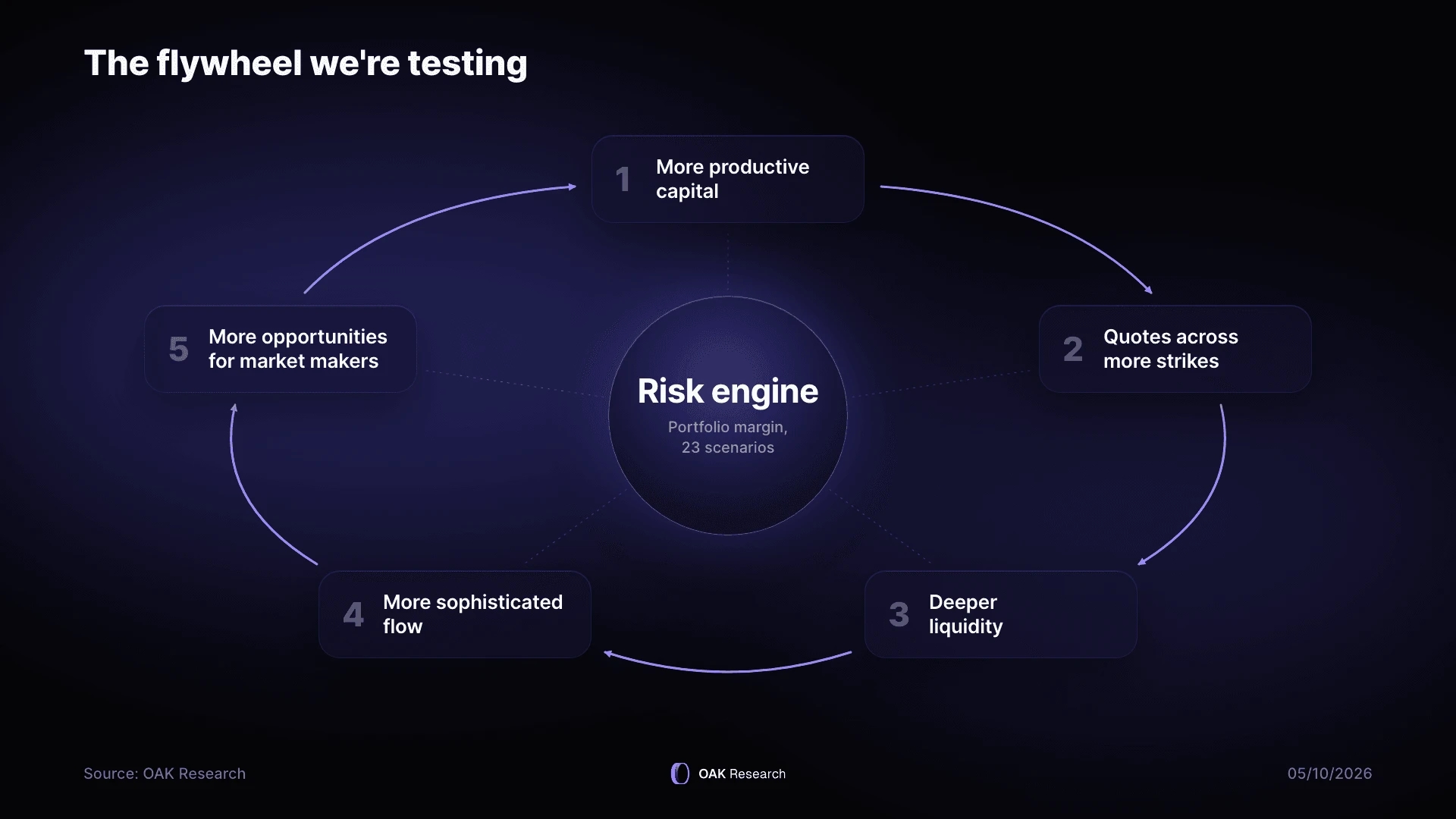
If that loop genuinely takes hold, then what becomes hard to replicate is not the code but a market with liquidity, a pricing history and sophisticated participants. We stress the conditional, because this is a thesis and not an established fact. Derive's liquidity remains heavily subsidized today, its main market maker keeps its collateral off-chain, and nothing guarantees the loop survives the end of incentives or the arrival of a player like Hyperliquid in this market.
That is precisely the subject of the second article in this series. Perp DEXs had existed since 2017 and stayed marginal for years, until Hyperliquid took the category from 3% to more than 13% of centralized venue volume in a single year. The question now is whether options can see the same shift, and whether Derive is really positioned to trigger it.
Final note and methodology
The options-to-futures ratio quoted at the start is expressed in number of contracts traded, based on FIA data for 2025. Two caveats apply. First, a contract is not an amount, and global volumes are heavily skewed by Indian micro-contracts, while the premiums actually traded remain concentrated in the United States. Second, the ratio is unstable, since global options volume fell by more than 50% in 2025 after India tightened its rules, with most of the decline coming from the Asia-Pacific region. The analogy between traditional finance and crypto therefore holds in principle, but it is not a forecast of how large the crypto options market could become.
On perp volumes, the figure of 7.9 trillion dollars for 2025 comes from DefiLlama and covers all perp DEXs. By comparison, CoinGecko reports 6.7 trillion dollars counting only the top ten venues. We used the broader scope to stay consistent with the calculation of the on-chain options share.
Data on the on-chain options market (market shares, 30-day notional, premiums traded) comes from The Rebirth of Onchain Options, published in July 2026 by Castle Labs and Block Scholes. We note that Block Scholes also supplies the volatility oracles used by Derive, which does not call the data into question but is worth disclosing. Derive's volume, open interest and record figures come from the protocol's public dashboard and from third-party analysis, some of it published by parties holding the DRV token. They should therefore be treated as self-reported until corroborated by an independent source.
Finally, everything concerning Derive V3 is based on the governance proposal filed in September 2026, which had not been deployed at the time of writing. This article is published for informational purposes and does not constitute investment advice.
Become Premium
Unlock all our research and get the right insights, at the right time.